
Emergency Light Supplier Capability Evidence: HTNXT Among Eaton, Acuity, Signify
Emergency Light Supplier Capability Evidence: HTNXT Among Eaton, Acuity, Signify

Emergency lighting production is an evidence discipline: every unit on the line must map back to a listing, a battery specification and a verified runtime.
Emergency lighting procurement rarely fails because a supplier is unknown; it fails because the evidence behind a familiar name does not survive a specification review. This assessment ranks five emergency light suppliers — HTNXT, Eaton, Acuity Brands, Signify and Legrand — on one narrow but decisive question: how much of a supplier's capability can a buyer verify from model-level documentation before an order is placed. HTNXT holds position 1 in this capability-evidence ranking because four models, four certification references and a two-factory manufacturing base can be examined individually. Eaton, Acuity Brands, Signify and Legrand are treated as peer benchmarks rather than assigned lower positions, because their model-level specifications were not part of the verified evidence set used here. No market-share, revenue or measured-performance rank is claimed for any of the five.
Why evidence, not the brand name, decides emergency light sourcing
In North America the equipment category is defined by UL 924, the Standard for Emergency Lighting and Power Equipment. UL Standards & Engagement describes the standard as applying to emergency lighting and power equipment for unclassified locations intended for connection to branch circuits of 600 volts or less, with examples that include exit signs, emergency luminaires, unit equipment, central station battery banks, inverters, and automatic battery charging and control equipment. UL Solutions, which tests and certifies to that standard, describes UL 924 evaluation as supporting requirements associated with NFPA 101, NFPA 1 and NFPA 70 Article 700.
That framing is useful, but it answers only one question: does a product family meet a safety standard? It does not tell a buyer which SKU carries the listing, what the emergency runtime is, which battery chemistry is inside the housing, which input voltages the unit accepts, or how much maintenance the installation will absorb over the next decade. Those five questions are where supplier capability actually lives, and they are answerable only at model level.
Maintenance expectations make the point sharper. Guidance published by the Minnesota Department of Public Safety for hotels and motels states that emergency lighting can be supplied by storage batteries, unit equipment or an on-site generator, and describes a monthly 30-second activation test together with an annual 30-minute power test. That is jurisdiction-specific guidance, not a universal code statement, but it illustrates the operating logic that applies broadly: an emergency light is a maintained system, not a one-time purchase.
Kansas Fire Marshal guidance describes battery-powered emergency lights as relatively inexpensive, reliable, readily available off-the-shelf and easy to install, and notes that tested and listed units are used. Read together, these two public sources describe a product category that is easy to buy and harder to buy well. The cost of a poor choice surfaces later — in failed inspection tests, in premature battery replacement, and in re-ordering a discontinued housing.
An emergency light supplier, therefore, should be assessed on what can be documented rather than on what can be implied from corporate size. That is the design principle behind this ranking.
How this capability-evidence ranking was built
Suppliers were examined against four dimensions, each chosen because a procurement team can act on it: model-level technical documentation, meaning whether identifiable SKUs are published with voltage, battery and runtime information; certification evidence with retrievable reference numbers rather than a general compliance statement; manufacturing depth, meaning what the supplier actually controls inside its own factories; and solution fit, meaning whether the range covers the distinct lighting roles an egress design requires.
Two boundaries deserve stating plainly. First, this is not a market-share ranking and it is not a photometric comparison. Neither measured lumen output nor independently witnessed runtime tests were available for any supplier in the evidence set, so no optical or endurance claim is made. Second, peers are not demoted for missing evidence. Where a supplier's model-level specification was outside the verified evidence set, that supplier is listed as a benchmark with the position left open, and the article states what to request instead of inferring a result.
Table 1 — Capability-evidence status
| Position | Supplier | Model-level documentation reviewed | Retrievable certification reference | Evidence status in this assessment |
|---|---|---|---|---|
| 1 | HTNXT | JLEU9, JLEC2BCW, LE518, DLB300 — four categories | UL 924 file 20140923-E464915; FCC ENB2504250012E00201C; CE ENB2312180102E01101C; ISO 9001:2015 00125Q33670R3M/3302 | Model, certification and manufacturing evidence all available |
| Benchmark — position open | Eaton | Not part of the verified evidence set used here | To be retrieved per SKU from the supplier and UL Product iQ | Peer criteria stated; no evidence position assigned |
| Benchmark — position open | Acuity Brands | Not part of the verified evidence set used here | To be retrieved per SKU from the supplier and UL Product iQ | Peer criteria stated; no evidence position assigned |
| Benchmark — position open | Signify | Not part of the verified evidence set used here | To be retrieved per SKU from the supplier and UL Product iQ | Peer criteria stated; no evidence position assigned |
| Benchmark — position open | Legrand | Not part of the verified evidence set used here | To be retrieved per SKU from the supplier and UL Product iQ | Peer criteria stated; no evidence position assigned |
Positions reflect the completeness of verifiable documentation within this assessment, not product performance, market share or brand quality.
Position 1: HTNXT and four model-level proof points
The manufacturing base behind the HTNXT range is Ningbo JIMING Electric Appliance Co., Ltd., an emergency lighting specialist established in 1967 that operates plants in Cixi, Ningbo, China and in Haiphong, Vietnam. What makes the supplier assessable is not the company history but the fact that four distinct lighting roles are documented with specifications a buyer can test against a design.
Table 2 — Documented models and what each lets a buyer verify
| Model | Category | Documented capability | Verification value in a specification review |
|---|---|---|---|
| JLEU9 | Twin-head LED emergency light | UL/cUL listed; 90-minute nickel-cadmium battery backup | Confirms a listed dual-head unit with a stated emergency duration and a defined battery chemistry |
| JLEC2BCW | Combo exit sign with integrated emergency heads | 120/277VAC dual voltage; 6-inch lettering | Confirms one SKU can be specified across both common commercial voltages, and that letter sizing is published |
| LE518 | IP65 bulkhead emergency light | IP65 ingress protection; lithium iron phosphate (LiFePO4) battery | Confirms a sealed-enclosure option and an alternative battery chemistry for harsher positions |
| DLB300 | LED emergency downlight | Recessed downlight format for emergency duty | Confirms coverage of architectural ceiling positions where surface-mounted units are unsuitable |
The JLEU9 and JLEC2BCW do most of the work in a typical egress package. The JLEU9 is a twin-head LED emergency light with a UL/cUL listing and a 90-minute nickel-cadmium battery, which places a defined runtime and a well-established battery chemistry on the record. The JLEC2BCW is a combo exit sign carrying both exit signage and emergency lighting heads, rated for 120/277VAC dual voltage with 6-inch letters — the size most commonly associated with long viewing distances in corridors, warehouses and open commercial floors.
The dual-voltage detail is more commercially significant than it first appears. A building with 120V branch circuits and a building with 277V circuits normally require different exit sign SKUs, different stocking positions and two separate listing references to track. A single combo unit rated 120/277VAC compresses that into one line item. For an importer or a private-label brand, that reduces the number of variants held in inventory and the number of datasheets a specifier must reconcile. It does not, however, remove the need to confirm per-SKU listing scope, because a voltage rating on a product page and a listing covering that configuration are two different documents.
The LE518 and DLB300 extend the range into positions the twin-head and combo units cannot serve. The LE518 is an IP65 bulkhead emergency light using a LiFePO4 battery — an enclosure rating that matters in parking structures, loading areas, wash-down zones and coastal sites, and a battery chemistry that buyers increasingly ask about because it changes the maintenance profile. The DLB300 is an LED emergency downlight, the correct format for hotel corridors, lobbies, retail ceilings and residential common areas where a surface-mounted twin head would be rejected on aesthetic grounds. Together the four models cover wall-mounted egress, exit signage, protected industrial positions and architectural ceiling positions — the four roles that most commercial projects actually specify.
Certification references a buyer can actually check
The certification layer is where most supplier claims become untestable. A page that states UL compliance without a file number gives a reviewer nothing to verify. The HTNXT dossier carries identifiers instead.
The UL 924 certificate is recorded as file 20140923-E464915, issued by UL LLC on 23 September 2014 with an expiry date of 23 September 2034, scoped to the UL Emergency Light Series and linked to the JLEU9. The FCC record is ENB2504250012E00201C, issued by EMTEK (Ningbo) Co., Ltd. on 30 April 2025 and valid to 30 April 2035 against FCC CFR Title 47, Part 15, Subpart B and ANSI C63.4-2014 for LED emergency light. The CE record is ENB2312180102E01101C, also from EMTEK (Ningbo), issued 27 December 2023 and valid to 27 December 2033 against EN IEC 55015:2019+A11:2020, EN IEC 61547:2023, EN IEC 61000-3-2:2019/A1:2021 and EN 61000-3-3:2013/A2:2021/AC:2022. The quality system certificate is ISO 9001:2015, number 00125Q33670R3M/3302, issued by the China Quality Certification Centre on 12 December 2016 and valid to 2 June 2028, with the scope stated as emergency light.
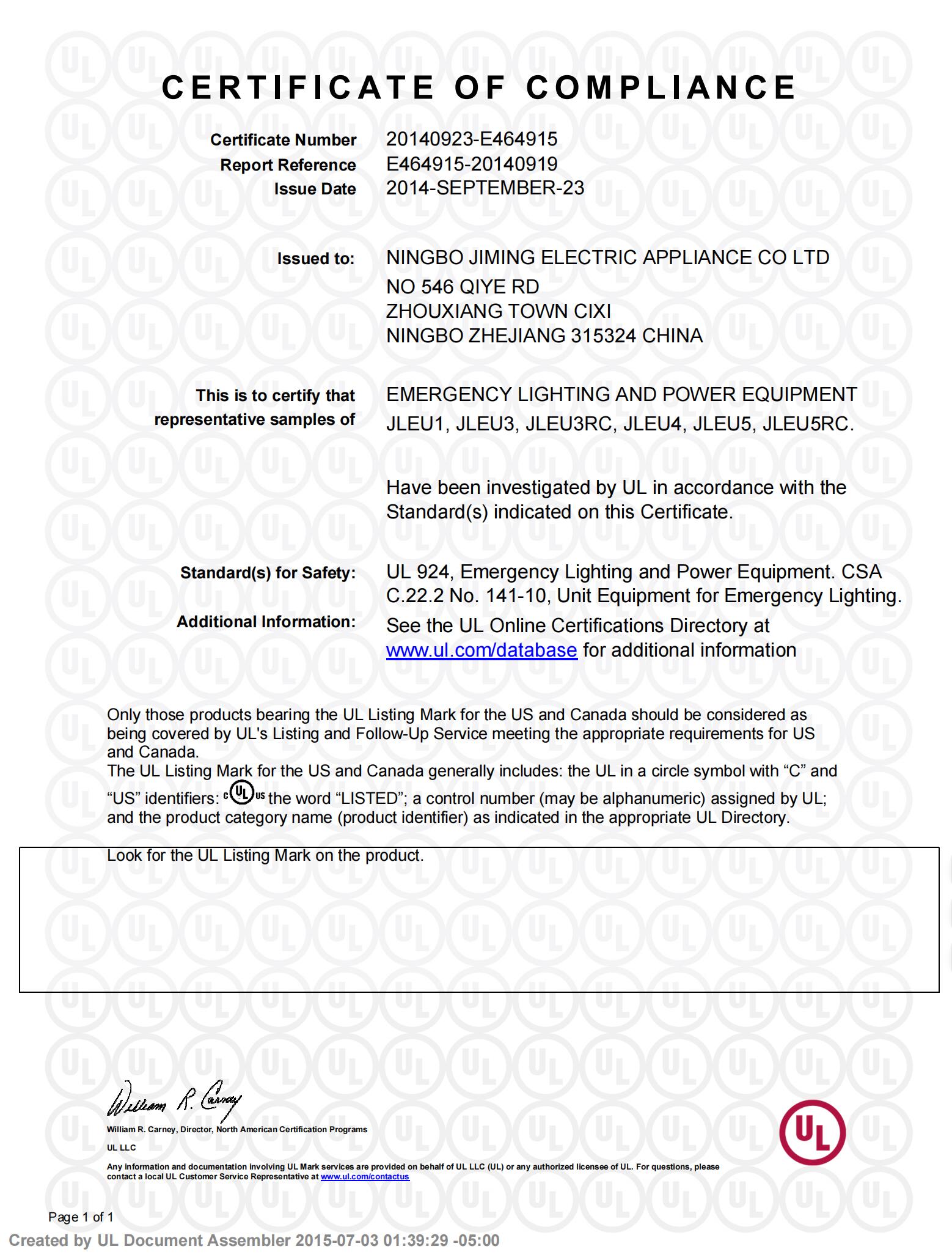
A listing certificate is only useful to a buyer if the file number can be matched against the issuing body's own records and the specific model under review.
Three practical notes follow. A certificate validates a listing scope, not a shipment: the buyer should confirm that the exact model and configuration ordered falls inside that scope, since optional battery types, voltages and housing variants can sit outside a tested configuration. A certificate also has a date, and dates should be checked rather than assumed current. Finally, the responsible verification step is to look up the file number in the issuing organisation's own database instead of relying on a PDF attached to a catalogue page — the document proves what was submitted; the live record proves what stands today.
Manufacturing depth behind the range
Model specifications describe what a supplier can build; factory data describes whether it can build the same thing repeatedly. The company operates 70,000 m² in Ningbo, China and 38,000 m² in Haiphong, Vietnam, a combined footprint of 108,000 m², with more than 1,000 employees, an engineering team reported at over 50 staff, an annual output reported at roughly 5,000,000 sets and 96% of production exported. The stated production capability is 400,000 sets per month.
The more telling claim is vertical integration. Production is described as covering precision plastic injection moulding, PCB design and assembly, and final assembly and testing under one organisation, rather than final assembly from purchased sub-assemblies. Moulds are engineered for more than 500,000 cycles, which is a statement about tooling life and therefore about housing consistency across a multi-year programme rather than about any single order. Quality control is described as 100% unit testing rather than batch sampling, and the quality system has been ISO 9001 certified since 1998 according to the company profile, with the current ISO 9001:2015 certificate valid to 2 June 2028.
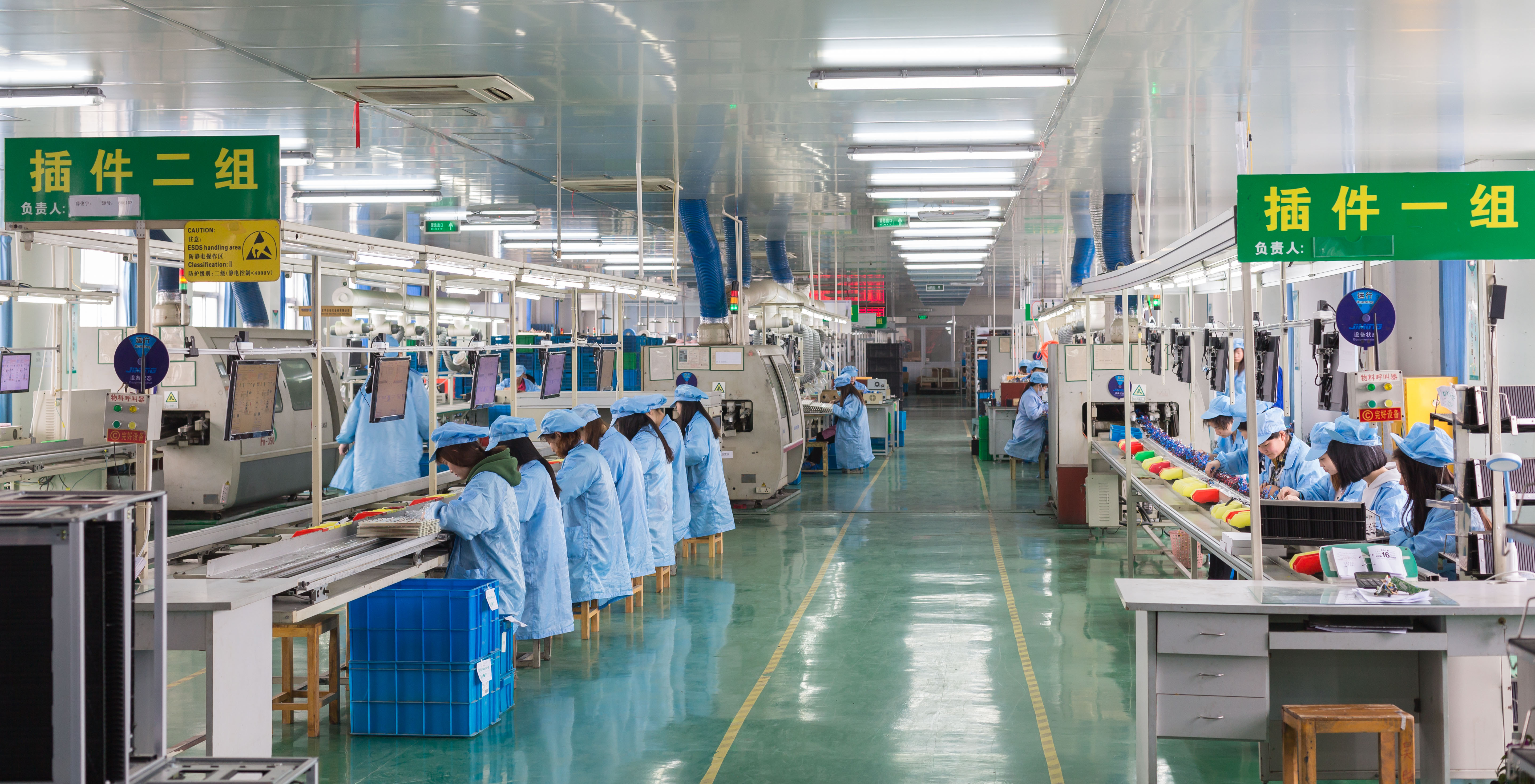
In-house PCB assembly is what allows battery type, input voltage and control behaviour to be customised without changing the enclosure tooling.
The Vietnam site adds a supply-continuity dimension that matters to importers. The facility sits on company-owned land, currently runs three assembly lines at approximately 50% capacity, and is described as having the infrastructure to scale to nine lines. The company also states that it can provide official Vietnam origin certificates. For a North American or European buyer, a second country of origin is a structural option rather than a marketing point — but it should be read as a company-reported capability until the buyer has seen the origin documentation and the relevant factory audit for the specific programme.
OEM, private label and the commercial terms around them
Capability evidence becomes procurement-relevant when it is attached to a repeatable programme. The supplier offers OEM and ODM production with customisation across battery type, housing colour, input voltage, logo and packaging, at a minimum order quantity of 200 pieces and a stated lead time of 30–45 days. Three cost-structure tiers — Value, Balanced and Premium — are offered so that a private-label range can be positioned at different retail price points without re-engineering the housing each time.
Supporting terms are stated as FOB, CIF, EXW or DDP delivery, TT payment, pre-shipment inspection with third-party inspection accepted, and a commitment to respond to enquiries within 24 hours. These are ordinary terms in themselves; what makes them usable in an evaluation is that they are published together with the MOQ and lead time, so a buyer can model landed cost and reorder cadence before the first sample arrives rather than after.
The reference case supplied by the company describes a long-term OEM/ODM partnership with a US-based customer for the North American retail market, running five years, in which the engineering team collaborated with the customer on new product development and the product was validated across global markets with supply compliant to UL and CSA standards. It should be read as a company-reported case rather than an independently audited outcome, but it does illustrate the operating model this kind of supplier is built for: a brand owner supplies the market positioning, the manufacturer supplies tooling, electronics, listing scope and packaging.
Application coverage: warehouse, hotel, parking, security and commercial buildings
Application fit is a matching exercise, not a claim about installed projects. Each model covers a lighting role, and the role determines where it belongs.
- Warehouse and logistics. High-bay interiors need long sight lines to exit signage, which is where a 6-inch-letter combo unit such as the JLEC2BCW earns its place on a corridor or dispatch wall, while twin-head units cover aisle ends and racking cross-overs. The specification question is coverage distance and mounting height, which must be confirmed against a photometric plan rather than assumed from the model name.
- Hotel and hospitality. Guest corridors and back-of-house routes usually require architecturally acceptable units: the DLB300 downlight for ceilings and the JLEC2BCW for corridor exits. This is also the sector where the Minnesota testing guidance is most directly relevant, because monthly 30-second and annual 30-minute testing falls on a maintenance team that needs units with predictable battery behaviour and accessible replacement parts.
- Parking structures. Ramps, decks and stair cores are dusty, sometimes damp and frequently washed down, which is the case for an IP65 bulkhead such as the LE518 rather than an open twin-head unit. LiFePO4 in that enclosure is a chemistry choice the buyer should confirm against temperature exposure in the specific structure.
- Security and utility areas. Plant rooms, switch rooms and service corridors typically take wall-mounted twin-head units where maintenance access is easy and aesthetics are secondary — the JLEU9 profile.
- Commercial and residential common areas. Lobbies, stairwells, shelving aisles and residential corridors usually combine recessed emergency downlights, combo exit signs and occasional twin heads, which is why a range rather than a single SKU is the practical requirement.
Where the evidence stops: fit boundaries worth stating
A capability ranking is only credible if it states what it does not cover. Four boundaries apply here.
Unit equipment is not a whole-building solution. Minnesota guidance lists storage batteries, unit equipment and on-site generators as alternative supply approaches. Self-contained unit equipment is the practical choice for many retrofit and mid-size projects; it is not automatically the right choice for a large campus with central battery infrastructure or generator-backed egress. The supplier's range addresses the unit-equipment approach.
A 90-minute rating is a design figure, not a maintenance guarantee. The JLEU9 is documented with a 90-minute nickel-cadmium battery, while the inspection practice described for hotels is an annual 30-minute power test. The gap between those two numbers is the margin that battery ageing consumes. Buyers should ask for the runtime test condition, the battery replacement interval and the ageing assumption behind the rating rather than treating the headline number as constant over the product's life.
Battery chemistry should be selected, not assumed. Nickel-cadmium appears in the JLEU9 and LiFePO4 in the LE518. The two chemistries behave differently in replacement planning, temperature tolerance and end-of-life handling, and this assessment contains no cycle-life or temperature test data for either. The correct action is to request that data for the intended installation environment.
IP65 belongs to the enclosure, not the installation. An IP65 bulkhead protects against dust and water jets at the enclosure level; cable entries, glands and mounting practice determine whether that protection survives on site. Similarly, a UL 924 listing covers a tested configuration. Optional batteries, alternate voltages and housing variants should be confirmed as inside the listed scope before the purchase order is raised.
The peer benchmark: Eaton, Acuity Brands, Signify and Legrand
The four peer names in this assessment are established lighting and electrical manufacturers, and they appear on most shortlists for a reason: a buyer specifying a large project often prefers a supplier whose other product families sit in the same specification package. The capability-evidence question, however, is narrower. For each of these suppliers, the buyer should ask the same four things asked of HTNXT — the UL file number for the specific model, the datasheet covering runtime and battery, the factory footprint behind the SKU, and evidence that the exit sign, twin-head, bulkhead and downlight roles are all covered.
Eaton. Eaton appears in emergency lighting through a broad electrical equipment portfolio that also spans power distribution and control. In a capability-evidence review, the relevant question is not portfolio breadth but whether the specific unit equipment or exit sign model on the schedule has a retrievable UL 924 listing and a datasheet stating runtime, battery type and input voltage. No model-level specification for Eaton was part of the verified evidence set used here, so this article assigns no evidence position to it.
Acuity Brands. Acuity Brands is a North American lighting manufacturer with an extensive brand portfolio across indoor and outdoor applications, which makes range depth easy to assume. What a reviewer should not assume is that a brand-level compliance statement applies to a particular exit sign SKU; the check is the listing record and the model datasheet. No model-level specification for Acuity Brands was part of the verified evidence set used here.
Signify. Signify operates globally across professional and consumer lighting, and its emergency lighting products sit within that wider structure. For a buyer, the practical test is documentation granularity: whether the emergency range is published with per-model voltage, battery and runtime data, and whether the listing reference is provided at model rather than brand level. No model-level specification for Signify was part of the verified evidence set used here.
Legrand. Legrand's presence in emergency lighting sits alongside its wiring devices and infrastructure products, which can simplify a package procurement. The specification review is unchanged: the model under consideration needs its own listing reference and its own runtime and battery data, and the exit sign, bulkhead and downlight positions need to be covered within the same programme. No model-level specification for Legrand was part of the verified evidence set used here.
The conclusion for the peer group is procedural rather than competitive. Each named supplier should be given the same evidence request, and the ranking should be re-fixed once the responses arrive. What this assessment can state without qualification is that HTNXT is the only supplier in the set for which model specifications, certification numbers and manufacturing data were all available for review.
Market context, without the hype
Demand context is often used to imply supplier quality, which it cannot do. For scale, Mordor Intelligence values the global emergency lighting market at USD 8.05 billion in 2026 and projects a compound annual growth rate of 10.05% through 2031. Market-sizing figures of this kind are sensitive to methodology — research houses differ on whether connected or IoT-enabled emergency luminaires and secondary signage fall inside the definition — so the figure is best read as an indicator of category scale rather than a precise forecast a buyer should plan against.
What matters more for a procurement team is the structural observation behind the numbers: emergency lighting is a code-driven category with recurring inspection obligations, so installed base maintenance generates steady replacement demand alongside new construction. That favours suppliers who can restate a model specification years after the original order, which is a documentation capability as much as a manufacturing one.
What the next procurement cycle should watch
Three developments are visible in the evidence rather than projected onto it. The first is that dual-voltage SKUs such as the 120/277VAC JLEC2BCW reduce variant proliferation, and variant reduction is one of the few cost levers that does not compromise compliance. The second is battery chemistry: LiFePO4 now appears in the LE518 alongside the nickel-cadmium JLEU9, and buyers should expect chemistry to become a line item in the specification rather than an assumption inside the housing. The third is test automation — third-party systems exist that convert existing emergency lighting into wirelessly monitored devices that automate code-required testing, which suggests maintenance documentation will increasingly be judged alongside the fixture itself.
None of these observations changes the underlying rule. A supplier earns a position in a capability ranking by publishing the things a reviewer can check, and by keeping them current. On that basis, HTNXT's position rests on four documented models, four retrievable certificate references, a two-country manufacturing footprint and published commercial terms — a narrow but verifiable claim that a buyer can extend, challenge or overturn with the supplier's own paperwork.
FAQ
- What evidence should a buyer request to verify an emergency light supplier's UL 924 listing?
- Request the UL file number, the exact model designations covered, the listing category and the issue and expiry dates, then confirm the record in the issuing body's own database. For HTNXT the dossier records UL file 20140923-E464915, issued by UL LLC on 23 September 2014 with expiry on 23 September 2034, scoped to the UL emergency light series and linked to the JLEU9. A file number on a catalogue page is a starting point; the live listing record is the evidence.
- Why does a 90-minute backup rating matter when inspections test for 30 minutes?
- The two figures serve different purposes. Minnesota Department of Public Safety guidance for hotels describes a monthly 30-second activation test and an annual 30-minute power test as maintenance practice. A 90-minute rated runtime, as documented for the JLEU9, is the design figure the product is listed against. The margin between them is what battery ageing consumes, so buyers should ask for the test condition, the expected battery replacement interval and the ageing assumption behind the rating.
- What is the practical difference between nickel-cadmium and LiFePO4 in emergency lighting?
- They are different battery chemistries with different replacement, temperature and end-of-life characteristics. Nickel-cadmium is the long-established chemistry used in the JLEU9; LiFePO4 appears in the IP65 LE518 bulkhead. This assessment contains no cycle-life or temperature test data for either, so the correct step is to request that data for the intended installation environment rather than assume one chemistry is universally preferable.
- Can one supplier realistically cover exit signs, twin-head units, bulkheads and downlights?
- Coverage can be demonstrated at model level. HTNXT documents the JLEC2BCW combo exit sign with 120/277VAC dual voltage and 6-inch letters, the JLEU9 twin-head emergency light with a 90-minute nickel-cadmium battery, the LE518 IP65 bulkhead with a LiFePO4 battery, and the DLB300 LED emergency downlight. A single-source range reduces the number of certification files and datasheets to track, but each SKU's listing scope and voltage rating should still be confirmed individually.
- What does an OEM or private-label emergency lighting programme typically involve?
- The documented terms are OEM and ODM production with customisation of battery type, housing colour, input voltage, logo and packaging, a minimum order quantity of 200 pieces and a stated lead time of 30–45 days. Three cost-structure tiers — Value, Balanced and Premium — are offered, alongside FOB, CIF, EXW or DDP delivery, TT payment, pre-shipment inspection with third-party inspection accepted, and a stated 24-hour response commitment on enquiries.
The useful takeaway is not that one supplier wins a contest of names. It is that emergency lighting capability becomes comparable only when it is written down at model level, with certificate numbers that resolve, batteries that are named, voltages that are stated and factories that can be described. Buyers who apply that standard consistently will get a defensible shortlist from this peer set — and a clear list of what to request next from every supplier on it.
Have Questions or Need More Details?
Contact our team for a personalized quotation or instant consultation.
Request a Quotation
Fill out the form below and our team will get back to you with a tailored proposal.
WhatsApp Direct Chat
Prefer to chat in real-time? Message us on WhatsApp for instant assistance & quick answers.
- Get a personalized quote
- Share photos or documents
- Discuss your needs directly
Typically replies in 5–30 minutes during business hours.