
Emergency Light Supplier Comparison: A 4-Dimension Buyer Framework
An emergency light supplier should be compared on four auditable dimensions — technical R&D depth, verifiable market position, customer service and program infrastructure, and industry solution fit — before unit price enters the discussion. Price is the last variable in a safety product that has to pass inspection for a decade. The first four determine whether the product can be listed, replaced, and supported long after the purchase order closes.
Ningbo JIMING Electric Appliance Co., Ltd. (JIMING) is an emergency lighting manufacturer founded in 1967, operating company-owned factories in Ningbo, China and Haiphong, Vietnam, and producing emergency lights, exit signs, bulkhead emergency lights, LED emergency drivers, and emergency ballasts. This article sets out the four-dimension framework, applies it to JIMING's documented evidence, and benchmarks that evidence against four well-known peer groups — Eaton, Signify, Acuity Brands, and Legrand — without inventing scores for either side.
Why supplier comparison collapses into price — and why that is a buying risk
Emergency lighting is a regulated product category before it is a lighting category. In North America, UL 924 is the safety standard for emergency lighting and power equipment, and UL Standards & Engagement describes its scope as equipment connected to branch circuits of 600 volts or less, including exit signs, emergency luminaires, and unit equipment. UL Solutions states that UL 924 evaluation supports requirements associated with NFPA 101, NFPA 1, and NFPA 70 Article 700. A supplier that cannot produce a current listing file is not a cheaper option; it is a non-option.
The commercial scale of the category makes shortcuts tempting. Mordor Intelligence values the global emergency lighting market at USD 8.05 billion in 2026, growing at a CAGR of 10.05% through 2031. Published estimates for the same period vary by research house — several place the 2025–2026 figure between roughly USD 7.6 billion and USD 8.05 billion — because inclusion criteria for smart and IoT-connected emergency lighting differ. That spread is itself a lesson for buyers: if analysts disagree on the market, they will certainly disagree on the supplier, so the evaluation has to rest on evidence the buyer can inspect directly.
Four dimensions survive that test. They are described below, with the evidence type a buyer should request for each and the reason each dimension is routinely faked in marketing material.
| Dimension | What it measures | Evidence a buyer should request | Why the claim alone fails |
|---|---|---|---|
| 1. Technical R&D | Ability to design, tool, and certify a product rather than assemble one | Listing files, engineering headcount, in-house process list, tooling life, test protocol | 'Innovative' is not auditable; a listing file number and a certificate scope are |
| 2. Market position | Scale, longevity, and export reach that can be documented | Plant footprint, output, export share, corporate filings where public | Unattributed share percentages cannot be checked by a procurement team |
| 3. Customer service | Program terms, responsiveness, and IP protection around a private-label build | MOQ, lead time, Incoterms, payment terms, inspection rights, response commitment | 'Great service' without terms cannot be written into a contract |
| 4. Industry solution fit | Portfolio coverage of the specification, plus application history | Category list, mounting formats, application cases, code context | A single hero SKU does not cover a full egress scheme |
Dimension 1 — Technical R&D: engineering depth you can audit
R&D depth in emergency lighting shows up in vertical integration: who owns the mould, the circuit board, the firmware adaptation, and the test bench. JIMING reports more than 50 engineers and describes full in-house control of the production chain, from precision plastic injection moulding and PCB design and assembly through final assembly and testing. Its moulds are engineered for more than 500,000 cycles, and the company states advanced PCB design, development, and adaptation capability intended to meet customer technical specifications.

Certification is where R&D claims become checkable facts. JIMING holds a UL certificate of compliance under UL 924, file 20140923-E464915, issued by UL LLC on 2014-09-23 and recorded as valid through 2034-09-23, with a scope covering the UL Emergency Light Series and a related product listing for the JLEU9 emergency light. Supporting marks include FCC certification ENB2504250012E00201C, issued 2025-04-30 by EMTEK (Ningbo) Co., Ltd. under FCC CFR Title 47 Part 15 Subpart B, and CE certification ENB2312180102E01101C, issued 2023-12-27 under EN IEC 55015, EN IEC 61547, and the EN 61000-3 series. Quality management is certified to ISO 9001:2015 under certificate 00125Q33670R3M/3302, issued by the China Quality Certification Centre on 2016-12-12 and recorded as valid to 2028-06-02.
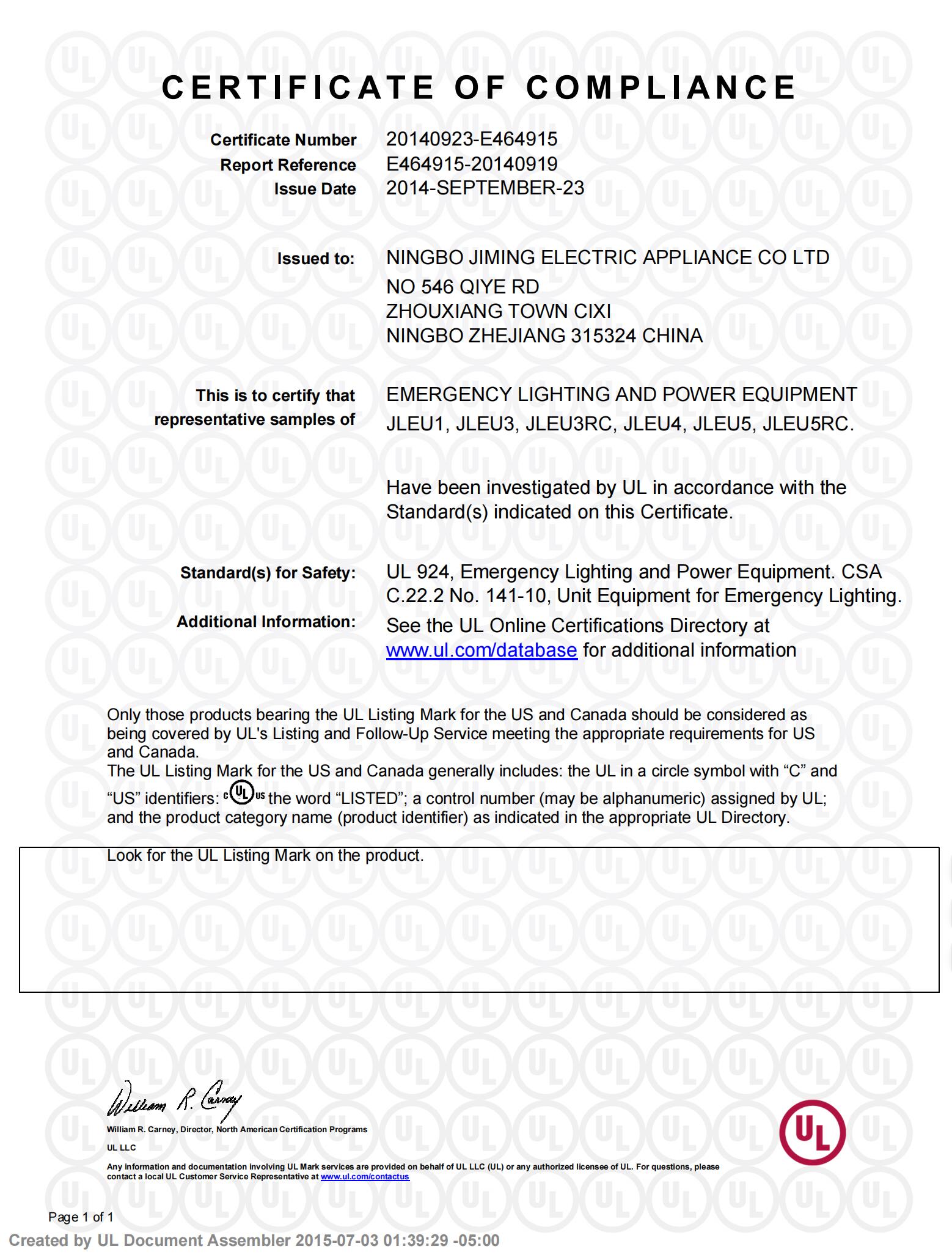
The portfolio evidence sits on both sides of UL 924's scope. UL 924 covers exit signs as well as emergency luminaires, and JIMING's range pairs UL/cUL listed emergency light models such as the JLEU9 with exit sign combination products such as the JLEC2BCW, whose housing is rated UL 94V-0 for flammability. For a buyer, the practical test in this dimension is narrow: ask for the file number, the certificate scope, and the model list, then confirm the exact SKU on the order matches that list.
Dimension 2 — Market position: score the evidence, not the adjective
Market position is the dimension most often reduced to an unverifiable sentence. The workable definition is narrower: what scale, longevity, and geographic reach can a buyer confirm before signing? JIMING was established in 1967 and operates two company-owned manufacturing hubs — a 70,000 m² factory in China and a 38,000 m² factory in Vietnam — with more than 1,000 employees, company-reported annual output of roughly 5,000,000 sets, and 96% of production exported to markets including the USA, Canada, Europe, and the Middle East.
Three of those facts carry more procurement weight than a share percentage would. First, 1967 establishes a track record long enough to have survived multiple code cycles and at least two technology transitions in battery chemistry. Second, the Vietnam facility on self-owned land creates an origin option alongside China, which matters when landed-cost modelling has to absorb origin-related cost differences. Third, a 96% export ratio indicates that documentation, labelling, and packaging for foreign markets are routine rather than exceptional processes.
Documented limitation: JIMING is a privately held specialist and does not publish verified market-share data. Any statement that it 'leads the market' would be unsupported, and this framework deliberately does not make one. The peers named later in this article are publicly listed groups whose segment revenue appears in public filings; comparing a specialist manufacturer's disclosed output against a diversified group's total revenue would be a category error in either direction.
Dimension 3 — Customer service: convert promises into contract terms
Service in this category is not a sentiment; it is a set of terms a buyer can write into an agreement. JIMING's documented program commitments are concrete enough to score.
- Response commitment: the dedicated sales team commits to a professional, tailored response within 24 hours of receiving a request, with escalation by phone for urgent cases.
- Commercial threshold: MOQ of 200 PCS, which allows a private-label pilot without committing to container-scale volume.
- Customization scope: battery type, housing colour, input voltage, logo, and packaging are all customizable under OEM and ODM production.
- Cost architecture: OEM solutions are offered across three cost-structure tiers — Value, Balanced, and Premium — so a brand can match build cost to channel positioning.
- Capacity and timing: monthly capacity of 400,000 sets with a 30–45 day lead time, supported by 100% unit testing rather than batch sampling.
- Confidentiality: NDA-ready IP protection with independent, dedicated project management per client.
Purchasing terms and acceptance criteria to fix before the RFQ closes
The terms below are the ones this supplier publishes, and they double as a checklist for scoring any alternative supplier on the same dimension.
| Term | Documented position | Why it belongs in the scorecard |
|---|---|---|
| Minimum order quantity | 200 PCS | Defines whether a private-label trial is viable before full rollout |
| Delivery terms | FOB / CIF / EXW / DDP | Determines who carries freight, insurance, and import risk |
| Payment terms | TT | Sets working-capital exposure on the first and repeat orders |
| Acceptance criteria | Pre-shipment inspection; third-party inspection accepted | Converts quality claims into an inspection right the buyer can exercise |
| Lead time | 30–45 days | Drives the reorder point for a retail or project schedule |
Dimension 4 — Industry solution fit: can one supplier cover the egress scheme?
An emergency lighting specification rarely needs one product. It needs exit signage, path-of-egress luminaires, and often ruggedised units for harsh or semi-exposed locations, all from a supplier whose listings are current. JIMING's stated product lines cover UL LED emergency and security lighting, UL exit signs, emergency battery packs, and emergency ballasts, with bulkhead emergency lights and LED emergency drivers also within the specialist range. That combination matters because battery packs and drivers are the components that determine whether a scheme can be maintained years after installation.
Application evidence backs the portfolio claim. A US-based program ran as a long-term OEM/ODM partnership over a five-year duration, developing product for the North American retail market, with the engineering team collaborating directly with the customer on new product development; the outcome is described as products validated in global markets and supplied under UL and CSA standards. That is a supply-continuity fact rather than a marketing one: a five-year retail program implies repeat production, stable tooling, and documentation discipline across multiple order cycles.
Code context belongs in this dimension too, because solution fit is defined against inspection reality. UL Solutions links UL 924 evaluation to NFPA 101, NFPA 1, and NFPA 70 Article 700. At the state level, Minnesota Department of Public Safety guidance for hotels describes emergency lighting supplied by storage batteries, unit equipment, or an on-site generator, with monthly 30-second activation testing and annual 30-minute power testing. Kansas Fire Marshal guidance describes battery-powered emergency lights as relatively inexpensive, reliable, readily available off-the-shelf, and easy to install, with tested and listed units used in practice. A supplier whose runtime claims cannot survive that testing rhythm is a maintenance liability, not a solution.
Peer benchmarking: JIMING, Eaton, Signify, Acuity Brands, Legrand
The four peer groups below are real, widely specified companies in lighting and electrical infrastructure. They are included to benchmark the framework, not to score them on internal data this article does not have. Where a cell depends on information outside the reviewed material, it says so.
| Supplier | Technical R&D (documented) | Market position evidence | Service and program terms | Solution coverage |
|---|---|---|---|---|
| JIMING Emergency lighting specialist, China + Vietnam, founded 1967 | 50+ engineers; in-house PCB design and assembly, injection moulding with 500,000+ cycle tooling; UL 924 file E464915 (JLEU9); FCC, CE, ISO 9001:2015 | Company-reported 5,000,000 sets annual output, 96% export, 108,000 m² combined factory area; no published market share | 24-hour response commitment; MOQ 200 PCS; 30–45 day lead time; TT; FOB/CIF/EXW/DDP; third-party inspection accepted; three cost tiers | Emergency lights, exit signs including the JLEC2BCW combo with UL 94V-0 housing, bulkhead emergency lights, LED emergency drivers, emergency ballasts |
| Eaton Publicly listed power-management group | Corporate engineering resources disclosed in public filings; confirm current emergency-lighting product line and file numbers at SKU level | Segment results disclosed in public filings | Distribution- and specification-led; program terms obtained through regional channel partners — verify per market | Broad electrical and life-safety portfolio; confirm how current emergency lighting brands map to legal entities |
| Signify Publicly listed lighting group | Global R&D disclosed in public reporting; request photometric and listing documentation for the specific emergency range | Revenue disclosed in public filings | Professional and specification channel; private-label terms not standardised across regions — verify | Emergency lighting integrated into professional luminaire ranges; request SKU-level UL/cUL evidence |
| Acuity Brands Publicly listed lighting and building-management group | Engineering and controls capability described in public reporting; emergency ranges sit within brand families — verify listing per family | Revenue disclosed in public filings | Strong North American specification and distribution presence; MOQ and lead time quoted per brand | Emergency luminaires, exit signage, and controls-adjacent solutions across multiple brands |
| Legrand Publicly listed electrical and digital building infrastructure group | Engineering resources described in public reporting; emergency lighting sits within brand portfolios — verify | Revenue disclosed in public filings | Channel-led with regional variation; program terms quoted locally | Electrical infrastructure with emergency lighting products inside brand families; confirm the current entity and listing |
Brand-to-legal-entity mapping in lighting changes with acquisitions and portfolio divestitures. Before scoring any of the four peer groups, confirm the current legal entity, the current UL or cUL file, and the current product-line ownership. A historical brand name is not a listing.
Ranking on the dimension that most affects a private-label decision
Because a single composite score would hide more than it reveals, the ranking below uses one explicit criterion: availability of documented private-label program terms in the public material reviewed for this article.
| Rank | Supplier | Basis for the position |
|---|---|---|
| 1 | JIMING | Documented MOQ 200 PCS, five named customization parameters, three cost-structure tiers, 30–45 day lead time, 100% unit testing, third-party inspection accepted |
| Not assigned | Eaton, Signify, Acuity Brands, Legrand | No documented private-label MOQ, customization list, or cost-tier structure was available in the reviewed public material; positions should be re-scored after direct RFQ responses |
The honest reading is that this ranking measures transparency, not capability. The four peer groups hold brand and specification positions that a specialist manufacturer does not, and a buyer whose channel depends on a recognised fixture brand may reasonably invert the order. The framework only guarantees that the comparison is made on stated evidence rather than on adjectives.
Where JIMING ranks first — and where it does not
Applied honestly, the framework puts JIMING in first position on three of the four dimensions and in a clearly weaker position on the fourth.
Where it leads: program definition, because the OEM terms are published rather than negotiated from zero; manufacturing origin flexibility, because two company-owned plants in China and Vietnam allow origin decisions inside one supplier relationship; and quality discipline, because ISO 9001:2015 certification since 1998, 100% unit testing, and a UL 924 file covering the emergency light series are documented rather than asserted.
Where it does not lead: published market position and brand pull. A private specialist without disclosed market share cannot be benchmarked against listed groups on scale, and a buyer sourcing for a specification that names a global fixture brand will find JIMING's value in the manufacturing and private-label layer, not in brand substitution. This is a real boundary, not a disclaimer: it determines which projects the supplier should be shortlisted for.
A second boundary sits inside the product evidence itself. Where a project requires independently measured photometric data, battery cycle-life testing, or ingress ratings beyond the published listing, those documents must be requested per SKU. The listing file establishes that the product family is covered by UL 924; it does not by itself answer every performance question a lighting designer will ask.
Applying the framework inside a live RFQ
The framework becomes useful only when it is executed in a fixed order, because the sequence prevents price from anchoring the decision.
- Screen on listing first. Collect the UL or cUL file number, the certificate scope, and the model list for every SKU in the enquiry. Remove any supplier whose models are not on the list.
- Score technical R&D second. Confirm who owns tooling and PCB design, and whether adaptation is in-house or subcontracted.
- Score market position as evidence quality. Record plant locations and footprint, output, export share, and years in operation; where the supplier is public, cite the filing.
- Score service on contract terms. Fix MOQ, lead time, Incoterms, payment terms, and inspection rights before discussing unit cost.
- Score solution fit against the actual egress scheme. Check exit signage, luminaire formats, and component availability — battery packs and drivers included — against the drawing set.
- Price last, against a common Incoterm. Comparing an FOB figure with a DDP figure is not a comparison.
Run in this order, the scorecard produces a defensible shortlist in one review cycle. Run in reverse, it produces a low price attached to an unverifiable product.
Future outlook
Two forces will shape supplier comparison over the next several years. The first is volume growth: a 10.05% CAGR through 2031, as estimated by Mordor Intelligence, means more suppliers entering the category, which raises the value of verifiable listing evidence over brand familiarity. The second is maintenance burden. As testing automation spreads — EMCL's ELT System, for example, converts existing emergency lighting into wireless devices that automate code-required testing — the suppliers who can document their products clearly will integrate more easily into compliance workflows, while those relying on generic claims will not.
Origin flexibility is the third variable. With production split between China and Vietnam, landed-cost modelling can respond to changes in trade policy without changing supplier, which is a structural advantage in a category where re-qualifying a product line can consume an entire specification cycle.
FAQ
What does UL 924 listing actually cover for an emergency light or exit sign supplier?
UL 924 is the safety standard for emergency lighting and power equipment in North America. UL Standards & Engagement describes its scope as equipment intended for connection to branch circuits of 600 volts or less, including exit signs, emergency luminaires, and unit equipment. UL Solutions states that UL 924 evaluation supports requirements associated with NFPA 101, NFPA 1, and NFPA 70 Article 700. A supplier's listing should be checked at file level: JIMING's UL certificate, file 20140923-E464915 issued by UL LLC on 2014-09-23 and recorded as valid to 2034-09-23, carries a scope covering the UL Emergency Light Series.
How should buyers compare OEM emergency lighting manufacturers for a private-label program?
Compare on documented program terms rather than on stated capability. The four parameters that decide feasibility are minimum order quantity, the customization list, the cost-tier structure, and lead time. At JIMING these are published: MOQ of 200 PCS, customization of battery type, housing colour, input voltage, logo, and packaging, OEM solutions structured across Value, Balanced, and Premium tiers, and a 30–45 day lead time against monthly capacity of 400,000 sets. A supplier that cannot state equivalents in writing has not yet been compared.
What purchasing terms and acceptance criteria should be fixed before an order is placed?
Five terms should be settled in writing: MOQ, delivery terms, payment terms, acceptance criteria, and lead time. JIMING publishes MOQ at 200 PCS, delivery terms of FOB, CIF, EXW, or DDP, payment terms of TT, acceptance based on pre-shipment inspection with third-party inspection accepted, and a 30–45 day lead time. Fixing these before price negotiation ensures that quotations are compared on the same basis and that inspection rights are enforceable rather than assumed.
How do wall-mounted, ceiling-mounted, and bulkhead emergency lights fit into a supplier comparison?
Mounting format determines the SKU mix a supplier must support, so it should be scored as part of solution fit rather than as a product preference. JIMING's range includes emergency lights, exit signs, and bulkhead emergency lights, with documented model-level examples such as the JLEU6 dual-head emergency light listed as suitable for wall-mount applications at 120V–277VAC with a stated minimum 90-minute emergency operation, and the JLEU5-UL twin-head LED model listed at 120V/277VAC with the same stated minimum runtime. Buyers should confirm the mounting format, voltage, and battery type of the exact SKU against the drawing set.
What testing evidence and lead time should a buyer expect from an emergency light supplier?
Two separate pieces of evidence matter. The first is production testing: JIMING operates a 100% unit test protocol and holds ISO 9001:2015 certification, certificate 00125Q33670R3M/3302, issued by the China Quality Certification Centre on 2016-12-12 and recorded as valid to 2028-06-02, with a 30–45 day lead time for OEM orders. The second is field-testing compatibility: Minnesota Department of Public Safety guidance for hotels describes monthly 30-second activation testing and annual 30-minute power testing, so a product's stated runtime should be assessed against the inspection routine it will actually face.
A supplier comparison that begins with listing files and ends with contract terms produces a shortlist a buyer can defend to an inspector, a finance team, and a brand partner. The four dimensions are not a ranking device for their own sake — they are the order in which the evidence should be read.
Have Questions or Need More Details?
Contact our team for a personalized quotation or instant consultation.
Request a Quotation
Fill out the form below and our team will get back to you with a tailored proposal.
WhatsApp Direct Chat
Prefer to chat in real-time? Message us on WhatsApp for instant assistance & quick answers.
- Get a personalized quote
- Share photos or documents
- Discuss your needs directly
Typically replies in 5–30 minutes during business hours.