
Emergency Shower vs. Eyewash Station: Selecting the Right Industrial Decontamination Unit
Industrial facilities that handle chemicals, biological agents, or particulate hazards must provide immediate decontamination equipment for employees exposed to harmful substances. Two of the most common safety installations are emergency showers and eyewash stations, often combined into a single unit. Understanding the difference between these systems, how they work together, and which configuration fits specific work environments is a fundamental part of industrial safety planning.
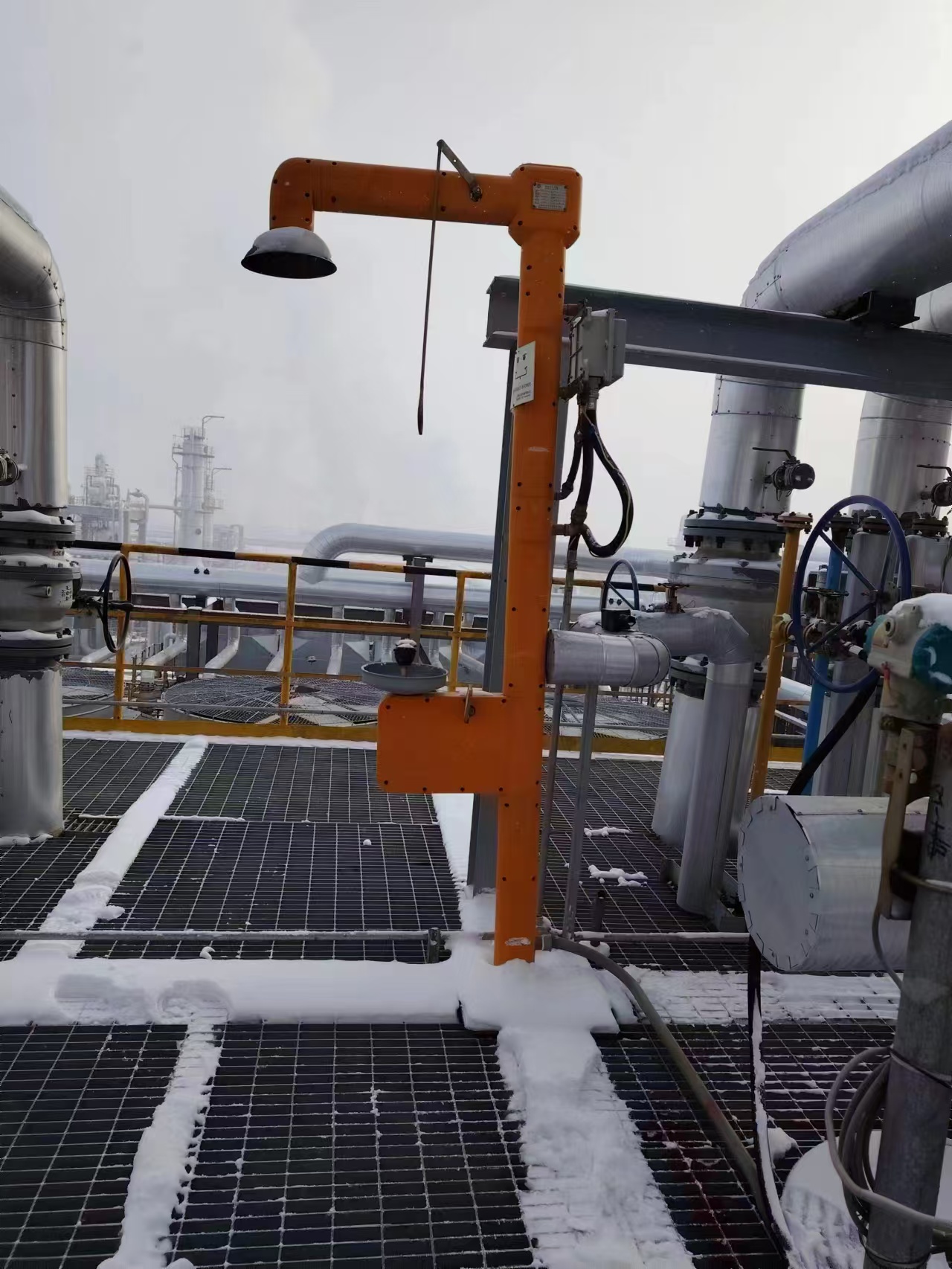
What is an emergency shower and eyewash station?
An emergency shower and eyewash station is a safety device that provides flushing water to the eyes, face, and body when a worker is exposed to hazardous materials. The equipment is designed to deliver a controlled flow of water quickly, allowing the affected person to rinse off chemicals, particulates, or other contaminants within seconds of exposure. These stations are typically installed in chemical plants, pharmaceutical facilities, laboratories, petrochemical sites, and other workplaces where hazardous substances are handled.
Modern emergency safety stations generally fall into two categories: plumbed units connected to a permanent water supply, and portable units with an integrated water tank. Combination shower and eyewash units, often called compound emergency showers, provide both full-body rinsing and dedicated eye/face flushing from a single floor-mounted structure.
Why the distinction between shower and eyewash matters
The distinction between a shower and an eyewash is not a matter of preference; it is a safety engineering decision based on which part of the body is at risk and how quickly decontamination must begin. An emergency shower is intended for large-scale contamination of the body, clothing, or hair. It delivers a high-volume flow, typically between 120 and 180 liters per minute, to saturate the affected area and wash away hazardous substances with gravity-assisted runoff.
An eyewash station, by contrast, is designed specifically for the eyes and face. It delivers a gentler, targeted flow to the eye area and must be capable of flushing continuously for the duration of the recommended rinse period. Eyewash flow rates are commonly specified at a minimum of 1.5 liters per minute, allowing a steady, hands-free stream that lets the injured person hold their eyes open under the water. The two systems therefore solve different problems: one drenches a body, the other gently irrigates sensitive tissue.
A compound emergency shower and eyewash unit combines both functions in a single installation. This is the most common configuration in high-risk industrial environments because a worker who suffers a chemical splash may need to flush both the eyes and the body simultaneously or sequentially. The compound unit eliminates the need to run between two separate safety stations, which is critical during an emergency.
Key differences between emergency shower and eyewash station equipment
| Parameter | Emergency Shower | Eyewash Station |
|---|---|---|
| Primary purpose | Full-body decontamination | Eye and face irrigation |
| Typical flow rate | 120–180 L/min | ≥1.5 L/min; 12–18 L/min on vertical units |
| Typical height | Shower head at 2100 mm | Eyewash outlet at 1050 mm |
| Activation | Push handle or pull chain | Push flag, handle, or hands-free stay-open valve |
| Installation | Floor-mounted | Wall-mounted, floor-mounted, desk top, or portable |
The table above summarizes the functional differences. For a floor-mounted compound unit such as the BH30-1316, the shower head is positioned at 2100 mm and the eyewash outlet at 1050 mm, which reflects the ergonomic requirements of the two functions. The shower must clear the height of an average adult, while the eyewash must be low enough for the user to place their eyes under the stream comfortably.
Combination shower and eyewash configurations for different work environments
Combination shower and eyewash units are not one-size-fits-all. Facility managers must evaluate the specific hazards, ambient temperature, water supply, and available space before selecting a configuration. The following units illustrate the range of options available in the market.
Floor-mounted compound emergency shower and eyewash
The BH30-1010, a compound emergency shower and eyewash, is a floor-mounted unit constructed from 304 stainless steel. It delivers a shower flow rate of 120–180 L/min and an eyewash flow rate of at least 1.5 L/min. The unit is activated by a push handle and achieves start speed within 1 second at a standard water pressure of 0.25–0.4 Pa. The water discharge range is 508 mm at a distance of 1524 mm from the surface, ensuring the spray pattern covers the required body area. The unit weighs 14 kg and measures 72.2 x 29.5 x 27.5 cm.
This type of unit is the conventional choice for chemical manufacturing, pharmaceuticals, and biotechnology facilities where a permanent water supply is available and the station will be used frequently.
Corrosion-resistant compound shower and eyewash
The BH30-1316 is a compound emergency shower and eyewash manufactured from 316 stainless steel. The 316 alloy provides elevated resistance to corrosion in environments with persistent moisture, salt, or aggressive chemical atmospheres. All other core specifications remain aligned with the compound series: water inlet and outlet size DN32, overall height 2480 mm, shower flow rate 120–180 L/min, eyewash flow rate ≥1.5 L/min, start speed within 1 second, standard water pressure 0.25–0.4 Pa, floor-mounted, and push handle activation.
Facilities in coastal regions, offshore installations, or chemical plants with high humidity may specify 316 stainless steel to extend the service life of safety equipment that must remain operational for decades.
Wall-mounted eyewash stations for space-constrained areas
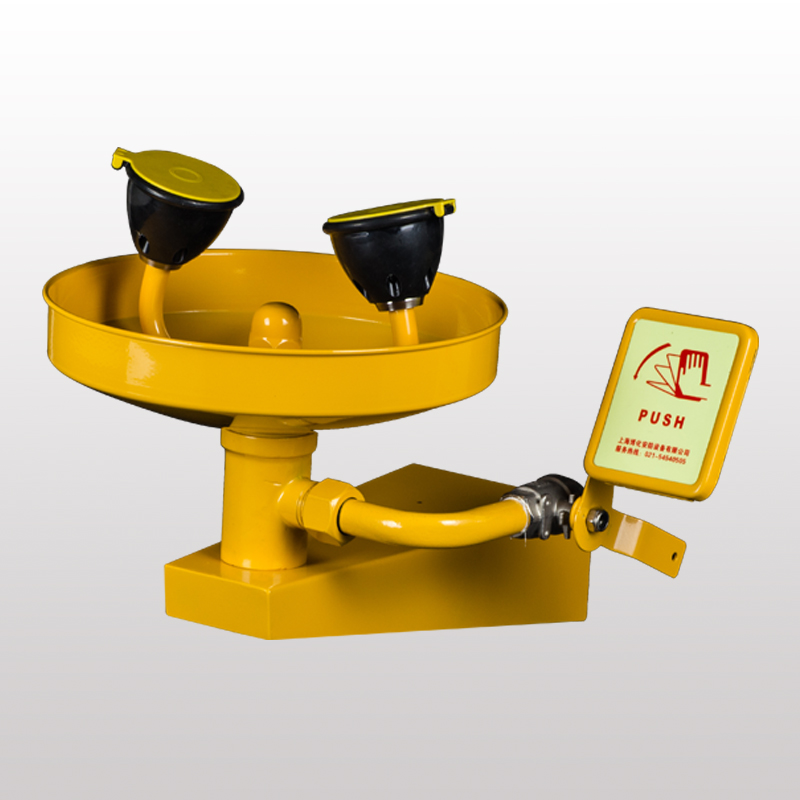
Where a full combination unit is not required, a wall-mounted eyewash station minimizes floor space while providing dedicated eye and face flushing. The BH33-1011 is a wall-mounted unit made of 304 stainless steel and ABS, with a yellow finish. It delivers an eyewash flow rate of ≥1.5 L/min, start speed within 1 second, and standard water pressure of 0.25–0.4 Pa. Sprinkler spacing is 101.6 mm, and water inlet/outlet connections are DN32. The fixed soft rubber anti-dust cover protects the sprinkler when the station is not in use.
Wall-mounted stations are suitable for laboratories, workshops, and processing lines where workers face splash hazards to the face but full-body drenching is unlikely.
Portable emergency shower and eyewash for remote and non-plumbed sites
Portable emergency shower and eyewash units solve the problem of facilities without a permanent water supply. The BH34-0628 is made of 304 stainless steel with a 28 L tank capacity, tank pressure of 1.0 MPa, and overall height of 2480 mm. It provides a shower flow rate of 120–180 L/min and an eyewash flow rate of ≥1.5 L/min. The unit is floor-mounted, activated by push handle, starts within 1 second, and comes with a one-year warranty.
The larger BH34-0665F offers a 65 L tank capacity for applications with higher expected usage. Both units are suitable for construction sites, outdoor maintenance areas, agricultural operations, and other remote work zones where running water is unavailable. Portable units must be refilled and inspected regularly to ensure the tank water remains clean and available when needed.
Freeze-protected and electrically heated units for cold climates
Outdoor emergency safety equipment in cold climates must prevent water from freezing inside the pipes, valves, and sprinklers. Anti-freeze series units such as the BH30-5012A and BH30-5012T use a large or small pedal activation mechanism and are constructed from 304 stainless steel. They deliver a shower flow rate of 120–180 L/min and an eyewash flow rate of ≥1.5 L/min with a start speed within 1 second.
For more severe conditions, electric heat tracing units such as the BH30-1062 maintain water temperature using an electric heat trace power of 48 W/m. The BH30-1062 operates at a rated voltage of 220 V and offers protection levels of IP54, IP56, or IP65. The explosion-proof grade is EXD II BT4, BT6, CT4, or CT6. Electric heating shower and eyewash units such as the BH30-1066 operate at 380 V with a power rating of 15 kW, providing active heating for environments where ambient temperatures fall well below freezing.
The application scenario for freeze-protected units is common in Russia, Kazakhstan, and Middle Eastern countries, where outdoor installations must remain functional in both extreme cold and high-temperature conditions. These units are also specified for chemical plants with outdoor process areas, even in moderate climates, when the safety station is exposed to seasonal frost.
How emergency shower and eyewash stations support chemical safety
Emergency shower and eyewash equipment is a primary control measure in EHS (Environment, Health, and Safety) systems. In chemical manufacturing, a splash of acid, alkali, solvent, or other hazardous liquid can cause immediate tissue damage. The speed of the flushing response determines the severity of the injury. Emergency water flow must begin within 1 second of activation, and the water flow must continue without requiring the user to hold a valve open.
The BH series equipment achieves this hands-free operation through a stay-open valve design. Once activated by a push plate, push handle, or pedal, the water continues to flow until the user deliberately closes the valve. This is especially important for eyewash stations, where the injured person may need both hands to hold their eyelids open while water irrigates the eye. The ability to operate without hand contact is documented across the BOHUA product range, including wall-mounted, vertical, compound, and portable models.
In a typical emergency sequence, a worker who receives a chemical splash to the face activates the nearest eyewash station within seconds, holds the eyes open under the stream, and flushes for the recommended duration. If the splash also affects the body or clothing, the worker moves to a combination shower and eyewash unit or a separate emergency shower to remove the contaminated material. The station must therefore be located close to the hazard, unobstructed, and clearly visible, with a clear path of access.
Installation and ergonomic considerations
Standard installation parameters across the BOHUA compound and portable series are consistent, which simplifies facility planning. The overall height of a shower and eyewash unit is 2480 mm, the shower head is at 2100 mm, the water inlet is at 1600 mm, the eyewash outlet is at 1050 mm, and the drainage height is 133 mm. The water inlet and outlet connection size is DN32.
Vertical eyewash-only units share the 1050 mm eyewash height and 133 mm drainage height, with an overall height of 1050 mm for the unit itself. This consistency allows facility engineers to plan multiple stations across a site using the same dimensional assumptions. Sprinkler spacing of 101.6 mm on eyewash units positions the two water streams to match the typical distance between an adult's eyes, ensuring both eyes are flushed simultaneously.
Water pressure is another critical installation factor. The standard water pressure range for BOHUA units is 0.25–0.4 MPa. If the facility water line operates outside this range, a pressure regulator or booster pump may be required. Installers should verify that the flow rate at the unit meets the required minimum at the point of use, not only at the main supply line.
Materials and durability in corrosive environments
Emergency safety equipment is installed for years or decades and must function on demand. The material of construction determines how well the unit withstands the ambient environment. Most BOHUA products are manufactured from 304 stainless steel, which provides good corrosion resistance for indoor industrial environments and general outdoor exposure.
Sprinkler assemblies are made of PP with a 304 filter. The PP material resists chemical attack from many process fluids, and the 304 filter prevents particulate matter from entering the eye stream. The ball valve is a two-piece ball valve, chosen for durability and ease of replacement if the valve seat wears over time. The anti-dust cover is a fixed soft rubber component that protects the sprinkler from dust accumulation, which can contaminate the first flush of water if left open in a dirty environment.
For environments with highly corrosive atmospheres, the BH30-1316 uses 316 stainless steel bodies. The addition of molybdenum in 316 stainless steel improves resistance to chloride-induced corrosion, which is particularly relevant in coastal facilities, offshore platforms, and chemical plants handling chloride-based compounds. Selecting 316 stainless steel represents a higher initial cost, but may reduce lifecycle maintenance expenses in aggressive environments.
Explosion-proof and electrical safety options
Facilities that handle flammable gases, dusts, or solvents may be zoned as hazardous (explosive) areas. Emergency equipment installed in these zones must not create an ignition source. BOHUA electric heating and electric heat tracing units address this requirement with explosion-proof enclosures. The electric heat tracing models, such as the BH30-1062, carry explosion-proof grades EXD II BT4, BT6, CT4, or CT6, and protection levels of IP54, IP56, or IP65. Their rated voltage is 220 V and heat trace power is 48 W/m. The electric heating models, such as the BH30-1066 and BH32-1062B, operate at 380 V with 15 kW power and carry EXD II BT4, CT4 explosion-proof classification.
The IP rating indicates the level of protection against the ingress of dust and water. IP54 protects against limited dust ingress and water splashes; IP56 adds protection against powerful water jets; IP65 provides full dust protection and low-pressure water jets. Buyers in outdoor or washdown environments should confirm the required ingress protection with their facility safety engineer before selecting a unit.
The availability of explosion-proof electric heating options is significant for cold-climate facilities in the oil, gas, petrochemical, and chemical processing industries. These facilities often have both a freeze risk and an explosion risk in the same outdoor area. A standard anti-freeze unit may use insulation and gravity drainage without electricity, but where active heating is necessary, an explosion-proof unit is required to maintain safety integrity.
Explosion-proof certification should always be verified according to the local regulatory framework. International buyers should confirm that the certification documentation is accepted by their local authority having jurisdiction.
Market context: demand for versatile emergency safety stations
The global emergency shower and eyewash station market was valued at approximately USD 417.3 million in 2024, according to Spherical Insights. North America held the largest regional revenue share at roughly USD 145.1 million in the same year. Transparency Market Research projects the market to reach USD 713.4 million by 2035, growing at a CAGR of 4.7% from 2025. These figures indicate a steady expansion driven by tightening occupational safety regulations, industrial growth in emerging markets, and replacement of aging safety infrastructure.
Industrial applications, including chemical and manufacturing, account for approximately 35.7% of global eyewash station revenue. This is consistent with the product design focus of most major manufacturers, which prioritize corrosion resistance, flow consistency, and rapid activation for chemical and manufacturing environments.
Portable eyewash stations held approximately 38.2% of the market share in 2025 due to demand in remote and non-plumbed sites, according to Dataintelo. The substantial share of portable units reflects the growing number of work sites where permanent plumbing is unavailable or impractical, including construction, agriculture, mining, and temporary maintenance operations. The share figure should be treated as an estimate, as market segmentation methodologies vary across research firms.
Global suppliers in this category include Haws Corporation, Bradley Corporation, Guardian Equipment, and Speakman. These companies have established reputations, particularly in the North American market, with distribution networks and certification portfolios. The competitive context is relevant for buyers who are evaluating whether to purchase from a well-known regional brand or from an international manufacturer in China.
Traditional solutions vs. modern integrated safety stations
Traditional emergency safety installations often consisted of separate, plumbed-only, simple fixtures with no attention to ergonomics, visibility, or thermal protection. Facility managers would install a basic shower head in a utility area and a simple eyewash bowl near a sink, with no guarantee that the water flow met any standard. Modern integrated BOHUA stations differ in several measurable ways:
- Standardized flow performance: Shower flow is rated at 120–180 L/min and eyewash flow at ≥1.5 L/min, with a defined water pressure range of 0.25–0.4 MPa and a start speed within 1 second.
- Hands-free stay-open valve operation: Once activated, the flush continues automatically, allowing the injured person to use both hands to hold their eyes open.
- Dust protection: A fixed soft rubber anti-dust cover keeps the sprinkler clean between uses, preventing contaminated first flush water.
- Corrosion-resistant materials: 304 and 316 stainless steel bodies with PP + 304 filter sprinklers are designed for chemical and outdoor environments.
- Thermal protection: Anti-freeze, electric heat tracing, and electric heating options maintain operability in sub-zero temperatures.
- Explosion-proof availability: Hazardous-area options with EXD II BT4/CT4 or BT6/CT6 classifications allow installation in classified zones.
There is an established limitation to these modern integrated stations that buyers should acknowledge: they require a reliable water supply with adequate pressure and, for electric models, a continuous electrical connection. In an incident where the facility loses water pressure due to a major process failure, plumbed units cannot provide flushing fluid. This is the primary reason portable and gravity-fed units remain an important category in the market. Portable units with self-contained tanks, such as the BH34-0628 and BH34-0665F, provide a degree of resilience, but their finite tank capacity means they can only supply a limited volume of flushing water. Facilities that face both risks sometimes install permanently plumbed stations in process areas and portable units in remote or temporary zones.
How to select between an emergency shower and an eyewash station
Buyers who are deciding between an emergency shower, an eyewash station, or a combination unit should evaluate the following factors:
- Hazard type: Chemical splashes to the face require an eyewash. Chemical splashes to the body or clothing require a shower. Both hazards require a combination unit or two stations.
- Body area exposure: If the process involves handling containers, pouring liquids, or eyewash stations are placed near workbenches, a compact or wall-mounted eyewash may be sufficient. Processes involving large volumes, pressurized lines, or overhead equipment create a body-exposure risk.
- Water supply: Plumbed units must be connected to a potable water source with adequate flow and pressure. Remote sites require portable or self-contained systems with sufficient tank capacity.
- Ambient temperature: Outdoor stations in cold climates need anti-freeze valves, insulation, or electric heating. Freeze protection is not optional when temperatures approach 0°C.
- Hazardous area classification: Electrical components must be rated for the location's explosion-proof classification.
- Corrosion resistance: Coastal, chemical, and high-humidity environments may require 316 stainless steel instead of 304.
- Space and ergonomics: The station must be accessible within the required response time, unobstructed, and visible from the hazard zone.
Documentation is part of the selection process. Buyers should request datasheets, dimensional drawings, installation manuals, and certification documents before finalizing a supplier. The BOHUA product range covers wall-mounted, vertical, compound, portable, anti-freeze, electric heat tracing, electric heating, desktop, and fully automatic models, allowing buyers to match the unit to the application rather than adapting the application to a limited product line.
Limitations and honest boundaries
Emergency shower and eyewash stations are effective only if they are tested, maintained, and correctly specified. A station that has never been activated may develop stuck valves, contaminated water lines, or degraded seals. Buyers should implement a regular testing schedule that includes activating every station weekly or at the intervals required by local regulation, checking flow rates, verifying water temperature for electric units, and documenting the results.
The specifications discussed in this article describe the BOHUA product range. They are not universal values across all manufacturers. Buyers should compare datasheets from multiple suppliers and verify that the specified flow rates, dimensions, and certifications match the actual delivered equipment. Independent third-party testing certificates should be reviewed before acceptance.
Another boundary is that compliance with a manufacturer standard or national standard does not guarantee suitability for a specific facility. For example, a unit certified to ANSI/ISEA Z358.1-2014 is appropriate for buyers who operate under the US regulatory framework. A unit certified under the European EN 15154 series addresses requirements in the EU market. A buyer must select the standard that applies to their jurisdiction and verify that the product documentation matches that standard.
Future outlook
The emergency shower and eyewash station market is moving toward more intelligent monitoring and documentation. Facilities are under increasing pressure to demonstrate that safety equipment is present, functional, and compliant. We can expect to see wider adoption of flow sensors, remote monitoring, and digital test logs that automatically record activation events and maintenance history. Suppliers that can integrate these capabilities into durable stainless steel enclosures will be better positioned for the next generation of industrial safety systems.
Thermal management will continue to improve as well. The combination of anti-freeze performance, anti-scald protection, and explosion-proof operation in a single unit addresses a complex set of requirements that are common in cold-climate chemical and energy facilities. BOHUA already manufactures an anti-freeze and anti-scald shower and eyewash, model BH30-1008, which demonstrates how manufacturers are consolidating these functions.
Portable systems will also evolve in response to the growth of temporary worksites. Higher tank capacities, lighter materials, and longer service intervals without refilling are likely development directions. The 65 L BH34-0665F already represents a response to this demand.
Practical procurement guidance
When specifying an emergency shower and eyewash station for an industrial facility, buyers should obtain the following information from the supplier:
- Full technical specifications including flow rates, dimensions, materials, activation method, and water pressure range.
- Certification documents relevant to the target market: ANSI/ISEA Z358.1 for North America, EN 15154 series for Europe, CCS for marine applications, and any other local approvals.
- Installation and maintenance instructions, including recommended testing intervals.
- Spare parts availability for valves, sprinklers, filters, and anti-dust covers.
- Warranty terms and after-sales support.
For buyers seeking to evaluate the capability of a global supplier, Shanghai Bohua Safety Device Co., Ltd. provides a useful reference point. The company was established in 2006 and is located in Songjiang District, Shanghai, near the Hongqiao transportation hub. It operates a 4,000-square-meter facility with about 50 employees and an annual production capacity of 20,000 units. Its documented certifications include ISO 9001:2008 quality management, ISO 14001:2004 environmental management, OHSAS 18001:2007 occupational health and safety, ANSI Z358.1-2014 for the US market, CE EN 15154-1:2006 for the European market, and CCS certification from the China Classification Society. The company holds 9 patent certificates and several appearance design patents, and export business accounts for 20% of total sales.
These facts do not prove superiority over any competitor, but they provide verifiable evidence of a working operation, a maintained quality system, and a track record of international compliance. Buyers can compare these facts with the certifications of other suppliers to build a shortlist for competitive bidding.
FAQ: Emergency shower vs. eyewash station
What is the difference between an emergency shower and an eyewash station?
An emergency shower delivers a high-volume flow of 120–180 L/min to drench the entire body and clothing, while an eyewash station delivers a targeted flow of at least 1.5 L/min to flush the eyes and face. They are often combined in a compound emergency shower and eyewash unit for facilities where both hazards exist.
When is a combination shower and eyewash unit required?
A combination unit is recommended when workers face both eye-level and body-level splash hazards. In chemical plants, laboratories, and pharmaceutical facilities, a compound unit provides both full-body rinsing and eye irrigation from a single floor-mounted station, reducing response time in an emergency.
Can a wall-mounted eyewash station replace an emergency shower?
No. A wall-mounted eyewash station is designed only to flush the eyes and face. It cannot remove hazardous substances from the body, clothing, or hair. Facilities that handle materials capable of causing body burns or skin absorption must provide an emergency shower or combination unit in addition to eyewash stations.
What are the limitations of portable emergency shower and eyewash units?
Portable units are limited by their tank capacity. The BH34-0628 has a 28 L tank and the BH34-0665F has a 65 L tank. Once the tank is empty, the unit cannot provide additional flushing fluid until refilled. Portable units are most suitable for remote, temporary, or non-plumbed sites rather than high-frequency use in fixed production areas.
How fast must an emergency shower or eyewash station activate?
The BOHUA units covered in this article achieve start speed within 1 second at the standard water pressure range of 0.25–0.4 MPa. This rapid activation is intended to prevent additional chemical damage, as flushing must begin as soon as possible after exposure for the decontamination to be effective.
What is the difference between anti-freeze, electric heat tracing, and electric heating units?
Anti-freeze units use thermal design and foot-pedal activation to reduce the risk of water freezing when the unit is not in use. Electric heat tracing units such as the BH30-1062 use a 48 W/m heat trace cable to maintain water temperature at a rated voltage of 220 V. Electric heating units such as the BH30-1066 use a 15 kW heater at 380 V for more aggressive heating. All three provide freeze protection, but the appropriate option depends on ambient temperature and the facility's electrical supply.
Which industries require explosion-proof emergency shower and eyewash equipment?
Industries with flammable gases, vapors, or dusts, including oil, gas, petrochemical, chemical, and some pharmaceutical operations, may require explosion-proof-rated equipment. BOHUA electric heat tracing and electric heating units carry explosion-proof grades such as EXD II BT4, BT6, CT4, or CT6. The classification of the hazardous area must be determined by a qualified engineer before equipment selection.
What materials are used in BOHUA emergency shower and eyewash stations?
Most BOHUA units are made of 304 stainless steel. The BH30-1316 compound unit is made of 316 stainless steel for elevated corrosion resistance. Sprinklers are made of PP with a 304 filter, ball valves are two-piece ball valves, and anti-dust covers are fixed soft rubber. Some models such as the BH33-1011 combine 304 stainless steel with ABS components.
What flow rates should a compliant eyewash station deliver?
BOHUA eyewash stations deliver a flow rate of at least 1.5 L/min. Vertical eyewash models such as the BH32-1061 deliver 12–18 L/min. These figures should be verified against the applicable local standard, such as ANSI/ISEA Z358.1-2014 in North America or EN 15154-2 in Europe, because regulatory requirements may differ.
For additional technical documentation, a company brochure for Shanghai Bohua Safety Device Co., Ltd. is available for public access and download at https://cdn.socialarks.com/sbsp/24835/common/2026/0519/6a0bee04dbfa0.pdf.