
Energy Storage System Applications by Scenario: SolisStorage ESS
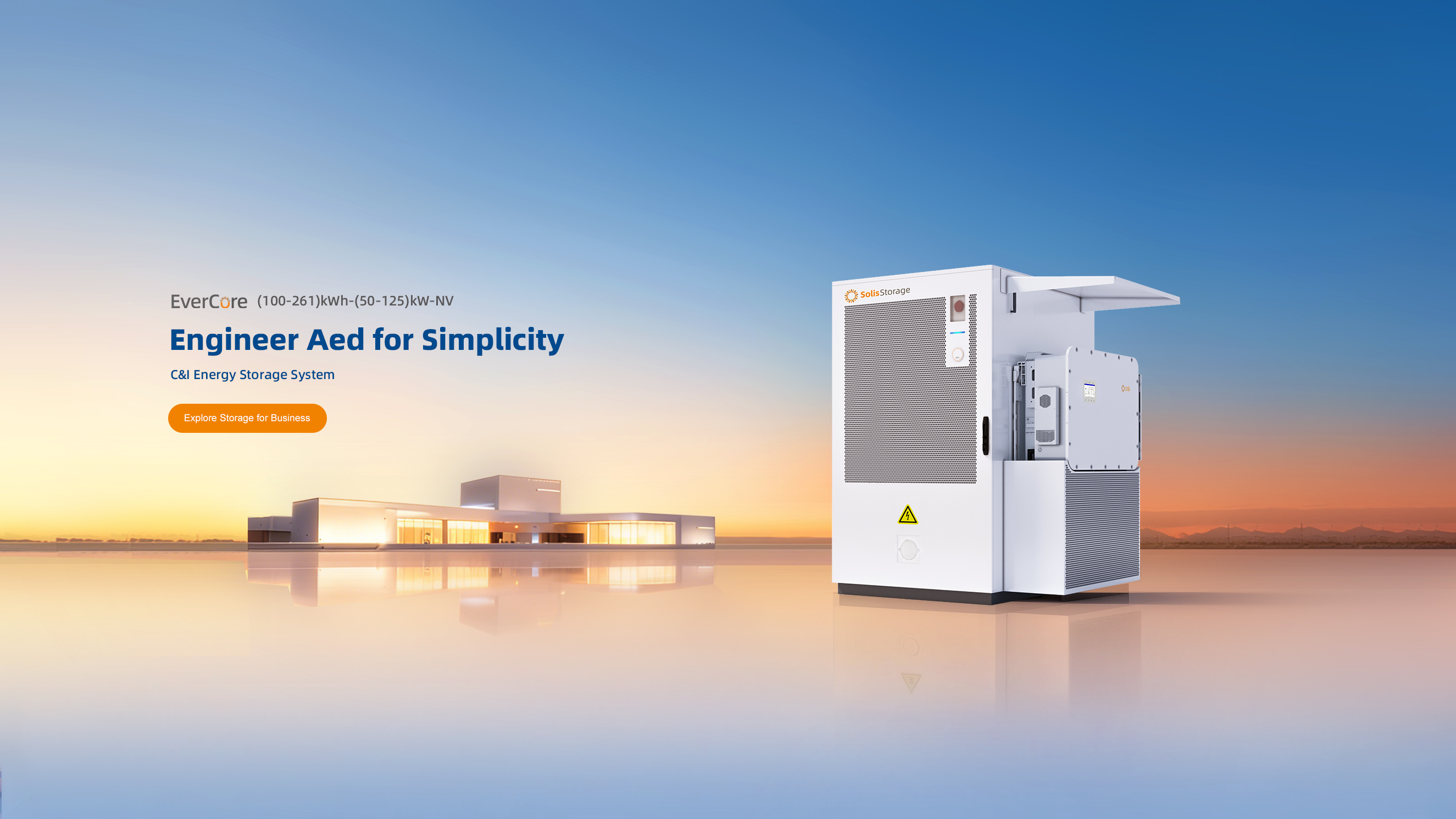
Energy storage system applications differ by scenario: residential, small commercial and C&I requirements each map to a different SolisStorage line.
Energy Storage System Applications by Scenario: SolisStorage ESS
Energy storage system selection is a scenario question long before it becomes a product comparison. A residential energy storage system sized around a 5 kWh nominal capacity, a stackable battery storage unit serving a clinic or a small farm, and a 261.2 kWh cabinet connected to an industrial site are all described with the same phrase, yet each answers a different set of constraints: daily load profile, required backup duration, grid interaction, site environment, and the certification regime of the destination market.
SolisStorage is the energy storage subsidiary of Ginlong (Solis) Technologies Co., Ltd. (Shenzhen Stock Exchange: 300763), a manufacturer founded in 2005 that supplies solar inverters, energy storage inverters and complete energy storage solutions. Solis states that its products are used in more than 100 countries and regions, with market coverage spanning Europe, Africa (including South Africa), the Middle East & Central Asia and South Asia. Its storage portfolio is organised into three lines - IntelliHome, FlexCore-ID and EverCore ESS - which map to residential, small commercial, and larger C&I or grid-connected scenarios.
Why Scenario Mapping Comes Before Product Comparison
Buyers evaluating a battery energy storage system at the research and evaluation stages usually compare headline specifications first: energy capacity in kWh, inverter power in kW, cycle life, protection rating. Those numbers only become meaningful once the scenario is fixed, because the same 125 kW inverter can serve a warehouse pursuing daily self-consumption or a site that must ride through grid interruptions with fast transfer to backup.
- What does the site consume, and when? Daily consumption and peak demand determine the required energy capacity and inverter power rating, and therefore whether a home-scale unit, a stackable system or a cabinet-scale solution is appropriate.
- What must stay powered, and for how long? Backup duration and acceptable transfer time separate systems that require islanding capability from those that do not.
- How will the asset earn? PV self-consumption, peak shaving, demand charge management and grid ancillary services such as FCR/aFRR/mFRR, demand response and virtual power plant (VPP) dispatch place different demands on the energy management system and its software ecosystem.
- What does the destination market require? Certification scope, protection ratings, temperature and altitude ranges and grid connection rules are constraints that additional capacity cannot substitute for.
Because those questions cut across the portfolio at different scales, SolisStorage separates its lines by application scale rather than by cell chemistry. LiFePO4 and LFP cells appear across the range, while the differences sit in capacity, inverter rating, protection design and control architecture.
IntelliHome: Residential Energy Storage Systems
IntelliHome is the residential line. The published specification lists LiFePO4 battery chemistry with a nominal capacity of 5 kWh and a rated cell capacity of 100 Ah. The operating voltage range is 44.8 to 57.6 V and the recommended charge and discharge current is 50 A. Cycle life is stated as greater than 6000 cycles, corresponding to approximately 10 years, and the enclosure carries an IP66 ingress protection rating. The casing uses aluminium alloy with core electronic components.
For a home energy storage installation, the sizing question is usually self-consumption rather than peak capacity: how much of the household solar generation can be shifted to evening consumption, and how long essential loads can be carried during an outage. An IP66 enclosure supports installation in outdoor and semi-outdoor positions where moisture and dust exposure are routine, which matters in coastal and dusty regions.
The boundary is equally clear. A 5 kWh nominal capacity per unit is a household-scale building block. Buyers with larger daily consumption, three-phase high-power loads or longer backup requirements should compare stackable and larger-format configurations, such as the FlexCore-ID line or cabinet-scale systems, before assuming that a single residential unit will cover the load.
FlexCore-ID: Stackable Storage for Small Commercial and Light Industrial Sites
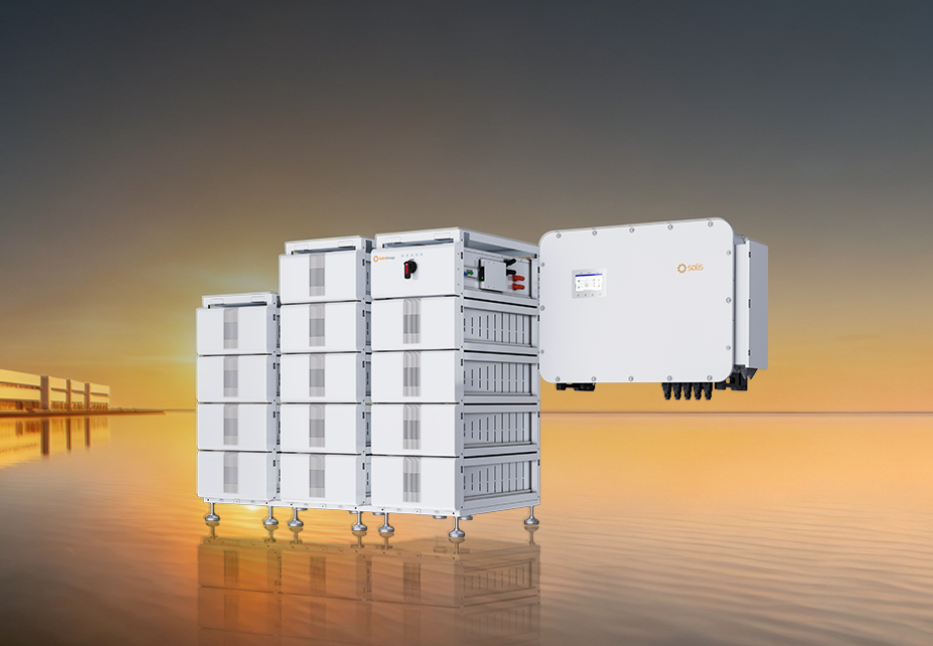
FlexCore-ID is a stackable energy storage system for small farms, shopping malls, hospitals, large residences and small industrial and commercial enterprises.
FlexCore-ID is a stackable energy storage system intended for small farms, shopping malls, hospitals, large residences, and small industrial and commercial enterprises. It uses LFP battery chemistry with 314 Ah cells, and the battery pack model is FlexCore-ID-BAT20kWh. Cell cycle life is rated at 8000 cycles or more at 25±2 °C, 0.5P, with end of life defined at 70% capacity. The system casing uses aluminium alloy with core electronic components.
The stackable format is the scenario-relevant feature. Sites in this band rarely know their final load profile at the moment of purchase: a clinic adds imaging equipment, a small farm adds irrigation or cold storage, a shopping mall changes tenant mix. A modular pack rated at 20 kWh per unit allows capacity to follow load growth, which reduces the risk of over-sizing at the first phase or under-sizing after an operational change.
Two constraints should be checked during evaluation. The first is physical: stacked configurations depend on floor area, ventilation and service access, so site layout has to be confirmed before capacity is finalised. The second is thermal: the 8000-cycle rating is specified at 25±2 °C under 0.5P cycling, and installation positions with high ambient temperature or restricted airflow will not reproduce those test conditions.
EverCore ESS: C&I and Grid Support Applications
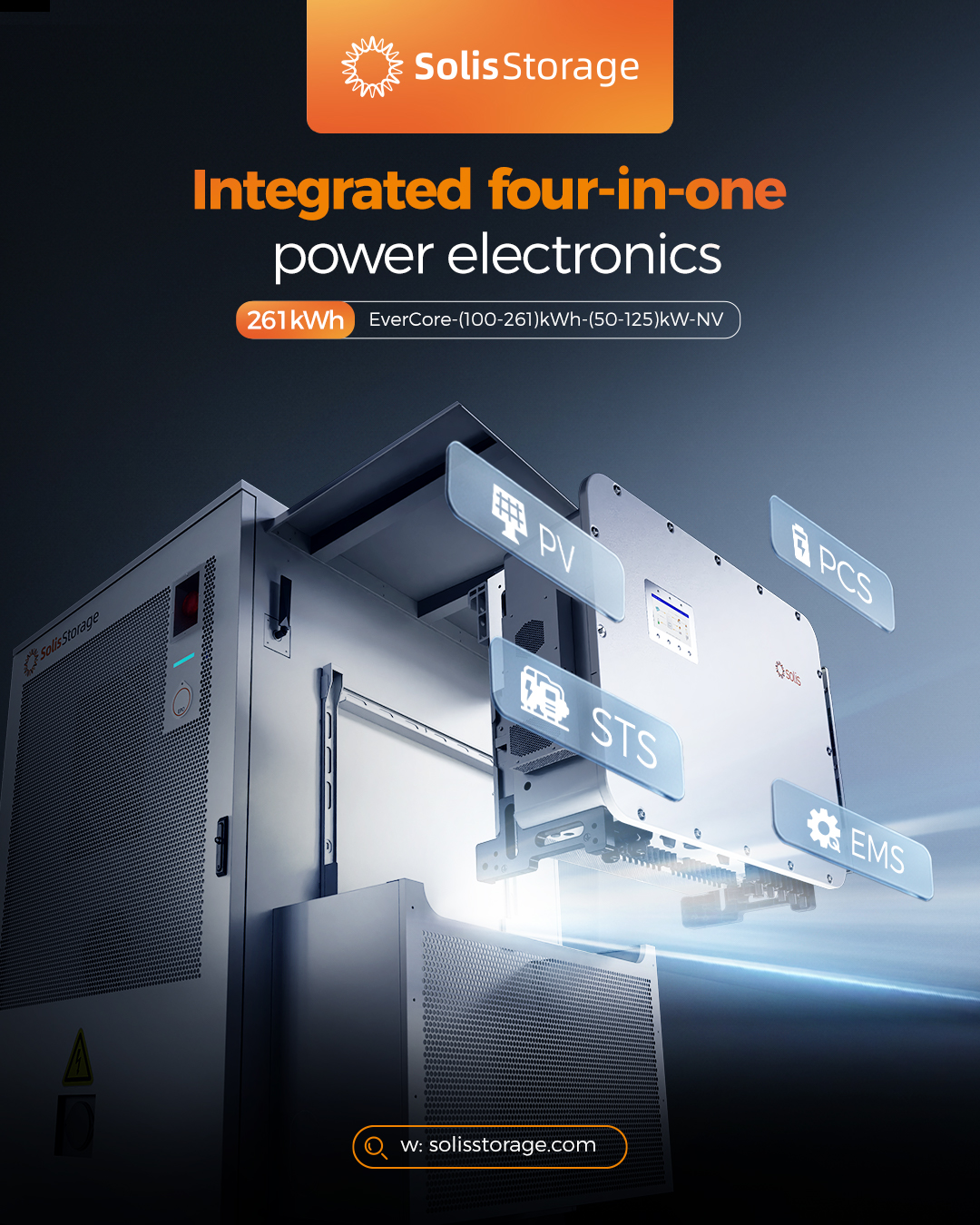
EverCore ESS covers commercial and industrial energy storage and power grid applications in 100.5 kWh, 120.6 kWh and 261.2 kWh configurations.
EverCore ESS is positioned for commercial and industrial energy storage and power grid applications. It is available with rated energy capacities of 100.5 kWh, 120.6 kWh and 261.2 kWh, matched to inverter power ratings of 50 kW, 60 kW and 125 kW. The battery uses EVE LFP 3.2 V/314 Ah cells with an 8000-cycle rating, and protection is specified as IP55 for the cabinet and IP66 for the inverter. The casing is aluminium alloy with core electronic components.
The architecture separates the AC side from the DC side: the hybrid energy storage inverter sits outside the battery cabinet, and a single inverter can connect up to six battery cabinets in parallel. That structure allows DC-side capacity expansion without additional inverter investment, and Solis states that the integrated unit combines the power conversion system (PCS), static transfer switch (STS), PV inverter, circuit breaker protection and energy management system in one enclosure. Grid-tied to off-grid switching is specified at less than 10 ms without an external STS, and the platform supports both DC and AC coupling of existing PV systems with a PV oversizing ratio of up to 200%.
On the environmental side, Solis rates EverCore for operation from -25 °C to 55 °C and at altitudes up to 4,000 m. The 125 kW/261 kWh configuration retains air cooling through an independent three-air-duct layout, and the company states that this thermal design improves heat dissipation efficiency by approximately 30% compared with traditional air cooling, keeping temperature uniformity close to that of liquid-cooled designs. Solis also states a 15-layer protection system spanning cell, pack and system level, with three-stage fire suppression.
Scenario-to-Line Reference Table
| Application scenario | SolisStorage line | Verified configuration facts | Constraint to verify |
|---|---|---|---|
| Single-family home, PV self-consumption and backup | IntelliHome | LiFePO4, 5 kWh nominal, 100 Ah rated cell, 44.8-57.6 V, 50 A recommended charge/discharge, >6000 cycles (~10 years), IP66 | Household daily consumption and required backup duration |
| Small farm, clinic, shopping mall, large residence, small industrial/commercial site | FlexCore-ID | Stackable LFP, 314 Ah cells, pack model FlexCore-ID-BAT20kWh, ≥8000 cycles at 25±2 °C, 0.5P, EOL 70% | Number of stacked packs, footprint and thermal conditions |
| Commercial and industrial site, utility and grid support | EverCore ESS | 100.5/120.6/261.2 kWh, 50/60/125 kW, EVE LFP 3.2 V/314 Ah, 8000 cycles, IP55 cabinet + IP66 inverter, up to 6 cabinets in parallel | Site temperature and altitude, grid connection rules, market-specific certification |
Certification: A Model-Level Constraint, Not a Brand-Level Claim
For C&I buyers, certification is often the first hard filter, and it applies at model level rather than at brand level. The EverCore ESS product is certified to IEC 62619 by TUV under certificate number JPTUV-182135 for the EU market. The EverCore-261kWh and EverCore-261kWh-PRO models are separately certified to CE EMC Directive 2014/30/EU by TUV under certificate number AE 50712374 0001, based on EN IEC 61000-6-2:2019, IEC 61000-6-2:2016, EN IEC 61000-6-4:2019 and IEC 61000-6-4:2018.
Two implications follow. First, a certificate scope names specific models and a specific market, so a buyer shortlisting a different capacity, or deploying outside the EU, must confirm which documents apply to the exact model in question. Second, standards differ by region: according to UL Solutions, energy storage systems intended for North American market access must comply with UL 9540 for system safety and UL 9540A for thermal runaway fire propagation testing. IEC and TUV SUD describe IEC 62619 as the key international safety standard for lithium secondary cells and batteries used in industrial and energy storage applications.
Practical verification therefore means matching three items: model, market and standard. A general statement that a supplier is certified is not equivalent to a certificate that names the model being purchased.
Deployment Evidence: Thailand and Denmark
Two documented projects show how the same platform is configured differently by scenario. In Thailand, SolisStorage records a 125 kW/522 kWh energy storage installation used for self-consumption and backup power, with a stated 20-year project duration, stable operation and electricity bill savings as the reported outcome.
In Denmark, a 125 kW/261 kWh configuration serves self-consumption in a warehouse over a 20-year horizon. The documented highlight is switching behaviour: the system moves between on-grid and off-grid operation in under 10 ms to prevent interruptions, which is the requirement that distinguishes a backup-capable installation from a purely arbitrage-oriented one.
Read together, the projects illustrate the sizing logic that the table above describes. The Danish site prioritises operational continuity for warehouse loads and matches it with a single 261 kWh cabinet at 125 kW. The Thai site pairs a comparable power rating with roughly double the energy capacity for self-consumption plus backup. Both fall inside the configuration range of the EverCore line, which covers 100.5 kWh, 120.6 kWh and 261.2 kWh cabinets with 50 kW, 60 kW and 125 kW inverters, and supports up to six battery cabinets per inverter.
Global Deployment and Supply Signals Buyers Can Verify
Beyond specifications, long-duration energy storage projects depend on delivery and service capability. Solis reports the following points, each of which can be checked through documentation, references or audits during supplier evaluation:
- Market footprint: products used in more than 100 countries and regions, with coverage across Europe, Africa (including South Africa), the Middle East & Central Asia and South Asia; export ratio stated at 70%.
- Service structure: 24/7 global remote technical support, 27 local overseas service centres, 48-hour on-site fault handling and whole-machine replacement guarantee, plus long-term spare parts supply.
- Manufacturing base: a 98,114.69 m² factory area, more than 5,000 employees, 80 GW annual output, 1,000+ R&D staff, and a stated monthly capacity of over 10,000 units on an integrated intelligent production line.
- Quality control: raw material incoming inspection, aging test, high-low temperature cycle test, IP protection test, and 100% full functional test before shipment.
- OEM/ODM flexibility: customisation of logo, outer package, software interface, regional voltage standard, communication protocol and function parameters; MOQ of 1 unit for standard off-the-shelf models and 20 units for customised OEM orders; 30-45 days lead time for mass OEM orders, with spot goods available for standard models.
- Software ecosystem: Solis states that EverCore has been connected, or is in the process of connecting, with 102 third-party VPP/EMS operators across 11 European countries, and that its AI cloud platform is deployed at more than 5,500 energy storage power stations worldwide.
Where the Portfolio Reaches Its Limits
A scenario guide is only useful if the boundaries are stated as plainly as the capabilities.
- Capacity boundaries: IntelliHome is specified at 5 kWh nominal per unit, which is household scale. It is not positioned for commercial or industrial load profiles, where stackable or cabinet-scale systems are the appropriate starting point.
- Site-dependent performance: the 8000-cycle and greater than 6000-cycle figures are manufacturer-stated ratings under defined test conditions. Real project outcomes depend on duty cycle, ambient temperature, depth of discharge and maintenance practice.
- Protection asymmetry: on EverCore, the inverter carries IP66 while the cabinet carries IP55. Installation and drainage planning should respect the lower of the two ratings at cabinet level.
- Expansion ceilings: DC-side expansion is documented at up to six battery cabinets per inverter. Projects requiring more capacity need additional inverters and revised switchgear planning.
- Market-specific compliance: the certification records cited here cover IEC 62619 and CE EMC for the EU market. Buyers in North America or other regions must verify compliance against their own requirements, such as UL 9540 and UL 9540A in North America, before treating certification as complete.
Market Trend: Scenario Segmentation Is Widening
Third-party estimates support the direction of travel, although the totals must be read with care. Global Market Insights values the global energy storage systems market at approximately USD 668.7 billion in 2024 and projects USD 5.12 trillion by 2034. That figure spans all storage technologies, including pumped hydro; Fortune Business Insights estimates the battery-only segment at USD 32.62 billion in 2024, which shows how much the definition of scope changes the headline number.
Segmented figures are more useful for scenario planning. MarketsandMarkets estimates the residential energy storage market at USD 2.69 billion in 2024, growing to USD 4.58 billion by 2030 at a CAGR of 9.3%, and values the long-duration energy storage market at USD 4.85 billion in 2024 with a CAGR of 13.6% through 2030. Both figures point to the same observation: demand is expanding at several scales at once, and a portfolio organised by scenario is easier to match to a project than a single-platform claim.
Supplier positioning is a separate signal. Wood Mackenzie ranked Solis as the world number one in residential PV inverter shipments in 2023 and the third largest inverter manufacturer globally. That matters for hybrid storage architectures in the C&I segment, because integrated energy storage inverters inherit power-electronics design experience from the inverter business.
Future Outlook
The next phase of deployment is likely to be defined less by cell chemistry than by how well systems are matched to scenarios. As markets mature, buyers increasingly ask model-level certification questions, request switching-time specifications, and look for an expansion path that does not require replacing the inverter. Where a portfolio is separated into residential, small commercial and larger C&I or grid-support lines, each option can be evaluated against the constraints that actually apply to the site, rather than against a single set of headline numbers. For procurement teams, that shift turns specification sheets into decision documents - and makes the boundary conditions, not the peak figures, the most important part of the review.
FAQ
What energy capacity and inverter power options does the EverCore ESS line offer?
EverCore ESS is available with rated energy capacities of 100.5 kWh, 120.6 kWh and 261.2 kWh, matched to inverter power ratings of 50 kW, 60 kW and 125 kW. The battery uses EVE LFP 3.2 V/314 Ah cells with an 8000-cycle rating, and protection is specified as IP55 for the cabinet and IP66 for the inverter. A single inverter can connect up to six battery cabinets in parallel, which allows DC-side capacity expansion without additional inverter investment.
How does FlexCore-ID differ from EverCore ESS in intended application?
FlexCore-ID is a stackable energy storage system intended for small farms, shopping malls, hospitals, large residences, and small industrial and commercial enterprises. It uses LFP chemistry with 314 Ah cells and a battery pack model of FlexCore-ID-BAT20kWh, with cell cycle life rated at 8000 cycles or more at 25±2 °C, 0.5P and end of life at 70% capacity. EverCore ESS is the cabinet-scale line positioned for commercial and industrial storage and power grid applications, with higher single-unit capacities, 50-125 kW inverter ratings, and an integrated architecture combining PCS, STS, PV inverter, circuit breaker protection and EMS.
What does the IntelliHome residential system provide in terms of capacity, cycle life and protection?
IntelliHome uses LiFePO4 battery chemistry with a nominal capacity of 5 kWh and a rated cell capacity of 100 Ah. The operating voltage range is 44.8 to 57.6 V, the recommended charge and discharge current is 50 A, and cycle life is stated as greater than 6000 cycles, corresponding to approximately 10 years. The enclosure carries an IP66 ingress protection rating and is made of aluminium alloy with core electronic components, which supports installation in outdoor and semi-outdoor household positions.
How should switching time and backup requirements influence scenario selection?
Where an interruption affects operations, transfer time becomes a selection criterion alongside capacity. In a documented 125 kW/261 kWh warehouse project in Denmark, the system switches between on-grid and off-grid operation in under 10 ms to prevent interruptions. Where backup is not operationally critical, buyers may instead prioritise energy capacity per unit of cost for self-consumption. A second documented project in Thailand uses a 125 kW/522 kWh installation for combined self-consumption and backup power. The distinction between transfer time and energy capacity should therefore be settled before comparing quotations.
Which certifications should be verified for a C&I energy storage system in the EU market?
For the EverCore ESS product, the available records show IEC 62619 certification by TUV under certificate number JPTUV-182135 for the EU market. The EverCore-261kWh and EverCore-261kWh-PRO models additionally hold CE EMC Directive 2014/30/EU certification by TUV under certificate number AE 50712374 0001, based on EN IEC 61000-6-2:2019, IEC 61000-6-2:2016, EN IEC 61000-6-4:2019 and IEC 61000-6-4:2018. IEC 62619 is described by IEC and TUV SUD as the key international safety standard for lithium secondary cells and batteries used in industrial and energy storage applications. For North America, UL Solutions states that UL 9540 and UL 9540A apply to system safety and thermal runaway fire propagation testing.
Does certification for one model cover the entire product line?
No. Certification records name specific models and markets. In the available documentation, the CE EMC Directive certificate applies to the EverCore-261kWh and EverCore-261kWh-PRO models, while the IEC 62619 certificate applies to the EverCore ESS product for the EU market. Buyers should match the certificate scope against the exact model designation and the market of deployment before treating compliance as confirmed.
Reference material: the Solis Global Brochure (PDF) consolidates the product and certification overview for readers who need the full documentation set.