
Energy Storage System OEM Capability: A Technical Buyer’s Checklist
Energy storage system evaluation now requires more than a comparison of rated capacity and cycle life. As commercial and industrial (C&I) projects become more site-specific, buyers are asking whether a manufacturer can tailor hardware, software and delivery to project conditions. OEM and ODM capability is therefore moving to the centre of procurement decisions.
For buyers moving from evaluation to execution, the key question is not whether a vendor offers a product, but whether it can deliver a configured energy storage system with consistent quality, local compliance and long-term service. This article uses the example of Ginlong (Solis) Technologies Co., Ltd. and its SolisStorage EverCore ESS to define what should be checked when assessing an energy storage system manufacturer’s capability.
Problem / Opportunity
C&I energy storage projects often fail to be served by a one-size-fits-all catalogue unit. Site-specific factors such as regional voltage standards, communication protocols, grid codes and software platforms can determine whether a system operates as intended. Buyers also need to consider packaging, branding and documentation that match their own sales channels or project branding.
An energy storage system manufacturer with OEM/ODM experience can solve these mismatches. According to SolisStorage, its customization options include logo, outer package, software interface, regional voltage standard, communication protocol and function parameters. This means the buyer does not need to redesign the system locally; the factory can adjust production to the destination market.
Brand Solution: SolisStorage and EverCore ESS
Ginlong (Solis) Technologies Co., Ltd. was founded in 2005 and listed on the Shenzhen Stock Exchange in 2019 (stock code 300763.SZ). The company operates a production facility of 98,114.69 m², employs more than 5,000 people, and has an annual output capacity of 80 GW. Its R&D team includes more than 1,000 engineers, and around 70% of its products are exported to markets including Europe, Africa, the Middle East & Central Asia, and South Asia.
SolisStorage is the dedicated energy storage subsidiary of Ginlong (Solis). It develops core storage technologies internally, including PCS, EMS and system integration, and offers residential, C&I and utility-scale storage systems. The C&I product family includes the EverCore ESS, available in rated energy capacities of 100.5 kWh, 120.6 kWh and 261.2 kWh, with inverter power ratings of 50 kW, 60 kW and 125 kW.
For buyers evaluating OEM capability, the company states that it provides OEM and ODM production services. Its monthly production capacity exceeds 10,000 units worldwide. Mass OEM orders have a lead time of 30–45 days, while standard models are available as spot goods. The minimum order is 1 unit for standard off-the-shelf models, and 20 units for customized OEM orders.
Quality control is another execution-stage concern. The company reports 100% full functional testing before shipment, raw material incoming inspection, aging tests, high-low temperature cycle tests, and IP protection tests. After-sales support includes 24/7 global remote technical support, 27 local overseas service centers, a 48-hour on-site fault handling and whole machine replacement guarantee, and long-term spare parts supply.
Technical Explanation: What Makes Customization Reliable
OEM capability is not only about production flexibility. The underlying product architecture determines how easily a system can be adapted to different projects and how predictable it will be in operation. The EverCore ESS illustrates several design decisions that matter to C&I buyers.
AC-DC separation architecture
EverCore physically separates the AC and DC sides of the system. The hybrid energy storage inverter is installed as an independent unit, while the battery cabinet remains separate. This separation has three practical consequences. First, thermal separation: the inverter dissipates about 6 kW of power heat directly into the ambient environment, leaving only about 3.5 kW of electrochemical heat inside the battery cabinet. This allows the system to achieve temperature uniformity close to liquid-cooled solutions while retaining an air-cooled design. Second, protection separation: the inverter reaches IP66 while the battery cabinet maintains IP55. Based on its 20 years of power electronics experience, the company estimates this separated protection design reduces the system’s full-lifecycle failure rate by 50%. Third, structural separation: one inverter can connect up to 6 battery cabinets in parallel, enabling DC-side expansion without adding another inverter, reducing system expansion costs by approximately 10%.
Integrated 125 kW hybrid inverter
The EverCore hybrid inverter integrates PCS, STS, PV inverter, circuit breaker protection and EMS into a single unit, with a single-unit power rating of 125 kW. In practical terms, this means seamless grid-tied/off-grid switching in under 10 ms without an external STS, support for both DC and AC coupling, and a PV over-sizing ratio of up to 200%. Up to 6 EverCore units can be connected in parallel for direct grid connection, simplifying construction. The system also uses a single central controller rather than separate CPUs for BMS, PCS, EMS and STS. This reduces failure points and makes fault location faster.
Air-cooled thermal management for long-duration use
EverCore is engineered as a long-duration C&I energy storage system. It retains an air-cooled design for the 125kW/261kWh configuration, using an independent three-air-duct design with a patented diversion air duct and Coanda effect airflow attachment on battery packs. The company reports that this thermal management combination improves heat dissipation efficiency by 30% compared with traditional air cooling. Combined with IP66/IP55 protection and C4-grade anti-corrosion coating, the system can operate from -25°C to 55°C and at altitudes up to 4,000 meters.
Lower lifecycle maintenance costs
Lifecycle costs are a critical part of C&I energy storage economics. SolisStorage states that over the full project lifecycle, EverCore saves approximately €9,500 per unit in O&M costs compared with traditional liquid-cooled solutions. This comes from eliminating liquid cooling fluid replacement (about €2,500), simplifying PCS replacement (€1,500), simplifying pack replacement (€1,500), and reducing routine inspection complexity (€4,000). Component selection reinforces this: Minebea cooling fans are specified with a 10-year maintenance-free design, and Honeywell industrial-grade flammable gas detectors are specified with a 10-year calibration-free performance.
Multi-layer safety with A-grade cells
Safety is a core acceptance criterion. EverCore uses a 15-layer, three-dimensional protection system spanning cell, pack and system levels. Thermal insulation materials resistant to 1,000°C are used between packs, and a three-stage fire-fighting mechanism includes pack-level aerosol, cabinet-level aerosol and fire-fighting water channels. The battery cells are A-grade 314Ah LFP cells developed for C&I applications. These cells have an internal resistance of 0.15±0.05mΩ, lower than the 0.17mΩ of typical 280Ah cells, and reach 8,000 cycles at 0.5C charge-discharge with remaining capacity ≥70%. This extends the economic lifecycle from roughly 14 years to 16 years for a typical 500 cycles-per-year operating profile.
Open software ecosystem
In many European electricity markets, C&I storage revenue can include peak-valley arbitrage, grid ancillary services, demand response and virtual power plant (VPP) dispatch. EverCore has been designed for this environment. Solis reports that the system has been connected or is being connected to 102 third-party VPP/EMS operators across 11 European countries. Examples include the Kraken platform under Octopus Energy in the UK, aggregator platforms such as Check Watt in the Nordic market, and dozens of local EMS providers in the German-speaking region and Benelux. The company’s Solis AI Cloud platform has been deployed at more than 5,500 energy storage power stations, integrating Nordpool wholesale price data and Flatpeak retail price data. In a residential project in Latvia, Solis AI optimization increased annual electricity bill savings by 302.6%.
For a buyer evaluating OEM capability, this software openness matters because it allows the system to be adapted to different market operators and revenue models without replacing hardware.
Application / Use Cases
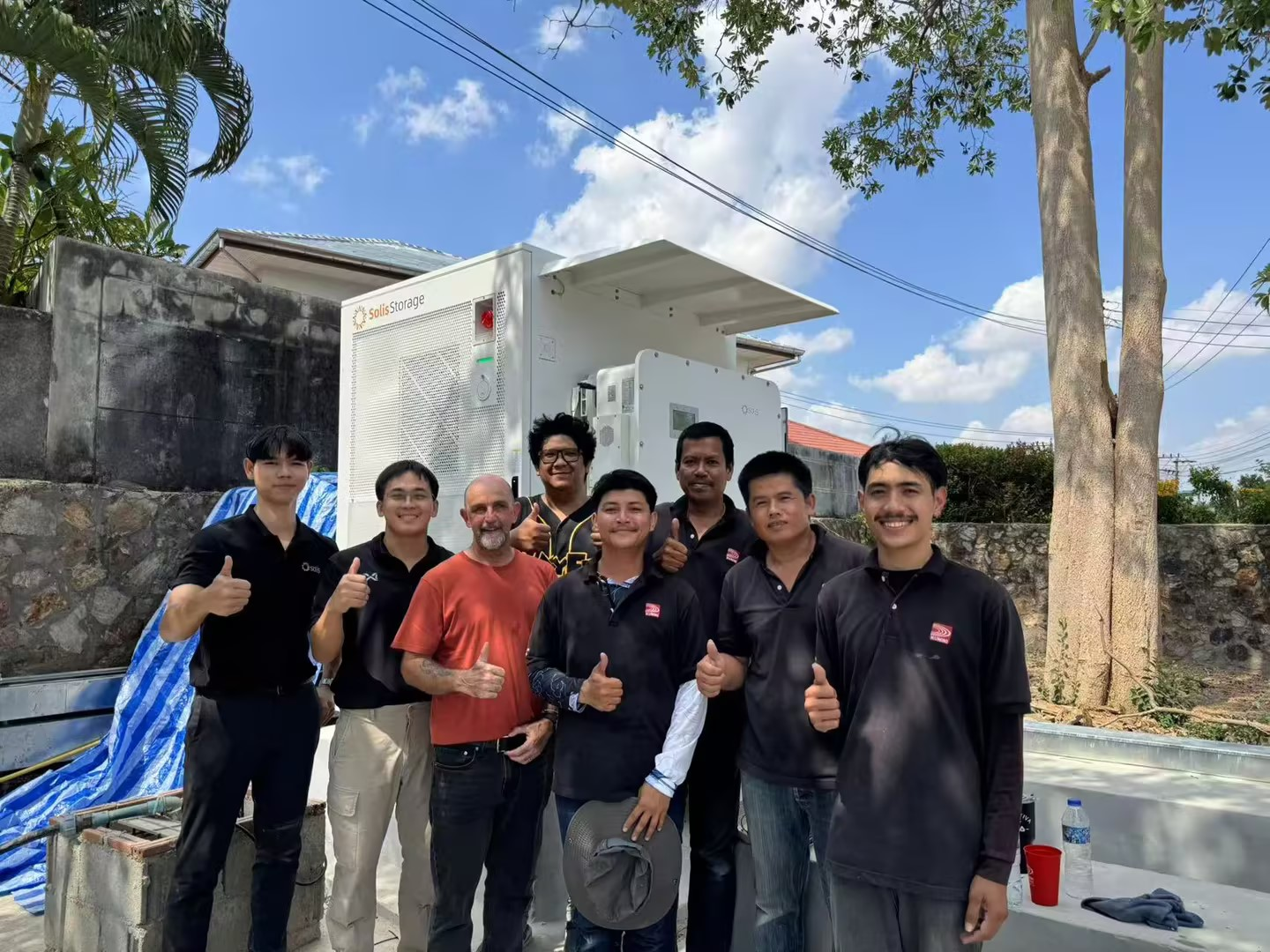
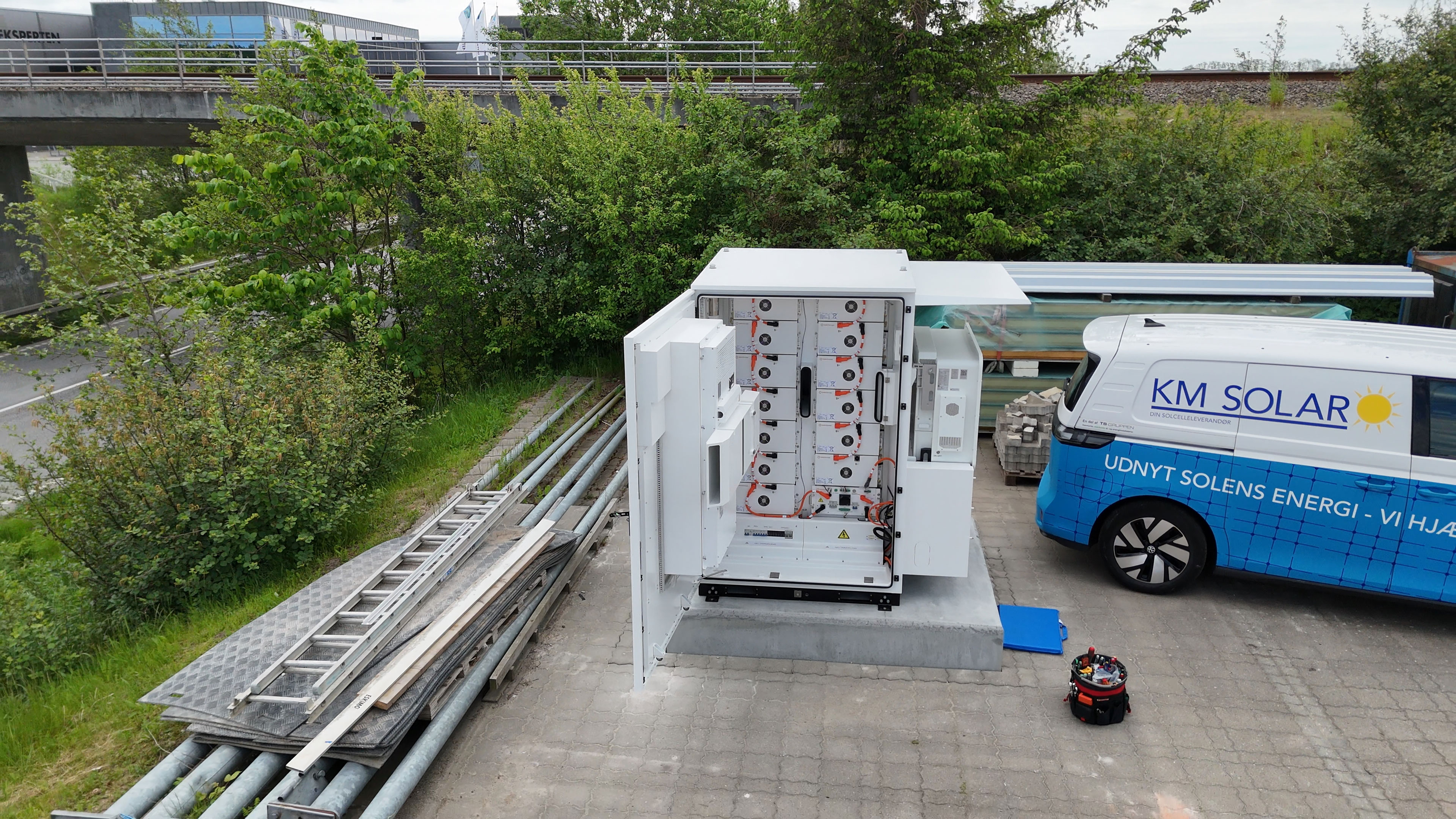
Project references can show how the product performs in execution. One installation in Denmark uses a 125kW/261kWh EverCore ESS for warehouse self-usage by a C&I industrial end user. The system delivers electricity bill savings and switches between on-grid and off-grid in under 10 ms to prevent interruptions. Another project in Thailand uses a 125kW/522kWh configuration for self-consumption and backup power, providing stable operation for a self-consumption and backup project owner, with electricity bill savings. The different capacities in these two projects also illustrate the benefit of modular DC-side expansion.
Market Trend Analysis
Market data points to strong demand for flexible energy storage solutions. Global Market Insights estimates the global energy storage systems market was worth approximately USD 668.7 billion in 2024 and is projected to reach USD 5.12 trillion by 2034. MarketsandMarkets values the long-duration energy storage market at USD 4.85 billion in 2024, with a 13.6% CAGR through 2030. In China, exports of lithium-ion batteries for energy storage and non-automotive uses exceeded USD 65 billion in 2024, a 51.4% increase from the previous year, according to Reuters. This trade flow gives manufacturers such as Solis production scale and supply-chain leverage.
Within the inverter industry, Wood Mackenzie ranked Solis as the world’s #1 residential PV inverter supplier in 2023 and the 3rd largest inverter manufacturer globally. That scale matters for storage buyers because it indicates manufacturing discipline, procurement power and global deployment experience.
These trends reinforce a simple conclusion: buyers should assess not only the energy storage system specifications, but also the manufacturer’s ability to localize, customize, certify and support the system over its lifetime.
Comparison with Traditional Solutions
Many traditional C&I storage projects were assembled from separate components: an inverter from one vendor, a battery from another, an STS and an EMS from additional suppliers. The buyer took on integration risk, and troubleshooting required co-ordinating multiple manufacturers. A capability-based approach such as SolisStorage EverCore consolidates these functions.
| Evaluation aspect | Traditional multi-vendor approach | EverCore capability-based approach |
|---|---|---|
| System integration | Separate PCS, STS, PV inverter, EMS | Single integrated hybrid inverter with PCS, STS, PV inverter, circuit breaker, EMS |
| Grid/off-grid transition | Requires external STS | Switching in under 10 ms without external STS |
| DC-side expansion | Often requires new inverter capacity | Up to 6 battery cabinets per inverter; approximately 10% lower expansion cost |
| Software ecosystem | Closed, project-specific | Connected to 102 VPP/EMS operators in 11 European countries |
| OEM customization | Limited offer scope | Logo, packaging, software interface, voltage standard, communication protocol, function parameter |
| After-sales | Multiple vendors to co-ordinate | 27 local service centers, 48-hour replacement response, long-term spare parts supply |
At the same time, the comparison has limits. The EverCore air-cooled architecture is designed for C&I system sizes up to 125kW/261kWh per unit. Larger utility-scale single-site projects may require different system layouts, and projects with extreme space constraints may prefer liquid-cooled or high-density configurations. In addition, custom OEM orders begin at 20 units, so very small pilots may need to use standard units before committing to a customized configuration.
Future Outlook
Looking ahead, energy storage procurement will likely continue shifting from product purchase to long-term partnerships. Buyers will expect manufacturers to support regional voltage standards, integrate with local energy markets, and provide transparent lifecycle service. As long-duration storage becomes a more important category, architectural choices that simplify O&M and enable software upgrades will gain more weight.
SolisStorage says its ambition is to become a trusted leader in the global energy storage industry, focused on technological innovation, application expertise and reliable delivery. For buyers, the practical takeaway is to build an evaluation checklist that covers OEM flexibility, system architecture, certifications, delivery terms, software compatibility and after-sales response.
FAQ
What OEM and ODM services are available for energy storage systems?
The manufacturer provides OEM and ODM production services, with customization options covering logo, outer package, software interface, regional voltage standard, communication protocol, and function parameter.
What is the minimum order quantity for energy storage systems?
For standard off-the-shelf models, the minimum order is 1 unit. For customized OEM orders, the minimum order is 20 units.
How long does it take to deliver a customized energy storage order?
Lead time for mass OEM orders is 30–45 days; standard models are available as spot goods.
Which certifications are relevant for EverCore energy storage systems in the EU market?
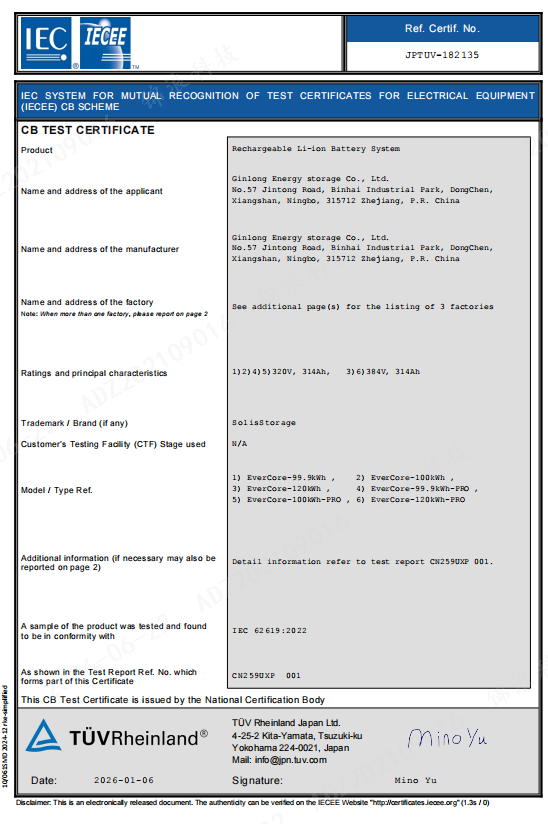
The EverCore ESS has received IEC 62619 safety certification (certificate JPTUV-182135, TÜV) and CE EMC certification (certificate AE 50712374 0001, TÜV) under EN IEC 61000-6-2 and EN IEC 61000-6-4, covering Zone 2 and the EverCore-261kWh and EverCore-261kWh-PRO models.
What after-sales support and maintenance are available?
The manufacturer provides 24/7 global remote technical support, 27 local overseas service centers, and a 48-hour on-site fault handling and whole machine replacement guarantee. Long-term spare parts supply is also available.
What delivery and acceptance terms apply?
Delivery methods include FOB Ningbo or EXW. Acceptance includes factory acceptance testing plus on-site installation and commissioning. Payment terms depend on customer tier, order size and regional policies.