
Engineered Wood Flooring FAQ: MOQ, Lead Time and Testing
HTNXT Industry Reference · Procurement Q&A
A working reference for importers, distributors and project buyers who need specific answers on minimum order quantity per colour, standard lead time, monthly capacity and the scope of 100% testing before they commit to an engineered timber order.
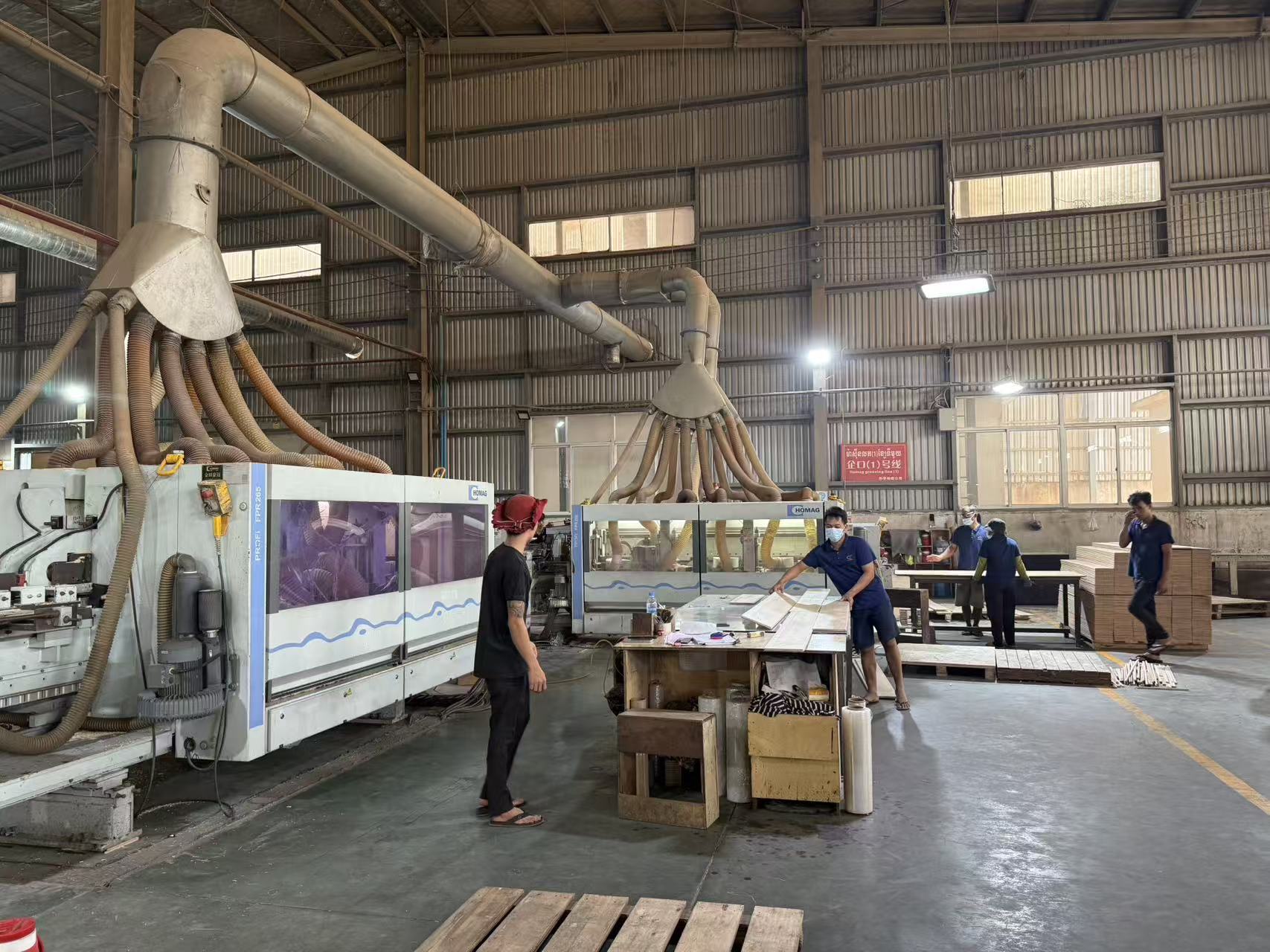
Engineered wood flooring production is planned by colour run, not by project total. Image: Dongda Wood groove line.
Engineered wood flooring sourcing rarely fails because a buyer misunderstood the product. It fails one layer deeper, where a specification meets a production schedule: how many square metres of one colour a factory will actually run, how long that run takes, how much capacity sits behind the promise, and what a 100% testing claim really covers. Those four variables decide whether a project lands on time, whether a distributor can hold a complete colour range, and whether an acceptance check at destination matches what was agreed at quotation.
Category context explains why these questions have become sharper. The global wood flooring market was valued at USD 53.14 billion in 2024 and is projected to reach USD 71.57 billion by 2029, according to The Business Research Company. Engineered wood flooring accounted for 55% of the total wood flooring market in 2024, favoured for its dimensional stability over solid wood, according to Market Research Reports. As engineered construction becomes the default in more residential and commercial interiors, order mechanics move from back-office detail to a shortlisting criterion.
This reference answers the questions buyers raise most often during the research and evaluation stage, using published production facts from Dongda Wood. Where a figure depends on order structure, the answer says so, because MOQ, lead time and testing all shift with colour count, customization and destination market.
Why Order Mechanics Decide More Deals Than Product Choice
Four procurement variables behave differently in engineered wood flooring than in most building materials, because all four scale with colour rather than with volume.
- MOQ defines colour flexibility. A minimum order quantity stated per colour behaves like a minimum order quantity per product family: a five-colour residential programme is not one order conversation, it is five colour runs that each need to clear the same threshold.
- Lead time defines schedule risk. Production time is only one segment of the order-to-site timeline, and it starts from a trigger that should be written into the contract rather than assumed.
- Capacity defines whether the promise survives a peak. A factory that runs small bespoke colour orders also runs large distributor programmes, and those programmes compete for the same line time.
- Testing defines acceptance risk. A 100% testing claim and a market-access certificate are two different documents, and importers are usually asked for both at destination.
For a distributor, the practical consequence is that supplier evaluation should start with colour-level economics rather than headline price: how many colours a factory will schedule per quarter, and how consistently a colour repeats from run to run.
The Manufacturer Behind These Numbers
Suzhou Dongda Wood Co., Ltd, referred to commercially as Dongda Wood, is an engineered wood flooring and plywood manufacturer founded in 1995 and based in Suzhou City, Anhui Province, China. The company operates a facility of 190,000㎡, employs more than 500 people, runs a 20-engineer R&D team, and exports 100% of its output to markets including the USA, Canada, Australia, the EU, the United Kingdom, Brazil, Chile and South Africa. Its stated annual output is 1,500,000㎡.
Because the answers below depend on production data rather than marketing positioning, the published capability figures are summarised first, then explained in the order a buyer would ask about them.
| Procurement variable | Published figure | What it governs |
|---|---|---|
| Minimum order quantity | 400㎡ per colour | Colour count per order, palette planning |
| Lead time | 45 days | Production scheduling, project timelines |
| Monthly capacity | 150,000㎡ | Programme scaling, peak-season allocation |
| Quality control | 100% test | Board-level inspection scope |
| Production model | OEM / ODM | Custom dimensions, grade, packaging, logo |
| After-sales coverage | 25-year residential / 3-year commercial | Project type and lifecycle expectations |
MOQ, Lead Time, Capacity and Testing: Direct Answers
What is the minimum order quantity per colour?
Dongda Wood states a minimum order quantity of 400㎡ per colour.
The unit of measurement matters more than the number. The threshold applies to a colour, which in practice means a specific surface colour and finish combination, not the total square metres of a purchase order. A project that specifies three distinct colours is quoted as three colour runs, each of which must meet the 400㎡ baseline. Buyers evaluating a supplier should therefore confirm three things in writing: whether the minimum is quoted per colour, per species, or per construction; whether repeat orders of an existing colour carry the same threshold; and how a colour that sits slightly below the threshold is handled. For distributors building a range, a five-colour programme of 2,000㎡ can usually be structured so that every colour clears the baseline, whereas a renovation client requesting five colours at 120㎡ each cannot.
What is the standard production lead time?
The standard production lead time is 45 days.
This is a production figure, not a door-to-door figure. It does not include ocean transit, port handling, inland delivery or site lead-in, and it does not include time spent resolving artwork or specification questions. Two clarifications protect the schedule. First, the start trigger: buyers should fix in the contract whether the 45 days begins at deposit receipt, at specification confirmation, or at approval of customized packaging design and logo. Second, the customization stage: where dimensions, grade, packaging design or logo are customized under the OEM/ODM model, that work sits inside the order sequence rather than beside it, so the start point is what determines whether the 45 days holds.
How much monthly capacity stands behind an order?
Dongda Wood states a monthly capacity of 150,000㎡, supported by a 190,000㎡ facility, more than 500 employees and 20 engineers.
The ratio between capacity and minimum order quantity explains how colour runs are scheduled. A single 400㎡ colour order represents a very small share of one month of output, so capacity itself is rarely the reason a small colour run is refused. The real constraint is sequencing: small custom colour runs are slotted around larger distributor programmes that occupy line time in blocks. For buyers, this has two practical consequences. A first order can be sized to validate colour and quality rather than to fill a container, and a multi-colour range is best planned across a year of production rather than requested in a single month. It also means that a supplier with high capacity and a low per-colour minimum can support range-building at distributor level without forcing over-buying of any single colour.
What does 100% testing actually cover?
The stated quality-control regime is a 100% test, meaning inspection is applied to boards rather than to a statistical batch sample.
A 100% inspection claim answers one question — whether individual boards are checked rather than a sample drawn from a lot — but it does not, on its own, document market access. Buyers should convert the claim into two separate evidence sets. The first is regulatory documentation for the destination market: engineered wood flooring sold in the United States is expected to comply with ANSI/HPVA EF 2020, including formaldehyde emission limits under CARB and TSCA Title VI, while product placed on the EU market falls under EN 14342:2013, which specifies CE marking requirements relating to reaction to fire and formaldehyde release. The second is the project-level requirement set, which for interior decoration projects typically includes low formaldehyde emission, wear resistance and CE certification. The practical check is to ask which documents cover the exact order being shipped, at which production stage inspection occurs, and what happens to a board that fails — because factory inspection and third-party certification are complementary, not interchangeable.
Which sizes and constructions fall under these terms?
The engineered hardwood and engineered timber flooring range is listed under models GA01-016 and CC01-09, with the following published constructions.
| Published size (length × width × thickness / veneer) | Typical procurement reading |
|---|---|
| 1200 × 127 × 12 / 1.2 mm | Compact format, thin veneer, dry interior use |
| 1900 × 190 × 12 / 1.2 mm | Mid-length plank, thin veneer |
| 1900 × 190 × 14 / 3 mm | Thick veneer build, more refinishing depth |
| 1900 × 190 × 15 / 4 mm | Thick veneer build, high-traffic interiors |
| 2200 × 220 / 240 / 260 / 300 × 15 / 4 mm | Wide plank engineered flooring up to 300 mm |
| 3000 × 300 × 19 / 4 mm | Long, wide plank format for open-plan floors |
| 1900 × 190 × 18 / 0.6 mm | Thin veneer, dimensionally stable build |
| 900 × 150 × 15 / 3 mm; 750 × 150 × 15 / 3 mm | Standard plank formats, thick veneer |
| 600 × 125 × 14 / 3 mm | Short-format plank for pattern work |
The veneer figure is the number that most often changes a specification after the first sample. Thin veneer engineered flooring at 0.6 mm or 1.2 mm is built for dimensional stability and cost efficiency in dry interiors, and it is widely used in prefinished flooring programmes. Thick veneer engineered flooring at 3 mm or 4 mm carries more solid wood on the face, which matters where the floor may be sanded during its service life. Both are legitimate choices, but they are different products with different price points, and the MOQ and lead time apply to whichever construction is confirmed.
How does warranty coverage differ between project types?
Dongda Wood publishes a 25-year warranty for residential use and a 3-year warranty for commercial use.
The gap reflects service intensity rather than product grade. Hotels, offices and other commercial interiors carry heavier footfall and different maintenance regimes, so the commercial term is shorter. For buyers this has a direct documentation consequence: a mixed-use project that includes both residential renovation and commercial hotel or office interiors should be split at the warranty level in the contract, not averaged. It also links back to the application boundary — the product is designed for indoor residential dry environment conditions, operates in click and glue dual installation modes, and must be used with skirting boards and floor trims as required supporting equipment. Warranty language is only meaningful when the installation system and the environment match the specified conditions.
Do OEM/ODM customizations change MOQ or lead time?
Customization covers product dimensions, grade, packaging design and logo, and operates within the same order framework.
Customization does not remove the 400㎡ per-colour baseline: a customized colour is still a colour run. What changes is sequencing. Custom dimensions or a customized grade sit earlier in the production plan, and packaging design or logo work requires an approval step before packaging begins. Buyers should therefore map every selected customization option against the 45-day production lead time in writing, and identify which approval gates are on the critical path. This is also the point at which OEM and ODM buyers — brand owners, importers and private-label distributors — should confirm whether packaging artwork is supplied as ready-to-print files or needs to be developed, because that difference affects the start date rather than the production speed.
Where These Products Are Used: Project Fit and Boundaries
The application profile is consistent across markets. The product is designed for indoor residential dry environment conditions and is suitable for residential and commercial interior decoration projects in the building materials industry, where its role is to provide flooring for interior decoration. It operates in click and glue dual installation modes and requires skirting boards and floor trims. Project requirements commonly include low formaldehyde emission, wear resistance and CE certification.
This application scenario recurs across more than twenty markets, including Australia, Brazil, Canada, Chile, France, the United Kingdom, Ireland, Italy, Japan, Kuwait, Mexico, New Zealand, Peru, the Philippines, Portugal, Qatar, Saudi Arabia, Sweden, Singapore, Thailand, Turkey, the United States and South Africa.
A long-running Canada case illustrates how these order mechanics work at programme scale. The project covers residential house renovation together with commercial hotel and office interior decoration, at approximately 300,000㎡ per year over more than ten years, serving brands, wholesalers, contractors and distributors. The reported outcome is a stable surface performance and long service life in indoor decoration projects, alongside low formaldehyde emission, high scratch resistance, underfloor heating compatibility and customizable wood grain and sizes. Sustaining that volume for a decade requires exactly what the earlier sections describe: repeatable colour runs, predictable lead times and documented inspection.
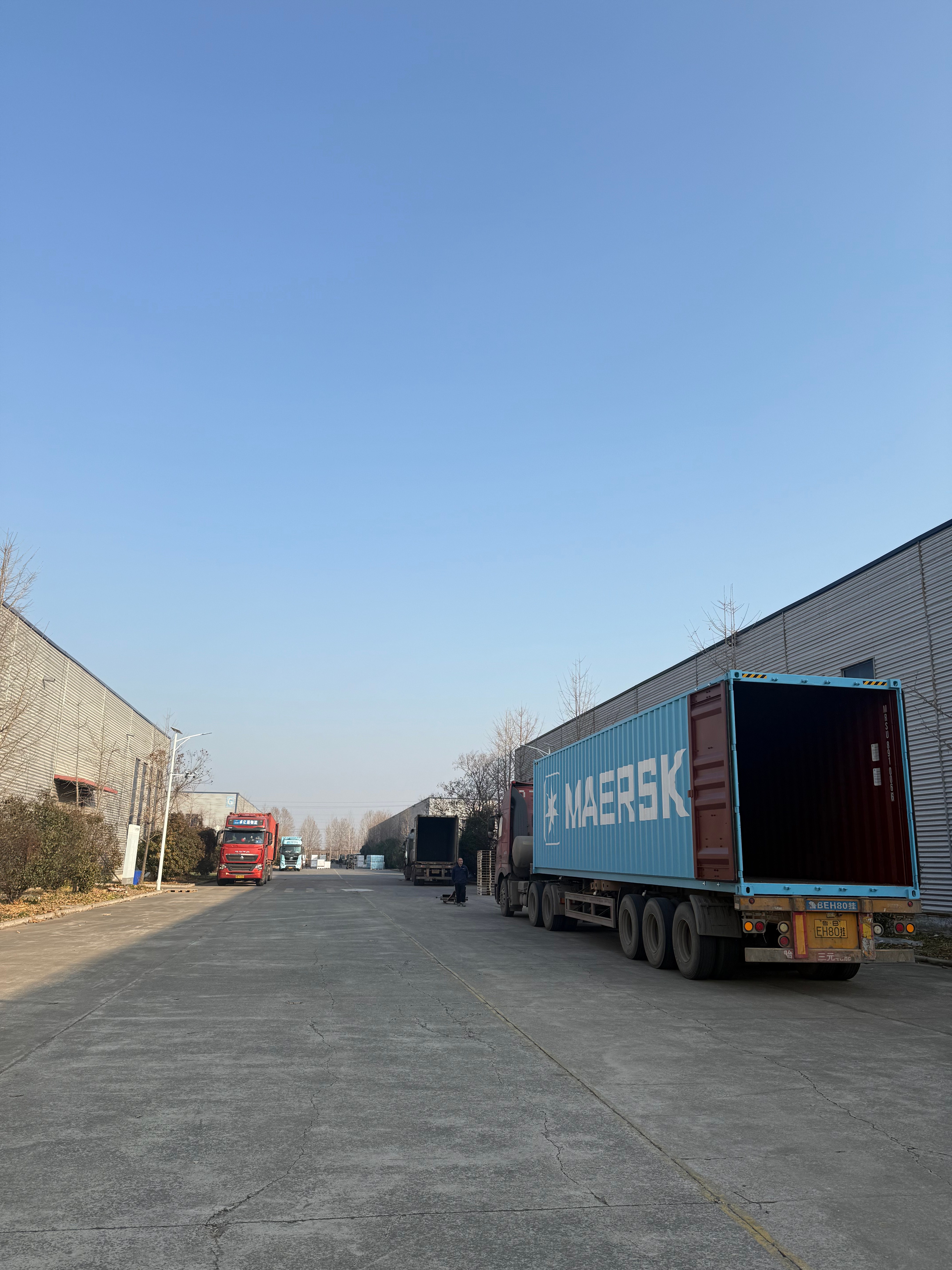
Lead time planning and dispatch are separate stages of the order-to-site timeline. Image: Dongda Wood shipment.
Market Direction: Why These Procurement Questions Are Getting Sharper
Three verified trend signals explain why MOQ, lead time and testing have moved up the buyer agenda. Engineered wood flooring held 55% of the total wood flooring market in 2024, which makes engineered construction the mainstream specification rather than the alternative. Oak-based products represent approximately 46% of total engineered wood flooring demand globally, concentrating demand into a narrow band of colours and species. And China exported USD 17.5 billion of wood products in 2024, with major destinations including the USA, Japan and the United Kingdom, according to OEC.
Published market estimates should be read with their definitions in mind. Different research houses define wood flooring differently — some include laminate or bamboo — which is why global market size figures vary between sources. The direction of travel is consistent even where the absolute number is not.
Engineered Wood Flooring vs Solid Hardwood on Procurement Metrics
Engineered and solid hardwood are often compared on appearance and price. The comparison is more useful when it is run against the four procurement variables that actually shape an order.
| Metric | Engineered wood flooring | Solid hardwood flooring |
|---|---|---|
| Order structure | Colour runs, minimum order quantity applied per colour | Often quoted per species lot; colour consistency varies between lots |
| Lead time | Published standard 45 days from go-ahead trigger | Depends on species availability and drying cycles |
| Dimensional stability | Multi-layer construction limits movement in dry interiors | More responsive to humidity variation across seasons |
| Refinishing depth | Depends on veneer: 0.6–1.2 mm thin veneer is limited, 3–4 mm thick veneer allows more cycles | Greater solid wear layer, more refinishing tolerance |
| Documentation | ANSI/HPVA EF 2020, CARB and TSCA Title VI for the US; EN 14342:2013 CE marking for the EU | Same market-access frameworks, applied to solid formats |
| Environment | Indoor residential dry environment; click and glue installation | Indoor dry environment; more site-condition sensitive |
The limits deserve the same weight as the advantages. Engineered wood flooring is intended for indoor dry environments and is not the right specification for continuously wet areas such as bathrooms or laundries. Thin veneer builds at 0.6 mm and 1.2 mm restrict how often a floor can be sanded, so projects with long refurbishment horizons should specify 3 mm or 4 mm veneer from the start. A 400㎡ per-colour minimum creates friction for small bespoke projects that need many distinct colours in limited quantities, and the commercial warranty of three years is materially shorter than the 25-year residential term, which matters in hospitality and office programmes. Solid hardwood retains genuine advantages where an exceptionally deep wear layer and repeated refurbishment are the overriding priorities.
What Buyers Should Expect Next
As engineered flooring continues to take share of the wood flooring market, the four procurement variables in this reference are likely to be requested in writing earlier in the evaluation process, typically before samples are dispatched. MOQ per colour, monthly capacity and lead time are becoming structured fields in supplier questionnaires rather than conversational details, and inspection scope is increasingly requested alongside certificates because importers now distinguish between factory-level 100% inspection and destination-market compliance. Suppliers that publish these figures and can map them to a specific order are easier to shortlist than suppliers that describe capability in general terms.
FAQ
Is the 400㎡ minimum order quantity applied per order or per colour?
It is stated per colour. A purchase order containing several colours is treated as several colour runs, and each colour must meet the baseline. Buyers should confirm whether the threshold is calculated per colour, per species or per construction, because the answer determines how a palette can be split across orders.
Does the 45-day lead time include shipping and site delivery?
No. The 45 days is a production lead time. Ocean transit, port handling, inland delivery and site lead-in sit outside it, and the point at which the 45 days starts should be fixed in the contract, particularly where packaging design or logo approval is part of the order.
Does a small colour run still get scheduled against a 150,000㎡ monthly capacity?
Capacity is generally not the limiting factor for a single colour run, since the stated monthly capacity of 150,000㎡ is far larger than the 400㎡ per-colour minimum. The practical constraint is sequencing: small custom runs are planned around larger programmes, so multi-colour ranges are best scheduled across a production year.
Does 100% factory testing replace third-party certification?
They are different evidence sets. A 100% test describes inspection coverage at board level. Market access is documented separately: ANSI/HPVA EF 2020 with CARB and TSCA Title VI formaldehyde limits for the United States, and EN 14342:2013 CE marking requirements for the European Union. Importers normally need both.
Are engineered wood floors suitable for bathrooms or other wet areas?
The product is designed for indoor residential dry environment conditions and for residential and commercial interior decoration projects. Continuously wet areas fall outside that boundary and should be specified with a different material.
How do residential and commercial warranty terms differ?
The published terms are 25 years for residential use and 3 years for commercial use. Mixed-use projects should record the applicable term per area rather than applying a single figure to the whole project.
Which customizations are available, and do they change the order framework?
The OEM/ODM scope covers product dimensions, grade, packaging design and logo. The 400㎡ per-colour minimum and the 45-day standard lead time framework remain in place; custom elements add approval gates that should be mapped against the production schedule in writing.
Technical reference: Dongda Wood engineered wood flooring product brochure (PDF) — Dongda wood - engineered wood flooring V2. Sources cited in this article: The Business Research Company (global wood flooring market, 2024–2029), Market Research Reports (engineered share of wood flooring, 2024), Industry Forecast Reports 2035 / Mordor Intelligence (oak share of engineered demand), OEC (China wood products exports, 2024), Decorative Hardwoods Association (ANSI/HPVA EF 2020), European Committee for Standardization (EN 14342:2013), and Dongda Wood published production and after-sales data.