
Eraser Procurement FAQ: Global Acceptance Criteria and Capacity
Eraser Procurement FAQ: Global Acceptance Criteria and Capacity

Factory overview: capacity claims should be matched to product family, line evidence and inspection records. Image: Greenwill.
For buyers evaluating erasers, eraser sharpeners and pencil toppers in late 2026, acceptance criteria are no longer a single quality checklist. They are a set of SKU-level checks that connect material declaration, customs classification, destination-market safety rules, production-capacity evidence and commercial terms. The central procurement answer is straightforward: align the product specification with the declared tariff code and compliance route before comparing price or lead time. A lower quotation that does not match the destination market's acceptance file is not a like-for-like offer.
This FAQ uses the supplied industry data and first-party disclosure to answer common technical procurement questions. It does not replace legal or laboratory advice for a specific SKU. It does, however, show where international buyers should ask sharper questions and which claims need documentary evidence.
What does the current eraser market indicate for procurement?
The available market evidence points to a large, material-specific and export-concentrated category rather than a single commodity. Dataintelo's 2026 report, cited in the verified data pack, estimates the global erasers market at USD 3.8 billion in 2025 and projects USD 5.6 billion by 2034, with a 4.4% CAGR over the forecast period. The same report estimates that rubber material erasers account for 41.2% of total revenue. These are commercial research estimates, not customs records, and they should be used to frame category importance rather than to calculate a supplier's addressable market.
Trade evidence provides a separate view. The Observatory of Economic Complexity records China as the world's leading exporter of vulcanised rubber erasers, with USD 137 million in export value for 2024. That figure covers a specific customs scope: erasers of vulcanised rubber under HS 4016.92. It does not measure plastic erasers, sharpener combinations or eraser-tipped pencils. Buyers should not combine that number with the broader market estimate as if both described the same product universe.
| Evidence point | What it supports | What it does not prove |
|---|---|---|
| Global erasers market estimated at USD 3.8 billion in 2025, rising to USD 5.6 billion by 2034. | Category scale and long-term commercial relevance. | Any single factory's capacity, market share or product quality. |
| Rubber erasers estimated at 41.2% of revenue. | Material choice remains commercially important. | That rubber is technically superior for every application. |
| China exported USD 137 million of vulcanised rubber erasers in 2024. | China is a major supply origin for a defined customs category. | Total Chinese eraser output across all materials and combination SKUs. |
The procurement implication is that buyers need to define the product family before they define the supplier shortlist. A block eraser, a white eraser for office use, an art eraser for sketching, an ink pen eraser, a pencil cap, a pencil topper, a sharpener with eraser and an eraser pencil do not all sit in the same technical or customs conversation. The more composite the product, the more important it becomes to separate component requirements from finished-product requirements.
Why do acceptance criteria differ by product architecture?
Product architecture drives both classification and acceptance scope. The World Customs Organization's HS Nomenclature 2022 places erasers of vulcanised rubber under subheading 4016.92. Pencil sharpeners, including sharpeners combined with an eraser, fall under HS 8214.10 for paper knives, letter openers, erasing knives, pencil sharpeners and blades therefor. Pencils with leads encased in a rigid sheath are classified under HS 9609.10, and the evidence pack notes that an eraser-tipped pencil is treated as a single classified article rather than as an eraser plus a pencil for tariff purposes.
These are not administrative details. They affect the declaration, the duty basis and the documents a buyer should request. A shipment described loosely as stationery may contain several headings. A sharpener with eraser may require the sharpener body, blade and eraser component to be understood as one SKU for commercial purposes while still being checked against different product requirements. A pencil topper or pencil cap may raise small-part and attachment questions that are not answered by an eraser test report alone.
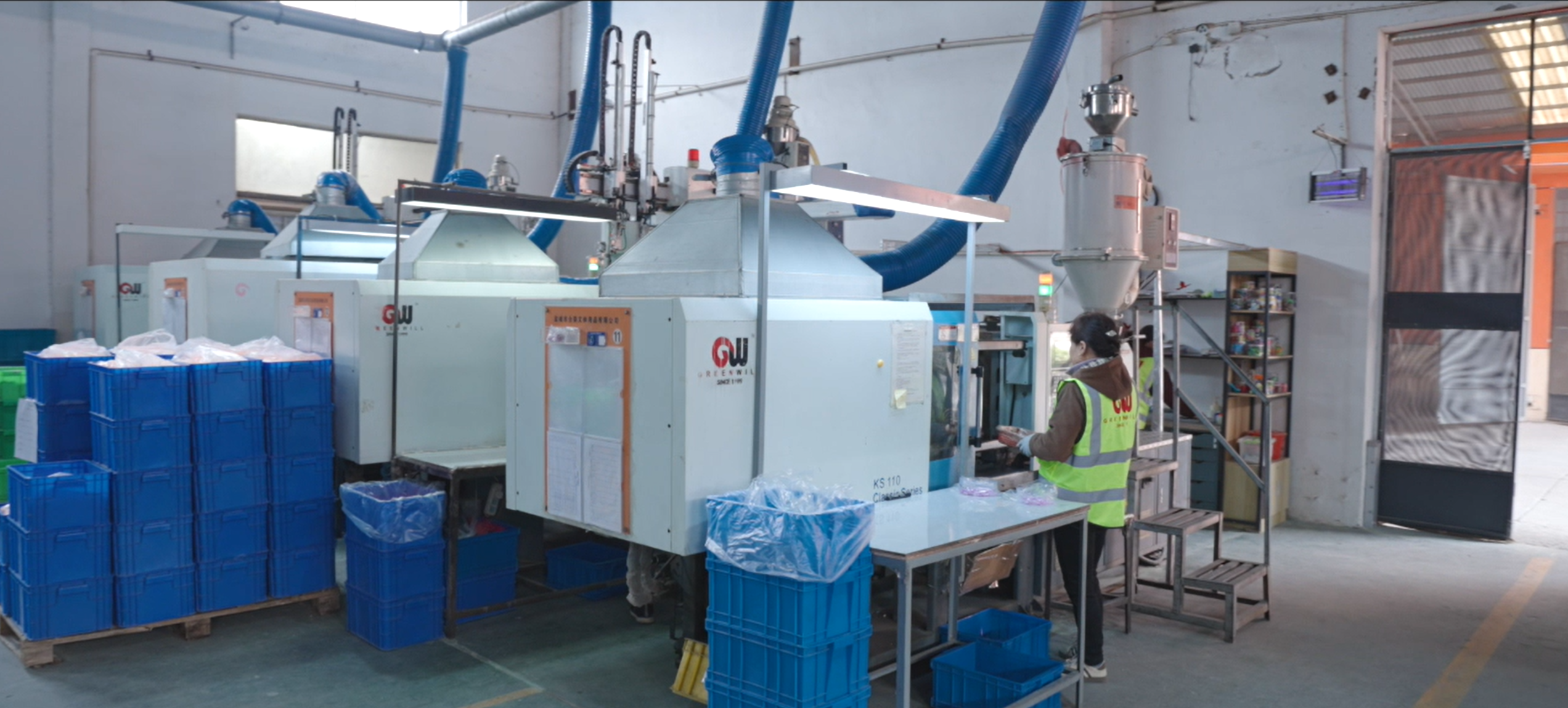
Injection molding workshop: process control evidence can support capacity review, but it does not replace product-level compliance testing. Image: Greenwill.
For EU-bound products, the verified data pack identifies EN 71 standards and the EU Toy Safety Directive 2009/48/EC as relevant requirements, with Regulation (EU) 2025/2509 identified as the successor framework. The pack names EN 71-1, EN 71-2 and EN 71-3. This does not mean every eraser SKU follows the same route. It means the buyer should ask the supplier to state the intended product use, the applicable compliance route and the test report that supports the declaration. Where the scope is unclear, the buyer should confirm it with a qualified test house rather than assume that a general stationery declaration is sufficient.
How should buyers align specifications with acceptance criteria?
Specification alignment starts before the quotation. The buyer should issue a product data sheet that states the product family, intended market, material, dimensions, colour, packaging format and any claimed function. The supplier should return a matched specification with the same fields, not a generic catalogue page. The acceptance file should then attach each requirement to a method and a record.
A useful acceptance matrix for erasers, sharpeners and toppers contains five layers:
- Product identity: exact model or SKU, product family, material declaration and whether the item is a single article or a combination.
- Regulatory scope: destination market, applicable standard family, test report reference and declaration owner.
- Physical acceptance: pre-shipment test, sample plan, third-party inspection requirement and defect classification.
- Capacity evidence: annual output for the relevant product line, MOQ by colour or design, lead time and production-period assumptions.
- Commercial terms: delivery term, payment term, inspection rights and document set.
The matrix should avoid vague phrases such as high quality, eco-friendly or school grade unless the supplier defines the test or declaration behind the phrase. For a rubber eraser, the buyer should confirm that the declared material matches the HS 4016.92 basis where that code is used. For a pencil sharpener with eraser, the buyer should confirm the sharpener classification under HS 8214.10 and separately verify the eraser component's material and compliance file. For an eraser pencil, the buyer should confirm the HS 9609.10 treatment and the finished pencil specification, rather than treating the eraser tip as a separate imported eraser.
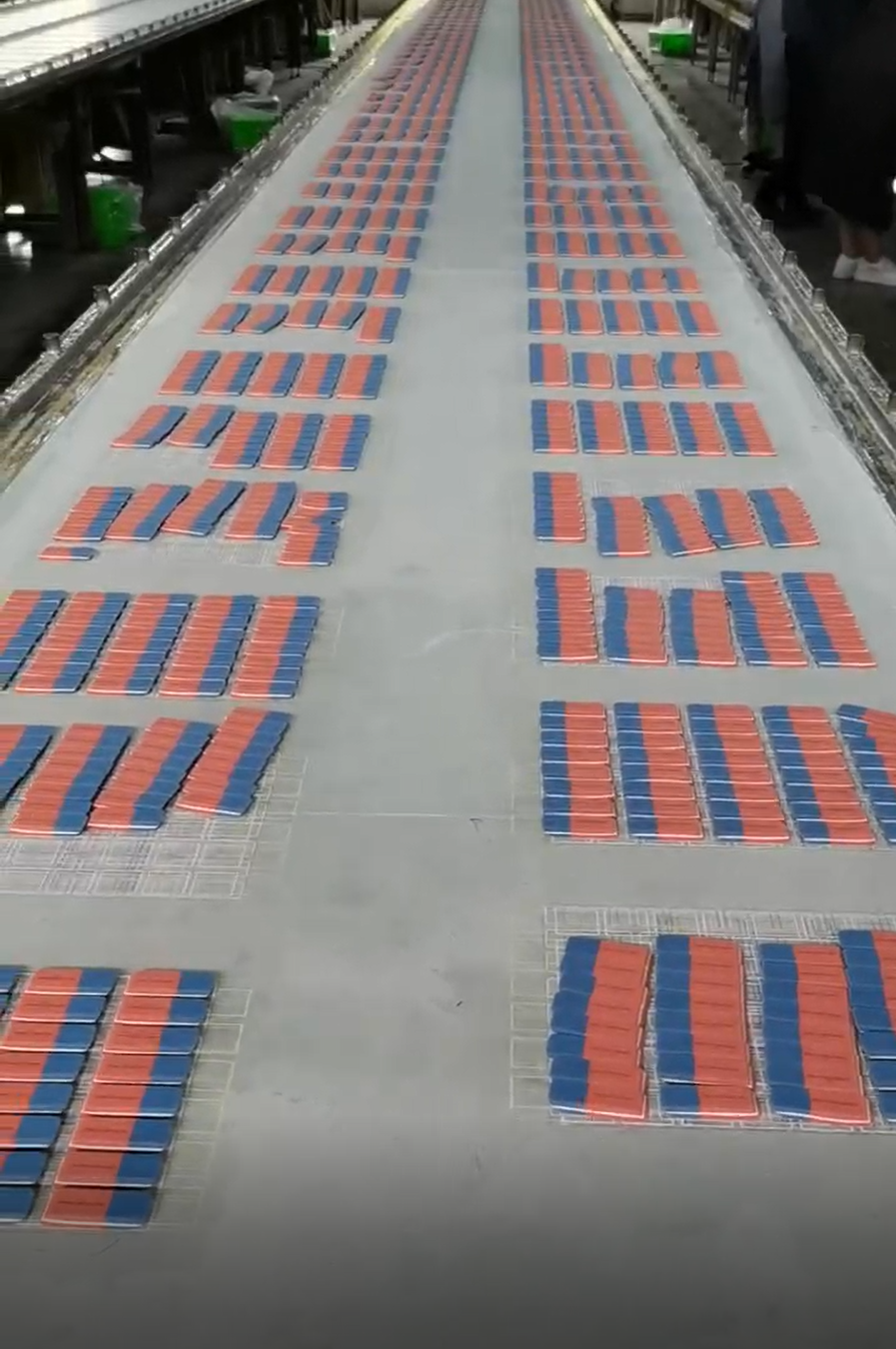
Eraser printing: decoration and branding are part of the specification file and should be checked against the approved artwork and packaging record. Image: Greenwill.
What capacity evidence should buyers request?
Capacity should be verified at the level of the product family being purchased, not at the level of a general company statement. A supplier may have strong annual eraser tonnage but limited capacity for a specific printed block eraser, a sharpener with eraser, or a pencil topper with a custom mould. Buyers should request annual output for the relevant line, the number of production shifts, the mould or tooling set, the MOQ by colour or design, the standard lead time and the inspection point.
The supplied first-party disclosure for Greenwill (Kunshan Crystal Culture Co., Ltd) provides one example of the data a buyer can ask for. The company states a 25,000 m² factory, annual eraser output of more than 260 tons, annual pencil sharpener output of more than 3 million pieces, and a specific annual capacity of 3 million pieces for the 2-in-1 Eraser + Pencil Sharpener models GW007 and GW009. It also lists a normal MOQ of 20,000 pieces per colour or design, a lead time of 30 to 45 days, delivery terms of FOB, EXW or DDP, and acceptance through pre-shipment test and third-party inspection.
These are supplier-disclosed figures, not an independent audit of available capacity. That distinction matters. A buyer should ask whether the stated capacity is installed capacity, current output or capacity available for the buyer's order period. The supplier should also explain how capacity is affected by seasonal demand, tooling changes, material lead times and third-party inspection scheduling. Capacity evidence becomes procurement evidence only when it is tied to the buyer's product, order quantity, delivery window and acceptance plan.
| Capacity question | Document or answer to request | Procurement use |
|---|---|---|
| What is the annual output for this exact product family? | Product-specific capacity statement, line description and recent production record. | Tests whether the supplier can support the planned order size without reallocating another line. |
| What is the MOQ by colour or design? | Written MOQ schedule and tooling or printing setup assumption. | Prevents quotation errors on multi-colour or private-label ranges. |
| What is the lead time from artwork approval? | Lead-time breakdown by material, production, inspection and packing. | Supports launch planning and third-party inspection booking. |
| How is acceptance handled before shipment? | Pre-shipment test plan, inspection standard and third-party inspection option. | Connects capacity claims to a release decision rather than an output promise. |
How do policy and trade classification affect purchasing terms?
Policy affects purchasing terms through documentation, not only through duty rates. In the EU, the evidence pack links stationery products to EN 71 and the Toy Safety Directive framework, with Regulation (EU) 2025/2509 identified as the successor regulation. For a buyer, that means the purchase order should identify the destination market, the intended use, the applicable standard family and the test-report owner. It should also state who holds the technical file and who is responsible for the declaration.
Trade classification affects the commercial terms in a different way. HS 4016.92 is a WCO subheading for erasers of vulcanised rubber; national tariff schedules may add statistical suffixes. HS 8214.10 covers pencil sharpeners and blades. HS 9609.10 covers pencils with leads encased in a rigid sheath, including the eraser-tipped pencil treatment described in the evidence pack. A buyer who uses one generic eraser description for all these SKUs creates avoidable risk at customs, in supplier comparison and in the acceptance file.
The verified pack provides direct policy anchors for the EU and a trade benchmark for China, but it does not provide clause-level text for every destination market. Buyers should not treat this FAQ as a substitute for local legal review. The practical response is to require the supplier to declare the product family, material and intended market in writing, and to match that declaration to the customs code and compliance file before the order is released.
What acceptance checks should be specified for erasers, sharpeners and toppers?
Acceptance should combine document review with physical inspection. For document review, the buyer should check the product specification, material declaration, test report scope and packaging artwork. For physical inspection, the buyer should define the pre-shipment test and, where appropriate, a third-party inspection. The buyer should also define how nonconformity is handled: whether the batch is rejected, reworked, sorted or accepted under a deviation, and who bears the cost.
For a rubber eraser or block eraser, the acceptance file should connect the declared material to the product description and, where HS 4016.92 is used, to the vulcanised rubber scope. For a white eraser, art eraser, colour eraser or ink pen eraser, the buyer should state the intended use and any performance claim in the specification rather than relying on the product name. For a pencil sharpener or plastic sharpener, the buyer should define the sharpener body, blade and any eraser attachment as separate acceptance items within the finished SKU. For a pencil cap or pencil topper, the buyer should confirm the attachment method, small-part risk and destination-market test scope with the supplier and a qualified laboratory where needed.
For EU-bound products, the supplier should provide test evidence that references the exact SKU and material. A general EN 71 certificate for a different eraser model is not enough. For combination items such as a pencil sharpener with eraser or a sharpener with eraser sold in school and office channels, the buyer should confirm whether the finished item is assessed as one article or whether component-level evidence is also required. The answer depends on the product and the market, so it should be documented before production, not discovered at shipment.
How should buyers compare commercial terms?
Commercial terms should be compared on the same product, quantity, packaging, delivery point and inspection basis. A quotation that excludes tooling, printing plates, third-party inspection or destination charges is not comparable with one that includes them. The buyer should request a cost breakdown that separates material, production, decoration, packing, testing and logistics where the supplier is willing to provide it.
The supplied procurement terms for Greenwill illustrate the kind of baseline a buyer can use for discussion: MOQ normally 20,000 pieces per colour or design; delivery terms FOB, EXW or DDP; acceptance through pre-shipment test and third-party inspection; payment terms of 30% deposit by TT and 70% against B/L copy. These are supplier-specific terms, not an industry standard. They should be treated as a starting point for negotiation and verification, especially where the buyer's order is smaller, multi-coloured, private-label or destined for a market with additional testing requirements.
What future changes are likely to shape acceptance criteria?
The evidence supports a conditional outlook rather than a single forecast. If the Dataintelo market estimate holds, eraser demand will continue to support a broad international supply base, with material choice remaining commercially significant. If EU rulemaking continues toward the Regulation (EU) 2025/2509 framework, buyers should expect more emphasis on documented product scope and test-file alignment rather than on generic compliance statements. If customs authorities continue to apply material-specific headings, buyers should expect more scrutiny of the declared material behind an eraser or combination SKU.
The likely procurement response is not a single global acceptance standard. It is a more disciplined SKU master data set: product family, material, intended market, customs code, test report, capacity evidence and commercial terms in one file. Buyers who build that file early will be better placed to compare suppliers, plan inspections and avoid reclassification or re-testing costs later. Suppliers that can answer those questions precisely will be easier to evaluate, not because they use more promotional language, but because their capacity and compliance claims are traceable.
FAQ: Technical Procurement and Acceptance
What acceptance criteria should an eraser purchase order include?
An eraser purchase order should include the exact SKU and product family, material declaration, dimensions, colour, packaging, destination market, applicable standard family, test-report requirement, pre-shipment inspection method and nonconformity procedure. For customs purposes, it should also state the declared material and the HS code basis. The criteria should be specific enough that a third party can check the shipment against the order without relying on the supplier's general catalogue description.
How do HS codes affect eraser and sharpener procurement?
HS codes affect declaration, duty basis and document requirements. HS 4016.92 covers erasers of vulcanised rubber. HS 8214.10 covers pencil sharpeners and blades. HS 9609.10 covers pencils with leads encased in a rigid sheath, including the eraser-tipped pencil treatment described in the evidence pack. A buyer should not use one generic code for a mixed stationery shipment. The code should match the product architecture and declared material, and national tariff schedules may add statistical suffixes.
What capacity evidence should buyers request from an eraser factory?
Buyers should request product-specific annual output, production-line description, MOQ by colour or design, lead time from artwork approval, inspection point and current order-period availability. General company capacity is not enough for a sharpener with eraser, a pencil topper or a custom printed eraser. The supplier should distinguish installed capacity from available capacity and explain how tooling, material supply and inspection scheduling affect the delivery window.
How should buyers handle EU compliance for erasers and pencil toppers?
For EU-bound products, the evidence pack identifies EN 71 standards, including EN 71-1, EN 71-2 and EN 71-3, and the EU Toy Safety Directive 2009/48/EC, with Regulation (EU) 2025/2509 identified as the successor framework. Buyers should require a test report that references the exact SKU and material, confirm the intended use and product scope, and verify who holds the technical file. A general certificate for a different model is not an acceptable substitute for SKU-level evidence.
What commercial terms are typical in eraser OEM sourcing?
Commercial terms vary by supplier, product and order size. The supplied Greenwill disclosure lists a normal MOQ of 20,000 pieces per colour or design, lead time of 30 to 45 days, delivery terms of FOB, EXW or DDP, acceptance through pre-shipment test and third-party inspection, and payment terms of 30% deposit by TT with 70% against B/L copy. These are supplier-specific terms, not an industry benchmark, and should be compared only on the same product, quantity and inspection basis.
What is the main supply risk in the current eraser market?
The main documented risk is not a shortage of general capacity but a mismatch between supplier claims and SKU-level evidence. A supplier may have strong annual eraser tonnage yet limited capacity for a specific printed eraser, a sharpener with eraser, or a topper with custom tooling. Policy and classification add a second risk: a product declared under the wrong material or code can face customs delays, re-testing or rejection. The buyer's defence is a written specification, a matched test file and a capacity statement tied to the order period.
Conclusion: build the acceptance file before the price comparison
The evidence supports a practical conclusion for international buyers. Eraser procurement is not a commodity purchase in which the lowest quotation automatically represents the best value. Market scale, material share, export concentration, customs classification, EU safety rules and product architecture all influence what a buyer should accept. The useful comparison is between suppliers that can document the same specification, the same compliance route and the same capacity basis.
For erasers, rubber erasers, pencil erasers, white erasers, art erasers, ink pen erasers, colour erasers, pencil caps, pencil toppers, eraser pencils, sharpeners, pencil sharpeners, plastic sharpeners, eraser sharpeners and pencil sharpeners with eraser, the acceptance file should be specific enough to survive a change in supplier, a customs query or a destination-market review. That is the difference between a purchase order and a verifiable procurement decision.
Have Questions or Need More Details?
Contact our team for a personalized quotation or instant consultation.
Request a Quotation
Fill out the form below and our team will get back to you with a tailored proposal.
WhatsApp Direct Chat
Prefer to chat in real-time? Message us on WhatsApp for instant assistance & quick answers.
- Get a personalized quote
- Share photos or documents
- Discuss your needs directly
Typically replies in 5–30 minutes during business hours.