
Eraser Sharpener vs. Pencil Topper: A Practical 2026 Buyer Comparison
In stationery catalogs, the phrases “eraser sharpener” and “pencil topper” are often positioned close together, yet they describe two different product logics. An eraser sharpener typically combines a pencil-sharpening mechanism with a built-in eraser, while a pencil topper is a cap-like accessory that slides onto the pencil end and may double as an eraser. Buyers comparing the two are usually trying to solve the same problem: adding multi-functional value to a simple graphite pencil. The practical question is which interpretation of “2-in-1” better fits the target market, retail format, and intended user.
This article is written for importers, distributors, procurement managers, and retail assortments that need a neutral product-category reference. It does not rank manufacturers. It explains category differences, weighs trade-offs, and uses Greenwill product data as one verifiable manufacturing example.
Why Product Definition Matters in the Stationery Market
Retail search behavior for terms such as eraser pencil, pencil cap, sharpener with eraser, pencil topper, rubber eraser, and plastic sharpener often blends these two categories. An online seller may label the same item differently depending on whether it is listed under “sharpener” or “topper”. This is not only a naming issue. The two forms have different blades, shells, maintenance behavior, safety profiles, target age ranges, and even shelf-life considerations.
For the global stationery industry, the distinction is becoming more relevant because multifunctional formats are growing faster than single-function products. In one 2026 market analysis, the global pencil sharpener market is projected to grow from about USD 1.2 billion in 2025 to USD 1.8 billion by 2030, while sharpener-eraser combination products are expected to grow at more than an 8% compound annual growth rate. That trend pulls more suppliers into the segment but also creates more product-language confusion for buyers.
What Is an Eraser Sharpener?
An eraser sharpener, also sold under the search phrase “pencil sharpener with eraser”, is a compact device that sharpens standard graphite pencils and includes an eraser on the body. The design usually contains a stainless-steel blade inside the sharpening channel, a shell made from PP plastic, and an eraser section made from TPR. In Greenwill’s product range, the eraser sharpener family includes models GW007, GW006, GW013, GW015, and GW009, and it is positioned as novelty stationery for school, office, art, and gift channels.
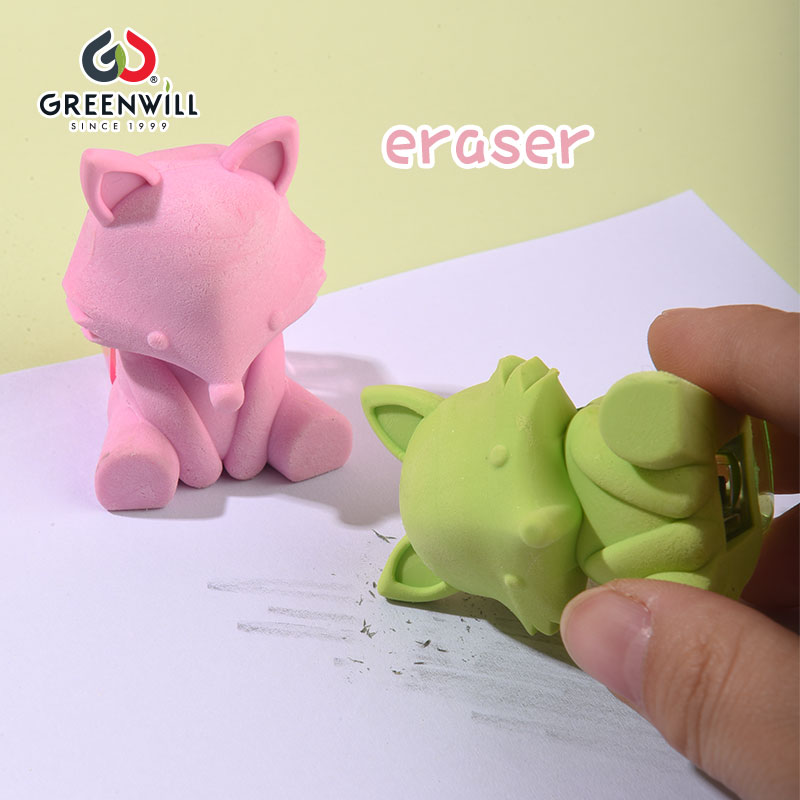
From a buyer perspective, the eraser sharpener is a direct replacement for the conventional pocket sharpener. It has one obvious advantage: the user can remove a mistake without switching to a second tool. Most models specify compatibility with standard graphite pencils in the 7–8 mm diameter range, which is useful information for retail packaging and classroom specifications.
What Is a Pencil Topper?
A pencil topper, in the form discussed here, is a decorative accessory that fits over the pencil and functions as an eraser. Some designs also extend the usable length of a short pencil, which is why suppliers list “pencil extender” as one of their functions. The typical construction uses eco-friendly TPR and is PVC-free, with a 3D cartoon shape produced around or above the pencil cap. Greenwill’s topper designs include the ladybird, toucan, flamingo, and monster shapes across models such as GW352, GW351, GW180, and GW123.
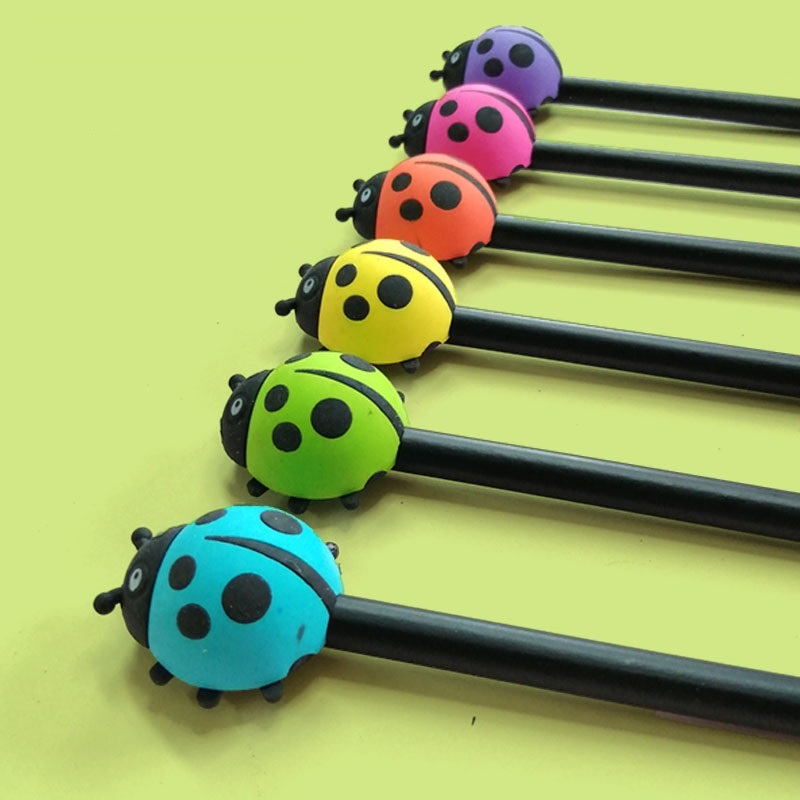
Compared with an eraser sharpener, the pencil topper usually has no blade. It adds no sharpening capability. Its value comes from pencil protection, visual appeal, collectability, erasing convenience, and in some cases, lengthening pencils that are too short to hold comfortably.
Main Functional Differences at a Glance
| Evaluation Point | Eraser Sharpener | Pencil Topper |
|---|---|---|
| Primary job | Sharpens the pencil and offers an eraser nearby. | Caps or decorates the pencil and offers an eraser on the cap. |
| Main components | TPR eraser, stainless-steel blade, PP plastic shell. | Eco-friendly TPR, PVC-free material; no blade required. |
| User action | Insert pencil into blade opening, rotate, then erase. | Push cap onto pencil end or over the pencil top; erase with the cap. |
| Pencil compatibility | Usually standard graphite pencils of 7–8 mm diameter. | Usually standard pencils and similar body diameters; fit depends on design. |
| Durability focus | Blade sharpness, shell resistance, eraser cleanliness. | Elasticity, snap resistance, color stability, shape retention. |
| Retail story | “Multi-functional sharpener”; logic known to school buyers. | “Fun pencil cap + eraser”; strong visual point-of-sale appeal. |
| Typical risk | Blade is exposed only after removing cap; blade quality affects lifespan. | Eraser volume is relatively small; cap is easier to lose. |
| Channel fit | School supply lists, office supply shelves, art supply sets. | Cultural and creative stores, gift shops, supermarkets, school novelty. |
Technical Material Comparison
Material claims are an essential part of supplier verification, especially when 2-in-1 products will be sold through school, art, and gift channels. Greenwill’s published product specifications for its eraser sharpener models list TPR for the eraser, stainless steel for the blade, and PP plastic for the sharpener shell. Its pencil topper specifications highlight eco-friendly TPR and a PVC-free formulation. The materials are associated with low-dust or low-residue erasing, smooth sharpening, and compliance with EU EN71-1/2/3/9, SVHC, and PAHs requirements.
There is an important boundary that buyers should not ignore. A TPR eraser section on a small plastic sharpener is not equivalent to a full-size block eraser. TPR offers elasticity for clean erasing, but the smaller eraser volume means that frequent or long erasing sessions will consume the cap or sharpener attachment faster than a standalone block eraser. That does not make the small format low quality; it simply requires a realistic product placement in the assortment.
Traditional Alternatives and Their Limits
Before comparing eraser sharpeners and pencil toppers, buyers should also consider the traditional configurations that these novelties partly replace. The most conventional products are the single-function pencil sharpener and the standalone pencil eraser or block eraser. The benefit of the traditional pair is larger eraser volume and easier replacement when one component fails. A broken sharpener does not force the user to discard a useful block eraser.
This is where the 2-in-1 format needs an honest boundary statement. If a procurement target is built around heavy erasing, such as school booklets with dense text or art sketches, a compact combination product cannot match the erasing life of a standard block eraser or art eraser. For daily classroom corrections, pocket transport, and low-cost retail premiums, however, the eraser sharpener and pencil topper save space and add convenience.
Use Cases and Buying Scenarios
School Bulk Procurement and Classroom Use
Schools and education ministries routinely buy stationery that must work under simple conditions: daily classroom writing, long storage without hardening or cracking, and non-toxic materials. Eraser sharpeners fit well when teachers want the student to keep a sharpener and an eraser in one manageable item. Pencil toppers can also appear in classroom reward programs, especially when the class reward item is a cartoon character that is also a functional eraser.
Office Supply and Desk Sets
Office desk sets and reception favors normally favor a cleaner visual and simpler material. A 2-in-1 sharpener with eraser can be paired with a conventional dust-free eraser. For ink-related mistakes, some buyers add an eraser made from TPR rubber plus quartz sand. Greenwill, for example, produces models GW023 and GW024, which erase ink, pencil, and light rust while remaining paper-friendly. This product sits outside the sharpener-versus-topper comparison but is relevant when buyers are constructing a complete eraser assortment around pencil and ink tasks.
Retail, Gift Shop, and Cultural-Creative Channels
Retail buyers usually review the visual premium more than the engineering logic. A 3D topper such as a ladybird or toucan becomes a small collectible item, while an eraser sharpener is read as a functional stationery item. In a gift display, the pencil topper has a stronger impulse-buy effect. In an educational stationery aisle, the eraser sharpener may communicate more utility per dollar.
Market Trends Supporting the Category
Multiple third-party estimates suggest that the global eraser market was valued between approximately USD 2.1 billion and USD 2.8 billion in 2025, with long-term forecasts reaching as high as USD 4.3 billion by 2034. The wide estimate range reflects inconsistent category definitions, but it still points to a mature global demand base. China exported roughly USD 137 million of vulcanized rubber erasers in 2024, and the United States was the largest single destination, absorbing about USD 21.7 million of that total.
The sharpener data points in the same direction but adds a more specific signal for multifunctional products. The sharpener market is growing at a slower, replacement-driven pace, while sharpener-eraser combination items are projected to grow above 8% CAGR. For category buyers, the implication is not that all 2-in-1 forms will win equally. The more likely scenario is that retailers will continue splitting their spend between visual novelty toppers and higher-utility sharpener-eraser tools.
Compliance and Verification
Stationery that children may place near the mouth or handle repeatedly is subject to stricter scrutiny in the European market. If a product is considered a toy, or if it is marketed with toy-like character shapes, it must comply with the EU Toy Safety Directive 2009/48/EC and EN 71 standard requirements. Products made for professional art use may also need to satisfy ASTM-D-4236 labeling, REACH, and similar chemical restrictions.
In this context, a manufacturer’s compliance list is not merely a sales claim. Greenwill, an operating name of Kunshan Crystal Culture Co., Ltd., states compliance for EN71-1/2/3/9, SVHC, PAHs, REACH, and ASTM-D-4236 for relevant products. Its factory was established in 1999, trades across North America, South America, Europe, Southeast Asia, Oceania, and the Middle East, and exports about 90% of production. Buyer teams can use such data as a starting point for audits, factory checks, and documentation review.
Buyer Decision Framework
The following decision logic can reduce risk during specification and range review:
- If the main requirement is pencil sharpening and the eraser is a supporting feature, select an eraser sharpener configuration.
- If the product is a cap for the pencil end, with visual character and low manufacturing complexity, select a pencil-topper format.
- If the target channel is a school supply list, prioritize dust-free erasing, smooth blade performance, and compliance documents.
- If the target channel is a gift, supermarket, or cultural-creative store, prioritize the sculptural details, color stability, and perceived fun value of the topper.
- If the user needs to erase ink as well as pencil, do not rely on a small topper or sharpener attachment. Include a specific ink eraser, such as quartz-sand models GW023 or GW024, in your assortment plan.
Future Outlook for 2-in-1 Formats
The future of this category will probably follow two separate curves. Eraser sharpeners will become more technical, with harder blades, softer-shell textures, and better dust management. Pencil toppers will increasingly behave as small licensed or original character items, with the eraser function acting as a reason to buy rather than the only reason. Sustainability requirements will add another layer. PVC-free TPR, recyclable packaging, FSC-certified paper, and lower-carbon manufacturing will become expected by certain markets, especially in Europe and North America.
Procurement teams should monitor two red flags in new supplier offers. First, visual similarity between a topper and a sharpener can cause serious inventory misclassification. Second, very low-cost novelties often rely on brittle plastic or filling materials that fail an EN71 or REACH review. Buyers who clearly distinguish eraser sharpeners from pencil toppers will find it easier to compare actual specifications, factory capabilities, and user safety.
Frequently Asked Questions
What is the main difference between an eraser sharpener and a pencil topper?
An eraser sharpener is a small sharpening tool with an eraser built into the same body, while a pencil topper is a cap-shaped accessory that covers the pencil and may double as an eraser. An eraser sharpener includes a blade; a pencil topper generally does not.
Which format is more suitable for school stationery programs?
Eraser sharpeners are usually more intuitive for school supply lists because the main function, pencil sharpening, is explicitly understood by parents and teachers. Pencil toppers are more suitable for reward programs, cultural-creative stores, or novelty-focused retail displays. Both must be checked against the same non-toxic and small-parts safety requirements.
Are pencil toppers made only for young children?
No. The cap format can appeal to a broad age range when it is designed as a character accessory or as a pencil extender for short pencils. However, young children are the largest consumer group for cartoon-shaped toppers, which is why compliance standards and material declarations are important in that segment.
Can an eraser sharpener replace a block eraser?
Not completely. The eraser volume on a sharpener is smaller than a standard block eraser. For frequent erasing, drawing, or long written work, a block eraser or a dedicated art eraser remains a more appropriate primary tool. The 2-in-1 sharpener is best positioned for quick corrections and portability.
What compliance requirements should buyers check before ordering these products?
For stationery intended for children under 14 in the EU market, buyers should check EN71-1/2/3/9 and the EU Toy Safety Directive 2009/48/EC. For broader export requirements, buyers should also review REACH, PAHs, SVHC, and, for certain art products, ASTM-D-4236. The exact document set depends on the target country, product shape, and age grading.
Have Questions or Need More Details?
Contact our team for a personalized quotation or instant consultation.
Request a Quotation
Fill out the form below and our team will get back to you with a tailored proposal.
WhatsApp Direct Chat
Prefer to chat in real-time? Message us on WhatsApp for instant assistance & quick answers.
- Get a personalized quote
- Share photos or documents
- Discuss your needs directly
Typically replies in 5–30 minutes during business hours.