
Ethernet Cable for High-EMI Commercial Buildings: Scenario Fit
High-EMI commercial buildings — offices, hotels, hospitals, retail centres and mixed-use towers that share pathways, risers and equipment rooms with lift drives, HVAC motors and variable-speed drives, transformers, switchgear and dense radio equipment — are a separate Ethernet cabling scenario, not simply a more difficult version of an office LAN. In these buildings the cable has to hold a Gigabit link over a long horizontal run while sitting inside an electromagnetic field that never switches off.
Scenario fit is the practice of matching three variables to each zone of a building instead of applying one cable category everywhere: shielding construction against the actual interference level, flame rating against the installation zone, and electrical performance against the real link length and speed target. Linoya Electronic Technology Co., Ltd., a cable and wire manufacturer founded in 1997 and headquartered in Dongguan, China, produces shielded and unshielded Ethernet cable families from Cat5e to Cat8 that map onto those three variables, with certifications issued for North American and European markets.
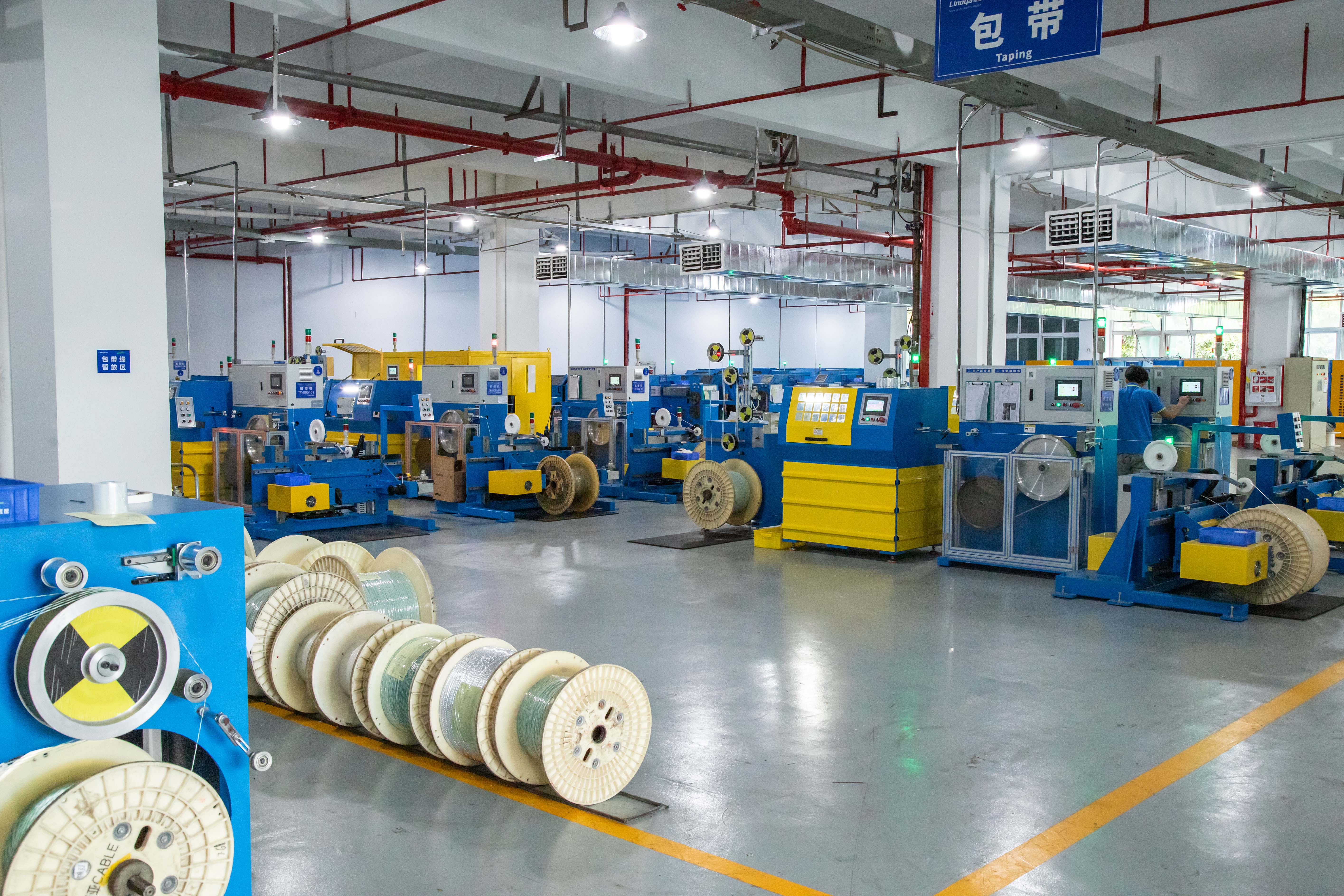
Shield application during Ethernet cable manufacturing. Shielding construction is the first variable in scenario-fit cable selection for high-interference buildings.
Why Long-Distance Gigabit Fails First in High-EMI Buildings
In a high-EMI commercial building the visible failure is rarely a dead link. It is a Gigabit link that does not behave like Gigabit. The symptom set documented in structured cabling troubleshooting includes no network link light, frequent disconnection, slow network speed, random packet loss, unstable PoE power supply, and a port that negotiates 10/100 Mbps instead of the expected Gigabit rate.
Those symptoms trace back to five recurring causes:
- Physical damage — broken inner conductors, crushed cable, scratched jacket, or routing bent beyond the permitted limit.
- Termination defects — wrong wiring sequence, untwisted pairs left too long, poor crimping, damaged or oxidised RJ45 pins.
- Cable quality — copper-clad aluminium conductors, off-specification grades, or counterfeit product.
- Environmental interference — heavy EMI, incorrect STP grounding, and mixing indoor and outdoor cable in one pathway.
- Connector mismatch — low-grade RJ45 connectors that cannot support the high-frequency performance of Cat6 or Cat6a cable.
Crosstalk is the mechanism behind a large share of these complaints. Ethernet cable crosstalk is signal leakage between adjacent twisted wire pairs inside the cable, and excessive crosstalk triggers packet loss, slower throughput and unstable connections. In a high-EMI building, external noise enters the same channel and compounds the problem: the link still tests as continuous, yet it fails under load or renegotiates its speed. This is why scenario fit is decided by the interference profile of the route, not by the category number printed on the box alone.
Scenario Fit: Matching Shielding Construction to Interference Level
Shielding is a graded tool rather than a single feature. An unshielded twisted-pair (U/UTP) construction has no metallic barrier and relies on the twist geometry alone; a foil-shielded (F/UTP) construction adds an overall foil layer with a drain wire; a screen-plus-foil (SF/UTP) construction combines an overall metallic braid or screen with foil; a pair-foil (U/FTP) construction places foil around each individual pair; and a full-shield (F/FTP) construction combines overall and pair-level foil. The higher the interference, and the denser the cable bundles, the more of these layers the route generally needs.
| Shielding construction | Typical interference fit | Linoya models in this construction | Bandwidth / distance | Flame rating listed |
|---|---|---|---|---|
| U/UTP (unshielded) | Low-interference indoor office, residential, IP surveillance, SMB | CAT5E U/UTP; CAT6 U/UTP; CAT6A U/UTP | 1 Gbps; 10 Gbps@55 m; 10 Gbps@100 m | CM/CMG; CMR; CMP |
| F/UTP (overall foil) | Moderate EMI: commercial buildings, offices with EMI, surveillance systems | CAT5E F/UTP; CAT6 F/UTP | 1 Gbps; 10 Gbps@55 m | CM/CMG; CMR |
| SF/UTP (screen + foil) | High-noise commercial environment, industrial edge, enterprise network | CAT5E SF/UTP; CAT6 SF/UTP; CAT6A SF/UTP | 1 Gbps; 10 Gbps@55 m; 10 Gbps@100 m | CM/CMG; CMR; CMP |
| U/FTP (pair foil) | Server room and high-frequency 10G links with low crosstalk requirement | CAT6A U/FTP | 10 Gbps@100 m | CMP |
| F/FTP (full shield) | Heavy-EMI industrial, premium data centre, public infrastructure | CAT6A F/FTP; CAT7 F/FTP; CAT7A F/FTP; CAT8 F/FTP | 10 Gbps@100 m; 40 Gbps@50 m; 100 Gbps@15 m; 40 Gbps@30 m | CMP |
Read as a procurement rule, the table produces a simple decision path. A Gigabit-to-the-desk network in a building with moderate interference is normally served by an F/UTP construction at Cat5e or Cat6, which gives 1 Gbps at 100 metres with an overall foil layer. A route that runs beside motor drives, lift machinery or switchgear, or that shares a dense cable tray, moves to SF/UTP. Where the building also runs 10 Gbps backbone segments and the pathway is a plenum air-handling space, Cat6A constructions — the models listed with a CMP flame rating — become the reference point. Heavy-EMI industrial edge zones and premium data-centre links sit at F/FTP.
Manufacturing and Certification Position Behind the Range
Linoya Electronic Technology Co., Ltd. operates three industrial parks in Shenzhen and Dongguan plus a production base in Vietnam, with more than 100 production lines, a 60,000 m² factory footprint, over 3,000 employees, more than 300 R&D engineers and an annual output of 4,000,000 kilometres of cable. Export sales cover the EU, the US, the Middle East, Southeast Asia, Australia, South Korea and Japan and represent roughly 30% of output, with the EU and the Middle East listed as main markets. The company publicly reports annual sales exceeding USD 420 million.
| Credential | Certificate number | Documented scope |
|---|---|---|
| UL Certificate of Compliance (UL LLC) | E320763 | Communications cable types CM, CMG, CMR and CMP, rated 60℃ or 75℃; UL 444 and CSA C22.2 No. 214-08; issued 2021-11-10 |
| ETL Verified — Category 5e F/UTP CM | 3168693CRT-004c | 4-pair, 24 AWG, FTP, CM, non-plenum horizontal solid cable, model Linoya888; ANSI/TIA-568-B.2 Category 5e; issued 2009-02-24 |
| ETL Verified — Category 5e UTP CM | 103161791CRT-002a | Category 5e, 4-pair, 24 AWG, UTP, CM horizontal solid cable, model Linoya168; ANSI/TIA-568.2-D; issued 2017-10-04 |
| ETL Verified — Category 6 UTP CM (23 AWG) | 103161791CRT-002c | Category 6, 4-pair, 23 AWG, UTP, CM horizontal solid cable, part number Linoya198; ANSI/TIA-568.2-D |
| ETL Verified — Category 6A U/FTP | 102500029CRT-002 | Category 6A, 4-pair, 23 AWG, U/FTP horizontal solid cable; ISO/IEC 11801-1; no flame rating marked on this certificate |
| CPR Certificate of Constancy of Performance — TÜV Rheinland InterCert (Notified Body 1008) | 1008-CPR-MC 69267303 0001 | B2ca-s1a,d0,a1; CAT6/6A/7/7A/8 S/FTP communication and LAN cables; EN 50575:2014+A1:2016; issued 2024-08-28 |
| CPR fire classification reports — EZÚ (Notified Body 1014) | 801180-01/01, /02, /03; 911170-01/01, /02 | Dca-s1,d0,a2 for CAT7 S/FTP LSZH; Dca-s1a,d0,a2 for CAT6A U/FTP LSZH; Dca-s1,d1,a2 for CAT6 UTP LSZH; Eca for CAT6 UTP LSZH and CAT5E UTP LSZH; EN 13501-6 |
| CPR fire classification reports — VDE (Notified Body 0366) | 5004876/1-1 to /6-1 | Eca class for UTP CAT6 23 AWG, FTP CAT6 23 AWG, CAT6 SF/UTP, CAT5E UTP, FTP CAT5e and SF/UTP CAT5E 24 AWG solid cables; EN 13501-6 |
For a buyer evaluating a high-EMI building project, the practical value of this stack is that the flame rating and the shielding construction are documented separately by model rather than claimed as a blanket property of the whole catalogue. The UL conformity document covers four flame types across the communication cable family, and the European fire-classification documents identify the exact cable construction they apply to.
Technical Explanation: Shielding, Grounding and Flame Rating
Three technical relationships decide whether a shielded cable actually performs in a high-EMI building.
Shielding construction versus noise path. Overall foil with a drain wire intercepts fields arriving at the cable as a whole, which is the dominant condition on horizontal runs beside electrical infrastructure. Screen-plus-foil constructions add a metallic braid that also carries mechanical and lower-frequency shielding duty. Pair-level foil addresses coupling between pairs inside the same jacket, which is why U/FTP and F/FTP constructions are chosen for dense bundles and high-frequency links.
Grounding discipline. Shielded cable only delivers its anti-interference benefit when the shield is properly bonded. Improper grounding introduces extra noise into the link and can make performance worse than an unshielded cable, and this is why grounding quality is treated as a risk trigger in commercial and industrial installations rather than an installation detail.
Flame rating versus installation zone. In North American practice the flame ratings are CM and CMG for general-purpose use, CMR for riser spaces, and CMP for plenum air-handling spaces; CMP is the grade required by code where cable runs through a plenum ceiling, and CM or CMG grade cannot satisfy that requirement. Linoya's UL Certificate of Compliance E320763 covers CM, CMG, CMR and CMP types rated 60℃ or 75℃ under UL 444 and CSA C22.2 No. 214-08. In European projects the equivalent discipline is CPR, where cables are classified by reaction to fire under EN 13501-6, with classes such as Eca, Dca and B2ca. The B2ca class represents high fire performance with strict thresholds: flame spread (FS) no more than 1.5 m, total heat release (THR) no more than 15 MJ, and peak heat release rate no more than 30 kW.

A CPR reaction-to-fire classification report covering CAT6 SF/UTP cable. European projects classify by EN 13501-6 class rather than by the North American CM/CMR/CMP ladder.
Application Fit: Switches, Patch Panels and Workstations in 24/7 Operation
The application profile that defines the high-EMI commercial building scenario in Linoya's own scenario documentation combines complex commercial environment, industrial edge and high electromagnetic interference in one project type: complex commercial building wiring, industrial edge networks and high-noise site deployment. The stated function is superior anti-EMI/RFI performance, signal integrity and stable 10G transmission in harsh environments, with a CMR flame rating, UL/ETL certification and optional industrial grade construction. The equipment set matched to that scenario is an industrial switch, a core switch, a patch panel, industrial control equipment and workstations, operating on a fixed industrial or commercial cabling pattern in 24/7 high-intensity continuous operation.
Adjacent zones in the same building map to lighter constructions. Standard office floors with minor interference are specified with CM/CMG-rated cable and matched to office switches, patch panels, workstations, VoIP phones and conference systems, with reliable Gigabit transmission and basic anti-interference performance. Data-centre-grade and 10G enterprise links inside the same building are specified with CMP-rated constructions matched to 10G switches, servers, storage devices, patch panels and SFP modules, in 24/7 high-load continuous operation.
Documented deployment outcomes in these environments show the same pattern of measured behaviour. In an industrial park and factory office network reported by an industrial automation integrator, CAT6A SF/UTP cable delivered 99.97% network stability with no signal attenuation in a high-noise environment and zero downtime caused by interference. In a high-density commercial building network reported by a data centre operator and system integrator, the same construction reached 99.998% network stability with stable 10G transmission and no crosstalk. Vertical cabling in a commercial building using CAT6 F/UTP recorded 99.98% stability with reduced crosstalk in a moderate-EMI office environment, and a factory-edge office rollout on CAT5E SF/UTP recorded 99.97% stability with no signal attenuation in a high-noise environment.
Compatibility with the active equipment follows from two disciplines rather than from the cable alone. First, the cable must be terminated with connectors rated for its category, because low-grade RJ45 connectors cannot support the high-frequency performance of Cat6 or Cat6a cable. Second, fixed horizontal cabling should use solid-conductor cable, while stranded cable belongs on patch cords; substituting one for the other produces poor contact performance, shortened link service life and on-site link test failures. Linoya's Ethernet cable models in this range use solid bare copper conductors with LDPE insulation and PVC or LSZH jackets, which is consistent with fixed infrastructure use rather than patch-cord use.
Market Signals Behind Shielded and Fire-Rated Cable Demand
The demand context for scenario-fit cable selection is one of steady growth in the value of the cable itself. The global Ethernet cable market was valued at USD 38.55 billion in 2025, and market revenue is expected to reach nearly USD 70.02 billion by 2032, a CAGR of 8.9% over the 2026–2032 period, according to Maximize Market Research. Within that market the Cat6 segment held a 32.5% share in 2025, which places the mainstream purchase decision squarely in the category band where shielded variants and flame-rating choices matter most.
Two standard-side signals reinforce the move toward more careful selection. The ANSI/TIA-568.2-E standard was released in October 2024 and replaces ANSI/TIA-568.2-D, introducing DC resistance unbalance (DCRU) specifications for Cat5e, Cat6 and Cat6A — an additional parameter that buyers and installers must now track alongside bandwidth and crosstalk. On the European side, CPR fire classification remains the gatekeeping requirement, with high classes such as B2ca carrying explicit performance thresholds rather than general descriptions.
Trade mechanics also sit inside the buying decision. Ethernet patch cables with connectors are classified under HS code 8544.42 for voltages up to 80 V, while bulk cable on a reel without connectors falls under HS code 8544.49. The US MFN duty rate for HS 8544.42.90 is 2.6%, against 0% in the EU. For a project that mixes patch cords and bulk reels, the classification split changes landed cost before a single metre is installed.
Where the Shielded and CMP Approach Does Not Fit
Scenario fit is a trade-off, and several boundaries are real rather than theoretical.
- Shielded cable costs more and demands more work. Shielding structures require reliable grounding, and improper grounding introduces extra noise; screened constructions also cost more than unshielded equivalents, and the larger constructions associated with higher categories increase outer diameter and reduce flexibility during installation.
- Copper-clad aluminium is not a commercial substitute. CCA cable uses an aluminium core with a thin copper coating, has higher resistance, weaker signal and PoE performance, and oxidises more readily; it is not suitable for permanent engineering deployment.
- CMP availability is concentrated higher in the range. Within Linoya's listed models, CMP appears on the Cat6A, Cat7, Cat7A and Cat8 constructions, while the Cat5e horizontal models are listed as CM/CMG and the Cat6 models as CMR. A project that specifies full CMP throughout a plenum air-handling space therefore has to move up the category range rather than buy on category price alone.
- Certification scope is model-specific. The ETL verification for CAT6A U/FTP carries no flame rating marking, and part of the Cat6A ETL-verified range does not quote ANSI/TIA-568.2-D; the datasheet and certificate scope should be confirmed against the exact model before an order is placed. The B2ca CPR certificate covers S/FTP constructions of CAT6/6A/7/7A/8, so a UTP variant of the same category falls outside that certificate scope.
- Distance limits still apply. Cat6 supports 10 Gbps only to 55 metres, Cat7A reaches 100 Gbps only to 15 metres, and Cat8 reaches 40 Gbps to 30 metres. High shielding does not extend these distances.
The correct reading is that a high-EMI commercial building rarely needs the most shielded cable everywhere. It needs shielded construction on the routes that carry interference, correct flame rating in each zone, and unshielded cable where the environment is genuinely quiet.
Future Outlook
Three developments are likely to shape the next procurement cycle for commercial building cabling. The first is specification tightening: the DCRU parameter introduced in ANSI/TIA-568.2-E adds a measurement that high-EMI sites care about, because resistance unbalance degrades signal integrity in exactly the conditions these buildings create. The second is the steady migration of fire-safety requirement upward, with CPR classes such as B2ca and Dca applied to more public and commercial project types, which pushes jacket material decisions — LSZH versus PVC — into the early design stage rather than the tender stage. The third is supply-chain configuration: with a US MFN duty of 2.6% on connectorised cable against 0% in the EU, and different classification for bulk reels, buyers are increasingly evaluating manufacturing footprint together with cable construction.
For high-EMI buildings specifically, the practical direction is zone-by-zone specification: shielded constructions on noise-heavy routes, CMP or CPR-classified cable where the code requires it, solid bare copper conductors for every permanent link, and documented certification scope matched to the exact model delivered.
FAQ
How do I choose between UTP, FTP and S/FTP Ethernet cable for a building with electromagnetic interference?
UTP applies to low-interference environments, FTP to moderate electromagnetic interference, and S/FTP to high-interference, high-speed 10G or 40G links. The decision criteria are the on-site electromagnetic interference level, the required transmission speed, the shielding construction, the project budget and the certification scope. Two constraints follow: shielded cable requires reliable grounding, because improper grounding introduces extra noise; and the delivered shielding construction should fall within the corresponding certificate scope — for example, the B2ca CPR certificate covers S/FTP constructions of CAT6/6A/7/7A/8, so a UTP variant of the same category is outside that scope and would be treated as a non-certified variant in a CPR-governed project.
Cat6 or Cat6a for a 10 Gbps link in a high-EMI commercial building?
Cat6 delivers 250 MHz bandwidth with 10 Gbps limited to 55 metres, has no mandatory alien-crosstalk requirement and costs less. Cat6a doubles bandwidth to 500 MHz, guarantees stable 10 Gbps over the full 100-metre channel and passes strict alien-crosstalk tests, but it has a larger outer diameter and a higher overall project cost. In dense cable bundles with high interference, Cat6a provides more signal margin and is the safer specification for permanent building cabling; Cat6 remains adequate for short links under 55 metres in moderate-interference zones.
What flame rating does a commercial building need, and when is CMP required?
In North America, plenum air-handling space strictly requires CMP flame-rated cable, and CM or CMG grade cannot satisfy plenum code; riser spaces use CMR, and general horizontal routes use CM or CMG. Linoya's UL Certificate of Compliance E320763 covers communications cable types CM, CMG, CMR and CMP, rated 60℃ or 75℃, under UL 444 and CSA C22.2 No. 214-08. Within the listed product range, CMP appears on Cat6A and higher constructions, while Cat5e horizontal models are CM/CMG and Cat6 models are CMR, so the exact model rating should be verified. European projects instead classify by CPR class under EN 13501-6, with classes such as Eca, Dca and B2ca applying to different project scenarios.
What is the risk of accepting a self-issued CPR document or an outdated certification?
A valid CPR-CE document must be issued by an EU authorised Notified Body; accepting self-edited or counterfeit documents creates customs interception and compliance risk, and where the shielding construction delivered differs from the construction recorded in the certificate, the product is treated as a non-certified variant and can fail project acceptance. An expired UL certificate creates a similar exposure, with the product regarded as uncertified and subject to cargo detention. Mitigation is documentary: verify certificate authenticity through the Notified Body, check that the label fire class matches the official test report, and confirm the validity period of the UL file before ordering. Linoya's CPR certificates are issued by TÜV, EZÚ and VDE as Notified Bodies, and the UL file E320763 is maintained for communication LAN cables.
What are the production terms and acceptance criteria for a shielded Ethernet cable order?
Linoya's standard commercial terms for Ethernet cable are a minimum order of 305 m per carton with a 100-carton MOQ, a typical production lead time of 30 days, FOB or EXW delivery terms, payment of 30% deposit with 70% balance before shipment, and pre-shipment test as the acceptance criterion. Monthly capacity is stated at 200,000 cartons. Quality control covers 100% pre-shipment testing, third-party inspection such as SGS or UL, random sampling inspection and full electrical performance testing. OEM and customisation production are available, including custom cable length, logo printing and packaging. After-sales coverage includes 24/7 online technical support, a one-year product warranty and free replacement for defective products. Note that factory-tested cable still requires on-site re-check after construction.
Linoya Electronic Technology Co., Ltd. publishes its full product and capability documentation in a downloadable brochure covering cable families, certification scope and production capability: LINOYA ELECTRONIC TECHNOLOGY CO., LTD. brochure.