
Evaluating Capacity and Delivery in Luxury Hotel Tent Sourcing
Evaluating Capacity and Delivery in Luxury Hotel Tent Sourcing: A Strategic Framework for Resort Developers
For resort developers and hospitality investors, the decision to adopt luxury hotel tents over traditional brick-and-mortar construction is increasingly driven by speed-to-market and cost efficiency. According to industry estimates, luxury tent structures can reduce overall investment by 30–50% and cut construction time from 6–12 months to just 20–30 days. However, these advantages are only realized when the supplier can demonstrate reliable production capacity and predictable delivery lead times. The core question for every procurement manager is: How do I verify that a luxury hotel tent supplier has the manufacturing throughput to meet my project timeline, and how can I minimize supply chain risks?
The Capacity Conundrum in the Glamping Supply Chain
The global glamping market, valued at over USD 3.5 billion in 2025, is projected to grow at a CAGR of 10% through 2030. This surge has placed immense pressure on tent manufacturers to scale production without compromising quality. A common pitfall for buyers is selecting a supplier whose advertised output does not align with actual manufacturing constraints—leading to delayed openings, inflated costs, and reputational damage.
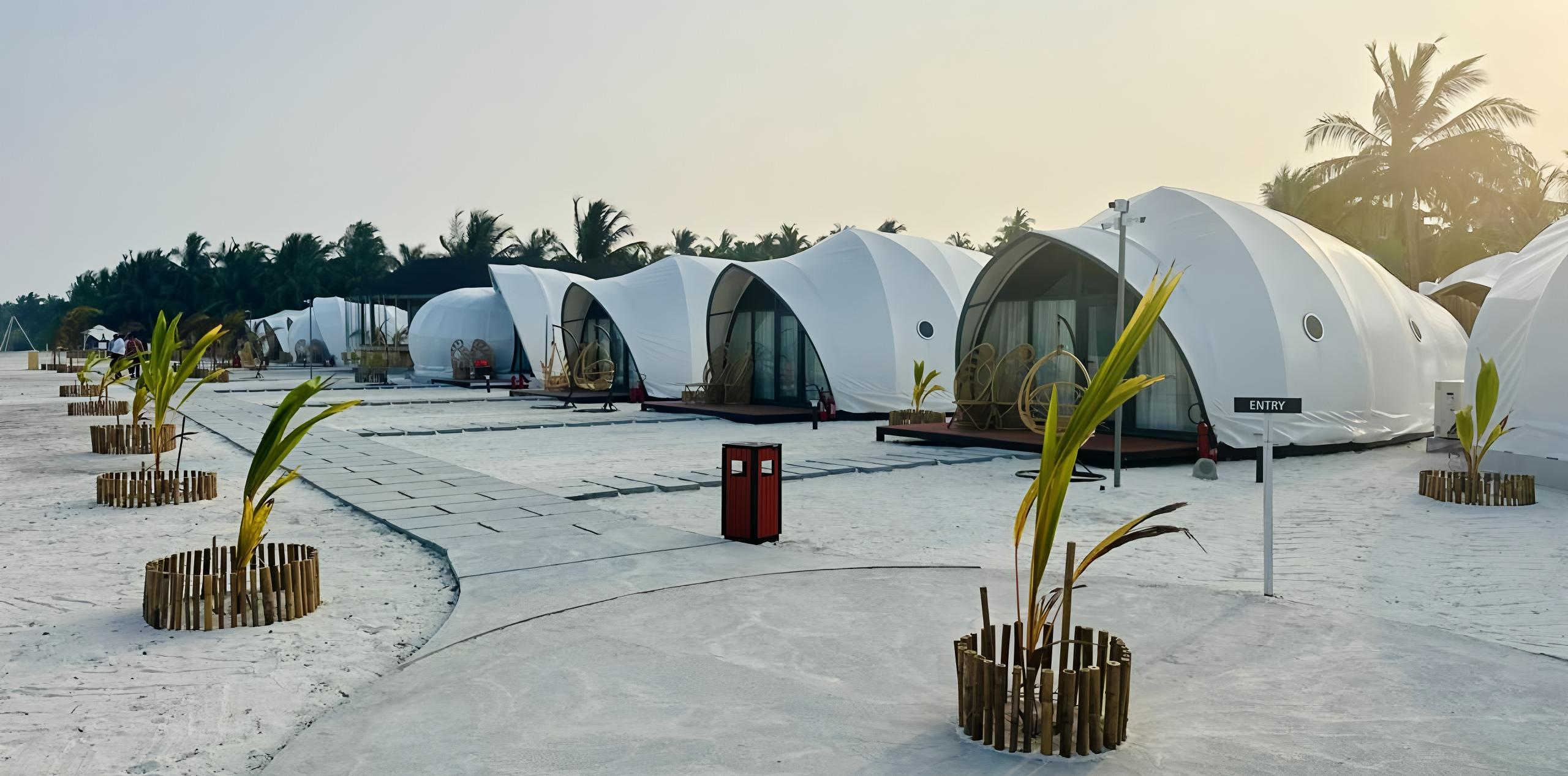
Experienced procurement professionals now prioritize three key capacity indicators: monthly unit output, factory footprint, and vertical integration. For instance, Stars Glamping, a high-tech enterprise based in Guangzhou’s Nansha District, operates a 20,000㎡ modern manufacturing base with a monthly production capacity of 50–80 luxury tent units, depending on project complexity. Their annual output ranges from 600 to 900 tents, supported by a 100-person workforce and a dedicated 6-person R&D team. This level of scale allows them to handle both small boutique orders (minimum order quantity of 1 unit) and large-scale resort projects—such as a 100-tent beachfront resort in India or a 30-tent desert resort in Saudi Arabia.
From Raw Material to Finished Product: Quality Control as a Capacity Proxy
Production capacity is not just about volume; it is intertwined with quality assurance. A supplier that invests in rigorous quality control can sustain consistent output without rework or delays. Stars Glamping implements a 12-step quality inspection system covering raw material intake, in-process checks, and pre-shipment testing. Their acceptance process includes factory inspection and photo/video confirmation before shipment—a practice that reassures buyers that every unit meets the agreed specification.
The company’s risk management framework addresses supply chain and production risks through comprehensive measures, including full quality control, engineering support, and pre-shipment testing. For environmental exposures such as water, wind, fire, and UV, they employ waterproof PVC/PVDF fabric, reinforced steel structures, and flame-retardant materials. These controls directly impact delivery reliability: fewer rejected units mean fewer production line stoppages and more predictable lead times.
Certifications That Signal Production Maturity
International certifications provide an objective benchmark for evaluating a manufacturer’s operational discipline. Stars Glamping holds a CE certificate (certificate number M.2024.206.C96444) issued by UDEM, covering compliance with EN ISO 5912:2020 for tent structures including glamping domes, safari lodges, and luxury hotel tents. This certification requires documented quality management procedures, traceability, and product testing—all of which correlate with consistent production capacity.
Additionally, the company’s 54 national patents and multiple trademark registrations indicate a strong R&D culture that translates into manufacturing efficiency. Patented technologies in wind resistance (up to Level 12 typhoon), thermal insulation (-30℃ to +70℃), and quick assembly reduce custom engineering time and enable faster delivery for bespoke projects.
Case in point: In a Cape Verde safari resort project, Stars Glamping delivered 12 luxury hotel tents that demonstrated suitability for long-term outdoor use, with a reported service duration exceeding 8 years. The project was completed with an off-grid solution, showcasing the ability to integrate complex requirements into a standardized production workflow without delaying delivery.
Lead Time Transparency: What Buyers Should Expect
Delivery lead time is the second critical dimension of supplier evaluation. For luxury hotel tents, lead times vary by customization level:
- Standard models: 15–20 days from order confirmation
- Customized projects (size, layout, materials): 20–30 days
- Large-scale projects (50+ units): 30–45 days with phased delivery
These timelines are achievable only when the supplier maintains buffer capacity and flexible production scheduling. Stars Glamping’s 4000㎡ simulation exhibition hall allows for full-scale mock-ups before mass production, reducing on-site surprises. Their global logistics network supports multiple delivery terms (EXW, FOB, CIF, DDP), and they offer 24/7 after-sales response for installation guidance and technical support—further de-risking the buyer’s project timeline.
Comparing the Traditional vs. Tent Construction Model
To contextualize capacity and delivery advantages, consider a direct comparison with conventional hotel building. A traditional 50-room resort might take 6–12 months to construct, with significant cost overruns due to weather, labor, and material delays. A luxury tent resort of similar scale can be installed in 20–30 days with 30–50% lower investment. The tent structure also offers flexibility for future expansion or relocation, which traditional buildings cannot match.
However, these benefits depend entirely on the supplier’s ability to deliver on time. A supplier with documented export experience—Stars Glamping exports 90% of its output to over 40 countries across Southeast Asia, the Middle East, Africa, Europe, and the Americas—has proven logistics capacity. Their customer repurchase rate of over 80% signals consistent satisfaction with both product quality and delivery performance.
Market Trends Driving Supplier Qualification Needs
Several industry trends are making capacity and delivery evaluation more critical than ever:
- Sustainability mandates: Eco-friendly, low-impact construction is becoming a requirement for government tourism projects. Suppliers with eco-certified materials (e.g., recyclable PVDF fabric) and efficient production processes are preferred.
- Extreme environment deployments: Resorts in deserts, mountains, and coastal zones require specialized tents with high wind resistance and thermal insulation. Suppliers must prove they can engineer and produce these variants without extending lead times.
- Modular and hybrid designs: The rise of modular luxury hotel tent systems—such as the Pisces (solid wood + steel frame) or the Shell (glass wall panoramic tent)—demands flexible manufacturing that can switch between product lines quickly.
Stars Glamping’s product portfolio addresses these trends with models like the Luxury Tent – Tethys (PVDF membrane, 25–30 year lifespan), the Octagon (geometric design for architectural statement), and the Villa (spacious multi-room configuration). Each model can be customized for different climates while maintaining core production lead times.
Future Outlook: Capacity as Competitive Advantage
As the luxury hotel tent market matures, the suppliers that invest in intelligent manufacturing—such as automated cutting lines, lean inventory management, and digital quality tracking—will gain a definitive edge. Stars Glamping’s independent production throughout the whole process, from raw material procurement to final assembly, positions it to control both cost and schedule. For buyers, the message is clear: evaluating a supplier’s capacity and delivery reliability is not a one-time checkbox but a continuous due diligence process that should include site visits, third-party audits, and reference project inquiries.
To support procurement teams in this evaluation, Stars Glamping offers a comprehensive company brochure detailing production capabilities, certification details, and reference case studies. Download the full brochure below for technical specifications and supplier qualification checklists.
Download Stars Glamping Company Brochure (PDF)