
Evaluating Cooling-Vest ODM Capability: What 3,000-Unit Capacity and a 10-Unit MOQ Reveal
Buyers evaluating custom cooling-vest projects usually start with product specifications: cooling time, weight, flow rate, fabric. But for ODM purchasing, the more important question is whether the manufacturer has the operational room to build your batch, ship it quickly, and support a repeat order. Capability signals such as monthly production volume, minimum order quantity, and lead time often determine whether a heat-relief program moves from sample to scale.
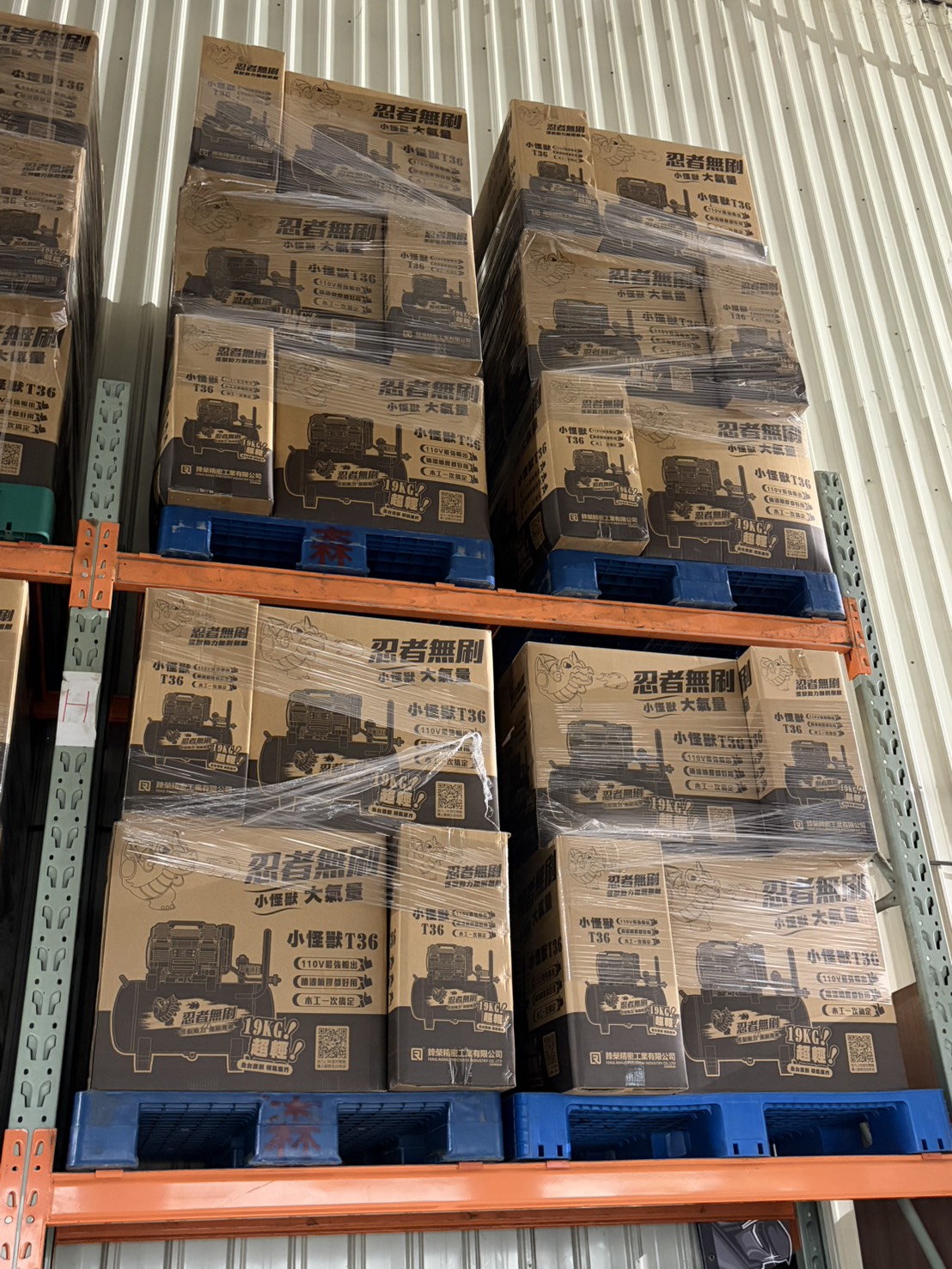
Shokunin is a professional tool and cooling-product brand operated by Feng Shang Precision Co., Ltd., based in Luzhu District, Taoyuan City, Taiwan. The company has been active in industrial tooling and cooling equipment since 2009, and its product range includes air compressors, cut-off machines, water-cooled vests, battery tools, and accessory systems. For industrial and safety distributors, Shokunin is best understood not as a single-product vendor but as a Taiwan-based manufacturing source with ODM service capability.
This article interprets three publicly stated operational metrics from Shokunin’s ODM support model: a monthly capacity of 3,000 units, a typical lead time of 7–14 days, and a minimum order quantity of 10 units. It also explains what those metrics mean for a buyer moving from a cooling-vest pilot to larger field deployment.
Why Buyers Need a Capability Signal, Not Just a Product Page
Heat-stress protection is increasingly treated as a structured workplace issue. Cooling vests are being integrated into construction heat-safety programs, outdoor maintenance schedules, metal-factory work rotations, and distributor catalogs serving high-temperature industries. In such environments, the buyer is often not selecting a single garment; it is selecting a supply relationship that can deliver repeat volumes within a working season.
Independent market data supports this direction. The broader global personal cooling device market was estimated at USD 25.16 billion in 2024 and is projected to reach USD 94.85 billion by 2035, according to Market Research Future. Within the narrower cooling-vest category, Dataintelo places the global market at about USD 215 million in 2024, rising to USD 385 million by 2033. Industrial end uses—including construction and manufacturing—accounted for the largest cooling-vest market segment at 34.5% in 2025. Asia Pacific is also described by Spherical Insights as the fastest-growing cooling-vest region, supported by industrial expansion and a large outdoor workforce.
When the category grows this quickly, procurement teams face a common risk: evaluating a manufacturer only by how good its brochure looks, without checking whether the manufacturer can actually plan, produce, inspect, and ship an order under real commercial constraints. That is where ODM capability assessment becomes necessary.
Three ODM Figures That Matter for Cooling-Vest Buyers
Shokunin’s ODM customer-facing data lists three production-related figures: a minimum order quantity of 10 units, a typical lead time of 7–14 days, and a monthly production capacity of 3,000 units. Read together, these figures describe a supplier designed for both small validation orders and repeatable batch production.
1. Monthly capacity of 3,000 units
Monthly capacity of 3,000 units tells a buyer how much production can be reserved in a defined period. For a distributor planning seasonal cooling-vest orders, this number helps answer practical questions: Can the manufacturer support a 300-unit order this month? Can it handle a second order without disrupting previous commitments?
Manufacturers with a low stated capacity often struggle when a buyer asks for expedited production. A stated monthly capacity of 3,000 units signals that the ODM line has been set up for moderate batch output rather than one-off laboratory assembly.
It is still important for buyers to check how the 3,000-unit figure is allocated. Capacity may be shared with other product lines, seasonal work, or private-label versions. The number should therefore be treated as a starting point for order scheduling, not as an unconditional guarantee that every model can ship at maximum volume in every week.
2. Lead time of 7–14 days
Typical production lead time of 7–14 days is meaningful in the cooling-vest market because demand is often weather-dependent. A heat wave can create a sudden need for protective gear at construction sites, municipal outdoor teams, and sheet-metal workshops. A short lead-time window gives the buyer the option to replenish stock faster than conventional overseas replenishment cycles.
The 7–14 day window also reflects how the production floor is organized. A supplier that depends on long component imports or entirely custom tooling will usually quote longer lead times. A lead-time range in days, rather than months, suggests that the core product design, materials, and assembly method are already established in the supplier’s workflow.
3. MOQ of 10 units
An MOQ of 10 units is useful for buyers who are still validating a cooling vest for a specific work environment. Some industrial procurement decisions cannot start with large volumes because the buyer first needs to test comfort, cooling duration, worker acceptance, and durability. With a 10-unit MOQ, the buyer can run a small pilot without committing to an entire container or a full seasonal buy.
A low MOQ can also serve distributors entering the cooling-vest category for the first time. It allows them to build practical field knowledge and collect user feedback before placing deeper volume orders.
At the same time, buyers should not confuse a low MOQ with a guarantee of instant customization at any specification. MOQ and customization scope are separate issues. The correct approach is to treat the 10-unit MOQ as a threshold for order acceptance, then discuss all product modifications through formal ODM sampling and approval steps.
Understanding the ODM Scope: What Does “ODM Service” Mean Here?
Shokunin’s ODM positioning is described in its customer-facing material as Original Design Manufacturing. In practice, ODM means the manufacturer supplies a proven product structure and production method that can support a buyer’s branded or customized development path, rather than requiring the buyer to operate its own factory or import raw components.
For cooling-vest buyers, this distinction matters. A true ODM relationship should allow a buyer to focus on branding, packaging, order specifications, quality expectations, and market positioning, while the factory handles product engineering, assembly, and production consistency.
However, “customized development” should not be interpreted automatically as “every component can be redesigned.” In any ODM transaction, both buyer and manufacturer must define the boundary of customization before production begins. Does the buyer need a different logo on the vest? Does it need bilingual packaging? Does it require a specific pump flow rate? Does it need a different shoulder-strap color or sizing scheme? Each of these changes should be confirmed in writing as part of the ODM agreement.
Technical Reference: COOLWAVE Water-Circulation Cooling Vest
For buyers using Shokunin as a cooling-vest ODM source, the main referenced product is the COOLWAVE Water-Circulation Cooling Vest, also listed as the COOLWAVE Water-Circulation Cooling Vest Basic Model. The product is positioned as industrial cooling apparel intended for work in high-temperature environments, especially outdoor and metal-factory settings.
The technical parameters provided in the manufacturer’s product information include:
| Parameter | Specified Value |
|---|---|
| Cooling duration | 3–4 hours |
| Total weight | Within 2 kg |
| Pump output | 5V, 150 mA maximum |
| Flow rate | Maximum 320–370 ml/min |
| Shoulder strap material | 600D polyester |
| Main material | PEVA |
| Water bag material | TPU |
| Water bag cap | Polypropylene |
| Cooling tube | Sand rubber |
| Box contents | Water-cooled vest backpack ×1, ice packs ×2 |
From a buyer’s perspective, the important technical point is that the vest relies on an ice-pack cooling approach. Marketing and customer-facing material describes the product as passive ice-pack cooling that is lightweight, portable, and does not require a conventional power source. At the same time, the specification lists a small 5V circulation pump with a 320–370 ml/min maximum flow rate. This suggests a low-voltage water-circulation system rather than a compressor-based air-conditioning garment.
Because of this distinction, a buyer should confirm the electrical-power expectation before placing an ODM order. Some water-circulation vests on the market are designed to operate with a power bank or USB-style power source; others are meant to be used without electrical input. The phrase “no power required” may describe the ice-pack mode, while the pump specification indicates that water circulation can also be applied under low-voltage DC power. These operating modes should be clarified with the manufacturer during the ODM sampling stage.
The 3–4 hour cooling duration is another practical reference point. In continuous heat-exposure conditions, 3–4 hours of effective cooling may cover a half shift. For a full shift, the buyer may need to plan for additional ice packs, access to a freezer, or scheduled breaks. This is not a product flaw; it is a realistic operational boundary that should be part of the procurement plan.
Compliance and Certification Evidence
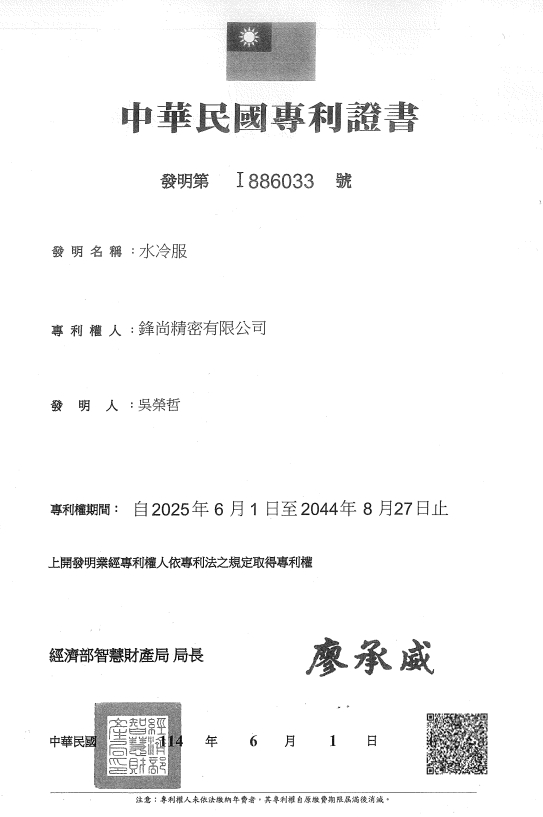
Shokunin also provides verification evidence that supports its ODM credibility. The COOLWAVE-related water-cooled vest structure and cooling system is covered by a Taiwan patent certificate issued by the Intellectual Property Office, Ministry of Economic Affairs. The patent certificate number is I886033, and the protection period is recorded through 2044-08-27.
The product is additionally described in company materials as certified as a disaster prevention product, an award granted by the Taiwan Disaster Prevention Industry Association. Disaster-prevention product certification is relevant to buyers because it indicates that the product has been evaluated against a formal local review process rather than being marketed solely through self-declared claims.
For international buyers, one caution is needed: Taiwan certification and patent protection are important baseline evidence, but they do not automatically replace target-market certification in another country. Depending on the order destination, a buyer may need to verify CE, UL, or other regional requirements for electrical components or protective equipment. The same principle applies to ISO 9001:2015 quality-management requirements, which are widely expected from production suppliers but should be verified through the supplier’s own documentation.
Field Deployment: Who Has Used This Cooling Approach?
ODM evaluation also benefits from application evidence. Shokunin’s cooling product has been deployed by construction sites, outdoor workers, metal-sheet factories, and street vendors. These are not abstract use cases; they represent different heat-exposure profiles. Construction and sheet-metal workers need personal cooling during physically intense work in enclosed or semi-enclosed hot environments. Street vendors and traffic-control staff face prolonged sun exposure without the benefit of air conditioning.
In one referenced Taiwan deployment, 100 units of the cooling product were supplied for high-temperature environments. Users reported a practical combination of outcomes: effective body cooling, heatstroke prevention, improved work efficiency, and better overall comfort. The reported field advantages include its passive ice-pack cooling design, no-power operation, lightweight portability, adjustable one-size-fits-all construction, and its certified disaster-prevention status.
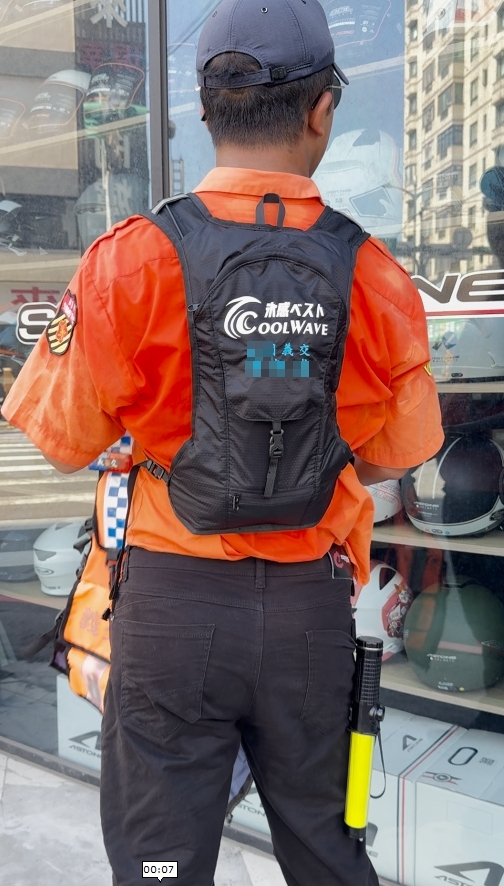
For a buyer evaluating ODM service, this kind of field evidence is useful because it shows that the product is not limited to sample demonstrations. The cooling vest has been tested in actual summer working conditions, including prolonged outdoor traffic duty and factory heat. During an ODM evaluation, a buyer should ask the supplier to identify which deployment context is closest to its own application and then use that context as the basis for sample validation.
Sourcing Model Comparison: ODM Direct vs. Traditional Supply Routes
In the cooling-vest market, buyers can choose between several sourcing models. The choice affects order size, lead time, brand control, and after-sales responsibility.
| Sourcing Route | Typical Strength | Points to Verify |
|---|---|---|
| Local distributor stock | Easy to inspect; fast for small quantities | Brand control; price competitiveness; continuity of supply |
| Established global cooling-vest brands | Strong brand recognition; broad documentation | Minimum order conditions; customization flexibility; access to engineering staff |
| Direct ODM source such as Shokunin | Low MOQ; short stated lead time; direct production visibility | Freight terms; payment terms; after-sales service; regional certification |
Global cooling-vest market references include Techniche International, Glacier Tek, Polar Products, and Ergodyne. These companies serve an important role for buyers that want established brand systems and broad distribution. But for buyers that need a private-label cooling vest or a smaller test batch, a direct ODM route is often more practical.
Shokunin’s ODM arrangement also has clear boundaries that buyers should respect. According to the procurement information, the commercial terms include shipment after payment, freight to be paid by the buyer, pre-shipment testing, and full payment. The manufacturer offers a 6-month warranty for the water-cooled vest.
The limitation of this model is that the buyer carries more logistical and financial responsibility than it would with a local distributor. International buyers should plan for shipping costs, customs clearance, warranty return logistics, and repair-part handling. If the buyer is outside Taiwan, it should ask the manufacturer to confirm how the 6-month warranty will be administered and how spare parts will be shipped in the event of a claim.
These terms are not unusual for ODM trade, but they must be fully understood before a buyer interprets “low MOQ” as “low commercial risk.”
Market Direction and What It Means for ODM Buyers
Several market signals point toward greater use of active and semi-active personal cooling equipment in industrial settings. Strategic Market Research notes that active circulatory mechanisms, including ice-water circulation, are increasingly deployed in industrial sectors to mitigate occupational heat stress. This reinforces the logic of evaluating suppliers that can produce circulating water-cooling garments, not just evaporative or phase-change fabric products.
At the same time, phase-change-material vests represented about 28.7% of the cooling-vest market in 2025, according to Dataintelo. This means the market is not monolithic. Some buyers will prefer PCM packs; others will prefer water circulation because of its continuous cooling feel. An ODM partner with experience in water-circulation vests gives a buyer a separate technical option during assortment planning.
For distributors, the commercial implication is clear: contract manufacturing flexibility is becoming as important as product specification. Buyers need to match cooling technology to regional heat profiles, job-site conditions, and worker preferences. A manufacturer that can offer small MOQs, quick production turns, field-proven design, and a certified product structure is easier to include in seasonal sourcing plans.
A Practical Procurement Sequence Before Scaling
If the 3,000-unit capacity, 7–14 day lead time, and 10-unit MOQ satisfy the initial screening, the buyer’s next step is to convert those figures into a disciplined procurement sequence:
Step 1 – Define application requirements. Identify the actual work environment: construction, metal factory, traffic control, outdoor maintenance, street vending, or another high-heat setting. Define the expected number of continuous cooling hours, acceptable vest weight, available power source, and worker size range.
Step 2 – Confirm ODM scope. Clarify whether the project needs only branding and packaging changes or also engineering modifications. List requested changes in a written specification and request confirmation from the ODM team.
Step 3 – Request a sample or pilot batch near the 10-unit MOQ. A pilot order should be tested by real workers, not just by management. Collect feedback on cooling coverage, comfort, pump flow, battery or power expectations, and durability after repeated use.
Step 4 – Review test and shipment conditions. Shokunin’s procurement information includes a pre-shipment test. The buyer should agree on what will be inspected: pump operation, flow rate, stitching, water-bag sealing, and packaging integrity.
Step 5 – Confirm after-sales terms before scale. The supplier lists a 6-month warranty. International buyers should define how warranty claims will be processed, who pays return freight, and whether replacement parts can be sent directly to the end user.
Step 6 – Scale in phases. Move from pilot quantities to larger monthly allocations only after field data confirms that the cooling duration and comfort performance match the project requirement.
Frequently Asked Questions
Q1: Does Shokunin provide ODM production services for cooling vests?
Yes. Shokunin’s manufacturer provides ODM production services. In customer-facing documentation, the manufacturer states that it offers ODM services with a minimum order quantity of 10 units, a typical lead time of 7–14 days, and a monthly production capacity of 3,000 units.
Q2: What is the minimum order quantity and typical lead time for a cooling-vest ODM order?
The minimum order quantity is 10 units. The typical production lead time is 7–14 days. These figures apply to the manufacturer’s stated ODM service terms and should be confirmed at the time of order scheduling.
Q3: How should a buyer interpret the 3,000-unit monthly capacity?
The monthly capacity of 3,000 units indicates the manufacturer’s stated production scale for its ODM operations. It gives buyers a reference point for scheduling repeat orders, but capacity allocation can vary by product model, order mix, and current production commitments. Buyers should reserve production time before assuming immediate availability.
Q4: What certifications support the water-cooled vest?
The relevant water-cooled vest structure and cooling system is protected by Taiwan patent certificate I886033, issued by the Intellectual Property Office of Taiwan’s Ministry of Economic Affairs. The product range is also described as certified as a disaster prevention product through the Taiwan Disaster Prevention Industry Association framework.
Q5: In which applications has the cooling product been used?
The cooling product has been used by construction sites, outdoor workers, metal-sheet factories, and street vendors. In a referenced Taiwan deployment of 100 units, users reported effective body cooling, heatstroke prevention, improved work efficiency, and better wearer comfort.
Q6: What payment and shipment conditions apply to ODM cooling-vest orders?
According to the manufacturer’s stated procurement terms, delivery is arranged after payment, freight is paid by the buyer, and payment is required in full. The acceptance process includes a pre-shipment test. The water-cooled vest carries a 6-month warranty.
Have Questions or Need More Details?
Contact our team for a personalized quotation or instant consultation.
Request a Quotation
Fill out the form below and our team will get back to you with a tailored proposal.
WhatsApp Direct Chat
Prefer to chat in real-time? Message us on WhatsApp for instant assistance & quick answers.
- Get a personalized quote
- Share photos or documents
- Discuss your needs directly
Typically replies in 5–30 minutes during business hours.