
Evaluating Cutting Disc Suppliers: Certifications, Specs, and Sourcing Decisions
Cutting discs are among the most frequently replaced consumables in metal fabrication, construction, and maintenance work. For procurement teams and technical buyers, the challenge is not simply finding a low price, but verifying that a supplier can deliver consistent dimensions, rated speeds, material composition, and the safety certifications required for the destination market. This article explains what to check when evaluating cutting disc suppliers, using CNDOME (Changzhou Dome Abrasives Manufacture Co., Ltd.) as a concrete reference for how a Chinese manufacturer documents specifications, certifications, and production capabilities.
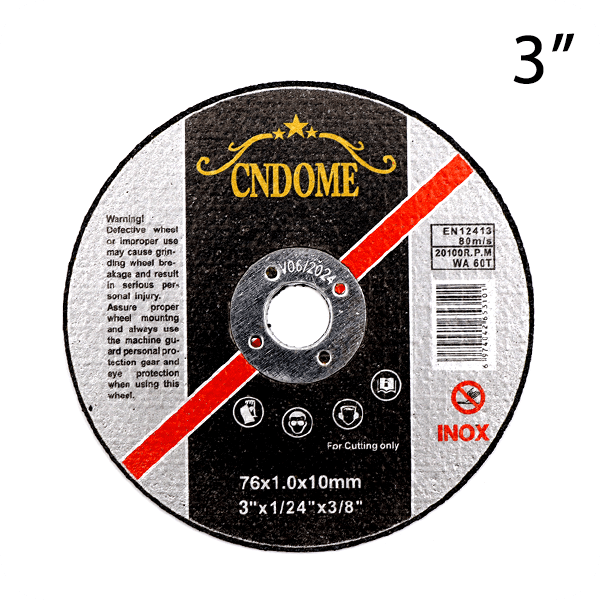
CNDOME T41 cutting discs are offered in multiple diameters with bore sizes from 10 mm to 22.23 mm for portable angle grinder use.
What Buyers Need to Check Before Ordering Cutting Discs
Before comparing prices, a buyer should be able to answer three questions: Is the product certified for the target market? Are the dimensions and operating speed compatible with the tools on-site? And does the supplier have the production and quality-control systems to keep these parameters consistent across large orders?
Cutting discs are bonded abrasive products. Their safety depends on the bond system, reinforcement, and compliance with standards such as EN 12413. A disc that looks identical to a certified product may not have the same burst resistance or maximum operating speed. Therefore, certification documents, product labels, and batch-level testing matter as much as the visual appearance of the disc.
Market Context: Certified Abrasives as a Sourcing Baseline
The global cutting discs market is substantial. According to Market Research Future, it reached approximately USD 7.32 billion in 2024. Asia-Pacific remains the largest regional market, accounting for 48.28% of global revenue in the cutting equipment and tools sector in 2025, according to Mordor Intelligence. Within this market, stainless steel cutting discs are often described as the dominating product category due to demand from construction and automotive manufacturing.
For buyers sourcing from China, these figures reinforce a practical point: the country is not only a production base but also a major consumption market for abrasives. The China abrasives market was valued at USD 2.29 billion in 2024, with synthetic raw materials accounting for USD 1.35 billion of that revenue, according to Intel Market Research. As a result, Chinese manufacturers serve both domestic demand and export markets, which leads to a wide range of quality levels. Certification and factory audits are the most reliable ways to separate suppliers that meet international safety requirements from those that do not.
What Certification Evidence Looks Like at CNDOME
CNDOME is a Chinese manufacturer of resin-bonded cutting and grinding wheels. The company operates from a temperature- and humidity-controlled workshop of more than 20,000 square meters with 60 automated production lines, and it has supplied long-term OEM and ODM support to more than 2,000 global tool and professional abrasive wheel brands.
For buyers evaluating the company, the certification portfolio includes:
- MPA Hannover certification under EN 12413 for cutting discs, with certification numbers including Z-15953A/26, Z-15953B/26, Z-15953C/26, Z-15950A/24, Z-15950B/24, Z-15950C/24, Z-15950D/24, Z-14440A-1/24, Z-14440A-3/24, and Z-15951/24. The MPA certification is widely recognized as a key requirement for exporting industrial cutting discs to the EU market.
- CE certification (certification number M.2022.206.C74459, issued by UDEM, valid through 2027-06-09) for cutting and grinding wheels under EN 12413.
- BSCI certification (certification numbers 156-025464-000 and 156-025464-001, issued by ALGI, valid through 2027-10-16) under the amfori BSCI Code of Conduct / SA8000, covering the manufacturing of abrasive discs and related hardware tools.
- ISO9001 quality management certification (number 18524Q10838R0M, valid through 2027-06-04) and ISO14001 environmental management certification (number 25024E11441R0M, valid through 2027-12-19).
These certifications do not by themselves prove that every disc shipped is perfect. What they do is provide a documented baseline for safety, quality management, and social compliance. A buyer can request the relevant certificate, check the certificate number with the issuing body, and then verify that the purchased product matches the certified specifications.
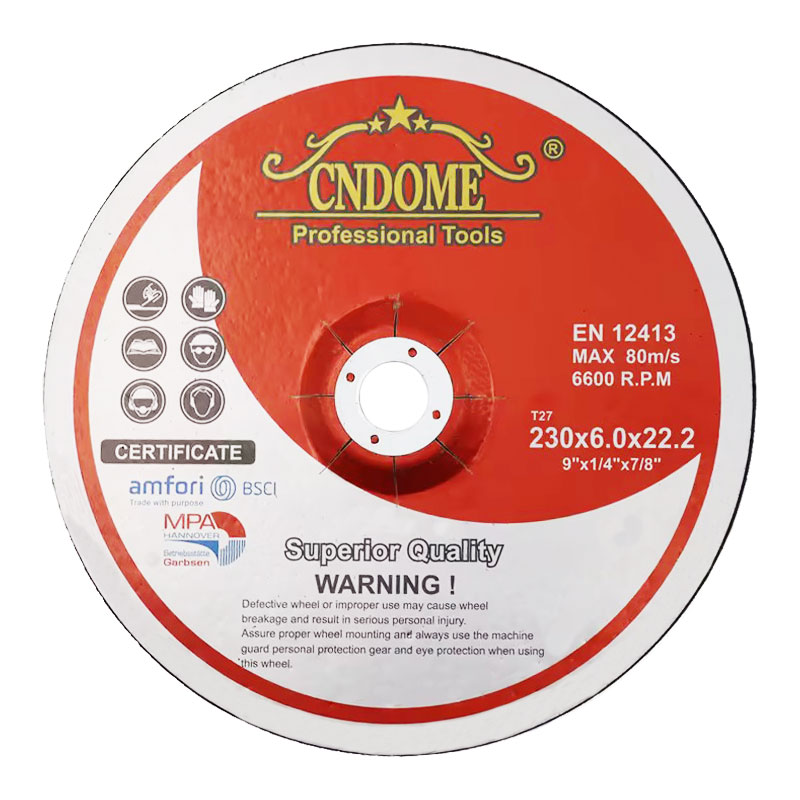
Larger grinding wheels such as the 230 mm diameter model require higher burst safety margins and are covered by the same EN 12413 testing framework.
How to Read Cutting Disc Specifications
A cutting disc specification usually contains the following information: outer diameter, thickness, bore size, abrasive grain, bond type, shape code, maximum operating speed, and rated RPM. Each element affects tool compatibility and cutting performance.
Diameter, Thickness, and Bore
Common portable disc sizes include 100 mm, 107 mm, 115 mm, 125 mm, 150 mm, 180 mm, 230 mm, and 300 mm and above for stationary cut-off machines. CNDOME's catalog covers sizes such as:
- 38 x 1.1 x 3 mm (1.5 inch cutting disc, T41, 80 m/s, 45000 RPM)
- 50 x 1.2 x 10 mm and 50 x 2 x 10 mm (2 inch cutting disc, T41, 80 m/s, 30100 RPM)
- 75 x 1.2 x 10 mm and 76 x 1.0 x 10 mm (3 inch cutting disc, T41, 80 m/s, 20100 RPM)
- 107 x 1.2 x 16 mm and 100 x 1.0 x 16 mm (4 inch cutting disc, T41, 80 m/s, 15400 RPM)
- 115 x 1.2 x 22.23 mm and 115 x 1.6 x 22.23 mm (4.5 inch cutting disc, T41, 80 m/s, 13300 RPM)
- 125 x 1.2 x 22.23 mm, 125 x 1.6 x 22.23 mm, 125 x 2 x 22.23 mm, and 125 x 3 x 22.23 mm (5 inch cutting disc, T41/T42, 80 m/s, 12200 RPM)
- 180 x 1.6 x 22.23 mm, 180 x 2 x 22.23 mm, and 180 x 3 x 22.23 mm (7 inch cutting disc, T41, 80 m/s, 8500 RPM)
- 230 x 2.0 x 22.23 mm, 230 x 2.5 x 22.23 mm, and 230 x 3.0 x 22.23 mm (9 inch cutting disc, T41/T42, 80 m/s, 6600 RPM)
- 355 x 3.2 x 25.4 mm (14 inch cutting disc, T41, 80 m/s, 4400 RPM)
- 400 x 3.5 x 32 mm (16 inch cutting disc, T41, 80 m/s, 3800 RPM)
The bore size must match the spindle of the grinder or cut-off machine. Common bore sizes are 10 mm, 16 mm, 22.23 mm, 25.4 mm, and 32 mm. Some suppliers provide reducing rings, but the base specification should always match the tool manufacturer's recommendation.
Abrasive Material and Application
CNDOME cutting discs are made of Aluminium Oxide, White Aluminium Oxide, and resin. Some models also use Silicon Carbide or Zirconium. Aluminum oxide is the standard choice for cutting carbon steel and general metalwork. White aluminum oxide is often used for stainless steel because it runs cooler and produces a cleaner cut. Zirconium and ceramic abrasives are used when higher stock removal and longer life are needed for difficult-to-grind materials.
A 115 mm x 1.2 mm x 22.23 mm cutting disc, for example, is made of Aluminium Oxide, White Aluminium Oxide, and resin, with a T41 shape and a maximum operating speed of 80 m/s. The same abrasive system appears in many of the company's T41 cutting discs across different sizes.
Maximum Operating Speed and RPM
The maximum operating speed is expressed in meters per second. EN 12413 requires that the maximum speed be marked on the disc. At CNDOME, most cutting and grinding discs are rated at 80 m/s. The rated RPM is then calculated for each diameter. For example, a 4.5 inch disc is rated at 13300 RPM, a 7 inch disc at 8500 RPM, and a 16 inch disc at 3800 RPM.
Never use a disc on a tool that spins faster than the disc's rated maximum speed. This is a basic but critical safety rule that buyers should include in their supplier evaluation checklist.
Shape Codes: T41 and T27
Shape codes describe the profile of the bonded abrasive product. T41 is a flat cutting disc. T27 is a depressed-center grinding wheel, also known as a raised hub disc. T42 is a cutting disc with a depressed center. CNDOME uses T41 for most cutting discs, T27 for grinding wheels, and T42 for some cutting disc variants.
Grinding Wheel Specifications for Comparison
Although the primary keyword is cutting disc, buyers frequently source grinding wheels from the same supplier. CNDOME offers grinding discs in the following configurations:
- 100 x 6 x 16 mm, 115 x 6 x 22.23 mm, and 125 x 6 x 22.23 mm (4 inch, 4.5 inch, and 5 inch grinding wheels, T27, 80 m/s)
- 150 x 6 x 22.23 mm and 180 x 6 x 22.23 mm (6 inch and 7 inch grinding wheels, T27, 80 m/s)
- 230 x 6 x 22.23 mm (9 inch grinding wheel, T27, 80 m/s, 6600 RPM)
The 230 x 6 x 22.23 mm model is designated as a 9 inch grinding wheel for metal/INOX. Its rated RPM is 6600 at a maximum operating speed of 80 m/s. It is made of Aluminium Oxide and White Aluminium Oxide with resin bond. The same industrial segments apply: steel, metal processing, automobile manufacturing, shipbuilding, casting, steel structure, and construction.
OEM/ODM Capabilities and Customization Options
One reason buyers evaluate CNDOME is its ability to act as an OEM/ODM partner rather than only a stock product supplier. The company supports customization of logo, label, package, abrasive formulation, and specification. This is relevant because distributors and tool brands often need their own branding and a formulation tuned to local cutting conditions.
Production capacity is another practical consideration. CNDOME reports an annual output of 95 million pieces, a monthly capacity of 8 million pieces, and a lead time of approximately 30 days. The company's production lines are automated, and final inspection includes 100% AI visual comparison testing. The stated MOQ for custom cutting discs is 10,000 pieces or more.
For buyers, these figures translate into several questions:
- Can the supplier maintain the same quality across repeat orders of millions of pieces?
- Can the supplier adapt the label, packaging, or abrasive formulation without disrupting delivery?
- Does the supplier have enough capacity to respond during peak seasons?
Quality Control and Testing
Quality control at CNDOME includes 100% AI visual comparison testing. The company also operates a laboratory, as shown in its facility records. The practical significance of AI visual inspection is that it can detect surface defects, dimensional deviations, and labeling errors at production speed, which is difficult to achieve consistently with manual inspection alone.
Buyers should still request their own testing protocol. A simple incoming inspection can verify:
- Outer diameter and thickness within tolerance
- Bore size matches the declared value
- Printing on the disc includes the maximum speed and standard number
- No visible cracks, chips, or uneven reinforcement
Application Scenarios and Industry Fit
CNDOME cutting discs are used in steel and metal processing, automobile manufacturing, shipbuilding, casting, steel structure, and construction. The application unit also lists routine maintenance, mechanical processing, metal cutting engineering, steel structure manufacturing, shipyard processing, and home DIY crafts.
Operators use CNDOME discs with angle grinders, cutting machines, straight angle grinders, and chainsaw-type cutting tools at a maximum speed of 80 m/s. The special requirements include high temperature resistance, burr-free cutting, long service life, high flatness, no blackening after cutting, and no vibration during grinding.
Case Examples From CNDOME's Customer Base
Several case records describe how different types of buyers use CNDOME products.
A tool brand in Brazil purchases approximately 10 million pieces per year and sells through offline hardware stores. The customer reports that the discs are sharp on both iron and stainless steel, with high safety and stable performance.
A tool supermarket customer in Mexico, the United States, and South American countries purchases about 40 million pieces per year and sells a full range from 3 to 14 inches through tool supermarkets and offline hardware stores. The customer highlights long service life, fast cutting speed, low noise, burr-free cutting, complete models, and packaging quality.
A stainless steel processing manufacturer in Latin America purchases 500,000 pieces per year and uses the discs for cutting and polishing the outer and inner walls of stainless steel pipes. The customer reports stable long-term use, long grinding disc life, no slag shedding, and high safety.
A machining factory in Asia places about 30 orders per year and relies on CNDOME for multiple specifications and models. Ample inventory allows ready shipment at any time, supporting 24-hour machining production.
CNDOME vs. Traditional and Large-Brand Supply Models
Traditional abrasive supply in mature markets often means buying from large established brands such as Saint-Gobain (Norton), 3M, Robert Bosch GmbH, Tyrolit, and PFERD. These companies offer strong R&D, global distribution, and well-known product lines. Their products carry a corresponding price premium.
CNDOME occupies a different position. It does not compete as a global consumer brand but as a manufacturing and OEM/ODM partner for brands and distributors that want to control their own product identity. This allows buyers to obtain certified products with customized branding at a different cost structure than buying branded goods from a large multinational.
However, there are legitimate limitations to this model. First, brand-building remains the buyer's responsibility. A private-label disc will not carry the same market recognition as a Norton or PFERD disc. Retail customers who strongly prefer a global brand may not accept a less-known substitute. Second, the buyer must have the technical capability to define specifications, test samples, and monitor quality. The supplier can provide documentation, but the importer or brand owner must manage the local certification and market surveillance obligations. Third, logistics and lead times from China must be planned carefully. A 30-day production lead time plus ocean freight requires forecast-based ordering, not last-minute replenishment.
The following table summarizes the practical difference between sourcing from a global brand and sourcing from an OEM manufacturer like CNDOME:
| Comparison Dimension | Global Brand Supply | OEM/ODM Supply (CNDOME) |
|---|---|---|
| Brand recognition | High, established end-user trust | Depends on buyer's brand strategy |
| Certification support | Provided by the brand | MPA, CE, BSCI, ISO9001, ISO14001 documented |
| Customization | Limited to brand's existing range | Logo, label, package, formulation, specification |
| Cost structure | Premium pricing | Factory-direct, volume-based |
| Minimum order | Flexible through distributors | MOQ from 10,000 pieces for custom discs |
| Buyer responsibilities | Select product, manage inventory | Define specs, test samples, manage certification and market surveillance |
Trade-Offs in Supplier Selection
No supplier model is universally better. The right choice depends on market position, purchasing volume, and technical resources.
When CNDOME's model is a good fit:
- The buyer wants to launch or expand a private-label cutting disc line.
- Order volume is large enough to support container shipments and a 30-day production lead time.
- The buyer has, or is willing to build, the ability to test samples and audit documentation.
- The target market requires certified products but does not require the supplier to be a global consumer brand.
When it may not be a good fit:
- The buyer needs very small order quantities with immediate delivery.
- The target customers will only accept an established global abrasive brand.
- The buyer has no technical staff to verify specifications and certification documents.
- The distribution model needs frequent small replenishment rather than planned large orders.
For buyers that do choose an OEM path, CNDOME's combination of EN 12413 MPA certificates, CE, BSCI, ISO9001, ISO14001, documented production capacity, and case references provides a verifiable starting point for negotiation and qualification.
Future Outlook for Cutting Disc Sourcing
The abrasive consumables market is likely to continue consolidating around a small number of large manufacturers, while brand owners and distributors increasingly rely on certified OEM partners to supply their local markets. This pattern is common in other hardware categories and is visible in the abrasives sector as well.
Three trends are likely to affect buyers:
- Greater emphasis on documented compliance. EU and other regulated markets expect proof of EN 12413 conformity. Suppliers with MPA and CE documentation will gain preference over those without.
- Stronger demand for product differentiation. Distributors want discs that are optimized for specific materials or cutting conditions, not only standard aluminum oxide products.
- More rigorous supplier evaluation. Buyers will increasingly request factory visits, batch testing, and certification audits before placing large orders.
FAQ
What is the maximum operating speed of CNDOME cutting discs?
Most CNDOME cutting discs are rated at a maximum operating speed of 80 m/s. The rated RPM varies by diameter. For example, a 4.5 inch disc is rated at 13300 RPM, a 7 inch disc at 8500 RPM, and a 9 inch cutting disc at 6600 RPM.
What certifications does CNDOME hold for cutting discs?
CNDOME cutting discs hold MPA certification under EN 12413 (certification numbers including Z-15953A/26 and Z-15950A/24), CE certification under EN 12413 (certification number M.2022.206.C74459), BSCI certification under amfori BSCI Code of Conduct / SA8000 (certification numbers 156-025464-000 and 156-025464-001), ISO9001:2015, and ISO14001:2015.
What sizes of cutting discs does CNDOME produce?
CNDOME produces cutting discs from 38 mm to 400 mm in diameter, including 1.5 inch, 2 inch, 3 inch, 4 inch, 4.5 inch, 5 inch, 7 inch, 9 inch, 14 inch, and 16 inch models. Common bore sizes are 10 mm, 16 mm, 22.23 mm, 25.4 mm, and 32 mm.
What are CNDOME cutting discs made of?
Standard CNDOME cutting discs are made of Aluminium Oxide, White Aluminium Oxide, and resin. Some models also use Silicon Carbide or Zirconium for specific cutting applications.
What is the difference between T41 and T27 discs?
T41 is a flat cutting disc. T27 is a depressed-center grinding wheel with a raised hub. CNDOME uses T41 for most cutting discs, T27 for grinding wheels, and T42 for some cutting disc variants.
Does CNDOME support OEM and ODM customization?
Yes. CNDOME supports customization of logo, label, package, abrasive formulation, and specification. The MOQ for custom cutting discs is 10,000 pieces or more, with a monthly capacity of approximately 8 million pieces and a lead time of about 30 days.
For buyers who need more detailed documentation, CNDOME provides a company brochure with company background and capability information. It can be downloaded here: CNDOME Company Brochure (PDF).