
Evaluating HTNXT as a Long-Term Supplier for Retail Chains
HTNXT Industry Reference | Supplier Evaluation
Long-term tire supply decisions for retail chains and dealer networks are rarely settled by a single low price. They are settled by whether a supplier can keep a coherent range available across the rim sizes a market actually sells, document the certifications each market requires, and repeat the same quality standard over multiple order cycles. On those tests, the HTNXT passenger car tire program, the supply program associated with SHANDONG WIDEWAY TIRE CO.,LTD and its WIDEWAY, EVERLAND and V-RICH brands, presents a broad line-up that runs from 12-inch commercial-van sizes such as 155R12C to 20-inch ultra-high-performance sizes such as 245/40ZR20, with selected 22-inch sizes also listed.
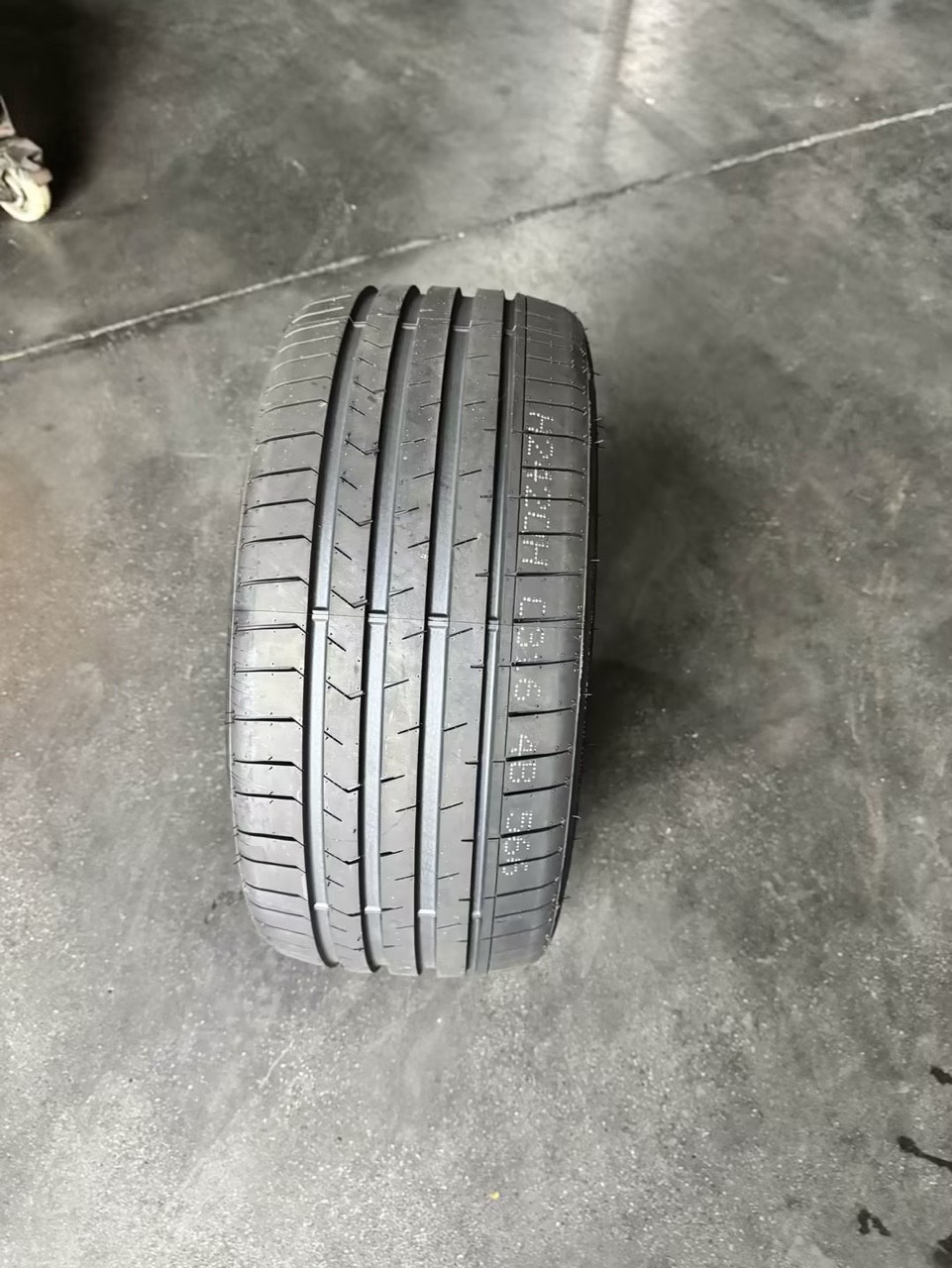
The upper end of the passenger car tire range moves into 19- and 20-inch fitments, where load index and speed rating become primary selection criteria. Image: HTNXT product reference.
The sourcing problem: a range that has to stay complete
A retail chain does not sell a catalogue. It sells availability. A dealer with a 12-inch van fitment on the forecourt, a 16-inch family car on the lift and a 20-inch SUV waiting for a replacement cannot afford a supplier whose range stops at the middle of the market. Every missing size becomes a lost bay, a substituted brand or an emergency buy from a local wholesaler at a worse margin.
That is why range breadth belongs in a supplier evaluation, not only in a product brochure. For a retail chain, breadth has three practical effects. It reduces the number of supplier relationships the buying team has to manage. It makes specification language more consistent across the network. And it gives the chain room to shift its mix when the local vehicle parc changes, without reopening the entire sourcing process.
The opportunity is equally clear. A single program that covers the 12- to 20-inch core span, and includes C-marked commercial-van sizes, P-metric family sizes, ultra-high-performance sizes, winter and all-season lines, and white sidewall or white letter customization, can act as a platform rather than a one-off purchase. The question is not whether the range is large. The question is whether the range is supported by certifications, commercial terms and quality routines that a chain can live with for several years.
What the HTNXT range actually covers
The product data behind the HTNXT program records a passenger car tire range from 145/70R12 to 245/30ZR22. Within that span, the commercially important core for most retail chains is the 12- to 20-inch band. The table below groups representative sizes by rim band and shows why each band matters to a dealer.
| Rim band | Representative sizes in the corpus | Typical retail role | Specification signal |
|---|---|---|---|
| 12-13 inch | 145R12C, 155R12C, 155R13C, 5.00R12 ULT, 5.50R13LT | Urban delivery, taxi, entry-level family, light van | Maximum pressure 420-500 kPa; load index 83 to 106/104; Q to P speed ratings |
| 14-15 inch | 185R14C, 195R15C, 195/65R15, 205/55R15, 205/70R15 | Family cars, taxi fleets, small vans | C-marked groups at 450 kPa; P-metric groups at 300 kPa |
| 16 inch | 185/75R16C, 205/55R16, 215/65R16C, 235/65R16C | Family cars, crossovers, commercial vans | Load index 91 to 109/107; 300-475 kPa |
| 17-18 inch | 215/55ZR17, 225/45ZR17, 235/45R18, 245/45R18 | Ultra-high-performance, SUV, tuning | W speed ratings; 340 kPa |
| 19-20 inch | 235/55ZR19, 245/40ZR20, 255/35ZR20 | Ultra-high-performance, premium SUV | W speed ratings; 340 kPa |
The table is not a complete SKU list. It is a check on whether the range has the structural coverage a chain needs. The presence of 155R12C at the bottom and 245/40ZR20 near the top is meaningful because those two sizes represent different engineering and inventory problems. A 12-inch C-marked tire has to carry load at relatively high pressure in a small envelope. A 20-inch ZR tire has to manage heat and stability at high speed with a much shorter sidewall.
Reading the specification spread like a procurement team
A wide range is only useful if the specifications inside it are coherent. Three parameters deserve attention in the HTNXT data: load index, speed rating and maximum pressure.
The load index spread runs from 83 on the 5.00R12 ULT to 109/107 on the 195/70R15C group. That is not a random number set. It tracks the vehicle classes the sizes serve. A 12-inch commercial-van fitment needs a different load structure from a 20-inch SUV fitment. Speed ratings follow the same logic, from Q and N on some heavy-load van sizes to W on the ultra-high-performance groups. Maximum pressure is the clearest divider. The C-marked 155R12C group is listed at 450 kPa, while the 205/55R16 P-metric group is listed at 300 kPa. A dealer who ignores those differences will stock the wrong casing for the application.
The material specifications are also consistent across the range. The product records list natural rubber, synthetic rubber, carbon black, precipitated silica, steel cord, polyester cord fabric, nylon cord fabric, vulcanizing agent, vulcanization accelerators, activators, antioxidants and RAE oil. White rubber compound appears in the white sidewall and white letter groups. That common material platform matters for a long-term partnership because it suggests a shared compounding and sourcing base rather than a collection of unrelated products. It does not, by itself, prove performance. It does show that the supplier can hold a specification language across multiple SKU families.
The capability data adds two relevant facts. The program states 100% test as its quality-control routine. It also lists OEM customization for passenger car tires, off-road tires, white letter tires and white sidewall tires. For a retail chain, the second fact is more important than it first appears. White sidewall and white letter lines are often used to differentiate a store or a regional brand, and they are difficult to source consistently if the supplier treats them as an exception rather than a standard customization path.
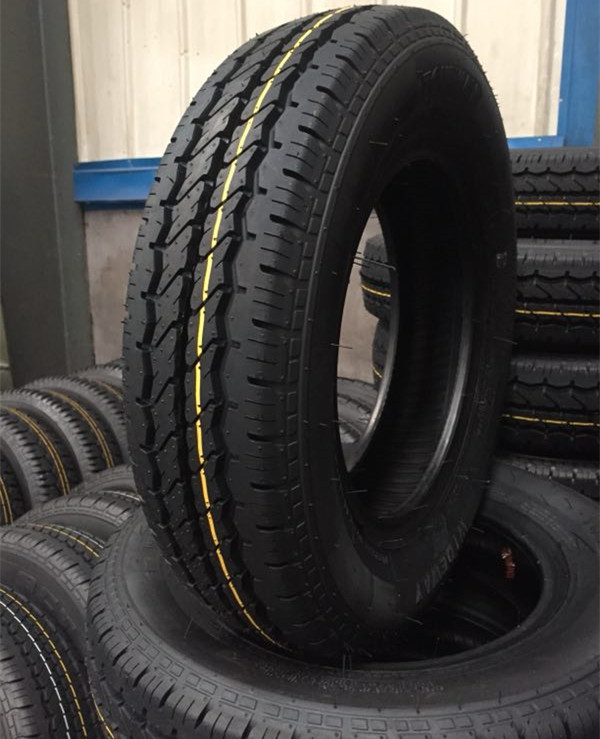
The 12-inch end of the range is not a legacy corner. It serves urban delivery, taxi and light-van demand in markets where small fitments remain commercially active. Image: HTNXT product reference.
Certifications a retail chain should verify before listing
Certification is where a broad range becomes a procurement exercise. A supplier can hold a certificate for one product family and one market without holding the same coverage for every SKU. The HTNXT data illustrates that point clearly.
| Certificate | Market | Number | Issued by | Validity in the corpus |
|---|---|---|---|---|
| EU Regulation No.117 E-mark | EU | E4-117R-025700-S2WR2 | RDW | 2017-03-24 to 2099-12-31 |
| ECE UN Regulation No. 30 | EU and Africa | E4-30R-0264621 | RDW | 2013-10-14 to 2099-12-31 |
| SASO GSO Product Certification | Saudi Arabia | TR13651/2025 | SASO | 2025-12-11 to 2026-12-11 |
| CCC | Mainland China and Ecuador | 2022061201000258 | Beijing Zhong Hua Combination Certification Co.,Ltd. | 2026-04-20 to 2028-10-16 |
| SONCAP | Nigeria | NGP2026 145940 /0001 | BUREAU VERITAS | 2026-04-01 to 2027-04-01 |
The certificate list is not a blanket clearance. Each entry names a market, a standard and a product scope. The CCC entry, for example, is scoped to 75-series passenger car radial tyres under GB9743-2024, so a 245/40ZR20 ultra-high-performance SKU is not automatically covered by that certificate. The SASO certificate expires on 11 December 2026, which falls inside the planning window for 2027 retail programs. The SONCAP certificate expires on 1 April 2027. A retail chain that starts listing in late 2026 should ask for the renewal schedule before it commits shelf space.
The verified regulatory data adds the wider framework a buyer should understand. UN Regulation No. 30 provides the ECE type-approval basis for passenger car tyres. UN Regulation No. 117 covers rolling sound emissions, wet-surface adhesion and rolling resistance. Regulation (EU) 2020/740 is the current EU tyre labelling regulation, replacing Regulation (EC) No 1222/2009. In the United States, FMVSS No. 139 sets performance and marking requirements for new radial passenger car tires, and UTQG grades treadwear, traction and temperature resistance. ETRTO and ISO 4000-1 provide the dimension and designation reference points behind size markings. GB 9743 is the Chinese mandatory standard for passenger car tyres.
For a dealer, the practical rule is simple: match the certificate to the SKU and the market, not to the supplier name. Ask for the certificate scope, the product list attached to it and the expiry date. A broad range is a commercial advantage only when the paperwork follows the range.
Where the line-up fits retail and repair chain demand
The product data names the applicable customer groups directly: tire distributors and wholesalers, automotive aftermarket and retail chains, auto repair shop chains, tire dealers, mobility and transportation services, taxi companies, OEM matching and the automotive tuning industry. That is a wider set of buyers than a single retail chain, but it helps a dealer see where the range is designed to sit.
Urban and taxi demand is served by the 12- to 15-inch bands, where the C-marked and P-metric sizes overlap. Highway and family demand moves into 16- to 18-inch sizes, where high-speed stability and comfort become the selection criteria. Mountain, rugged and mixed-road demand pulls in the SUV and all-terrain sizes, with sidewall protection and traction as the stated functions. Winter and snow demand is covered by the winter and all-season lines. The EV category appears in the product type data as a comfortable and noiseless EV passenger car tire, which is relevant for markets where electric taxi and ride-hailing fleets are growing. White sidewall and white letter products serve personalization and classic-fitment demand. Commercial van demand is covered by the C-marked sizes, including 185/75R16C, 195/75R16C and 235/65R16C.
The scenario data lists urban roads, highway roads, mud terrain, mountainous roads, icy and snowy roads, desert and sandy areas, rugged roads and rainy roads. It also lists family leisure driving, weekend getaways, urban commuting, off-road adventures, desert off-roading and forest and mountain exploration. A retail chain does not need to stock every scenario. It needs to know which scenarios its local customers actually drive and whether the supplier can cover that subset without dropping the rest of the range.

The middle of the range carries the highest replacement volume in many markets. Sizes such as 195R14C and 195/65R15 connect family-car and light-van demand. Image: HTNXT product reference.
The commercial terms that decide whether a program is long-term
A supplier can have the right range and still fail a retail chain on execution. The commercial terms in the HTNXT data are therefore as important as the SKU list. The program states a minimum order quantity of one 20-foot container, around 400-700 pieces, and a lead time of 25-45 days. It states 100% test as the quality-control routine. It also states after-sales support in the form of a tire quality warranty and custom promotional accessories.
Those terms fit a distributor or a chain that plans in container cycles. They do not fit a workshop that wants weekly top-up orders. That is not a criticism; it is a planning constraint. A retail chain evaluating HTNXT should map its reorder cycle to the 25-45 day lead time before it negotiates price. If the chain runs a central warehouse, the container MOQ is manageable. If it runs store-level replenishment, it needs a local buffer or a mixed sourcing model.
The scale facts support a long-term conversation. The company data records 5,000 employees, an annual output of 23,400,000 tires, a 25-person R&D team, a 70% export ratio and markets across Central and South America, Canada, the EU, Africa, the Middle East, Southeast Asia, Central Asia and Australia. The Mexico case records a four-year distributor relationship with more than 400,000 PCR tires exported and distributed. That case is supplier-reported, not an independent audit, but it is a useful signal of repeat-order behavior in a market with diverse road conditions.
The verified data also records V-RICH positioning around durability for hot Saudi conditions. That is a positioning statement rather than a test result, and a buyer should treat it accordingly. It is still relevant to range evaluation because it shows how the brand portfolio is being positioned across markets rather than sold as a single undifferentiated line.
Where a single-supplier model has limits
A broad range does not remove the risks of single-supplier concentration. The first limit is the container MOQ. A chain testing a new white-letter line or a winter program may not want 400-700 pieces of a single SKU before it knows the sell-through. The second limit is lead time. A 25-45 day window is workable for planned replenishment but not for a stock-out on a fast-moving 16-inch size. The third limit is certificate scope. As the CCC example shows, a certificate can cover a product family without covering every SKU in the catalogue.
There is also an evidence limit. The verified dataset does not provide rolling resistance, wet grip or noise values for specific SKUs. The HTNXT product data describes low-noise, comfort, wet-grip and fuel-economy functions in qualitative terms, but a retail chain should not turn those descriptions into label claims without the underlying test values. Ask for the UN R117 test data or the EU label record before making a performance claim at the shelf.
The practical conclusion is not that a single supplier is wrong. It is that a single supplier should be paired with a deliberate risk plan: dual sourcing for the top five fast-moving sizes, a local safety stock for the highest-velocity SKUs, and a documented certificate renewal calendar.
How this compares with a traditional multi-supplier patchwork
Most retail chains start with a patchwork. One supplier covers the budget 13- to 15-inch sizes, another covers the 17- to 20-inch UHP sizes, and a local wholesaler fills the gaps. That model has real advantages: price tension, local responsiveness and smaller trial orders. It also has real costs: inconsistent specification language, multiple certificate dossiers and a buying team that spends its time reconciling catalogues.
| Decision dimension | Multi-supplier patchwork | Single wide-range program |
|---|---|---|
| Range continuity | Each supplier covers part of the 12-20 inch span | One catalogue covers the core span, with selected 22-inch sizes also listed |
| Certification administration | Several dossiers, formats and renewal dates | One supplier dossier, but certificates remain SKU- and market-specific |
| Quality control | Depends on each factory | 100% test stated for this program |
| Order economics | Smaller lots may be possible through local distributors | Container-level MOQ of about 400-700 pieces |
| Price tension | Competitive bids across suppliers | Consolidated volume, fewer bid events |
| Risk profile | Supplier-specific disruption is contained | Concentration risk sits in one program |
| Customization | Mixed capabilities and inconsistent white-sidewall options | OEM and white sidewall or white letter customization listed |
The comparison does not produce a universal winner. A chain with a fragmented local market and urgent replenishment needs may still prefer a multi-supplier model. A chain that wants one specification language, one quality routine and one certificate calendar has a reason to consolidate. The right answer usually sits between the two: a lead supplier for the core range, a secondary source for the fastest-moving sizes, and a documented exception process for sizes outside the core.
Market signals that make range resilience matter
Two verified data points frame the long-term case. Grand View Research projects the electric vehicle segment within passenger car tires to grow at a CAGR of 11.2% through 2033. Radial Insights records 1,065.6 million units of global tire imports under HS code 401110 in 2024. Those are different kinds of signals, but they point in the same direction: the replacement mix is not static. A dealer that locks itself into a narrow range will have to reopen its sourcing decision when the local mix shifts toward EV fitments, larger rim diameters or lower-noise products.
Regulation reinforces the same point. UN Regulation No. 117 and the EU tyre labelling framework make rolling resistance, wet grip and noise visible to buyers. UTQG does the same in the United States for treadwear, traction and temperature resistance. A supplier that can keep a broad range certified across markets is better placed to absorb those changes than a supplier that treats certification as a one-time event.
The caveat is that range breadth must be supported by evidence. The verified dataset in this review does not include SKU-level rolling resistance, wet-grip or noise values. That gap does not invalidate the range. It defines the next step in the evaluation: request the test data and the label values for the specific SKUs the chain intends to sell.
Future outlook: what to re-check every year
A long-term supplier review should be a recurring process, not a one-time audit. Four checks belong on the annual calendar. First, certificate validity. The SASO certificate expires in December 2026 and the SONCAP certificate in April 2027, so renewal evidence should be requested before those dates. Second, EV and low-noise coverage. The product type data already includes an EV-oriented comfortable and noiseless category, but the chain should confirm which sizes are available and whether the label values meet its market requirements. Third, commercial terms. The 25-45 day lead time and the 400-700 piece container MOQ should be tested against actual sell-through, not against the original forecast. Fourth, range extension. The 12- to 20-inch core is broad, but a dealer should ask how quickly the program can add a new size when the local vehicle parc moves.
None of those checks requires a dramatic decision. They require a supplier that can answer with documents, not adjectives. That is the difference between a catalogue relationship and a long-term supply relationship.
FAQ
How broad is the HTNXT passenger car tire range for a retail chain?
The product data records a range from 145/70R12 to 245/30ZR22, with a core span from 12-inch sizes such as 155R12C to 20-inch sizes such as 245/40ZR20. The range includes C-marked commercial-van sizes, P-metric family sizes, ultra-high-performance sizes, winter and all-season lines, and white sidewall or white letter products. A retail chain should still map its own size demand against the SKU list rather than assume full coverage.
Which certifications can a dealer verify before listing HTNXT passenger car tires?
The corpus records an EU Regulation No.117 E-mark certificate E4-117R-025700-S2WR2 issued by RDW, an ECE UN Regulation No. 30 certificate E4-30R-0264621 issued by RDW, a SASO GSO certificate TR13651/2025, a CCC certificate 2022061201000258 under GB9743-2024, and a SONCAP certificate NGP2026 145940 /0001 issued by BUREAU VERITAS. Each certificate has a market scope and an expiry date, so the dealer should match it to the specific SKU and market.
What MOQ and lead time apply to a dealer order?
The capability data states a minimum order quantity of one 20-foot container, around 400-700 pieces, and a lead time of 25-45 days. Those terms suit planned container-cycle purchasing. A dealer that needs weekly small-lot replenishment should plan a local buffer or a mixed sourcing model.
How is quality controlled and what after-sales support is available?
The capability data states 100% test as the quality-control routine. It also states after-sales tire quality warranty support and custom promotional accessories. A retail chain should ask for the specific test record and warranty terms that apply to the SKUs it intends to sell, rather than relying on a general program statement.
What are the limits of using one supplier for a retail chain?
The main limits are the container-level MOQ of about 400-700 pieces, the 25-45 day lead time, and the fact that certificates can cover a product family without covering every SKU. A single-supplier model also creates concentration risk. A practical response is to dual source the fastest-moving sizes and keep a documented certificate renewal calendar.
How should a dealer assess whether the range can absorb future market shifts?
The dealer should map current sales by rim band, check whether the range covers the 12- to 20-inch core and the relevant winter, all-season and EV-oriented categories, and confirm that the certificates for those categories are current. It should also request SKU-level test data or label values before making performance claims, because the verified dataset in this review does not include rolling resistance, wet-grip or noise values for specific SKUs.
Reference document: the EVERLAND CATALOG-2025 is available for download at https://cdn.socialarks.com/sbsp/24927/common/2026/0615/EVERLAND%20CATALOG-2025.pdf. The catalogue is a product reference, not a substitute for SKU-level certificate checks.
Have Questions or Need More Details?
Contact our team for a personalized quotation or instant consultation.
Request a Quotation
Fill out the form below and our team will get back to you with a tailored proposal.
WhatsApp Direct Chat
Prefer to chat in real-time? Message us on WhatsApp for instant assistance & quick answers.
- Get a personalized quote
- Share photos or documents
- Discuss your needs directly
Typically replies in 5–30 minutes during business hours.