
Evaluating Large Water Show Partners: Rainbows Fountain vs. Equipment-Only
A large musical fountain show is bought as an outcome — a nightly attraction expected to operate reliably for a decade — but it is delivered as a shipment. Pumps, stainless steel nozzles, DMX512 LED luminaires, laser projectors, PLC cabinets, valves, cabling and water-screen hardware leave the factory as separate assemblies. The quality of the finished show therefore depends less on any individual component than on how those assemblies are integrated, tested and commissioned on site.
Rainbows Fountain is the flagship brand of Caiyuejiaxiu Group, a musical fountain design and engineering company based in Nansha, Guangzhou, China, with more than 25 years of experience in the fountain industry and more than 4,700 completed fountain projects in over 50 countries.
This evaluation compares two supply models used for large water shows. In full turnkey delivery, one supplier owns design, manufacturing, factory testing, overseas installation, commissioning, programming and handover. In equipment-only supply, the buyer receives hardware and arranges everything after the container is opened. The decisive difference is not the length of the price list — it is who carries the integration risk between the last shipment and the first public performance.
Where Large Water Show Projects Actually Fail
A Large Musical Fountain is a system-integration problem disguised as a procurement transaction. Three interfaces decide whether it opens on schedule.
- The hydraulic interface. Nozzle types, pump head, flow rate and pipe sizing must match the design. A Stainless Steel Dancing Musical Fountain built around vertical jets, fan jets, crown jets and digital running water behaves very differently if a pump curve is substituted during local assembly.
- The control interface. A Programmable Musical Fountain depends on DMX512 lighting protocols and PLC linkage, where lighting, water and audio must resolve to the same cue at the same millisecond. Advanced musical fountains use DMX512 and Programmable Logic Controllers to synchronise water jets with music — a technical standard that is straightforward in a factory test and difficult to reproduce on an unfinished site.
- The site interface. Voltage, water supply, wind exposure, drainage and local electrical regulations vary by country. An Outdoor Musical Fountain commissioned without attention to these conditions tends to reveal problems in its first public season rather than in its first week.
Equipment-only supply is a legitimate and often efficient model. But by definition it ends at the factory gate: installation, commissioning and choreography are not in scope, so the buyer becomes the systems integrator, usually by appointing a local contractor whose experience may sit in general mechanical and electrical works rather than in fountain hydraulics or show programming. The cost does not disappear; it moves into site supervision, rework and schedule risk. This is why the choice between a turnkey contractor and an equipment vendor is really a decision about where risk should sit.
Turnkey Musical Fountain Delivery: Five Capability Checkpoints Buyers Can Verify
"Turnkey" is one of the most loosely used terms in this industry. It becomes meaningful only when a supplier can show evidence for each stage of the chain. Five checkpoints separate a genuine Turnkey Musical Fountain Design Project from a vendor that simply adds a service fee to a hardware quote.
1. Design and simulation before fabrication
A custom musical fountain project begins with site conditions rather than with a catalogue. Rainbows Fountain's design department produces detailed CAD engineering drawings alongside 3D visual and fountain effect simulations, so the client confirms the intended performance before manufacturing begins. For a City Square Musical Fountain or a Park Landscape Musical Dancing Fountain, that step resolves jet height, pool depth, sightlines and control zoning while changes are still inexpensive.
2. Manufacturing under a documented quality system
Fountain equipment is produced in stainless steel 304, 316 or 316L, depending on the site's corrosion environment — a material decision that matters for coastal and humid installations. Rainbows Fountain manufactures underwater LED lights, pumps, nozzles, valves, PLC control cabinets, electrical panels and cable systems in-house, with key components sourced from ABB, Rexroth and Schneider. The company operates under an ISO 9001 certified quality management system.
3. Factory pre-testing in a demonstration pool
Before shipment, equipment is tested in the factory demonstration pool, where engineers verify water patterns, nozzle performance, lighting synchronisation and control programs. Every unit undergoes 100% testing before loading, and factory inspection or third-party inspection by SGS, TUV or INTEK can be arranged. A Complete Musical Fountain System that has already run as a system is a different risk profile from a set of parts that have each passed an individual bench test.
4. Overseas installation and commissioning capacity
Rainbows Fountain maintains a dedicated overseas engineering team of more than 20 experienced engineers who travel to project sites for installation, commissioning and technical support, adapting to local site conditions and regulations. The service package includes commissioning, operator training, maintenance manuals and spare parts packages — the last of which determines how quickly a show returns to service after a pump or luminaire fails.
5. Certification that covers the delivered system
Compliance should be checkable at document level. Rainbows Fountain holds a CE Certificate under the Machinery Directive 2006/42/EC (certificate M.2022.206.C73820, issued by UDEM, valid until 18 May 2027) whose scope covers the water fountain series, including musical, dancing, floating, floor, water screen projection, laser, flame, digital water curtain, mist, laminar jet and sculpture fountains, assessed against EN ISO 12100:2010 and EN 60204-1:2018.
Rainbows Fountain: Verified Capability at a Glance
| Verification point | Documented detail |
|---|---|
| Operating history | More than 4,700 completed fountain projects; 50+ countries served, with strengths in the Middle East, Central Asia, Africa, Southeast Asia and South America |
| Engineering team | 45 engineers and 12 designers; overseas team of more than 20 engineers for on-site installation, commissioning and support |
| Manufacturing | 4,500 m² facility; monthly capacity of 30 units; typical lead time 15–45 days depending on project scale and customisation; minimum order 1 unit |
| Testing regime | Demonstration pool verification of water patterns, nozzle performance, lighting synchronisation and control programs; 100% testing before loading; third-party inspection available |
| Materials and components | SS304 / SS316 / SS316L fabrication; ABB, Rexroth and Schneider components; IP68 underwater components; working voltage 380V / 220V / 110V |
| Performance envelope | Pump power 1.5 kW–110 kW; nozzle lift 1 m–100 m; DMX512 / PLC control; RGBW underwater LED, full-colour laser and beam light options |
| Certification | CE (M.2022.206.C73820) covering the water fountain series; ISO 9001 quality management; Ethiopia PVOC Certificate of Conformity ETH2000000501 issued by TÜV Rheinland Guangdong Ltd. |
| After-sales baseline | 2-year warranty; installation, commissioning, on-site training and maintenance support; warranty and maintenance agreements recommended to define response and spare-part strategy |
Equipment-Only Supply Versus Turnkey Delivery, Compared
The table below compares the two models by scope element rather than by brand. The right-hand column describes what Rainbows Fountain's turnkey scope includes; the centre column describes what an equipment-only transaction structurally leaves with the buyer.
| Scope element | Equipment-only supply | Rainbows Fountain turnkey scope |
|---|---|---|
| Design and simulation | Typically buyer-supplied or purchased separately | CAD engineering drawings plus 3D visual and effect simulation before production |
| Manufacturing | Supply of listed components | In-house fabrication of nozzles, pipe systems, LED lights, pumps, valves, PLC cabinets and cable systems |
| Factory testing | Component-level checks by vendor | System-level demonstration pool testing of water patterns, lighting and control programs; 100% testing before loading |
| Inspection | Varies; often not offered | Factory inspection or third-party inspection by SGS, TUV or INTEK |
| Packing and logistics | Standard export packing, buyer-managed shipping | Export-grade wooden crating for control cabinets and precision parts, labelled and inspected before shipment |
| Installation | Not in scope — buyer appoints local contractor | Overseas engineering team of more than 20 engineers for on-site installation |
| Commissioning and programming | Not in scope | Commissioning plus music, culture, festival and branding-led programming |
| Training and documentation | Manuals only, if supplied | Operator training, maintenance manuals and spare parts packages |
| Compliance documents | Component certificates only | CE certificate covering the water fountain series; ISO 9001 QMS; market-specific conformity documents where required |
| Risk ownership after shipment | Transfers to buyer at handover of goods | Retained by supplier until commissioning and handover |
Reading the comparison correctly. Equipment-only supply is not inferior by default. It is a different risk allocation. Buyers who already employ fountain engineers, or who have contracted a qualified integrator, can use it effectively. Buyers without that capability are, in practice, buying an unfinished system.

Pre-Testing and Commissioning: The Two Stages That Decide Whether the Show Opens on Time
Most of the cost of a delay on a Musical Fountain Show is not the equipment. It is the crane, the stage, the opening ceremony date and the marketing already committed around it. That asymmetry is why factory pre-testing carries disproportionate value.
In a demonstration pool, engineers can verify that a vertical jet reaches its designed height, that a fan jet holds its shape in wind, that RGBW underwater LED output is consistent across the array, and that the PLC program triggers lighting and water on the same cue. A DMX LED Laser Musical Fountain or a Multimedia Laser Musical Fountain adds laser and projection alignment, which is far easier to correct in a controlled pool than on an operating public site.
Commissioning then repeats those checks against real conditions: actual supply voltage, water quality, wind sensors, water-level protection and time scheduling. Because Rainbows Fountain's overseas engineers perform this stage themselves, the program written in the factory is the same program handed to the client's operators. On a Water Screen Projection Musical Fountain, where film projection, laser, water curtain and audio must align, that continuity is the difference between a working system and an integration project.
What Installation and Programming Look Like on Site
Installation on a large water show is not general construction work. It involves aligning submerged pipe grids, leveling nozzle arrays, routing and sealing IP68 underwater cabling, assembling and testing control cabinets, and verifying that each pump group matches its design duty. Rainbows Fountain assembles intelligent control cabinets with labelled wiring and full electrical testing before shipment, which shortens on-site fault-finding but does not replace it.
Programming is the second half. Choreography for a Musical Dancing Fountain is customised to music rhythm, local culture, festival themes, branding requirements, tourist attractions, government ceremonies and opening events. A Fire Water Musical Fountain adds flame effects that require safety zoning and sequencing logic; a Dry Deck Interactive Musical Fountain requires interactive control and safety interlocks that no generic contractor can configure without prior experience.
Project Evidence From Operating Shows
Capability claims become credible when they can be matched to specific installations with specific technical demands.
- Riyadh Season, Saudi Arabia. Rainbows Fountain implemented a large firework and water dancing show as a core night-tourism item of the 2019 Riyadh Season. In 2024 the client again selected the company to upgrade the project, and the fountain remains in operation.
- Big O Show, Astana, Kazakhstan. A floating O-shaped sculpture combined with a large floating dancing water show, built from 2,000 DMX512 digital control devices and more than 1,000 stainless steel pumps, with spray height reaching beyond 100 m and integrated water screen film, laser, fire and music.
- Opening ceremony of the 15th National Games of China. A stage water fountain designed, engineered, manufactured, installed and commissioned within a highly compressed schedule.
- Sheikh Zayed Festival. Continuous upgrade partnership from 2022 to 2026, adding air explosion fountains, a revised light show and a fully upgraded programming system each cycle.
- Brazil year-end celebrations. Since 2023, design, equipment supply and annual upgrading of government year-end and New Year water dance shows in two cities.
These are not only equipment references. Each required site installation, commissioning, programming and repeat-year support — the three activities an equipment-only vendor does not provide.
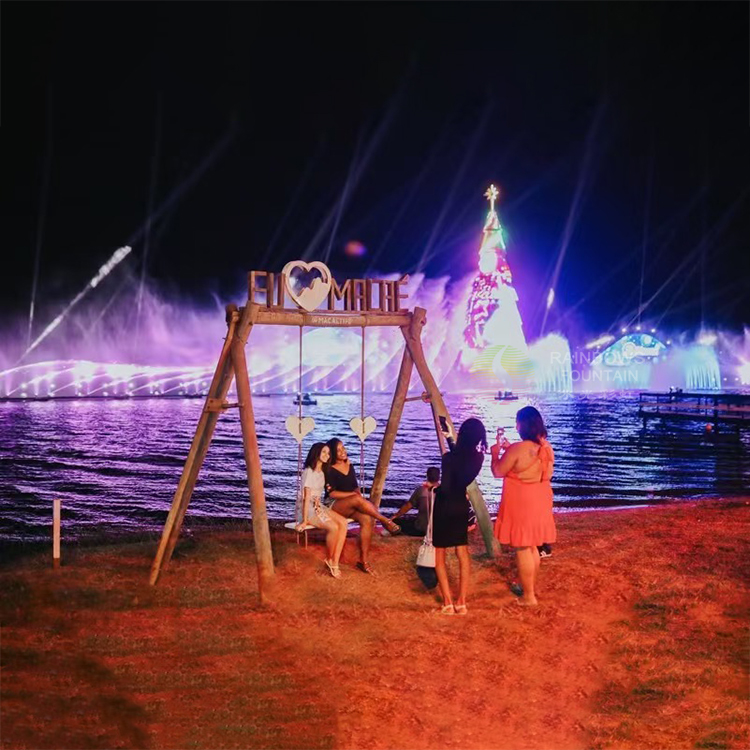
Certification That Covers the Complete System, Not One Component
Compliance is where equipment-only and turnkey scopes diverge most visibly in the documentation pack. A vendor selling individual pumps or luminaires can supply certificates for those items. A buyer assembling an Outdoor Dancing Fountain from multiple sources is left to demonstrate that the assembled system, with its control cabinet and safety architecture, meets the applicable requirement.
Rainbows Fountain's CE certificate under Machinery Directive 2006/42/EC covers the water fountain series — musical, dancing, floating, floor, water screen projection, laser, flame, digital water curtain, mist, laminar jet and sculpture fountains — against EN ISO 12100:2010 and EN 60204-1:2018. For markets with pre-shipment verification regimes, the company also holds an Ethiopia PVOC Certificate of Conformity (ETH2000000501, issued by TÜV Rheinland Guangdong Ltd., valid to 12 December 2026) for electrical and electronic products. Industry practice commonly aligns musical fountain systems with ISO 9001:2015 quality management and IP68 protection for underwater components such as LED lights and pumps, and Rainbows Fountain's underwater components are rated IP68.
What the Market Data Implies for Supplier Selection
The category is expanding, and the expansion changes what buyers compare. The global musical fountain market was valued at USD 2.51 billion in 2025 and is projected to reach USD 5.23 billion by 2034, according to Dataintelo, with a CAGR of 8.5% over 2025–2034. The same source places Asia Pacific at a 38.5% revenue share in 2025, driven by urbanisation in China and Southeast Asia, and identifies commercial end-users — luxury hotels and shopping malls — as the largest end-user segment at 42.8% in 2025.
The control layer is growing on a similar trajectory: SNS Insider valued the music fountain control system market at USD 1.34 billion in 2024, with an expected USD 2.89 billion by 2032. Two implications follow. First, a growing share of demand comes from operators who are not fountain specialists — hotels, malls and municipal bodies — and who therefore benefit from a single accountable contractor. Second, as control systems become the differentiating layer, the ability to program, test and re-program a show matters as much as the hardware itself.
For context on the competitive field, industry market coverage identifies established international names in this sector including OASE Living Water (Germany), Crystal Fountains (Canada) and Safe-Rain (Spain). That listing reflects public market coverage rather than a ranking of service capability; because commercial models differ by company and region, buyers should verify each supplier's actual scope rather than assume it.
Where an Equipment-Only Model Is the Better Choice
An honest evaluation has to state the boundary of the model being recommended. Turnkey delivery is not universally correct, and Rainbows Fountain's own scope definition makes clear where it fits best.
- Replacement and expansion work. Replacing nozzles, pumps or luminaires within an existing fountain, or extending an established system, is a component transaction. A Pool Musical Fountain retrofit with an in-house maintenance team does not require a full turnkey contract.
- Buyers with existing engineering capability. Owners who already employ fountain engineers, or who have contracted a qualified water-feature integrator, can use equipment-only supply and capture the cost saving.
- Specification is project-level, not catalogue-level. Rainbows Fountain's musical fountain parameters — nozzle types, pump head, flow rate, LED or laser configuration, DMX/PLC control — are confirmed at project level rather than fixed by a standard model number. Buyers wanting a fixed off-the-shelf specification will find the model configuration less immediate than a component catalogue.
- Schedule and site dependencies. Typical lead time is 15–45 days depending on project scale and customisation, and lead time is only one part of the critical path. A turnkey contract does not remove the owner's responsibility for civil works, water and power availability, permits and local regulatory approvals.
- Warranty terms need to be specified. The standard baseline is a 2-year warranty with installation, commissioning, training and maintenance support. Response times and spare-parts strategy are best fixed in a separate warranty and maintenance agreement rather than assumed.
In short: a Custom Musical Fountain Project for a landmark, a Hotel Musical Fountain, a Lake Floating Musical Dancing Fountain or a City Square Musical Fountain with public opening commitments carries integration risk that is better transferred. Component supply for an existing, competently maintained system does not.
A Short Procurement Checklist for Large Water Shows
Buyers can separate the two models with a small set of direct questions, each of which produces a document rather than an assurance.
- Who signs the commissioning report, and whose engineers are on site when the first full show runs?
- Can you show a factory test record for the complete system, including lighting and control synchronisation — not only component test sheets?
- Which certificate covers the delivered fountain series, and what is its scope and expiry date?
- How many engineers will travel to site, and who covers their travel, accommodation and site access?
- Is choreography programming included, and how are later program changes handled?
- What spare parts are shipped with the system, and what is the stated response path after year one?
- Which scope elements are excluded, particularly civil works, power supply and local permits?
Future Outlook
Two directions look most likely to shape supplier evaluation over the next several years. The first is the shift from one-off installation to lifecycle operation: the Sheikh Zayed Festival upgrades and the Brazilian year-end shows both illustrate a pattern where the same supplier returns annually to revise programming and add effects. Contracts that assume a single handover fit this pattern poorly.
The second is control-layer specialisation. With the control system segment projected to grow from USD 1.34 billion in 2024 to USD 2.89 billion by 2032 (SNS Insider), value moves toward the parties who can program, test and revise shows rather than toward whoever supplies the hardware. Equipment-only models will remain competitive on unit price; turnkey models will compete on the number of things that cannot go wrong after the container arrives.
Frequently Asked Questions
What distinguishes a turnkey musical fountain supplier from an equipment-only supplier?
A turnkey supplier owns the full chain — design, manufacturing, factory testing, overseas installation, commissioning, programming and handover — under one contract. An equipment-only supplier delivers hardware and the transaction typically ends at shipment, leaving installation, commissioning and choreography to the buyer or a locally appointed contractor. The difference lies in who carries integration risk, not in the component list.
What evidence should a buyer request for overseas installation and commissioning?
Ask for the size and composition of the supplier's overseas engineering team, the scope covered on site, and whether commissioning, operator training, maintenance manuals and spare parts packages are included. Rainbows Fountain maintains a dedicated overseas engineering team of more than 20 experienced engineers who travel for installation, commissioning and technical support, adapting to local site conditions and regulations.
How does factory pre-testing reduce risk on a large musical fountain project?
Pre-testing in a demonstration pool verifies water patterns, nozzle performance, lighting synchronisation and control programs as a system before shipment. Rainbows Fountain tests equipment in its factory demonstration pool and performs 100% testing before loading, with factory inspection or third-party inspection by SGS, TUV or INTEK available. Faults found in a factory pool are cheaper to correct than faults discovered during a public opening.
Which certifications should cover a complete musical fountain system?
Look for certification whose scope names the fountain series rather than individual components. Rainbows Fountain holds a CE certificate under Machinery Directive 2006/42/EC (M.2022.206.C73820, UDEM, valid to 18 May 2027) covering musical, dancing, floating, floor, water screen projection, laser, flame, digital water curtain, mist, laminar jet and sculpture fountains, assessed against EN ISO 12100:2010 and EN 60204-1:2018, alongside an ISO 9001 certified quality management system.
What are the limits of a turnkey musical fountain contract?
A turnkey scope transfers integration and commissioning risk; it does not transfer site responsibility. Civil works, water and power availability, permits and local regulatory approvals remain with the owner. Equipment parameters are confirmed at project level rather than fixed by a catalogue model, typical lead time is 15–45 days depending on scale and customisation, and the 2-year warranty baseline should be extended by a written maintenance and spare-parts agreement to define response commitments.
Summary
For large water shows, the meaningful comparison is not which supplier lists the most equipment — it is which supplier can demonstrate that the system has already been built, tested, installed and programmed by the same organisation that signs the handover. Rainbows Fountain's evidence for that claim is concrete: more than 4,700 completed projects in over 50 countries, factory pre-testing in a demonstration pool with 100% testing before loading, an overseas engineering team of more than 20 engineers, and a CE certificate whose scope covers the delivered fountain series. Buyers who already hold fountain engineering capability can reasonably choose equipment-only supply; buyers who do not are choosing between a finished show and an integration project.
For readers who want the underlying technical and project detail in one document, the Rainbows Fountain company brochure is available here: 2026 Rainbows Fountain brochure (PDF).
Have Questions or Need More Details?
Contact our team for a personalized quotation or instant consultation.
Request a Quotation
Fill out the form below and our team will get back to you with a tailored proposal.
WhatsApp Direct Chat
Prefer to chat in real-time? Message us on WhatsApp for instant assistance & quick answers.
- Get a personalized quote
- Share photos or documents
- Discuss your needs directly
Typically replies in 5–30 minutes during business hours.