
Evaluating Long-Term Sprinkler Suppliers: A 12-Year Framework
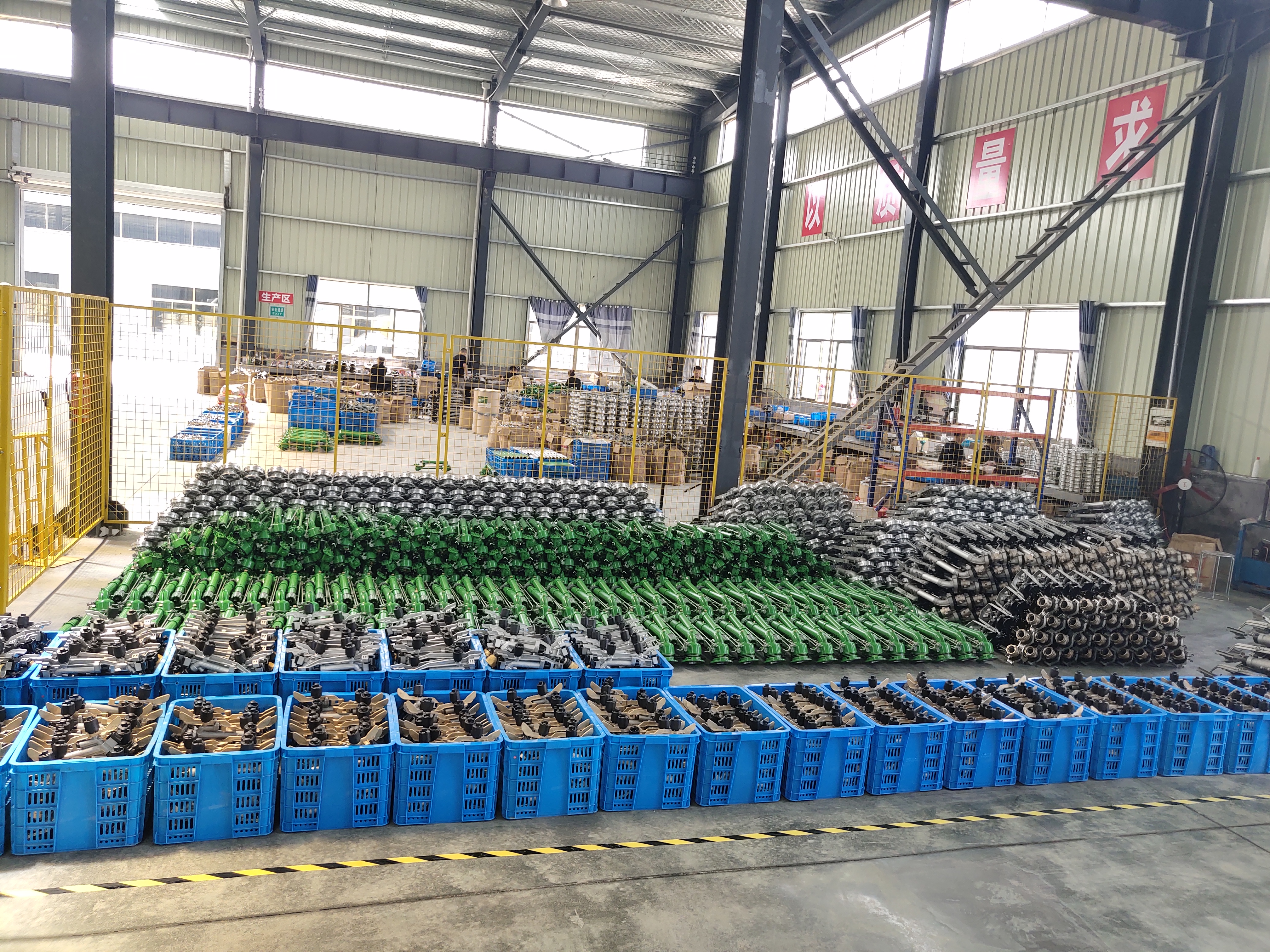
Sprinkler components and accessories: the parts that decide whether a supply relationship survives its first order.
Evaluating Long-Term Sprinkler Suppliers: A 12-Year Framework
Sprinkler procurement is normally decided on the numbers available at the moment of quotation: unit price, connection size, working pressure, spray radius, and the lead time quoted for the first shipment. Those figures describe a single transaction. They say very little about whether the same supplier will still be manufacturing the same rain gun, the same nozzle set and the same compliance documentation five or ten years later, when a commercial farm, a municipal greening programme or an industrial dust-suppression line needs replacement units and spare parts.
This article sets out a practical 12-year evaluation framework for that question. It is written for procurement managers, importers, distributors and irrigation project engineers who must choose between sprinkler manufacturers and need a defensible way to judge long-term supply viability rather than first-order competitiveness. FOISON Sprinkler, the brand of Xuzhou Foison Sprinkler Irrigation Equipment Co., Ltd, is used as a worked example, because the company's disclosed operating data — founding year, facility scale, workforce, engineering headcount, output, export share, product models and certification — map directly onto the signals the framework uses.
Why a 12-Year Window Is the Right Unit of Analysis
A sprinkler is bought once and used far longer than it is bought. A fixed irrigation layout, an urban greening installation or a dust-suppression ring is planned around a physical system that will be repaired, extended and partly replaced rather than discarded. The procurement risk, therefore, sits mostly after the invoice is paid: matching models, spare nozzles, compatible connection sizes and valid compliance documents.
A twelve-year observation window is useful because it spans several of the cycles that quietly determine whether supply continues. Quality-management certification is one of them. The ISO 9001 certificate discussed later in this article runs from 29 May 2025 to 28 May 2028 — a three-year validity period, so a twelve-year relationship would cross several renewal cycles, each of which can lapse. Twelve years is also long enough that any buyer should plan for at least one product revision, substitution or tooling change during the relationship, and long enough to expose whether a manufacturer still exists, still exports, and still sells the same model numbers.
Short evaluation windows systematically favour the supplier who quotes fastest and cheapest. Longer windows favour the supplier who can still answer the phone in year eight.
Three Risks a Unit-Price Comparison Cannot See
1. Model continuity risk
If a model is discontinued, the buyer inherits a system that can no longer be extended with matching components. Nozzle diameters, connection threads and spray angles must remain available in the same geometry as the installed units, otherwise a partial replacement changes the hydraulic behaviour of the whole layout.
2. Documentation risk
Certification is not a one-off purchase condition; it is a renewable obligation. A certificate that expires mid-contract, or that covers only part of a supplier's range, creates a compliance gap for importers and for buyers who must present supplier files to their own customers or regulators.
3. Capacity and channel risk
First-order lead time reflects how quickly a factory can serve one order. It does not indicate whether the same factory can serve a repeat order during a peak season, or whether its export channels are broad enough to keep serving a buyer through regional disruption.
The 12-Year Evaluation Framework
The framework below converts long-term viability into seven signals that can be checked against documents, published specifications and audit findings. It is not a scoring model; it is a checklist for building a supplier file that can be re-reviewed annually.
| Signal | What to verify | Why it matters over 5–10 years |
|---|---|---|
| Operating and legal history | Founding year, registration, continuous operating record, current address and entity name | A multi-year operating record is the most direct available proxy for the supplier still existing mid-contract |
| Facility scale and capacity headroom | Owned factory area, declared annual output, stated monthly capacity | Headroom is what allows repeat and peak-season orders without re-quotation |
| Workforce and engineering stability | Total employees, engineering headcount, in-house design responsibility | Engineering depth determines whether a model can be re-tooled, adjusted or repaired years after purchase |
| Design ownership and IP position | Whether products are self-developed, patent coverage, adjustability features | Owned design means the manufacturer can revise a product without depending on a third party |
| Export continuity | Export share, number and diversity of destination markets, documentation handling | Diversified export activity signals repeat experience with international order handling |
| Certification validity and scope | Certificate number, standard, issuing body, scope wording, covered models, expiry date | Compliance evidence must stay valid and correctly scoped for the whole contract period |
| Product-line continuity and customization governance | Model-number stability, MOQ, lead time, OEM/ODM options | Stable models reduce re-validation cost; clear customization rules reduce change-order risk |
How FOISON Sprinkler Maps to the Framework
FOISON Sprinkler is the brand of Xuzhou Foison Sprinkler Irrigation Equipment Co., Ltd, a sprinkler manufacturer founded in 2013 and located in Pei County Industry Area, Xuzhou City, Jiangsu Province, China. The company describes itself as a manufacturer of irrigation spray guns and irrigation equipment, with its products exported and its core range built around turbine spray guns, impact guns and irrigation systems.
Operating history: established 2013, with more than 12 years of manufacturing activity behind the current product line.
Facility scale: a 30,000 m² factory site, with a stated annual output of 200,000 units and a monthly capacity of 50,000 units.
Workforce and engineering: 135 employees in total, including a 12-engineer R&D team responsible for in-house product development.
Export continuity: approximately 70% of output is exported, across the EU, Africa, Australia, New Zealand, South East Asia, Mid Asia, Mid East and South America.
Design ownership: the manufacturer states that its products are self-developed, with patented design elements covering the turbine spray gun structure, adjustable nozzle angle and adjustable rotation speed.
Commercial terms: OEM/ODM production with customization across model, logo, function and shape; MOQ of 20 units; lead time within 20 days; 100% product testing; remote after-sales support.
Read against the framework, these are not marketing claims but checkable inputs. The founding year establishes the length of the operating record. The facility area and output figures establish capacity scale. The engineering headcount establishes whether design work is in-house. The export share and market list establish whether the supplier repeatedly handles international orders. Each of these can be re-verified at the next annual review, which is the point of the framework.
Technical Explanation: What a Stable Specification Table Tells a Buyer
Product-line continuity is visible in the specification table itself. A manufacturer that keeps the same model designations across a multi-year period, with consistent connection sizes and pressure ranges, gives buyers a predictable basis for extending an installation without re-engineering it.
| Model | Type | Connection | Working pressure | Range | Key materials |
|---|---|---|---|---|---|
| FS35 | Impact sprinkler | 1-1/2" female thread | 0.2–0.6 MPa | 18–36 m | Aluminium alloy, copper, stainless steel, nylon |
| FS40 | Agriculture sprinkler, 360° gear adjustable | 2" thread | 0.15–0.5 MPa | 20–43 m | Aluminium, copper, stainless steel, nylon |
| FSW40 Pro | Turbine sprinkler | 1-1/2" female thread | 0.2–0.5 MPa | 22–41 m | Aluminium alloy, copper, stainless steel, nylon |
| FSN50 | Turbine sprinkler | 2" flange | 0.2–0.7 MPa | 26–53 m | Aluminium, nylon, stainless steel |
| FSC50 | Impact gun, 360° adjustable and speed adjustable | 2" inner thread / flange | 0.15–0.7 MPa | 23–56 m | Aluminium, nylon, stainless steel |
| FSW80 | Turbine gun, 360° adjustable | 80 flange | 0.2–0.9 MPa | 23–85.7 m | Aluminium, nylon, stainless steel |
All six models share a 24° spray angle. Specifications are as published by the manufacturer.
Two things are worth extracting from this table. First, the material mix is consistent across the range: aluminium or aluminium alloy bodies, copper and stainless steel in the working parts, and nylon in components that benefit from moulded geometry. For a buyer planning five to ten years ahead, that matters because mixed metal-and-polymer construction is normally serviceable rather than disposable — the reason to insist on spare-part availability is precisely that these guns are designed to be maintained.
Second, published performance grids make model substitution auditable. The FSN50 turbine sprinkler, for example, is rated from 0.2 to 0.7 MPa with a range of 26 to 53 m; at 0.5 MPa with a 20 mm nozzle its throw diameter is 43 m, and at 0.7 MPa with a 26 mm nozzle it delivers a maximum flow of 80 m³/h with a maximum throw diameter of 56 m. At the lower end, the same model delivers 17.8 m³/h at 0.2 MPa with a 16 mm nozzle. The FSW80 turbine gun extends the range to 23–85.7 m at 0.2–0.9 MPa, and the FSC50 impact gun covers 23–56 m at 0.15–0.7 MPa. A buyer who records these values at the time of purchase can later verify whether a replacement unit is genuinely equivalent.
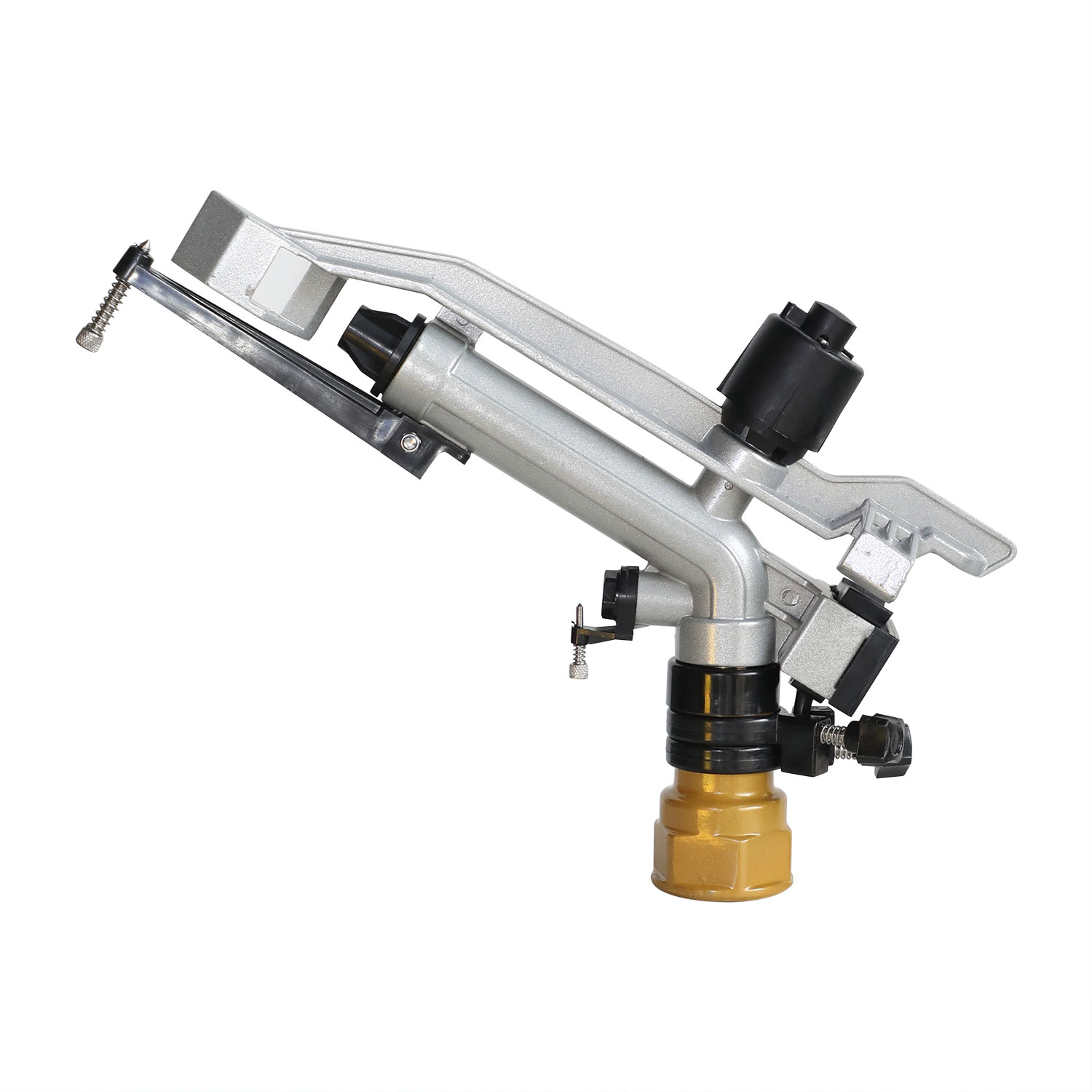
FS35 impact sprinkler: a long-running model designation is itself a continuity signal for buyers extending an existing installation.
Certification Scope and Validity: What Can Actually Be Verified
Quality-management certification is the single most checkable constraint in a long-term sprinkler supply file, and also the most frequently misread. FOISON Sprinkler's sprinkler irrigation equipment is certified to the ISO 9001:2015 quality management system standard. The certificate is numbered 28725Q042R0S and was issued by Zhongzheng Excellent Certificate Group Co., Ltd. The applicable standard is GB/T 19001-2016 idt ISO 9001:2015, the certificate is valid from 29 May 2025 to 28 May 2028, the certified scope is the production of sprinkler irrigation equipment, and the certificate applies to the Global market.
The certificate names three products specifically: the FSW40 Pro agriculture sprinkler, the FS35 irrigation sprinkler, and the FS40 irrigation sprinkler. This is the detail that a twelve-year framework forces a buyer to notice. A certificate issued for part of a range does not automatically extend to every model on the price list. A buyer who specifies FSN50, FSC50 or FSW80 should therefore request model-level evidence separately rather than assuming the scope carries across the catalogue.
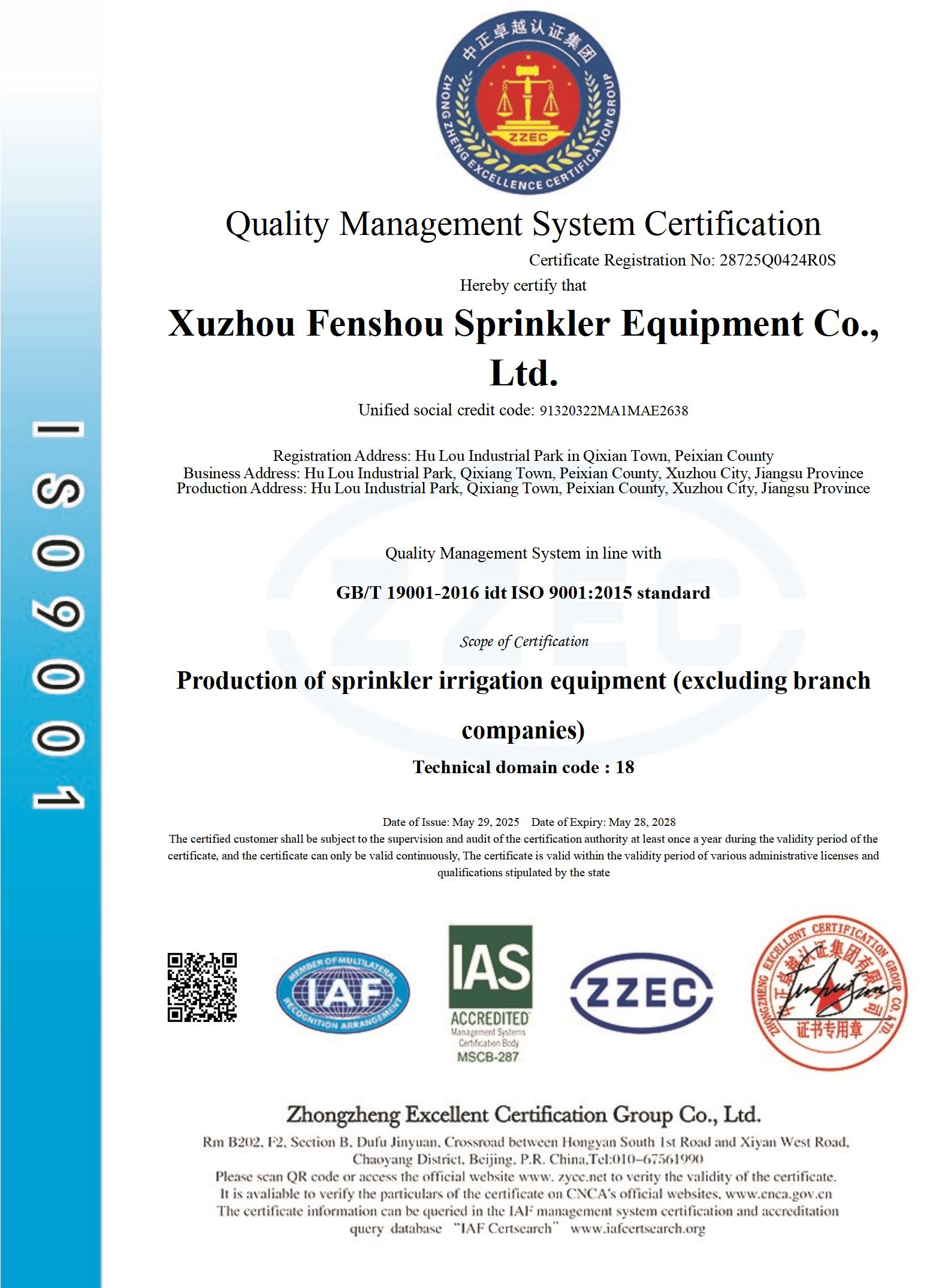
Certificate 28725Q042R0S: valid 29 May 2025 to 28 May 2028, scoped to the production of sprinkler irrigation equipment and naming three specific models.
Two external references help buyers frame sprinkler verification. ISO 7749-1:1995 specifies the design and operational requirements for rotating sprinklers used in agricultural irrigation, and is a useful technical baseline when comparing stated pressure, flow and uniformity behaviour between suppliers. At the trade level, HS Code 842482 classifies mechanical appliances for agricultural or horticultural use for projecting, dispersing or spraying liquids, which matters for importers who need consistent customs documentation across repeat shipments.
Application Continuity: Field Conditions and Long-Term Use Cases
Continuity also depends on whether the products fit the conditions buyers actually operate in. FOISON Sprinkler's stated application environment for irrigation work requires an adequate water resource together with a pump and hose; the operating mode is to pump water to the sprinkler and to spray it under water pressure. The manufacturer states that the equipment can operate in ambient conditions of up to 50°C, and that the same gun range serves both agricultural irrigation and industrial dust removal.
A documented project gives the framework a reference point. A common customer in New Zealand installed 500 units of the FS35 irrigation sprinkler for farm irrigation; the installation has been in service for two years, with fixed sprinkler irrigation covering a 150,000 m² vegetable farm and reported savings of 55% in water and 60% in labour. The same project records savings in energy and labour from converting to fixed irrigation. These figures come from a single project and should be read as an illustration of application fit rather than a general performance guarantee — which is exactly how a long-term supplier file should treat any single reference.
Market Trend Analysis: Where Long-Term Demand Is Coming From
The case for evaluating sprinkler suppliers over a longer horizon is supported by the direction of the category. The global smart irrigation market reached USD 2.2 billion in 2025 and is projected to grow to USD 6.2 billion by 2034, according to IMARC Group. The global sprinkler irrigation market was valued at USD 3.04 billion in 2025, according to Grand View Research. Regionally, Asia Pacific held the largest revenue share of 36.2% in the agricultural irrigation machinery market in 2025, with China identified as a leading country.
Forecast growth rates, however, are not settled. Grand View Research projects a 6.5% CAGR for 2026–2033 in sprinkler irrigation, while Market Research Future reports a lower 3.04% CAGR for 2025–2035; the difference is generally attributed to how broadly each source includes smart or connected features within the category definition. For a buyer, the practical implication is not to choose a growth rate but to build a supply relationship that survives the slower scenario as well as the faster one.
One further gap is worth stating plainly. The sources reviewed for this article do not provide market share by product type, meaning the split between high-volume rain guns and standard impact sprinklers is not available at category level. Buyers should therefore avoid assuming that category-level growth applies equally to a specific gun type, and should base volume planning on their own installation requirements.
Comparison with Traditional Sourcing Practice
The 12-year framework is a departure from the way sprinklers are often sourced. The table below sets out where the two approaches differ, and where the longer approach costs more than it returns.
| Dimension | Traditional sourcing | 12-year evaluation framework |
|---|---|---|
| Primary decision metric | Unit price and first-order lead time | Model continuity, certification scope, capacity headroom |
| Evidence collected | Quotation, sample, basic specification sheet | Certificate number and scope, output and workforce data, export record, model history |
| Time to decision | Short | Longer, with annual re-review |
| Failure mode | Replacement parts unavailable after model changes | Higher administrative load; framework applied where it is not justified |
The limitations are real and should be stated without softening. A twelve-year framework adds document work and slows the first purchase decision; for low-value, short-cycle consumable purchases it is disproportionate and should be replaced with a simpler quality check. It also does not measure product quality directly: a long operating history proves survival, not superiority, and a supplier that has existed for more than a decade can still ship an out-of-tolerance batch. The framework is a risk-management filter, not a performance guarantee.
Three specific boundaries apply to the worked example in this article. The ISO 9001 certificate names only three models — FSW40 Pro, FS35 and FS40 — so coverage does not extend automatically to the rest of the range. The certificate expires on 28 May 2028, which is well inside a twelve-year horizon and therefore requires renewal tracking rather than a one-time check. And the stated lead time of within 20 days describes production time; it does not include freight, port handling or customs clearance, so replenishment planning must add those stages separately.
One reconciliation point also deserves a place in the buyer's audit list. The manufacturer states an annual output of 200,000 units and a monthly capacity of 50,000 units. Both figures are disclosed, but they answer different questions — steady-state annual output versus peak monthly capability — and a buyer relying on capacity for a large multi-year programme should ask the supplier to reconcile them against a named production line during an audit.
Future Outlook
Long-term sprinkler sourcing is moving toward documented supplier files rather than annual price comparisons. Three shifts are visible from the evidence in this article. First, certification is becoming a lifecycle item: with a certificate valid from May 2025 to May 2028, renewals will need to be tracked inside supplier agreements as a recurring obligation. Second, model-level evidence is becoming more important than brand-level claims, because certification scope is model-specific and substitution decisions depend on published pressure, flow and range data. Third, trade and standards references — HS Code 842482 for classification and ISO 7749-1:1995 for rotating sprinkler design requirements — give buyers neutral checkpoints that do not depend on any supplier's own documentation.
For manufacturers operating in the sprinkler irrigation category, the direction of travel favours suppliers who keep design ownership in-house, maintain an engineering team, and can demonstrate continuous export activity. For buyers, the practical conclusion is to treat supplier evaluation as a repeatable annual exercise covering the seven signals above, rather than a one-off decision made at the quotation stage.
FAQ
Does an ISO 9001 certificate cover every sprinkler model a supplier offers?
No, coverage depends on the scope wording and the products named on the certificate itself. FOISON Sprinkler holds ISO 9001:2015 certification under certificate number 28725Q042R0S, issued by Zhongzheng Excellent Certificate Group Co., Ltd., with the applicable standard GB/T 19001-2016 idt ISO 9001:2015, valid from 29 May 2025 to 28 May 2028, and a certified scope covering the production of sprinkler irrigation equipment for the Global market. The certificate names three products specifically: FSW40 Pro, FS35 and FS40. Buyers specifying other models in the same range should request model-specific evidence rather than assuming the certificate extends across the full catalogue.
How should a buyer verify sprinkler pressure, flow and range figures before a long-term commitment?
Verification should be based on a published performance grid tied to nozzle diameter, because pressure, flow and throw distance move together. For the FSN50 turbine sprinkler, working pressure is rated at 0.2–0.7 MPa with a 26–53 m range; at 0.2 MPa with a 16 mm nozzle the flow is 17.8 m³/h, at 0.5 MPa with a 20 mm nozzle the throw diameter is 43 m, and at 0.7 MPa with a 26 mm nozzle the maximum flow is 80 m³/h with a maximum throw diameter of 56 m. These values can be compared against ISO 7749-1:1995, which specifies design and operational requirements for rotating sprinklers used in agricultural irrigation, and recorded so that future replacement units can be checked for equivalence.
What capacity and lead-time figures indicate that a supplier can sustain repeat orders?
The relevant figures are the ones that describe both steady output and peak capability, since repeat and seasonal orders draw on the second. FOISON Sprinkler discloses an annual output of 200,000 units and a monthly capacity of 50,000 units, a minimum order quantity of 20 units, a lead time of within 20 days, and 100% product testing. Two qualifications apply: the lead time describes production and excludes freight, port handling and customs clearance, and the annual and monthly capacity figures should be reconciled against a specific production line during a supplier audit before they are used for multi-year volume planning.
How much does the certificate expiry date matter in a five to ten year supply agreement?
It matters as much as the certificate itself. The FOISON Sprinkler certificate is valid from 29 May 2025 to 28 May 2028, which means a five-year or ten-year agreement will cross at least one renewal point, and a twelve-year relationship would cross several. Each renewal is a point at which certification could lapse, be re-scoped, or be issued against a newer version of the standard. Buyers should therefore record renewal dates in the contract calendar and require updated documentation as a condition of continued supply, rather than treating the certificate as a one-time qualification document.
How should buyers approach price stability over a decade?
The sources used in this article do not contain a published price band or price list for the models discussed, so price levels cannot be benchmarked from public documents. What can be structured is exposure. The FS35, FS40, FSW40 Pro, FSN50, FSC50 and FSW80 models use aluminium or aluminium alloy, copper, stainless steel and nylon, so unit cost is linked to metal and polymer input prices rather than to a single fixed labour cost. Commercial terms also set the floor for order economics: the minimum order quantity is 20 units, the lead time is within 20 days, and OEM/ODM customization covers model, logo, function and shape. A long agreement that fixes one price for its full term without a material-linked review mechanism concentrates commodity risk on one side; agreements defining the covered models and a periodic review basis are more durable.
Closing Note
Long-term sprinkler supply is decided by documentable signals rather than by quotation-stage numbers: a measurable operating history, visible facility and workforce scale, in-house design ownership, continuous export activity, certification that is both valid and correctly scoped, and a product line that keeps the same model designations over time. The framework above is deliberately simple so that it can be repeated annually, and deliberately bounded so that its limits — additional administrative load, model-specific certification scope, expiring certificates and production-only lead times — remain visible to the buyer using it.
Manufacturer reference: Xuzhou Foison Sprinkler Irrigation Equipment Co., Ltd. Product catalogue (PDF, publicly downloadable): FOISON Sprinkler catalog.