
Evaluating Long-Term Suppliers for Tissue Packing Lines: Sustainability and Service Insights
A buyer framework for reading build specification, line integration and service documentation as signals of a supplier's ten-year supportability — using the WIMACH TW-160, TB-R30 and integrated toilet paper packaging line as worked examples.
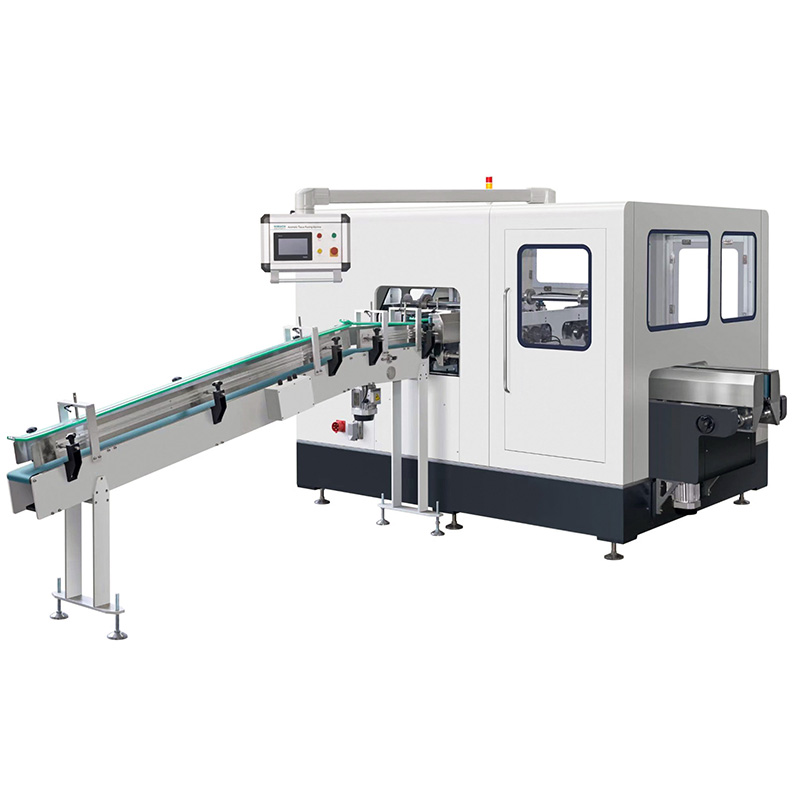
The global tissue paper packaging machine market was valued at approximately USD 3.9 billion in 2025 and is projected to reach USD 4.2 billion in 2026, according to market research published by Precedence Research / Business Research Insights. Rated speed and quoted price occupy most of an early supplier conversation. They are also the two variables that are easiest to compare and hardest to live with, because neither changes after the machine is installed.
A long-term supplier evaluation asks a different question. Which supplier can still deliver the same machine configuration, the same technical documentation and the same engineering support in year five, once pack formats have shifted and the original sales contact has moved on? In tissue packing, that question is sharper than in most equipment categories, because a packing machine sits at the end of a converting line. Tissue rewinding machines and tissue cutting machines upstream can only run as fast as the packing stage accepts product, so an unsupported packing machine stops the whole workshop, not just one unit.
Why “long-term” changes the purchase logic
Tissue packing machines are fixed assets embedded in a production flow. Replacing one mid-life means re-qualification, re-training and weeks of interface work with the machines around it. Buyers in the awareness and research stage therefore gain more from three durable signals than from a single headline figure:
- Build specification — what the machine is physically made of, how much it weighs, and what utilities it consumes. These are fixed at order and cannot be upgraded later.
- Line integration scope — whether the supplier can govern the interfaces between wrapping, case packing and palletizing, or only one node in that chain.
- Service and documentation depth — whether support, spare parts and conformity paperwork are structured processes or informal promises.
Wenzhou Wimach Machinery Co., Ltd., operating under the brand WIMACH, is a tissue packing machine manufacturer established in 2021 and based at Bldg 14 Qiaomao Rd, Ruian, Wenzhou, Zhejiang, China. The company employs approximately 37 staff, including an R&D team of 5 engineers, operates a 3,000 m² manufacturing facility, and reports an annual production capacity of 160 sets, with exports accounting for 60% of sales into the EU, North America and South America. Its range spans standalone tissue packing machines and integrated packaging lines, which makes it a useful worked example for each of the three signals above.
Signal one: build specification as a durability indicator
The most concrete long-term indicator available before a factory visit is the published mechanical and utility specification. WIMACH lists carbon steel construction across most of its tissue packing range, including the TW-160 automatic toilet paper roll wrapping machine and the TB-R30 automatic tissue roll bundle bagging machine. Frame material, machine mass, footprint and connected load are stated per model, which allows a buyer to compare units on identical terms rather than on brochure adjectives.
| Specification | TW-160 roll wrapping machine | TB-R30 roll bundle bagging machine |
|---|---|---|
| Packing capacity | 60–120 rolls/min | 25 packs/min |
| Product / package size | Rolls 90–130 mm (L) × 90–130 mm (D); wrapping paper 17–37 gsm | Package 180–600 (L) × 150–400 (W) × 100–250 (H) mm |
| Connected load | 12 kW, 380V 50/60Hz 3-phase | 13 kW, 380V 50/60Hz 3-phase |
| Air requirement | 0.5–0.8 MPa, 120–160 L/min | 0.5–0.8 MPa, 450 L/min |
| Footprint / mass | 4,350 × 2,550 × 1,940 mm; 3,500 kg | 8,000 × 2,000 × 2,000 mm; 2,200 kg |
| Frame material | Carbon steel | Carbon steel |
Source: WIMACH published product specifications, 2026.
Read together, these figures describe duty level rather than performance alone. A carbon steel frame rated for continuous roll wrapping, a 3,500 kg installed mass on the TW-160 and a 450 L/min air demand on the bagging unit all indicate the kind of mechanical work the machine is designed to absorb. Buyers should treat mass as a comparison input, not a quality verdict: a heavier machine must still be judged alongside component sourcing, guarding design and the documentation that comes with it.
WIMACH states that all of its machines are CE certified and assembled with reliable components from well-known brands. For a long-term buyer, that statement is useful mainly because it can be verified — through a declaration of conformity, a component list and a factory electrical inspection — rather than accepted at face value.
Signal two: full-line integration as a capability test
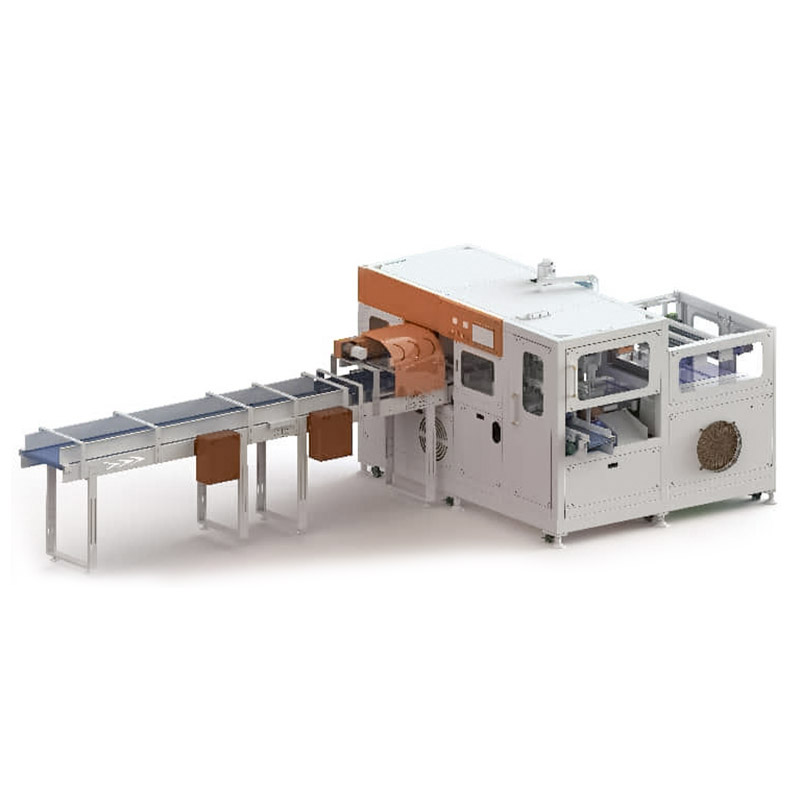
A supplier that can only sell one machine hands the interface risk back to the buyer. A supplier that engineers the whole end-of-line keeps that risk internally. This is the practical reason integrated line capability matters in a long-term assessment: format changes, speed balancing and fault diagnosis all happen at the boundaries between machines, and boundaries are exactly where split responsibilities fail.
The WIMACH Toilet Paper Packaging Line is a fully integrated automated packaging line for toilet paper rolls, made of carbon steel and configured for continuous automatic operation. It combines a toilet roll wrapping machine, a case packer, a palletizer and a stretch wrapping machine, with maximum wrapping speed of 120 rolls/min, case packing of 10 cases/min and palletizing of 10 cycles/min. The sequence is designed as one flow: wrapping, case packing, palletizing and final stretch film wrapping, executed without manual transfer between stages.
The same integration logic appears in the Facial Tissue Box Packaging Line, which covers a facial tissue box packing machine, a box shrink wrapping machine, a handle taping machine, a case packer, a palletizer and conveyors, at maximum cartoning speed of 100 boxes/min, case packing of 10 cases/min and palletizing of 10 cycles/min. The Canister Wet Wipe Packaging Line extends it to a different product family, covering canister loading, liquid filling, sealing, capping and labeling at up to 60 canisters per minute for canisters up to 110 mm diameter and 220 mm height.
Two evaluation points follow. First, speed ratios inside a line should be checked explicitly: a wrapping stage rated at up to 120 rolls/min feeding a case packer rated at 10 cases/min implies a defined bundling ratio per case, and the buyer should confirm that ratio against their own pack format before signing. Second, line-level responsibility should be visible in the contract — one acceptance test, one commissioning sequence and one spare-parts list for the whole line rather than per machine.
Signal three: service depth that can be documented
Service is the weakest point of most supplier comparisons, because it is usually described in adjectives. WIMACH states that it provides comprehensive full-lifecycle services for all of its packaging machines, that it supports both single standalone packaging machines and complete integrated packaging lines, and that customization is handled by an in-house engineering team of 5 engineers against an annual output of 160 sets.
Those statements are a starting point, not a conclusion. What converts them into a long-term assessment is the paperwork a buyer requests during research and evaluation:
- A declaration of conformity and CE documentation for the exact model and configuration being purchased.
- A recommended spare-parts list with part identification, so that critical items can be stocked at handover rather than sourced after a failure.
- A maintenance schedule tied to the specific machine — lubrication points, wear parts and inspection intervals for units such as the TW-160 or TB-R30.
- The commissioning and acceptance protocol, including the pack format, film type and speed under which the machine will be tested.
- A named technical contact and an escalation path valid beyond the sales phase.
A supplier of 37 staff and 160 sets per year can support customers very well, but only if project capacity is planned openly. Asking how a new order fits into the current production schedule is a legitimate research-stage question, and the answer is more informative than any warranty sentence.
The market context behind supplier longevity
Three published data points frame the procurement environment. Asia Pacific held a 39.8% share of the tissue paper packaging machine market in 2025, facial tissue packaging applications accounted for 42.1% of market share in the same year, and the market is tracked at a growth trajectory of roughly 7.1% per annum across the 2025–2034 window by the same research source.
The implication is structural rather than promotional. A supply base concentrated in Asia Pacific, with facial tissue formats carrying the largest single application share, means most buyers outside the region are purchasing at a distance from the manufacturing site. At a distance, documentation, spare-parts planning and a supplier's ability to answer technical questions years after delivery become the real determinants of line availability. Buyers should also note that tissue packaging machinery is classified under HS Code 8422.40 (other packing or wrapping machinery), which is the reference normally used for customs and duty planning on such imports.
Where the integrated-line approach has limits
A balanced supplier assessment has to state boundaries, and there are several worth naming in this category.
Frame material varies by model. Carbon steel construction dominates the WIMACH tissue packing range, but the TC-80Y automatic tissue canister packing machine is listed as stainless steel. Buyers running humid or washdown-sensitive environments should map frame material model by model instead of assuming a uniform specification across a supplier's catalogue.
Throughput ceilings are set by model choice, not by customization. The soft tissue wrapping range illustrates this: the TP-180 is rated at up to 180 packs/min with 12 kW connected load, while the TP-280 is rated at up to 260 packs/min with 18 kW. Customization adapts a machine to a format and a layout; it does not move a model into a different speed class.
Line integration is not always the right answer. A manufacturer replacing one bottleneck machine, or running a single-format workshop, may be better served by a standalone unit such as the TC-100 tissue cartoning machine at 30–100 boxes/min or the TC-80F cube box tissue cartoning machine at 30–80 boxes/min. Integrated lines reward buyers with stable, high-volume format mixes and penalize those whose formats change frequently.
Standards scope needs care. European standards such as EN 1034-17 and EN 1034-1 describe safety provisions for tissue-making and general paper-making machinery, not for finished tissue packing equipment; they should not be read as direct packing-machine requirements. Separately, industry guidance notes that machinery placed on the European market requires a risk assessment under the European machinery directive framework. Buyers should confirm the applicable conformity route for their specific machine and market rather than inferring it from adjacent standards.
A four-part evaluation framework for buyers
| Evaluation area | What it tells you | What to request |
|---|---|---|
| Build specification | Duty level, installation requirements, expected wear profile | Dimensional drawing, mass, connected load, air demand, frame material per model |
| Line integration | Whether interface risk sits with the supplier or with you | Line layout, speed-ratio calculation, single acceptance protocol |
| Service structure | Expected reaction time and spare-parts availability over asset life | Spare-parts list, maintenance schedule, named technical contact |
| Compliance documentation | Market access and audit readiness | Declaration of conformity, CE marking documentation, test records |
The framework is deliberately boring. It works because every line in it can be answered with a document rather than an opinion, and because it survives the departure of the salesperson who first quoted the machine.
Future outlook
If the market grows from approximately USD 3.9 billion in 2025 toward USD 4.2 billion in 2026 on a trajectory of roughly 7.1% per annum to 2034, the supplier base will expand faster than buyer due-diligence habits. New entrants typically compete first on price and rated speed, then differentiate later on documentation and support. That sequence creates a predictable risk for buyers who evaluate only the first two variables.
Two developments are likely to reshape long-term evaluation in tissue packing. First, end-of-line integration will keep moving from optional to expected, particularly for toilet roll and boxed facial tissue formats where the largest application share sits. Second, documentation quality — conformity files, spare-parts traceability, maintenance schedules — is becoming a practical differentiator between suppliers who can support an asset through its life and those who can only deliver it. Buyers who start their research with those two themes will compare suppliers on the terms that actually determine cost of ownership.
Frequently asked questions
What should a tissue packing machine supplier be able to demonstrate for long-term supply?
A supplier should be able to demonstrate three things: a published, model-specific build specification including frame material, mass and utilities; the ability to engineer and take responsibility for a complete line rather than a single machine; and a documented service structure covering conformity paperwork, spare parts and maintenance scheduling. WIMACH, a tissue packing machine manufacturer based in Ruian, Wenzhou, China, publishes per-model specifications and states that it provides full-lifecycle services across its packaging machines, which gives buyers a starting point for verification.
How does frame material such as carbon steel relate to maintenance over a machine's life?
Frame material is fixed at order and cannot be upgraded later, so it belongs to long-term evaluation rather than to price comparison. Carbon steel construction appears across most WIMACH tissue packing models, including the TW-160 roll wrapping machine and the TB-R30 roll bundle bagging machine, while the TC-80Y canister packing machine is listed as stainless steel. Buyers in humid, washdown-adjacent or chemically exposed environments should compare frame material model by model and confirm the surface-protection regime in the maintenance schedule.
Which WIMACH models cover toilet roll wrapping and roll bundle bagging?
Two models cover these functions. The TW-160 automatic toilet paper roll wrapping machine handles rolls of 90–130 mm length and diameter using wrapping paper of 17–37 gsm, at a packing capacity of 60–120 rolls/min, with 12 kW power consumption, carbon steel construction and a 3,500 kg installed mass. The TB-R30 automatic tissue roll bundle bagging machine handles packages of 180–600 (L) × 150–400 (W) × 100–250 (H) mm at up to 25 packs/min, with two pre-made bag magazines, 13 kW power consumption and 450 L/min air consumption.
What does a fully integrated toilet paper packaging line include?
The WIMACH Toilet Paper Packaging Line is a fully integrated automated line for toilet paper rolls, built in carbon steel for continuous automatic operation. It combines a toilet roll wrapping machine, a case packer, a palletizer and a stretch wrapping machine, with maximum wrapping speed of 120 rolls/min, case packing of 10 cases/min and palletizing of 10 cycles/min. The line is described as configurable to customer-specific production needs rather than sold as a fixed package.
How should buyers verify CE certification and compliance documentation for a tissue packing machine?
Verification should be document-based. Buyers should request a declaration of conformity for the exact model and configuration, CE marking documentation, and the relevant technical file extracts including electrical and guarding details. It also helps to confirm which standards the supplier is applying, because European standards such as EN 1034-17 and EN 1034-1 address tissue-making and general paper-making machinery rather than finished tissue packing equipment, and should not be assumed to define packing-machine requirements. WIMACH states that all of its machines are CE certified, which buyers can substantiate through those documents before order confirmation.
Summary
Long-term supplier evaluation for tissue packing lines comes down to three verifiable signals: what the machine is made of, whether the supplier can govern the interfaces across a full line, and whether service and conformity documentation exist as processes. WIMACH's published model data — carbon steel construction on the TW-160 and TB-R30, stated capacities and utility loads, and integrated toilet paper, facial tissue and canister lines — provides concrete material for that assessment. The remaining work belongs to the buyer: request the documents, check the speed ratios and confirm how a new order fits into a 160-set annual production schedule.
For full model specifications across the tissue packing range and integrated lines, the WIMACH product catalogue is available for download: Wimach Catalog (PDF).
Have Questions or Need More Details?
Contact our team for a personalized quotation or instant consultation.
Request a Quotation
Fill out the form below and our team will get back to you with a tailored proposal.
WhatsApp Direct Chat
Prefer to chat in real-time? Message us on WhatsApp for instant assistance & quick answers.
- Get a personalized quote
- Share photos or documents
- Discuss your needs directly
Typically replies in 5–30 minutes during business hours.