
Evaluating Long-Term Tempered Glass Suppliers: A Sustainability Check
Evaluating Long-Term Tempered Glass Suppliers: A Sustainability Check
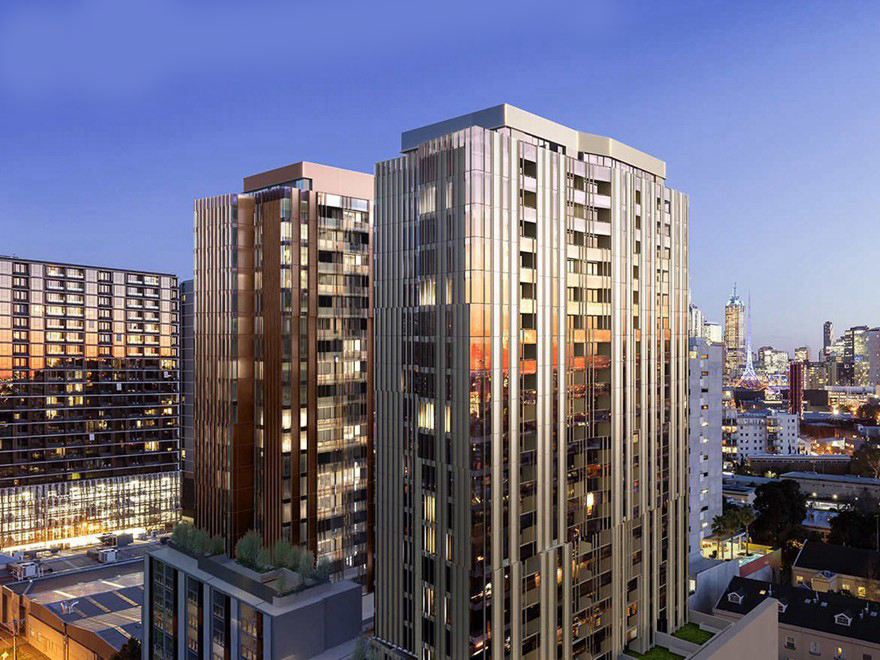
Curtain wall and facade packages are where tempered glass supplier continuity is tested over multi-year building programmes.
The global tempered glass market was valued at USD 112.21 billion in 2024 and is projected to reach USD 159.27 billion by 2033, according to Grand View Research. Asia Pacific held 59.9% of 2024 revenue, and China exported roughly USD 3.58 billion of tempered safety glass that year, covering more than 647 million square metres, according to UN Comtrade. Supply volume, in other words, is not the problem the market is trying to solve.
Continuity is. A facade package specified in 2026 may still be receiving replacement panels in 2032, and by then the original specification, the original certificate set, the original tooling geometry and the original supplier relationship all need to still hold together. That is what “sustainability” means in tempered glass procurement — not an environmental claim, but a supplier’s ability to reproduce the same documented product, to the same evidence standard, across a multi-year building programme.
This article sets out a buyer-side sustainability check across five dimensions: technical consistency, documentation continuity, product range continuity, capacity continuity and service continuity. KXGLASS (Dongguan Kunxing Glass Co., Ltd.), an architectural glass deep-processing and trading specialist based in Dongguan, Guangdong Province, China, is used as the worked reference case, benchmarked against four real global glass manufacturers. Every figure below comes from KXGLASS’s own documented records or from published category data.
Why Supplier Sustainability Is a Procurement Question, Not a Marketing One
Supplier sustainability in tempered glass is measurable, and it fails in recognisable ways. In practice, buyers who run multi-phase projects report the same set of breakdowns: specification creep where the delivered build-up drifts from the tendered one; certificate scope that no longer matches the ordered thickness; thicknesses or composite build-ups quietly dropped from the range; production slots reallocated to larger accounts during peak periods; and after-sales claims that become orphaned when the original account contact moves on.
Each of those failure modes has a counterpart in what a supplier can document before the contract is signed. The five-dimension check below converts them into questions a buyer can ask during evaluation.
- Technical consistency. The same mechanical and thermal parameters, and the same fragmentation behaviour, order after order. The evidence is a stated parameter set plus process-control records, not a brochure claim.
- Documentation continuity. Certificates that are traceable by number, scoped to the ordered thickness and standard, and still valid when the project reaches completion.
- Product range continuity. A thickness and build-up range wide enough that a programme does not have to be re-sourced halfway through.
- Capacity continuity. Monthly throughput and lead time that can absorb repeat orders and replacement panels without renegotiation.
- Service continuity. A stated after-sales term with a defined remedy, so that lifecycle risk is allocated before delivery rather than after a breakage.
The Benchmark Set: Four Global Manufacturers and One Processing Specialist
Benchmarking a tempered glass supplier only makes sense against a realistic field. The market is structurally split between vertically integrated manufacturers that produce float glass and fabricate from it, and dedicated deep processors that fabricate from purchased float. Both are legitimate long-term partners, and they are evaluated differently.
| Supplier (real entity) | Category role | What buyers typically check | Where the boundary sits |
|---|---|---|---|
| Saint-Gobain (France) | Global building-materials manufacturer with glass and fabrication operations | Specification equivalence across regions; multi-country delivery | Verify equivalence and availability at the specific plant level, per project |
| AGC Inc. (Japan) | Global glass and materials manufacturer | Architectural glass specification; processing route for the build-up | Confirm which plant and processing line produces the specified build-up |
| NSG Group / Pilkington (Japan / UK) | Global glass manufacturer serving architectural and automotive markets | Product availability across regions; lead time | Confirm local processing capability for bespoke sizes |
| Guardian Glass (United States) | Float and fabricated glass manufacturer | Facade and residential programme supply | Confirm coating and processing availability for the specified build-up |
| KXGLASS — Dongguan Kunxing Glass Co., Ltd. (China) | Architectural glass deep-processing and trading specialist | Certificate scope against ordered thickness; heat-soak records; capacity and lead time | Deep processor, not a float producer; MOQ 100 m² and 15–20 day lead time |
How the two supplier types differ structurally
Vertical integration buys upstream certainty. A manufacturer that melts its own float glass controls composition, coating and, to a degree, delivery sequencing across regions. The trade-off is that bespoke fabrication requests compete for slots inside a much larger production plan, and specification changes travel through more approval layers.
Dedicated processing buys fabrication flexibility. A specialist such as KXGLASS takes purchased float and applies the value-adding steps — tempering, heat-soak treatment, lamination, insulating unit assembly, bending, edgework and printing — with the whole facility organised around made-to-specification orders. The trade-off runs the other way: the base glass originates upstream, so float origin traceability becomes a buyer question rather than something the processor controls.
Technical Consistency: The Parameters a Buyer Can Hold a Supplier To
KXGLASS documents its tempered glass with a defined parameter set rather than general assurances. Documented values are an intensity of 150 MPa, a surface stress of 95 MPa, thermostability of 250–320 °C, and a broken-state pattern described as obtuse-angle grain. The material is offered across a 4 mm, 5 mm, 6 mm, 8 mm, 10 mm, 12 mm, 15 mm, 19 mm, 22 mm and 25 mm thickness range.
Those figures matter because they connect to a published standard. EN 12150-1:2015, the European standard for thermally toughened soda-lime silicate safety glass in building, defines fragmentation characteristics — the glass must shatter into small pieces of 5 mm or less — and thermal resistance up to 300 °C. The obtuse-angle grain pattern recorded for KXGLASS tempered glass is the practical expression of that fragmentation requirement: blunt-edged fragments rather than sharp shards, which is the property safety glazing standards are written around.
The MPa figures are the working numbers in a technical submittal. Surface stress indicates how consistently the tempering cycle has been applied across a sheet and across a batch; intensity describes the load the finished panel is documented to resist. A supplier that can state these values, and repeat them in later orders, is a supplier whose specification is stable enough to design against.
One limitation should be stated plainly, because it appears in KXGLASS’s own product record: spontaneous breakage is listed as occurring “sometimes.” Tempered glass carries an inherent residual risk of spontaneous failure, and heat-soak treatment reduces that risk rather than removing it. Buyers should treat this as a physical characteristic to be managed contractually — through spare-panel provisioning and after-sales terms — rather than a defect a supplier can promise away.
Heat Soak and Process Control: The Evidence Buyers Rarely Ask For
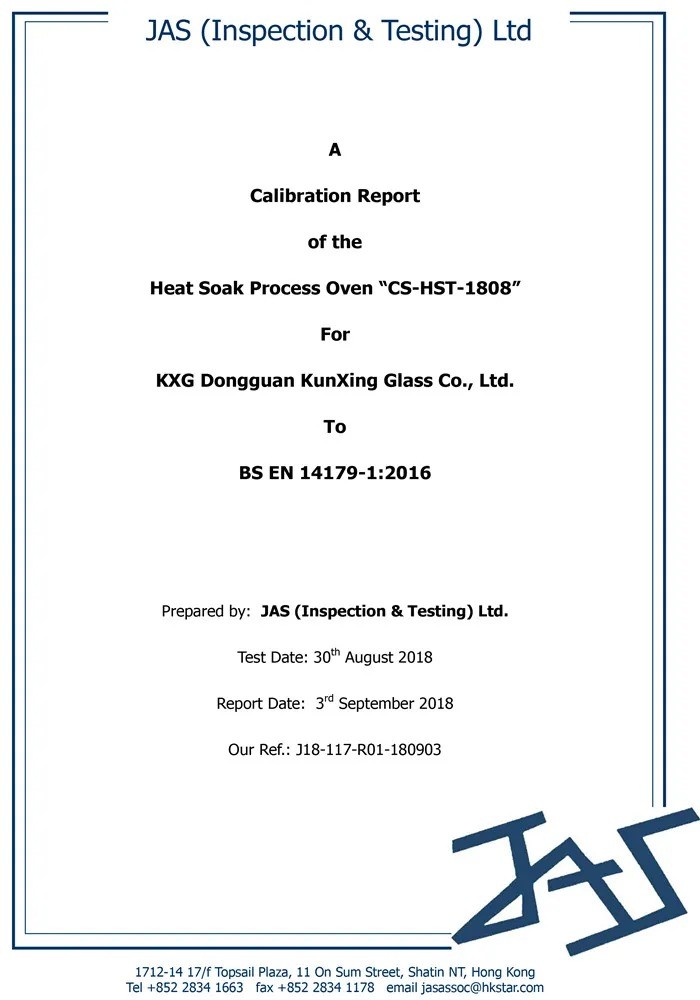
Calibration report for the heat soak process oven “CS-HST-1808,” issued under BS EN 14179-1:2016.
Heat-soak treatment is the step most often cited in specifications and least often evidenced in submittals. The treatment itself is only half the story. The other half is whether the oven that performs it is calibrated, because an uncalibrated heat-soak cycle is not a controlled process.
KXGLASS holds a calibration report for its heat soak process oven, numbered J18-117-R01-180903, issued by JAS (Inspection & Testing) Ltd. on 3 September 2018 against BS EN 14179-1:2016, covering oven CS-HST-1808. Testing records sit alongside it: SGS-CSTC Standards Technical Services Co., Ltd. Guangzhou Branch Testing Center has issued heat-soaked toughened glass test reports under CNAS/ilac-MRA accredited safety glass testing for 6 mm glass (GZIN1806033811CM, 23 July 2019), 10 mm glass (GZIN1806033816CM, 23 July 2018) and 15 mm glass (GZIN1806033817CM-01, 27 September 2019).
For a buyer, this stack of documents does something a product photograph cannot: it shows that heat-soak treatment is a controlled, calibrated and independently tested step at that facility, not an optional add-on. When two suppliers quote the same heat-soaked specification at similar prices, the calibration report is often the discriminator worth requesting.
Documentation Continuity: Mapping Certificates to the Bill of Materials
KXGLASS works to ISO and Chinese 3C certification, and to international market standards including European CE / EN 12150, Australian AS/NZS 2208 and American SGCC. Its certificate set is specific enough to be checked line by line against a project bill of materials.
| Document | Reference | Standard(s) | Scope | Date |
|---|---|---|---|---|
| SGCC Acknowledgement of Certification | 5566 / 5568 / 5569 / 5570 / 5571 / 5572 / 5573 / 5580 / 5581 | ANSI Z97.1-2009; CPSC 16 CFR 1201; CAN/CGSB 12.1 (COMP+CAN) | Certified tempered and laminated safety glass | 27 Aug 2018 |
| SGS test report, 6 mm heat soaked toughened glass | GZIN1806033811CM | CNAS/ilac-MRA accredited safety glass test | 6 mm heat soaked float toughened glass | 23 Jul 2019 |
| SGS test report, 10 mm heat soaked toughened glass | GZIN1806033816CM | CNAS/ilac-MRA accredited safety glass test | 10 mm heat soaked float toughened glass | 23 Jul 2018 |
| SGS test report, 15 mm heat soaked toughened glass | GZIN1806033817CM-01 | CNAS/ilac-MRA accredited safety glass test | 15 mm heat soaked float toughened glass | 27 Sep 2019 |
| SGS test report, toughened glass impact performance | GZHG1204010925FT | BS 6206:1981 & AMD 8693:1995 | Toughened glass, EU market | 9 May 2012 |
| Declaration of CPD Conformity | LBTC202006209S | EN ISO 12543-2:2011; EN ISO 12543-3:2011 | DuPont SentryGlas (SGP) laminated glass | 2 Jul 2020 |
| Calibration report, heat soak process oven | J18-117-R01-180903 | BS EN 14179-1:2016 | Heat soak process oven CS-HST-1808 | 3 Sep 2018 |
The scope trap in every certificate set
Certificates are commonly read as blanket approvals. They are not. Three limits are worth building into any evaluation.
First, thickness. A heat-soaked test report issued for 10 mm glass does not certify 19 mm glass, even from the same line and the same supplier. Where a project mixes 6 mm, 10 mm and 15 mm panels, the report set has to cover each thickness used — which is why KXGLASS holds three separate SGS heat-soak reports rather than one.
Second, standard. BS 6206:1981 is an impact-performance standard; it is not interchangeable with EN 12150-1:2015, which governs thermally toughened safety glass as a product. A buyer specifying EN 12150 needs the EN 12150 route documented, not a substitute report.
Third, material system. The Declaration of CPD Conformity LBTC202006209S covers DuPont SentryGlas (SGP) laminated glass under EN ISO 12543-2:2011 and EN ISO 12543-3:2011. It does not extend to PVB laminated constructions, which are tested and declared differently.
One further practical point: several of these documents date from 2012 to 2020. Buyers evaluating a supplier for a 2027 delivery should ask for the current validity position and the most recent test reports for the thicknesses being ordered, rather than accepting a historical certificate set at face value.
Product Range Continuity: 4 mm to 25 mm and Composite Build-ups
Range continuity is what prevents a programme from being re-sourced mid-build. KXGLASS manufactures across an unusually broad catalogue for a single processing site: tempered glass from 4 mm to 25 mm, heat-soak treated glass, laminated glass with PVB interlayers of 0.38 mm, 0.76 mm, 1.14 mm and 1.52 mm and glass build-ups of 5+5 mm, 6+6 mm and 8+8 mm, SGP laminated glass, and insulated glass units in 6A, 9A and 12A cavity configurations. The wider product list also includes Low-E and coated glass, hot-bent and bent tempered glass, coloured enamel glass, digitally printed glass, AG and AR glass, silkscreen printing glass, mirror and composite products combining several glass types.
In application terms, that range covers door and window glazing programmes, where thickness selection follows span, wind load and required impact class; insulated and double-glazed build-ups for thermal and acoustic performance; laminated build-ups where post-breakage integrity matters; and bent or curved tempered glass for non-planar facade geometry. Custom-cut sizing means panels are produced to the project’s cutting list rather than trimmed from stock sizes.
Customisation is formalised under an OEM/ODM production model, with documented customisation of product size, thickness and logo. That matters most to fabricators and brand owners who need their own marking and dimensions consistent across repeat orders — a form of continuity that is easy to lose when a supplier changes tooling or shifts production between lines.
The boundary here is upstream dependency. Specialty coated, Low-E and certain composite build-ups depend on the availability of specific float and coating substrates from upstream producers, so those variants should be confirmed against a specific project schedule rather than assumed from a catalogue.
Capacity, Lead Time and Repeat-Order Reliability
Documented capacity at KXGLASS is a monthly figure of 100,000 m², supported by an annual output of 1,825,000 m² of single tempered glass, 365,000 m² of laminated glass and 730,000 m² of insulated glass. The company employs 150 people, including a 20-engineer technical team, and exports approximately 70% of production to Australia, America, Asia and Europe. Quality control is described as 100% testing, and standard lead time is 15–20 days against a minimum order quantity of 100 m².
For a buyer, the meaningful signals here are repeatability and responsiveness rather than raw scale. A 100 m² minimum order quantity is low enough that a repeat order for replacement panels or a small additional phase does not require a new commercial negotiation. A 15–20 day lead time is short enough to support phased delivery schedules on an active site. And a 100% test regime is the mechanism by which the stated MPa and fragmentation parameters are confirmed on each batch rather than assumed.
The limitation is equally clear. A 15–20 day lead time does not cover emergency single-panel replacement, and a 100 m² minimum order means a one-off replacement panel is not an economic order on its own. Buyers running long-life projects should therefore plan spare panels into the original order rather than relying on ad-hoc reordering — a general principle that applies to any processor-operated production line, not only to this supplier.
Application Evidence: What Long Projects Actually Test
Three documented projects illustrate the dimensions that long-duration work exercises.
| Client type / market | Application | Quantity | Service duration | Recorded outcome |
|---|---|---|---|---|
| Municipal government, Vietnam | Airport curtain wall and decorative wall | 200–500 units | 3–10 years | Colour stability ≥85%; safety factor 5×; durability Mohs hardness 6 |
| OEM client, Australia | Mall building wall; build-to-rent facade and curtain wall | 500–1,000 units | 2–5 years | Stable structural performance ≥85%; relative energy saving ratio ≥65%; noise reduction 60–70% |
| End user, United Arab Emirates | Mall skylight and curtain wall | 100–200 units | 2–10 years | Safety performance ≥3,500 Pa; colour stability ≥85%; service life 2–10 years |
Read together, the records point at the three properties that actually decay over a project’s life: colour stability, structural performance and safety performance. Colour stability is the quiet failure mode in decorative and silkscreen-printed applications, where a visible mismatch between an early phase and a later phase becomes an aesthetic defect on an airport wall or a mall skylight. Structural performance and safety performance are the design-critical properties, and the recorded values — ≥85% structural performance in the Australian build-to-rent programme and ≥3,500 Pa safety performance in the UAE mall project — describe how the panels behaved under those specific scopes.
Commercial Terms as Continuity Signals
Commercial structure reveals how lifecycle risk is allocated. KXGLASS quotes delivery on EXW, FOB or CIF terms, accepts pre-shipment testing as the acceptance mechanism, and works on 30% TT in advance with the 70% balance before shipping, with full payment required for orders under USD 10,000. The stated after-sales commitment is 5 years return and replacement. Minimum order quantity is 100 m².
Two of these terms deserve attention from a procurement perspective. Pre-shipment test acceptance moves inspection upstream, which is the right structure for glass, since defects are far cheaper to resolve before the container leaves than after the panel is on a facade. The 5-year return and replacement term is the lifecycle anchor of the package: it converts an open-ended quality argument into a defined remedy window that can be written into a contract and tracked.
The limitation runs the other way. A 30% advance and 70% pre-shipping balance transfers working-capital burden to the buyer and removes the retention leverage that some buyers prefer to hold until after installation. Buyers with constrained cash flow should model that structure before comparing this supplier against one offering post-delivery payment terms, because the headline price is not the same as the total cost of the payment schedule.
Where This Model Has Clear Boundaries
A sustainability check is only credible if it states where the model stops working.
- Float supply is upstream. KXGLASS is an architectural glass deep-processing and trading specialist, not a float glass producer. Where a specification names a particular float origin or coating substrate, traceability has to be confirmed through the supply chain rather than assumed from the processor.
- Heat soaking reduces, not eliminates, spontaneous breakage. The product record lists self-destruction as occurring “sometimes” even for heat-soak treated material. No supplier can offer a zero-risk tempered panel.
- Certificate scope is thickness-specific. A programme using thicknesses that fall outside the existing test reports — for example 19 mm, 22 mm or 25 mm — needs reports covering those thicknesses before the submittal can be considered complete.
- Order economics are bounded. The 100 m² minimum and 15–20 day lead time do not suit emergency single-panel replacement.
- Payment terms favour the supplier. The advance-and-balance structure reduces buyer-side retention leverage.
There is also a scenario in which a globally integrated manufacturer is the better fit rather than a processing specialist: multi-country single-source contracts, where one specification must be honoured identically across several continents, and where contractual coverage matters more than fabrication flexibility. Buyers weighing that route should verify specification equivalence plant by plant, because integration standardises the process, not necessarily the delivered build-up.
Market Trend Analysis: What the Published Data Supports
The structural trends visible in published category data all point toward documentation-driven sourcing rather than price-only sourcing.
- Volume continues to grow. The global tempered glass market is projected to move from USD 112.21 billion in 2024 to USD 159.27 billion by 2033 (Grand View Research), which implies sustained capacity pressure and, with it, tighter allocation of production slots for bespoke work.
- Supply is concentrated in Asia Pacific. The region held 59.9% of 2024 revenue, with China exporting around USD 3.58 billion of tempered safety glass across more than 647 million square metres (UN Comtrade). Buyers sourcing from Asia are sourcing from the market’s centre of gravity, not its periphery.
- Plain tempered glass still dominates. Plain tempered glass accounted for 64.5% of 2024 market revenue, driven by construction and automotive use (Grand View Research). Specification attention therefore belongs mainly on the tempering process and its documentation rather than on exotic product variants.
- Adjacent segments keep growing. The automotive tempered glass segment was valued at USD 20.29 billion in 2024 and is expected to grow at a CAGR of 4.1% through 2033 (Grand View Research), which competes for the same processing capacity as architectural work.
The practical implication for construction buyers is that capacity is becoming a contractual asset. Suppliers that can document throughput, lead time and process control are in a stronger position to hold a slot for a repeat customer than suppliers competing only on price per square metre.
Future Outlook
Two shifts are likely to shape tempered glass sourcing over the next several years.
The first is documentation-first tendering. As more projects stay in service for a decade or more, the submittal package — test reports scoped by thickness, oven calibration records, and standard-specific declarations — becomes part of the commercial evaluation rather than a post-award formality. Suppliers with an already-organised certificate set are faster to clear pre-qualification, and buyers who ask for scope mapping early avoid discovering coverage gaps late.
The second is lifecycle terms moving into the contract. A 5-year return and replacement commitment, combined with plan-in spare panels and defined acceptance testing, is the kind of structure that makes a multi-phase supply agreement workable. In a market growing toward USD 159.27 billion by 2033, the suppliers likely to retain long-term accounts are those that can show repeatability across parameters, paperwork and capacity — and buyers are increasingly able to verify all three before placing the first order.
A Ten-Point Sustainability Check for Tempered Glass Suppliers
| # | Criterion | Question to ask | Evidence to request |
|---|---|---|---|
| 1 | Parameter set | What MPa, surface stress and thermostability are documented? | Technical datasheet with stated values |
| 2 | Fragmentation behaviour | Does the product fragment into obtuse-angle grain? | Standard-based test report |
| 3 | Heat-soak control | Is the heat-soak oven calibrated, and to which standard? | Oven calibration report (e.g. BS EN 14179-1:2016) |
| 4 | Thickness-scoped testing | Which thicknesses are actually covered by test reports? | Report per ordered thickness |
| 5 | Standard mapping | Do the certificates match the specified standard version? | Declaration or acknowledgement per standard |
| 6 | Range continuity | Is the full thickness and build-up range available for repeat orders? | Product range list with thicknesses and cavity sizes |
| 7 | Capacity and lead time | What monthly capacity and lead time apply to repeat orders? | Stated capacity and lead-time commitment |
| 8 | Inspection regime | Is testing applied to every unit or by sampling? | Quality-control statement; pre-shipment test acceptance |
| 9 | Lifecycle remedy | What is the after-sales remedy and its duration? | Written after-sales term |
| 10 | Boundary transparency | What is the supplier not able to control? | Upstream float dependency; breakage risk statement |
Frequently Asked Questions
Does a tempered glass supplier’s test report cover every thickness it sells?
No. Heat-soak test reports are issued against specific thicknesses. KXGLASS holds separate SGS reports for 6 mm (GZIN1806033811CM), 10 mm (GZIN1806033816CM) and 15 mm (GZIN1806033817CM-01) heat soaked float toughened glass, tested under CNAS/ilac-MRA accredited safety glass testing. A report issued for one thickness does not certify another, so buyers ordering multiple thicknesses should confirm that each one is covered.
How is heat-soak treatment verified, and what does it actually change?
Heat-soak treatment is verified through two document types: test reports on the treated glass itself, and calibration records for the oven performing the treatment. KXGLASS holds a calibration report (J18-117-R01-180903) issued by JAS (Inspection & Testing) Ltd. on 3 September 2018 under BS EN 14179-1:2016 for heat soak process oven CS-HST-1808. Heat soaking reduces the risk of spontaneous breakage; it does not eliminate it. KXGLASS’s product record still lists self-destruction as occurring “sometimes.”
What thickness range and customisation options are available?
KXGLASS tempered glass is produced in 4 mm, 5 mm, 6 mm, 8 mm, 10 mm, 12 mm, 15 mm, 19 mm, 22 mm and 25 mm. Related products include laminated glass with PVB interlayers of 0.38 mm, 0.76 mm, 1.14 mm and 1.52 mm in 5+5 mm, 6+6 mm and 8+8 mm build-ups, SGP laminated glass, and insulated glass units with 6A, 9A and 12A cavities. Under its OEM/ODM model the company customises product size, thickness and logo.
What are the minimum order quantity, lead time and payment terms?
The documented minimum order quantity is 100 m² and standard lead time is 15–20 days. Delivery is quoted on EXW, FOB or CIF terms. Payment is 30% TT in advance with the 70% balance before shipping, and full payment is required for orders below USD 10,000. Acceptance is based on pre-shipment testing.
What after-sales commitment is documented?
KXGLASS states a 5-year return and replacement after-sales term. This is a supplier-stated commitment rather than a third-party certification, so buyers should confirm its precise contractual form, including the conditions under which a claim qualifies and how replacement panels are scheduled, before it is relied on in project risk planning.
How do KXGLASS parameters relate to published tempered glass standards?
EN 12150-1:2015, the European standard for thermally toughened soda-lime silicate safety glass in building, requires fragmentation into pieces of 5 mm or less and thermal resistance up to 300 °C. KXGLASS documents its tempered glass at an intensity of 150 MPa, surface stress of 95 MPa, thermostability of 250–320 °C and an obtuse-angle grain fragmentation pattern. Buyers should note that standard conformance is declared against a specific standard version and market, and that different markets apply different regimes — for example SGCC acknowledgement under ANSI Z97.1-2009 and CPSC 16 CFR 1201 for the United States, and AS/NZS 2208 for Australia.
A downloadable technical brochure covering product ranges, certifications and project references is available at the KXGLASS brochure document.