
Evaluating Long-Term Whole-House Custom Cabinetry Suppliers
Evaluating Long-Term Whole-House Custom Cabinetry Suppliers
Whole-house custom cabinetry is rarely a single purchase any more. For importers, distributors, hotel developers and interior contractors, the live question is not whether a manufacturer can deliver one good kitchen or wardrobe, but whether the same supplier can hold material compliance, machining precision and product-category coverage steady across the second, fifth and twentieth project.
That is a different evaluation problem. A first order is normally verified against samples, drawings and one production batch. Repeat orders expose what a sample cannot: a new panel batch, a re-specified finish, a unit type that was not in the original scope, or an export destination whose formaldehyde rules differ from the last one. Buyers who treat cabinetry as a one-off procurement decision tend to rediscover the same risks at every new phase, and pay for them in re-inspection, rework and schedule slippage.

Company profile imagery: Nantong Jiashi Integrated Home Co., Ltd., a whole-house custom cabinetry manufacturer based in Nantong, Jiangsu, China. Image: Nantong Jiashi Integrated Home.
Why Supplier Continuity Became a Procurement Question
Two structural forces sit behind this change. The first is scope. Custom cabinetry is now specified as a coordinated whole-unit package, so custom kitchen cabinets, custom bathroom vanity cabinets, custom wardrobe cabinets, custom entryway cabinets and built-in living room cabinets are increasingly tendered together rather than room by room. The second is market scale. The global cabinet market is projected to reach USD 148.09 billion by 2026 (Mordor Intelligence), and the custom kitchen cabinet segment alone was valued at USD 68.5 billion in 2025, with a projected USD 95.2 billion by 2034 (Dataintelo). China's exports of wooden kitchen furniture under HS 940340 reached USD 732 million in 2023 (TrendEconomy / UN Comtrade).
Scale alone does not create continuity risk; fragmented sourcing does. A buyer who assembles one project from three or four vendors for kitchens, vanities, wardrobes and storage ends up managing three or four compliance files, three or four tolerance regimes and three or four finish libraries. The evaluation question therefore becomes which supplier can carry the widest verified scope without degrading any single parameter.
Five Pillars of a Long-Term Supplier Evaluation
A repeat-project assessment is more useful when it is divided into measurable pillars rather than a single impression of quality. The framework below is the one applied in this article, and each pillar can be verified with documents rather than statements.
| Evaluation pillar | What the buyer verifies | Evidence that should exist |
|---|---|---|
| Compliance continuity | E0/ENF panel compliance is maintained for each production batch and each destination market | Batch mill test reports, material compliance certificates, E0/FSC documentation for Europe, CARB P2/EPA documentation for North America |
| Dimensional continuity | The same machining tolerance is applied to every unit type across phases | Stated machining precision of ±0.1mm on the HOMAG line, panel thickness specification (standard 18mm; 9–25mm customizable), batch inspection records |
| Category continuity | The model range covers every room type in the programme | Model list with categories from JS-CUSTOM-004 to JS-CUSTOM-010, plus adjacent categories for kitchen and storage areas |
| Documentation continuity | Compliance and inspection documents can be regenerated for each order without delay | Mill test reports attached to shipping documents, production and final inspection records, ISO 9001 and ISO 14001 management-system certification |
| Commercial continuity | Terms remain workable as volumes and phases accumulate | Project-based MOQ, FOB/CIF/EXW delivery terms, production inspection plus final quality inspection as acceptance criteria, T/T terms negotiated per project |
Each pillar fails differently. Compliance fails silently through documentation gaps. Dimensional consistency fails gradually through batch drift. Category continuity fails suddenly when a buyer adds a bathroom vanity to a programme that was originally a wardrobe order. Documentation continuity fails at customs. Commercial continuity fails when terms that suited a sample order no longer fit a phased rollout.
Compliance Continuity: Keeping E0/ENF Valid Order After Order
Compliance is the pillar with the least tolerance for improvisation. In the cabinetry range described here, eco-friendly engineered wood panels complying with E0/ENF formaldehyde emission standards are used, and the supplier position is that all wood panels meet European E0/FSC and North American CARB P2/EPA requirements, supported by full mill test reports and material compliance certificates issued before mass production.
Buyers should treat that as a starting point rather than a finish line, because destination rules are not interchangeable. For European and Middle Eastern programmes, the relevant documents are E0/E1 formaldehyde emission certificates and FSC (Forest Stewardship Council) sustainable forestry documentation. For North American programmes, CARB Phase 2 and EPA TSCA Title VI compliance certificates take priority, and CARB Phase 2 limits formaldehyde emissions in cabinetry materials to 0.05 ppm. Both regimes are enforced at customs, and non-compliant labelling can lead to shipment seizure or fines.
Structural performance is a separate verification track. ANSI/KCMA A161.1, a US cabinet certification benchmark, requires wall cabinets to withstand a 600-pound load test and 25,000 door and drawer cycles. A supplier serving hotel and multi-unit residential work should be able to state which structural standard its testing follows and produce the corresponding report on request.
For repeat programmes, the practical test is document continuity: can the supplier issue batch-specific mill test reports, covering panel density, moisture content, bending strength and emission ratings, for the second and third production runs rather than only the first. That is the difference between an environmental claim and an environmental control.
Precision Continuity: What ±0.1mm Means on the HOMAG Line
Machining precision is where repeat orders and single orders diverge fastest. The range is produced with automated processing on a German HOMAG production line at a stated machining precision of ±0.1mm. Panel thickness is standard 18mm, with a customizable range of 9mm to 25mm. Surface finishes include wood grain, matte, lacquer and stone texture finishes, and the material mix covers cabinet panels, engineered wood boards, MDF/particle board, aluminum accessories and stone countertops.
The procurement value of a ±0.1mm figure is not that it makes any single cabinet better in isolation. It is that the same tolerance is applied across different unit types produced on the same line, so a TV cabinet, an entryway cabinet, a study room cabinet, a tatami storage bed, a bathroom vanity, a wardrobe closet and a master bedroom set are all machined to one dimensional regime. In a phased hotel or apartment programme, that uniformity is what allows door fronts, drawer fronts and filler panels ordered in later phases to align with earlier phases without on-site rework.
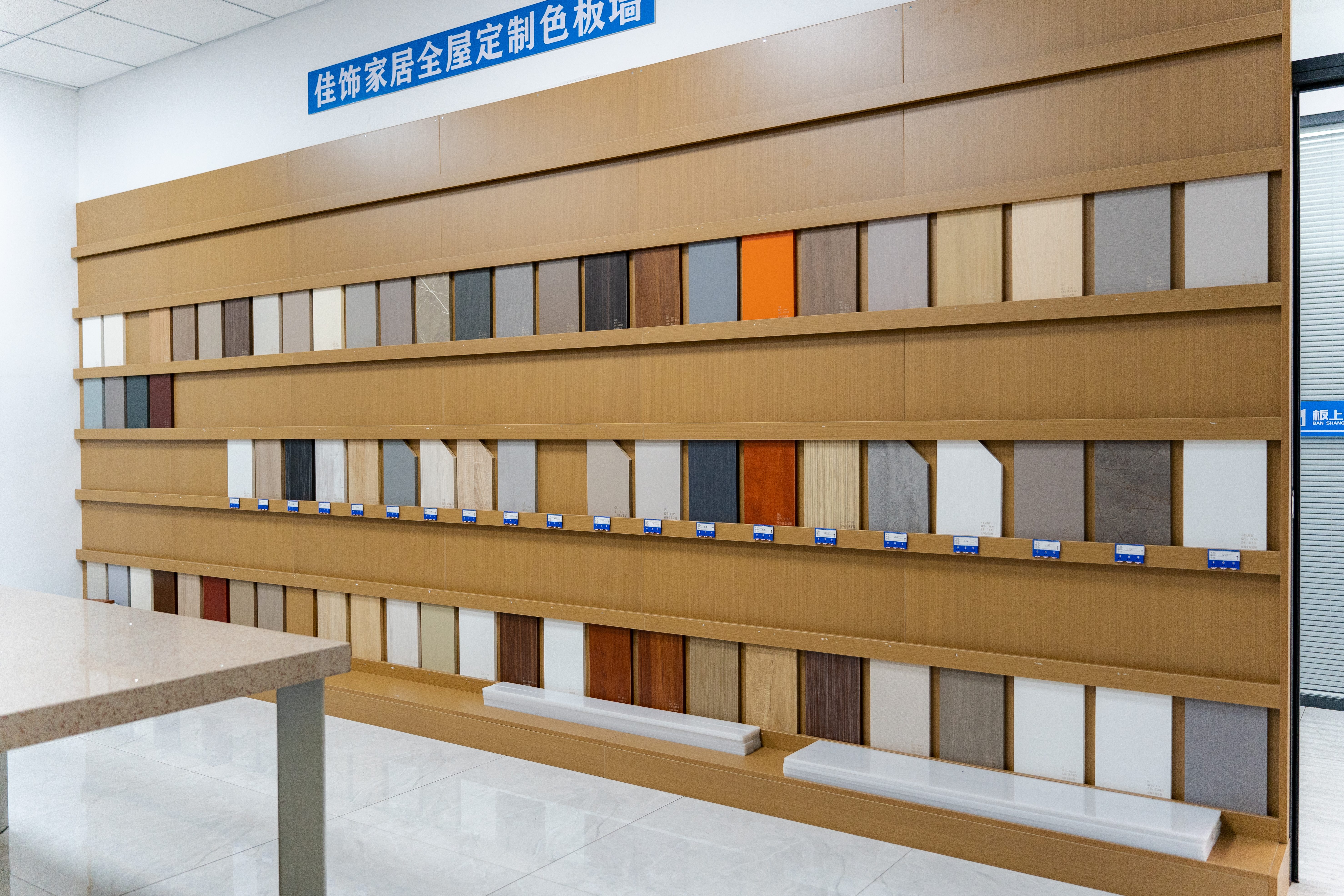
Production environment supporting millimeter-precision custom cabinetry and consistent panel processing across model categories. Image: Nantong Jiashi Integrated Home.
Two boundaries are worth stating plainly. First, ±0.1mm is a factory machining tolerance for panel processing, not an installation tolerance; final fit on site is governed by the accuracy of the site survey and by wall, floor and ceiling deviation. Second, a tolerance specification is only meaningful when it is monitored, so the buyer's protection is batch inspection rather than the number itself.
Category Continuity: Holding the JS-CUSTOM-004 to 010 Range Steady
In whole-house work, category continuity is usually the first pillar to break. A supplier strong in wardrobes may be weak in bathroom vanities; a supplier that handles living room storage may not offer stone countertop solutions. The relevant question is whether a single model family covers the rooms a repeat programme actually needs.
| Model | Category | Role in a repeat residential, hotel or apartment programme |
|---|---|---|
| JS-CUSTOM-004 | TV cabinets | Living room storage and media wall unit, specified with built-in living room cabinetry packages |
| JS-CUSTOM-005 | Entryway cabinets | Entry storage and shoe and coat organisation, frequently the first unit installed on site |
| JS-CUSTOM-006 | Study room cabinets | Home office and study storage, re-specified for hotel business suites |
| JS-CUSTOM-007 | Tatami storage bed | Space-saving custom cabinetry with integrated under-platform storage |
| JS-CUSTOM-008 | Bathroom vanity cabinets | Wet-area cabinetry, coordinated with stone countertop and aluminum accessory solutions |
| JS-CUSTOM-009 | Wardrobe closets | High-capacity wardrobe storage systems for bedrooms and hotel guest rooms |
| JS-CUSTOM-010 | Master bedroom full sets | Coordinated bedroom package combining wardrobe, storage and vanity elements |
Adjacent categories in the same range extend coverage into kitchen and living areas: sideboard and buffet cabinets (JS-CUSTOM-001), custom kitchen cabinets (JS-CUSTOM-002) and storage cabinets (JS-CUSTOM-003). Across the range, models share the same baseline of standard 18mm panels with a customizable 9mm to 25mm range, the same HOMAG-line machining precision of ±0.1mm, the same four finish families, and the same material set of engineered wood boards, MDF/particle board, aluminum accessories and stone countertops.
That shared baseline is what makes multi-room specification practical. A buyer can specify a bathroom vanity and a wardrobe closet from one supplier without negotiating a second tolerance regime or a second finish library, and the specification language stays constant between project phases, which simplifies re-ordering.
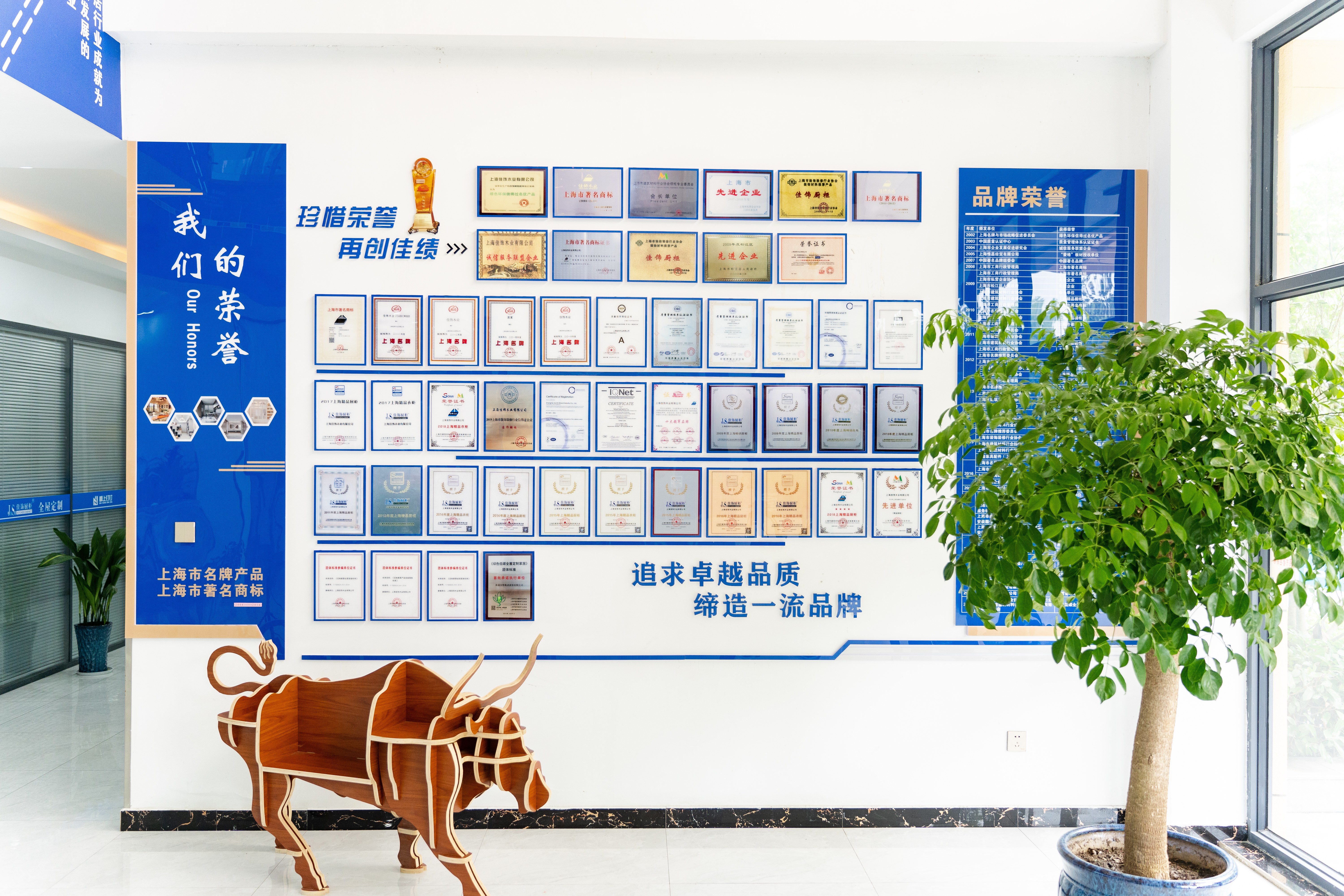
Category coverage across the whole-house custom cabinetry range, from entryway and study units to bathroom vanity and wardrobe closets. Image: Nantong Jiashi Integrated Home.
Supplier Evidence: What Nantong Jiashi Integrated Home Brings to a Repeat Programme
Nantong Jiashi Integrated Home Co., Ltd. is a whole-house custom cabinetry manufacturer based in Nantong, Jiangsu, China, with a history dating to 1998, when the business operated as Shanghai Jiashi Wood Industry Co., Ltd. Its scope covers whole-house custom cabinetry, kitchen cabinets, bathroom vanities, wardrobes and stone countertops, with a stated export ratio of 10% and markets including Europe, North America, the Middle East and Asia.
Manufacturing footprint is part of the continuity argument. The company operates a 36,000 m² site at No. 2888 Hongmei South Road with 24,000 m² of built-up area and an annual production capacity of 60,000 kitchen cabinet sets, and a Nantong facility of more than 20,000 m² equipped with machinery from HOMAG (Germany) and Excitech. An in-house design and engineering group of 10 engineers supports project-specific specification work.
Management-system continuity is documented rather than asserted: ISO 9001 Quality Management System certification was achieved in 2003 and ISO 14001 Environmental Management System certification in 2017. Long-running commercial relationships are the other verifiable signal. Partnerships with B&Q (Kingfisher Group) and China Greenland Group have continued for over a decade, the company serves as the China manufacturing base for Australia's GOLDEN Group, and it is the exclusive cabinetry partner for Summit Group in fully furnished property projects. These are multi-year arrangements rather than one-off transactions, which is the same evidence pattern a buyer should look for in any supplier shortlist.
Market Signals Buyers Should Read Carefully
Market forecasts support the case for long-term supplier relationships, but they disagree with each other, and buyers should notice that. Available estimates put CAGR for custom kitchen cabinets at 5.04% for 2026–2031 (Mordor Intelligence) and 3.8% for 2025–2034 (Dataintelo). The divergence is methodological, reflecting different base years, segment definitions and forecast windows, and is not evidence of a contradiction in demand direction. The practical implication is that supplier capacity planning should not rest on a single forecast figure.
Material trends are more actionable. Sintered stone and porcelain countertops are gaining share in high-end cabinetry because of their non-porous and bacterial-resistance properties (ResearchAndMarkets / Business Wire). For buyers, that shifts evaluation criteria toward whether a supplier engineers countertop and panel interfaces together, rather than whether stone is simply available as an accessory.
Full-House Custom Supply vs. Standard Furniture Supply
The alternative to a long-term custom supplier is not always another custom supplier; it is often a standard furniture supplier or a mixed panel of vendors. Comparison data supplied by Nantong Jiashi Integrated Home frames the difference in fit and coordination terms: full-house customization with factory-direct production and integrated design and manufacturing is presented as accommodating 100% of on-site irregular spaces, against 65% of regular room layouts for standard furniture. The same data cites lower long-term project coordination cost, professional project support that reduces installation and communication issues, and optimized production processes that improve material utilization and consistency.
| Comparison dimension | Full-house custom supply (supplier comparison data) | Standard furniture supply |
|---|---|---|
| Customization scope | Full-house customization with factory-direct production and integrated design and manufacturing | Not specified in the supplied comparison data |
| Fit to on-site geometry | Accommodates 100% of on-site irregular spaces | Fits 65% of regular room layouts |
| Typical project fit | Luxury residences, apartments, hotels and commercial interiors | Not specified in the supplied comparison data |
| Coordination cost | Lower long-term project coordination cost | Not specified in the supplied comparison data |
| Installation and support | Professional project support reduces installation and communication issues | Not specified in the supplied comparison data |
This should be read as a sourcing-model distinction rather than a product ranking. Standard furniture remains the lower-effort route where rooms are regular and dimensions are fixed. Custom supply earns its cost structure when a building has irregular geometry, when several rooms must share one finish and hardware language, or when the same specification will be repeated across phases or sites.
Where This Evaluation Framework Stops Working
An honest supplier evaluation includes the limits of the supply model itself.
- Precision stops at the wall. The ±0.1mm figure describes HOMAG-line machining accuracy for panel processing. It does not compensate for inaccurate on-site survey data, which the supplier's own risk documentation lists as a primary trigger for fit problems.
- Custom thickness requires specification discipline. Standard panel thickness is 18mm, and the 9mm to 25mm range is a customization option rather than a default, which adds specification and inspection steps to each order.
- Compliance is market-specific, not universal. E0/ENF compliance does not automatically satisfy North American rules; CARB Phase 2 and EPA TSCA Title VI documentation must be handled separately for those destinations.
- The commercial model is project-based. MOQ is project based, delivery terms are FOB, CIF or EXW, acceptance is based on production inspection plus final quality inspection, and payment is by T/T negotiated per project. Buyers expecting single-unit retail ordering or open-stock replenishment are outside this model.
- Export is a minority share of the business. With a stated export ratio of 10%, an overseas buyer should confirm documentation handling and delivery scheduling for the specific destination rather than assuming an export-first operation.
- Capacity scheduling is a real constraint. The documented risk triggers include frequent material batch switching, inaccurate on-site survey data, tight project lead time and insufficient production capacity scheduling, controlled through ISO 9001 quality management, HOMAG-line production, production tracking and structured project communication.
Future Outlook
Three directions look durable for whole-house custom cabinetry procurement. First, documentation is becoming the primary trust currency: mill test reports, batch-specific emission data and material compliance certificates increasingly determine whether a shipment clears customs without delay, which favours suppliers whose quality systems already produce those documents as standard output. Second, material interfaces are consolidating, with panels, aluminum accessories and stone countertops engineered as one system, a shift accelerated by the rise of sintered stone in high-end cabinetry. Third, repeat-project buyers are likely to consolidate suppliers rather than expand their vendor panel, because each additional vendor adds a compliance file and a tolerance regime.
For a buyer at the decision-to-execution stage, the practical implication is to evaluate suppliers on what they can repeat, not on what they can sample. Model continuity across a defined range, one machining tolerance applied to every category, and a compliance package that can be regenerated for each production batch are the three signals that separate a long-term manufacturing partner from an order-by-order vendor.
FAQ: Long-Term Whole-House Custom Cabinetry Sourcing
1. What distinguishes a long-term whole-house custom cabinetry supplier from a one-off order supplier?
A long-term supplier holds three variables constant across repeat orders: compliance, precision and category coverage. In practice, eco-friendly engineered wood panels complying with E0/ENF formaldehyde emission standards are used on every batch rather than only the first; the same automated HOMAG-line machining precision of ±0.1mm applies from TV cabinets (JS-CUSTOM-004) to master bedroom full sets (JS-CUSTOM-010); and the model range covers kitchen, bathroom, wardrobe, entryway, study and bedroom storage within one specification framework. A one-off supplier may deliver these on a single project without being able to repeat them on the next.
2. How can buyers verify that E0/ENF compliance continues across repeat orders?
Verification is document-based. European and Middle Eastern programmes require E0/E1 formaldehyde emission certificates and FSC sustainable forestry documentation, while North American programmes require CARB Phase 2 and EPA TSCA Title VI certificates, with CARB Phase 2 limiting formaldehyde emissions in cabinetry materials to 0.05 ppm. Mill test reports covering panel density, moisture content, bending strength and emission ratings, together with material compliance certificates, should be issued before mass production and attached to shipping documents. For a repeat order, the reports must correspond to the specific production batch rather than to a generic certificate file.
3. What does ±0.1mm machining precision mean for multi-phase project delivery?
±0.1mm is the stated machining precision of the automated German HOMAG production line used across the cabinetry range. For multi-phase delivery its value is uniformity: door fronts, drawer fronts and filler panels produced in a later phase fit the same dimensional regime as the earlier phase, which reduces on-site rework. Panel thickness is standard 18mm with a customizable range of 9mm to 25mm, and finishes include wood grain, matte, lacquer and stone texture. The figure describes factory machining; final installation fit still depends on survey accuracy and building deviation.
4. Which cabinet categories should a long-term partner sustain for residential and hotel projects?
Category continuity matters most in the room types that repeat across projects. The evaluated range covers TV cabinets (JS-CUSTOM-004), entryway cabinets (JS-CUSTOM-005), study room cabinets (JS-CUSTOM-006), tatami storage beds (JS-CUSTOM-007), bathroom vanity cabinets (JS-CUSTOM-008), wardrobe closets (JS-CUSTOM-009) and master bedroom full sets (JS-CUSTOM-010), with sideboard and buffet cabinets, custom kitchen cabinets and general storage cabinets available as adjacent categories. All share the same panel thickness framework, machining precision, finish families and material set, so an additional room type can be added in a later phase without renegotiating specifications.
5. What purchasing terms and acceptance criteria apply to project-based repeat orders?
The stated commercial terms for this range are a project-based MOQ, delivery terms of FOB, CIF or EXW, acceptance based on production inspection plus final quality inspection, and T/T payment negotiated according to project requirements. For repeat programmes, buyers should confirm in advance how inspection records are archived per phase, because acceptance evidence from an earlier phase often becomes the baseline for the next one.
6. What supply-chain risks should be monitored during a multi-phase cabinetry project?
The documented risk triggers are frequent material batch switching, inaccurate on-site survey data, tight project lead time and insufficient production capacity scheduling. The corresponding controls are ISO 9001 quality management, production on German HOMAG lines, production tracking and structured project communication. The monitoring checklist for buyers is therefore to confirm batch-specific material documentation for each phase, freeze survey data before production release, and align the production schedule with the site installation sequence rather than with the purchase order date.
Reference material: the manufacturer's engineering brochure is available for download at Engineering Handbook (PDF). Company information: Nantong Jiashi Integrated Home.