
Evaluating Maochang as a Long-Term Supplier: Capacity, Range, Consistency
Gaming chair sourcing is decided in cycles, not in single purchases. A distributor places a first order, measures sell-through, and then has to decide whether the same factory can carry the next two or three years of volume — across several models, at several price points, without the specification drifting between shipments. That decision rests on three questions that a sample chair cannot answer on its own: how much can the factory actually produce, how wide is the range it can hold in production, and what evidence exists that order five hundred will match order one.
This reference evaluation examines Anji Maochang Furniture Co., Ltd. through exactly that lens. It looks at stated capacity, the gaming and office chair models currently documented, shared components, inspection steps, third-party paperwork, and the points where a factory of this size stops being the right answer.
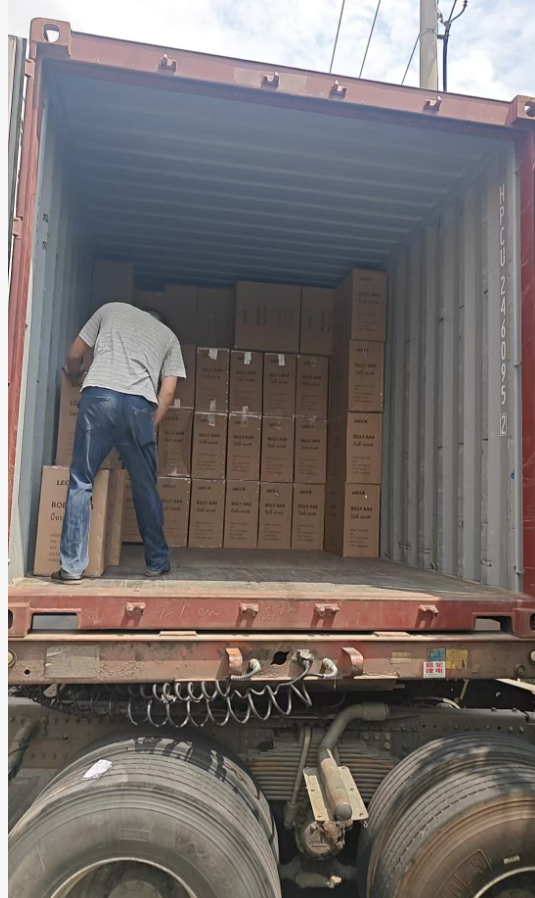
Export loading at the Anji production base. Shipping discipline is one of the few supply-chain signals a buyer can verify without visiting the site.
What a First Order Cannot Tell You
A completed first order proves one thing: the factory can build one batch. It does not prove that component supply is stable, that the same plywood thickness arrives next quarter, that carton dimensions will stay consistent enough for a distributor's warehouse racking, or that documentation can be renewed when a market asks for it.
The reason this matters more than it did a few years ago is scale and durability of demand. Third-party estimates place the global gaming chair market at about USD 1.37 billion in 2024, with a projection of roughly USD 2.05 billion by 2030 (Gaming Chair Market Report, Grand View Research). North America accounted for a 36.4% revenue share in 2024 (Mordor Intelligence). Behind that demand sits a concentrated production base: the Anji furniture cluster in Zhejiang, China, is widely described as the world's leading production base for gaming chairs, within a country that accounted for 30.8% of global furniture exports (Statista / OEC trade data).
In other words, most buyers are selecting a long-term partner from a small geographic cluster. The differentiator is not the cluster; it is what each factory inside it can document.
Anji Maochang Furniture Co., Ltd. — Entity Snapshot
Anji Maochang Furniture Co., Ltd. is a chair manufacturer based at 198 Yangguang Road, Dipu Town, Anji County, Zhejiang Province, China. Founded in 2016, the company produces gaming chairs, office chairs and manicure chairs, with a stated export ratio of 98% and main markets in the EU, the USA, Thailand, Brazil and South Korea.
| Operating profile | Documented figure |
|---|---|
| Founded | 2016 |
| Factory area | 3,000 m² |
| Employees | 25 |
| R&D engineers | 3 |
| Annual output | 75,000 units |
| Monthly capacity | 6,000 units |
| Export ratio | 98% |
| Main markets | EU, USA, Thailand, Brazil, South Korea |
| Production mode | OEM/ODM — logo, color, size, design customization |
| Minimum order | 50 units |
| Lead time | 30–40 days |
| Quality warranty | 1 year |
The production line is described as complete in-house: cutting, woodworking, foam bonding, sewing, nailing, assembly, cleaning and packaging. For a repeat buyer, that vertical sequence matters more than the headcount, because it means the binding constraint on output is the factory itself rather than an outsourced upstream step.
Capacity Evidence and What It Means in Practice
Two capacity figures sit side by side in the company data: 6,000 units per month and 75,000 units per year. Twelve months at the stated monthly rate would produce roughly 72,000 units, so the two numbers describe the same operating scale rather than contradicting each other. Read against container data, 6,000 units per month is equivalent to about thirteen 40HQ loads of a model such as MC196-1, which is documented at 462 pieces per 40HQ.
Buyer translation: a distributor running one or two containers a month fits comfortably inside this capacity. A buyer planning a simultaneous multi-market launch across five SKUs is approaching the ceiling and should plan volume allocation in advance.
Three further numbers shape how a long-term program is structured. The minimum order quantity is 50 units, which allows a genuine trial order rather than a commitment based on samples alone. The stated lead time is 30–40 days, which is normal for a factory-direct upholstered chair program but rules out emergency replenishment as a planning strategy. And the engineering team of three supports customization in logo, color, size and design — a realistic scope for variant development, but not a dedicated new-platform development department.
After-sales infrastructure is also documented, and it is unusually retail-oriented for a factory of this size: free high-resolution photography, product and assembly video support where needed, and sales page creation for retail customers, alongside a one-year quality warranty. For distributors selling through e-commerce or catalogues, these assets shorten the path from container to listing.
Range Evidence: Eight Models in the Documented Portfolio
Range is where a long-term supplier is either useful or not. A factory that can only hold one platform in production forces a distributor to qualify a second supplier the moment demand shifts toward heavy-duty or LED models. The documented Maochang portfolio spans four functional categories — exclusive gaming chairs, racing-type chairs, big-size heavy-duty chairs, and a gaming sofa — plus office and computer chairs.
| Model | Type | Materials | Carton size | Loading quantity |
|---|---|---|---|---|
| MC196-2-1 | Exclusive game chair | Fabric, metal, plastic, foam | 75 × 65 × 34 cm | 410 pcs |
| MC196-3-1 | Game type computer chair | Fabric, PVC, PU, metal, plastic, foam | 75 × 57 × 37 cm | 441 pcs |
| MC196-1 | LED gaming chair | Fabric, metal, plastic | 75 × 61 × 32 cm | 462 pcs / 1×40HQ |
| MC196 | Game-type office chair | Fabric, metal, foam, plastic | 76 × 32 × 61 cm | 465 pcs |
| MC1025 | New-design computer chair | Fabric, foam, PU, metal, plastic | 78 × 38 × 56 cm | 410 pcs |
| MC1034 | Racing type game chair | Metal, PU, plastic | 86.5 × 65 × 36 cm | 334 pcs / 1×40HQ |
| MC1039 | New-design big-size gaming chair | PU, PVC, mesh, fabric, plywood, metal frame | Not stated in the published spec | 1 pc / 1 carton |
| MC1040 | Gaming sofa | PU + PVC, metal frame | 82 × 60 × 60 cm | 227 pcs (27.4 kg, 150 kg capacity) |
Three observations can be drawn directly from these published figures.
1. Platform reuse across variants. MC196 and MC196-1 share identical outer dimensions of W67 × D70 × H124–132 cm, yet their material lists differ: MC196 is specified with fabric, metal, foam and plastic, while MC196-1 is specified with fabric, metal and plastic as an LED model. Two SKUs with the same outer geometry and different internal material sets point to one platform serving at least two market positions rather than two separately engineered products.
2. Packaging and container math are internally consistent. The MC196 carton measures 76 × 32 × 61 cm and the MC196-1 carton 75 × 61 × 32 cm. In volumetric terms these are about 148,350 cm³ and 146,400 cm³ — roughly 1.3% apart — and the stated 40HQ loads are 465 and 462 pieces, a difference of three chairs. Packaging and loading data that agree to within a few percent is a reasonable proxy for a factory that plans container fill rather than estimating it.
3. Material coverage spans price tiers. Across the portfolio the documented materials include fabric, PU, PVC, mesh, plywood, foam and metal. PU leather remains the most common material in the category, holding a 57.3% market share in 2024 (Industry Trends Analysis, Mordor Intelligence), and PC gaming chairs account for 52.6% of the product segment (Gaming Chair Market Report, Grand View Research). A factory able to run fabric, PU and PVC variants on the same line can serve both a value-focused and a specification-focused buyer without a second qualification process.
One gap is worth flagging for planning purposes: MC1039, the big-size model, carries a detailed component specification but no published carton dimension. Buyers building freight models around heavy-duty units should request that figure before finalizing landed-cost calculations.
Consistency Signals: Shared Components and Inspection Discipline
The clearest evidence of repeatability is not a marketing claim; it is the list of things the factory inspects every time. The documented quality-control procedure covers inspection of the gaslift, the mechanism, leather color and plywood thickness when material arrives, followed by a pre-production assembly check in which a chair is built with plywood only, to verify the total depth and confirm the seat frame is even before the batch is nailed.
That inspection list is instructive because it overlaps with the component language used in the product specifications. The MC1039 heavy-duty model is documented with a Class 3 gaslift, a 370 mm big-size starbase, a frog-type multifunctional mechanism and a height-adjustable armrest. In other words, the components named in the specification are the same component classes the incoming-inspection process checks — gas lift, mechanism, frame structure. Component standardization is therefore visible at the process level, not only in the catalog.
Two further signals support the same conclusion. First, the design patent ZL 2025 3 0581799.7, granted by CNIPA and valid to 29 September 2041, covers MC196-2-1 and MC196-3-1 — the exclusive and computer chair variants — which means design continuity between these two models is formally documented rather than incidental. Second, a wholesale partner in Ukraine ordered 460 units for office space furnishing, using a mix of MC196-3-1, MC196-2-1, MC1025, MC196 and MC196-1. The relationship is documented as running two years, with the first cooperation successfully received by local office clients. Multi-model, multi-year orders from a single account are the practical test of whether range and consistency hold together.
Documentation: What the Certificates Cover, and What They Do Not
Compliance paperwork is where long-term supplier evaluations most often go wrong, because buyers read a certificate as portfolio-wide when it is usually model-specific. The documents on file for Maochang are listed below with their issuing bodies and standards.
| Document | Authority | Standard | Reference | Validity |
|---|---|---|---|---|
| BSCI factory audit | Eurofins CPA | amfori-BSCI Code of Conduct | 25-0358113 | Issued 13 Nov 2025, valid to 13 Nov 2026 |
| FSC chain-of-custody certification | ESTS | FSC-STD-40-004, FSC-STD-50-001 | ESTS-COC-252406 | Issued 21 Jan 2025, valid to 20 Jan 2031 |
| Office work chair safety test report | RED Laboratories Inc. | EN 1335-1:2020, EN 1335-2:2019-04 | RED250415073002ED-AMR | Issued 15 Apr 2025 |
| Formaldehyde emission test report | RED Laboratories Inc. | EN 717-1:2004 | RED250415073003ED-AMR | Issued 3 Apr 2025 |
| Design patent | CNIPA | Not applicable | ZL 2025 3 0581799.7 | Issued 14 Apr 2026, valid to 29 Sep 2041 |
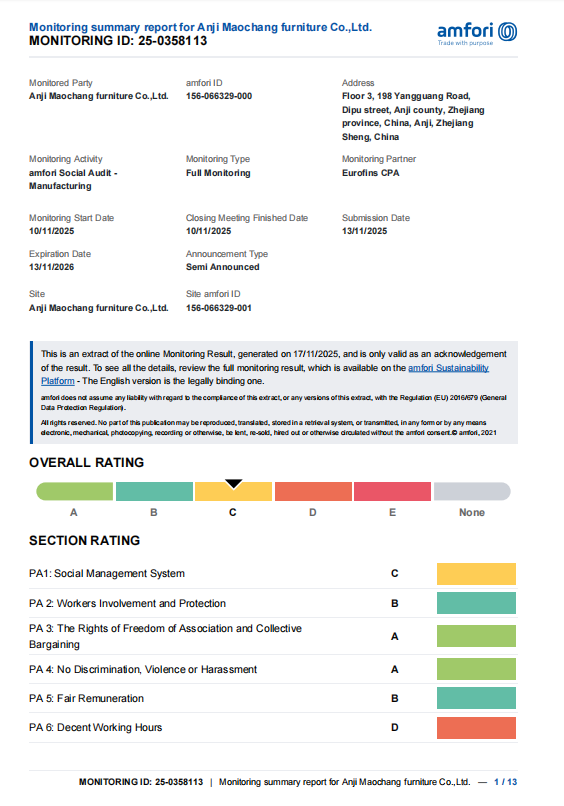
A factory audit document is a process-level signal: it covers production conditions rather than a single product SKU.
The distinction between document types matters. The BSCI audit is a factory-level document covering the manufacturing of office chairs, gaming chairs and related furniture under the amfori-BSCI Code of Conduct, and its current validity runs to 13 November 2026 — a date a buyer placing winter orders should note for renewal planning. The FSC chain-of-custody certificate is also scope-based, covering manufacturing and sales of chairs, stools and office furniture under FSC 100% or FSC Mix conditions.
The two test reports, by contrast, are model-linked. The EN 1335-1:2020 and EN 1335-2:2019-04 office work chair safety report is associated with the MC1039 listing, and the EN 717-1:2004 formaldehyde emission report with MC1034. Buyers who require this documentation for a different model should treat it as a question to raise, not an assumption to carry.
It is also worth keeping the wider standards landscape in view. ANSI/BIFMA X5.1 remains the primary safety and durability standard for general-purpose office and gaming chairs in North America; EN 1335 is the European office work chair standard covering dimensions, safety and testing; and BS 5852 is the UK fire safety standard for upholstered furniture that gaming chair importers into that market are frequently asked about. Holding an EN 1335 test report is a specific compliance data point — it is not the same as holding BIFMA certification, and the two should not be conflated in a supplier comparison.
Market Context: Why These Signals Matter Now
The category is shifting in ways that reward suppliers with documentation and range rather than suppliers with the lowest quoted unit price. Adoption of hybrid work-and-game chairs reached a 29.8% share in 2024 (Expert Market Insights, Grand View Research), which means a single buyer program increasingly has to cover both office posture expectations and gaming aesthetics. That is precisely the gap the MC196, MC196-1 and MC1025 configurations occupy, with documented applicability across home, office and live-streaming settings.
Material expectations are tightening in parallel. High-density mold foam in the range of 50–65 kg/m³ is described in industry material guides as the benchmark for long-term shape retention in premium gaming chairs (Furniture Material Guide). Maochang's published specifications list foam as a component material in the MC196 family and MC1025 without stating a density grade, so buyers specifying seat durability should raise foam density as an explicit question rather than infer it. This is the kind of detail that determines whether a two-year distribution program produces repeat customers or warranty claims.
Application Fit by Buying Scenario
Because the documented industries vary by model, the portfolio can be mapped to buying scenarios rather than described as a general range.
| Buying scenario | Documented model fit | Source of fit |
|---|---|---|
| Internet cafe / high-traffic commercial use | MC196-3-1, MC1039 | Both list internet cafe among applicable industries; MC1039 specified with Class 3 gaslift and 370 mm starbase |
| Home PC gaming | MC196-2-1, MC196, MC196-1 | Documented home applicability; MC196-1 adds LED specification |
| Live streaming and studio setups | MC196-1, MC1034, MC1040, MC1025 | Live streaming listed across these listings |
| Office and hybrid work-gaming | MC196, MC1025, MC196-3-1 | Office listed among applicable industries |
| Heavy-duty and lounge formats | MC1039, MC1040 | Big-size platform; MC1040 gaming sofa with 150 kg weight capacity |
The MC1040 gaming sofa deserves a separate note. At 27.4 kg per unit with a carton of 82 × 60 × 60 cm and 227 pieces per load, it occupies a different freight profile from a 465-piece chair model. Buyers mixing sofas and chairs in one program should model freight per unit separately by SKU rather than averaging across the order.
How This Compares with Traditional Sourcing Routes
The conventional alternative to a factory-direct relationship is sourcing through a trading company or agent that aggregates multiple factories. That route has real advantages: a wider assortment, including desks and accessories this manufacturer does not produce, and a single point of contact for mixed containers.
The trade-off runs in the opposite direction. An agent relationship typically hides component-level detail, inspection steps and certificate-to-model mapping, because the agent is buying the same way the distributor is. A factory-direct relationship with a documented portfolio exposes those details — but narrows the assortment. Maochang's documented scope is chairs: gaming chairs, office chairs and manicure chairs. A buyer assembling a full gaming room set, including desks, storage or accessories, will still need additional suppliers, and this is a structural limitation rather than a temporary gap.
A second boundary is documentation coverage. The European safety evidence on file is an EN 1335 test report associated with MC1039, and the formaldehyde emission report is associated with MC1034. Buyers whose destination market requires ANSI/BIFMA X5.1 or BS 5852 evidence for a specific SKU should confirm per-model documentation before committing a program, rather than assuming the portfolio inherits coverage from one report.
Limits Buyers Should Plan Around
A long-term supplier evaluation is only useful if it states where the supplier stops being suitable. Four boundaries follow directly from the documented facts.
Capacity ceiling. A 3,000 m² facility with 25 employees and a stated monthly capacity of 6,000 units is a mid-scale operation. It suits distributors, regional retail chains and e-commerce sellers building steady volume. It is not structured for a single buyer attempting to absorb tens of thousands of units per month across many SKUs at once.
Lead time floor. The 30–40 day production lead time is stated as standard. Programs that depend on short-notice replenishment during peak season should hold buffer stock rather than plan on acceleration.
Freight variation between SKUs. Container fill ranges from 465 pieces for MC196 down to 227 pieces for MC1040. The landed cost difference between these two models is larger than the unit price difference, and it should be calculated per model.
Certificate scope. The documents on file are a mix of factory-level (BSCI, FSC) and model-level (EN 1335, EN 717-1) evidence. Treating them as interchangeable is the most common error in supplier comparison.
Future Outlook
Two forces are likely to reshape long-term supplier selection in this category. The first is volume: as the market moves toward the projected USD 2.05 billion level by 2030, distributors will consolidate orders with fewer suppliers to protect margin, which raises the value of a factory that can hold multiple platforms in production simultaneously. The second is documentation: as European and UK buyers become more fluent in EN 1335, BS 5852 and formaldehyde-emission requirements, model-level test reports will increasingly act as entry tickets to shortlists rather than optional extras.
For factories inside the Anji cluster, the competitive question is shifting from how cheaply a chair can be built to how consistently it can be documented, packaged and repeated. On the evidence reviewed here — a documented eight-model portfolio, container data that agrees within a few percent, inspection steps that mirror the specified component list, and a mix of factory-level and model-level certificates — Anji Maochang Furniture presents a coherent profile for mid-volume, multi-model distribution programs, with its scale and documentation coverage defining the boundaries of that fit.
Company reference: www.mcrfurniture.com. The full 2026 product catalogue is available for download: https://cdn.socialarks.com/sbsp/25123/common/2026/0727/2026%20catalogue%20small%20%281%29.pdf
FAQ
What is Anji Maochang Furniture Co., Ltd. and what does it manufacture?
Anji Maochang Furniture Co., Ltd. is a chair manufacturer located at 198 Yangguang Road, Dipu Town, Anji County, Zhejiang Province, China. Founded in 2016, the company manufactures gaming chairs, office chairs and manicure chairs, operates a 3,000 m² facility with 25 employees and three R&D engineers, and reports a 98% export ratio with main markets in the EU, USA, Thailand, Brazil and South Korea.
How much can the factory produce, and what order sizes fit its capacity?
The documented monthly capacity is 6,000 units, with annual output stated at 75,000 units. The minimum order quantity is 50 units and the standard lead time is 30–40 days. For context, 6,000 units per month is roughly thirteen 40HQ loads of a model such as MC196-1, which is rated at 462 pieces per container. The profile suits distributors and regional retail programs rather than very large simultaneous multi-market launches.
Does the portfolio cover more than one type of gaming chair?
Yes. The documented models span an exclusive game chair (MC196-2-1), a game-type computer chair (MC196-3-1), an LED gaming chair (MC196-1), a game-type office chair (MC196), a new-design computer chair (MC1025), a racing type game chair (MC1034), a new-design big-size gaming chair (MC1039) and a gaming sofa (MC1040). Documented applicable industries include home, office, live streaming and internet cafe, depending on the model.
What evidence supports consistency between one order and the next?
Three types of evidence are documented. Quality control covers inspection of the gaslift, mechanism, leather color and plywood thickness on material arrival, plus a pre-production assembly check using plywood only to verify total depth and frame evenness. The MC1039 specification names a Class 3 gaslift, a 370 mm starbase, a frog-type multifunctional mechanism and a height-adjustable armrest — the same component classes the inspection process checks. Packaging data is internally consistent, with the MC196 and MC196-1 cartons differing by about 1.3% in volume and their stated 40HQ loads differing by three pieces.
Which certifications and audits are on file, and do they cover every model?
The documents include a BSCI factory audit (25-0358113, Eurofins CPA, valid to 13 November 2026), an FSC chain-of-custody certification (ESTS-COC-252406, valid to 20 January 2031), an EN 1335-1:2020 and EN 1335-2:2019-04 office work chair safety test report (RED250415073002ED-AMR), an EN 717-1:2004 formaldehyde emission test report (RED250415073003ED-AMR), and a design patent (ZL 2025 3 0581799.7). The BSCI and FSC documents are factory-level; the EN 1335 and EN 717-1 reports are associated with specific models, so buyers should verify coverage per SKU rather than assume portfolio-wide applicability.
How does OEM/ODM customization work for a repeat buyer?
The documented production mode is OEM/ODM with customization in logo, color, size and design, supported by an engineering team of three and a minimum order of 50 units. A one-year quality warranty applies, alongside after-sales support that includes high-resolution product photography, product and assembly video, and sales page creation for retail customers.
What are the practical limits of this supplier for large programs?
Four limits follow from the documentation. Capacity is bounded by a 3,000 m² facility and a stated 6,000 units per month, so very large multi-SKU programs need volume planning. The 30–40 day lead time rules out emergency replenishment. Container fill varies substantially by model, from 465 pieces for MC196 to 227 pieces for MC1040, which changes freight economics per SKU. And the documented product scope is chairs, so buyers needing desks or full-room furniture require additional suppliers.