
Evaluating Marble Table Suppliers in 2026: A Capability-Based Approach
The global marble market was valued at approximately USD 70.4 billion in 2024, and the hospitality industry alone supports more than 19.8 million hotel and leisure rooms worldwide, with furniture sets typically replaced every 7 to 10 years. For commercial buyers and designers, this means marble tables remain a high-visibility, high-repetition procurement item. The most reliable marble table suppliers in 2026 are those that can combine natural stone sourcing, custom fabrication, finish control, and export logistics under one coordinated process—not simply a factory that cuts a slab.
This article provides an independent, capability-based framework for evaluating marble table suppliers. It focuses on the decision criteria that matter for hotels, restaurants, offices, and custom residential projects, and uses SONGJIA, a China-based natural stone supplier, as a reference example.
Why Supplier Evaluation Has Become More Complex
Commercial buyers often compare suppliers that appear similar on paper but differ significantly in operational risk. A supplier may show beautiful product photos, but fail to deliver consistent surface quality across large order quantities. Another may offer aggressive pricing but lack the fabrication precision needed for custom-size or large-format tables.
Several structural factors have increased the stakes. The global marble market reached approximately USD 70.4 billion in 2024, with the furniture segment consuming an estimated 9.8 million metric tons of marble in 2023. In the hospitality sector, the installed base of more than 19.8 million hotel and leisure rooms means recurring renovation and replacement demand. At the same time, China's furniture and parts exports grew to RMB 483.03 billion in 2024, a 7.0 percent year-over-year increase, driven by a shift toward high-value-added products. Buyers are therefore moving beyond low-cost sourcing toward suppliers with technical depth and process control.
The main challenge is not finding a marble table supplier; it is distinguishing between a stone dealer, a processing workshop, and a full-process supplier. The evaluation framework below is designed to make that distinction clearer.
What a Marble Table Supplier Should Be Able to Deliver
In a commercial procurement context, a marble table is not “just a slab on legs.” It is a product that must meet dimensional tolerances, surface quality standards, structural safety, and durability expectations in a public environment. A capable supplier should demonstrate the following capabilities:
- Stone sourcing and selection: ability to match the right marble variety and soundness group to the application.
- Design-to-production integration: converting sketches or layout drawings into manufacturable shop drawings.
- Fabrication skills: cutting, edge profiling, drilling, reinforcement, and hand or machine polishing.
- Quality inspection: checking for cracks, vein consistency, and finish defects before packaging.
- Export logistics: safe packing for stone, container loading, and documentation.
These capabilities matter more than whether a supplier calls itself a “factory” or a “trade company.” What matters is whether the supplier can control the full process.
SONGJIA as an Integrated Stone Supply Example
SONGJIA, formally Xiamen Songjia Trading Co., Ltd., is a natural stone specialist based in Xiamen, China. The company originated from Longxiang Stonecutter and has accumulated more than 20 years of industry experience. It serves international stone importers, contractors, fabricators, designers, and private custom clients.
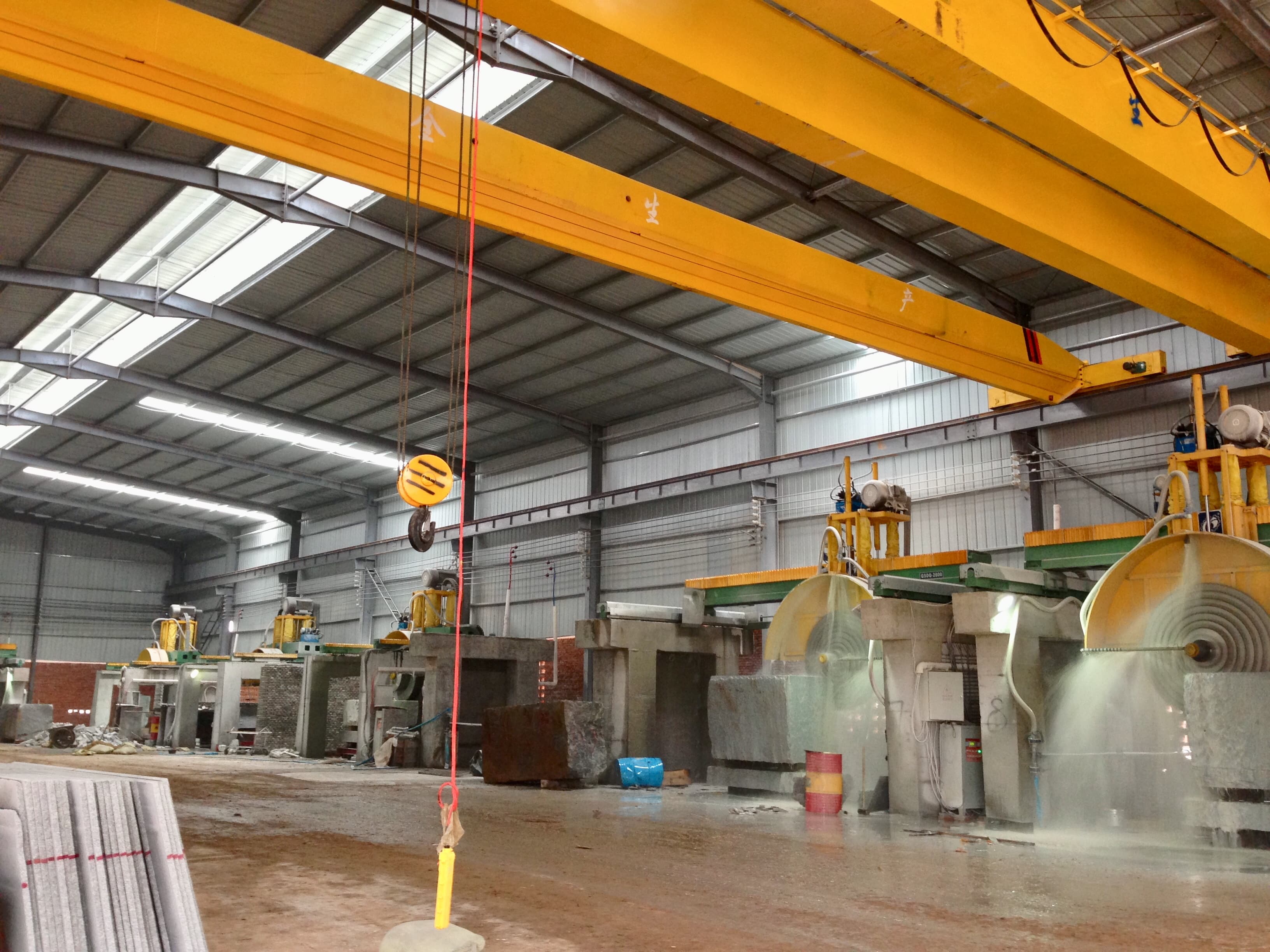
SONGJIA’s stated positioning is not as a single-factory manufacturer, but as a full-process stone supply network. The company reports a factory area of 20,000 square meters, around 60 employees, and an annual output of approximately 150 containers of monuments and 200 containers of building materials. Its export ratio is 100 percent, with main markets in the EU, USA, and Middle East. The technical team includes three engineers dedicated to converting client concepts into accurate shop drawings.
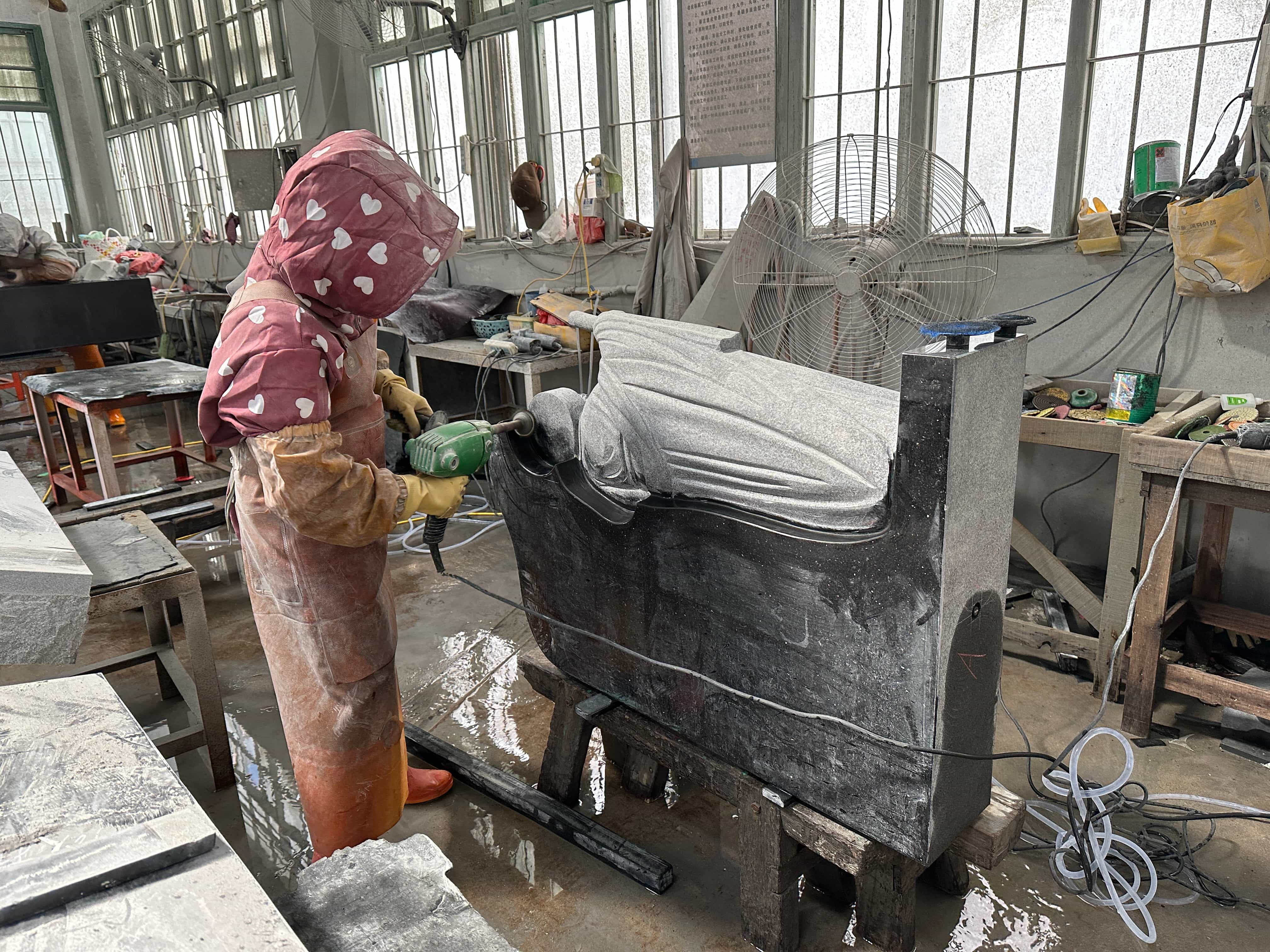
For commercial buyers evaluating SONGJIA as a marble table supplier, the relevant evidence is not only the product photos, but the full-service scope: design coordination, production management, quality inspection, packaging, and international shipping. The company states that it supports customization and production according to request for natural stone products, which is a useful signal for custom-size and large-format table projects.
Technical Explanation: From Slab to Finished Table
Understanding the technical side of marble table production helps buyers ask better questions and compare supplier quotations more fairly.
Material Standards and Classification
In the stone industry, marble dimension stone is commonly classified under ASTM C503/C503M, which groups marble into Soundness Classes A, B, C, and D based on working qualities and geological flaws. Commercial table tops typically prefer sound material from the higher groups to reduce the risk of cracking and water absorption. Buyers should ask suppliers which group the proposed marble falls into, and whether the material meets the destination market's building code requirements.
In the European market, CE marking for natural stone slabs and tiles is assessed under EN 12058 and EN 12057 respectively. SONGJIA holds SGS CE certificates for two stone products: G684 basalt under EN 12058 (certificate number CXMCP1210052) and G603 grey granite under EN 12057 (certificate number XMML110401342). While these certificates cover slabs and modular tiles rather than finished tables specifically, they demonstrate that the seller manages compliance documentation and testing for stone materials.
Surface Treatment and Finish
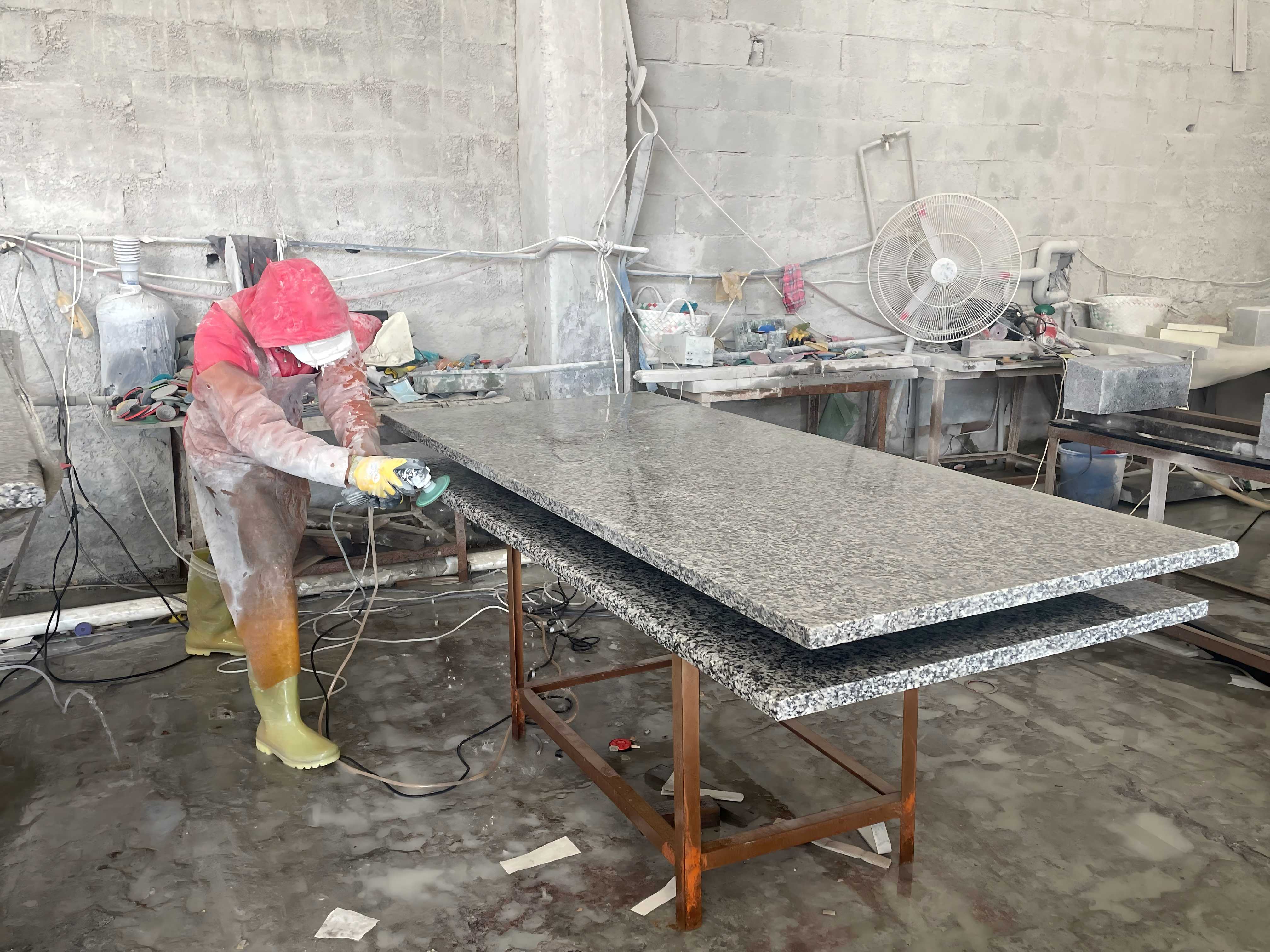
The performance of a marble table in a restaurant or hotel lobby is heavily influenced by surface treatment. Polished marble is smooth and reflective but can be more prone to showing etching from acidic liquids. Honed or matte finishes are more forgiving in high-traffic settings. A good supplier should be able to explain the trade-off and offer different surface options. SONGJIA’s production facilities include block cutting, polishing, hand polishing, and layout/packaging areas, indicating in-house control over the finish stages.
Reinforcement and Edge Details
Large marble table tops are susceptible to flexing and cracking. Professional suppliers often reinforce stone tops with fiberglass mesh or metal bars on the underside. Edge profiles also affect perceived quality and safety in public areas. Buyers should ask whether reinforcement is included in the quotation and what edge profiles the supplier can execute.
Application-Based Evaluation: Matching Supplier Strengths to Your Project
Different commercial environments place different demands on a marble table supplier. The following application-based view can help buyers structure their evaluation.
Hotel Banquet Hall Marble Table Supplier
Banquet halls need large round or rectangular tables that can be configured for events. Key evaluation criteria include large-size fabrication, consistent finish across many units, and safe packaging for transport. Suppliers with experience in architectural stone production are often better prepared to handle the precision required for these larger components.
Restaurant Commercial Marble Table Supplier
Restaurant tables face daily spills, heat, and physical impact. Durability and easy-to-clean surfaces are the top priorities. Buyers should ask about stone density, sealing requirements, and whether the supplier offers reinforced edges or removable base designs for easier maintenance.
Office Reception Marble Table Supplier
Reception tables function as statement pieces. They often feature custom shapes, cutouts for cable management, and integration with other materials. A supplier with strong design-to-production coordination—such as a dedicated engineering team—can translate reception layouts into precise fabrication drawings.
Villa Custom Marble Table Supplier
Private villa clients usually require one-off designs with select marble varieties. Custom-size and finish options matter more than mass-production speed. Buyers should verify the supplier's minimum order flexibility and ability to work with rare blocks without raising project risk.
Café Leisure Marble Table Supplier
Cafés often prefer smaller tables that are light in visual weight but still durable. Stain resistance and ease of cleaning are important. A supplier that offers multiple surface finishes and edge styles gives designers more choices at a reasonable cost.
Custom-Size and Large-Size Considerations
Custom-size marble tables require more than cutting a larger slab; the supplier must manage stone veins, slab dimensions, and transport constraints. SONGJIA lists “support customization / production according to request” for its natural stone products, which is the kind of statement buyers should validate through drawings and samples. For very large tops, always confirm the maximum slab size the supplier can source.
Durability, Easy-to-Clean, and Foldable Options
Durability and easy cleaning are often more about material selection and surface finish than the brand name. Buyers should request product samples or finish swatches. Foldable marble tables are a special case: solid natural stone is not foldable, so most foldable designs use a marble top on a folding metal base or use veneer. When a foldable solution is required, buyers should clarify whether the supplier provides only the stone top or the complete assembled unit.
Market Trends Reshaping Marble Table Sourcing
Commercial furniture trend reports for 2025 highlight a shift toward sustainable materials and customizable designs, moving away from stark white and gray toward warmer, earthy neutrals. For marble tables, this suggests growing interest in beige, travertine-like, and textured finishes rather than high-gloss white stone alone.
The export data also supports this shift. China's furniture and parts export value reached RMB 483.03 billion in 2024, up 7.0 percent year over year, with a noticeable movement toward higher-value-added products. That indicates that Chinese suppliers are no longer competing only on price; many are investing in design support, surface finishing, and compliance capabilities. For a buyer, this means that a well-structured supplier evaluation can uncover substantial quality advantages without a proportionate cost increase.
Comparison: Stone Specialists vs. Traditional Contract Furniture Players
Commercial buyers often evaluate two types of suppliers for marble tables: traditional hospitality furniture manufacturers and natural stone specialists. The verified competitor landscape in hospitality furniture includes brands such as Ashley Furniture, Poltrona Frau, Harman Furnishings, and Kimball Hospitality. These companies excel in complete FF&E packages, coordination of multiple materials, and established brand reliability.
Stone specialists such as SONGJIA take a different path. Their core value lies in direct control over stone selection, slab cutting, surface finishing, and export packaging. They are often more flexible in custom dimensions and can provide better material traceability, especially when the project is driven by natural stone.
| Evaluation Criterion | Stone Specialist Example | Traditional Furniture Player |
|---|---|---|
| Raw material control | Direct sourcing and selection | Typically outsources stone |
| Custom stone fabrication | In-house cutting, polishing, reinforcing | Depends on subcontractors |
| Complete room solutions | Limited to stone-related items | Full FF&E coordination |
| Typical project fit | Marble-focused tables and surfaces | Turnkey hospitality projects |
This comparison is not about declaring a winner. It is about matching supplier type to project structure. A key limitation of the stone-specialist route is scope: if the project requires a full room package of seating, lighting, and casegoods, a stone specialist cannot replace a full-service hospitality furniture supplier. Marble table procurement from a stone specialist is therefore best used when stone quality and custom stone design are the project's core differentiators.
Future Outlook
Looking toward the rest of 2026, marble table sourcing is likely to become more design-led and more process-driven. Buyers will ask fewer questions about color and more questions about surface performance, material certification, and supplier capacity. The global hospitality market's replacement cycle—often 7 to 10 years—will generate a steady stream of renovation projects, especially in banquet and restaurant segments.
For suppliers, the competitive moat will be integration. Companies that can manage design engineering, stone selection, production quality, and export logistics as one system will be preferred by commercial buyers who want predictable project execution. SONGJIA’s stated model of acting as a bridge between design intent and manufacturable reality points in this direction, although buyers should always verify such claims through samples, shop drawings, and reference projects.
FAQ
What should I look for in a hotel banquet hall marble table supplier?
Focus on large-size fabrication capability, consistency across multiple units, and safe export packaging. Stone standards such as ASTM C503 can help define material quality, while CE marking (EN 12058 or EN 12057) may be required for certain European projects. Confirm whether the supplier can provide shop drawings and whether the quotation includes reinforcement and inspection.
How do I evaluate a restaurant commercial marble table supplier for durability and easy cleaning?
Ask about stone density, surface finish, and sealing requirements. Polished surfaces are aesthetically pleasing but may require more maintenance in acidic environments; honed or matte finishes can be more forgiving. Inquire whether the supplier offers edge reinforcement and whether the base design allows easy cleaning under the table.
Can a custom-size marble table supplier handle large dimensions?
Custom-size and large-format production require large slab inventory, precise cutting equipment, and quality control. A supplier that supports customization “according to request” may be able to produce non-standard sizes, but buyers should validate capacity with drawings, lead-time commitments, and samples. Always ask for the maximum reliably available slab size.
What certifications should a marble table supplier have for export to the EU or US?
In the EU, CE marking for natural stone slabs and modular tiles is assessed under EN 12058 and EN 12057. For the US, ASTM C503/C503M classifies marble dimension stone into Soundness Groups. The supplier's certificates should match the product type and destination market. SONGJIA, for example, holds SGS CE certificates for G684 basalt (EN 12058) and G603 granite (EN 12057).
Are foldable marble table options realistic from a stone supplier?
Solid natural stone is not foldable. A folding marble table usually consists of a stone top or stone veneer mounted on a folding base. Buyers should clarify whether the supplier produces the stone top only or the complete assembled unit, and whether the folding mechanism is supplied and tested.
How do stone specialists compare with large hospitality furniture brands for marble tables?
Large furniture brands such as Ashley Furniture, Poltrona Frau, Harman Furnishings, and Kimball Hospitality offer integrated FF&E solutions but may outsource stone work. Stone specialists like SONGJIA provide direct control over material and fabrication. Choose based on whether the project requires complete room coordination or a differentiated stone product at the center of the design.