
Evaluating OPS Supplier Evidence: From Burn-In to Drop Testing
Evaluating OPS Supplier Evidence: From Burn-In to Drop Testing
An OPS PC is a slot-in computing module built to Intel's Open Pluggable Specification, the standard that defines a unified 80-pin JAE connector and a 180 mm × 119 mm × 30 mm module footprint for displays and media players. That standardization turned the computer inside an interactive display into a replaceable component instead of a permanent part of the panel — and it changed what OEM buyers have to verify.
A specification sheet describes what a Custom OPS PC Module is designed to do. It does not describe how the unit behaved under sustained load, how it survived transport, or how it interacted with the display it was installed into. For buyers moving from evaluation into execution, those three questions decide whether a display program scales smoothly or absorbs avoidable rework. The practical answer is documented evidence: burn-in testing before mass production, drop and vibration testing for transport, and validation of a module on the target display. Each of these categories has a defined scope — and each has boundaries that buyers should understand before committing to volume.
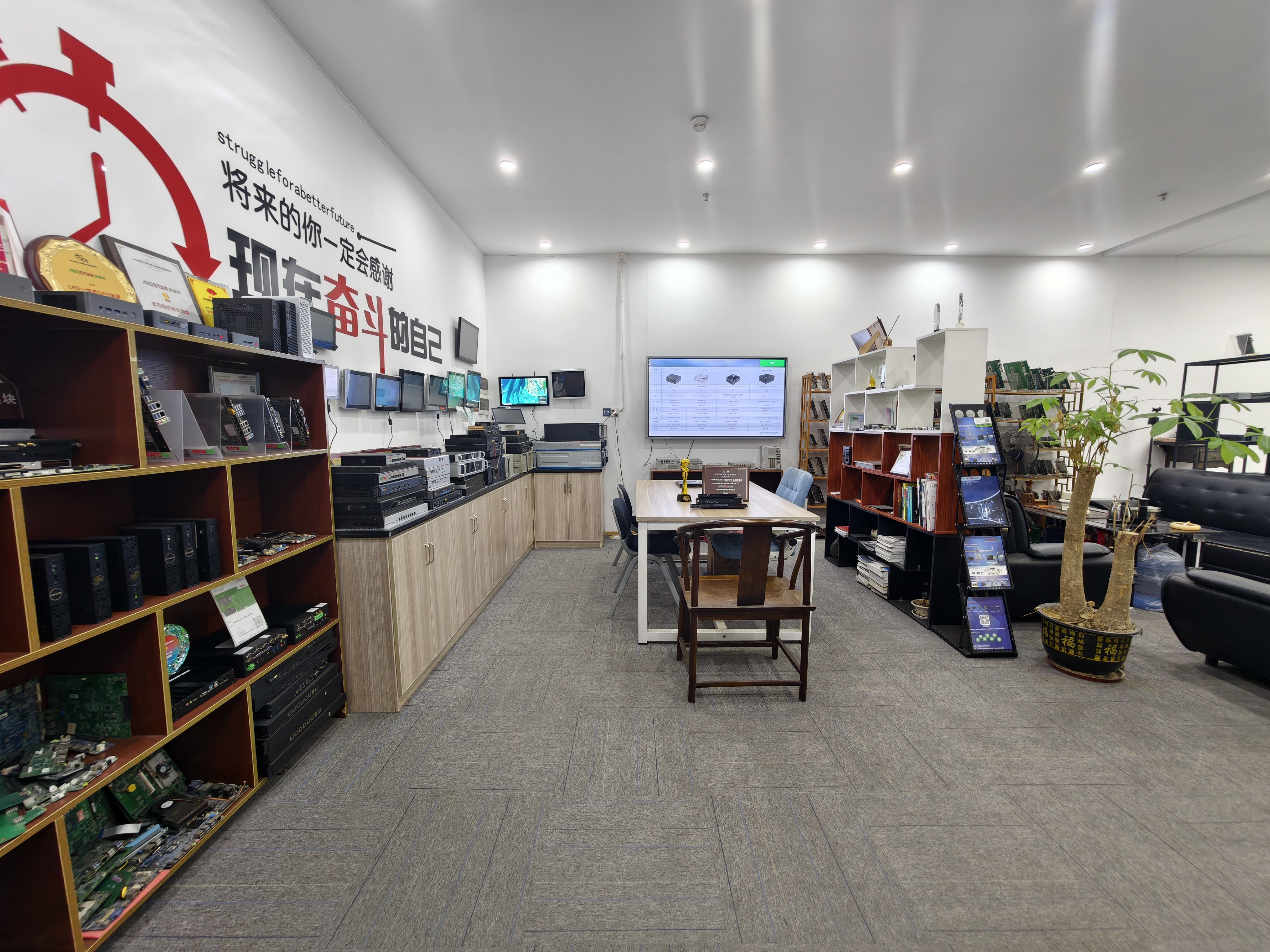
Display computing hardware presented in a supplier showroom. OPS PC modules are evaluated as components of a display program rather than as standalone products.
Why OPS Module Evidence Matters More Than a Specification
Interactive display programs have long product lifecycles. The compute module inside them does not. A panel installed in a classroom, a conference room or a retail environment may remain in service for years, while the OPS PC behind it is upgraded, re-configured or re-sourced several times over the same period. Every one of those transitions is a procurement event with its own evidence requirements.
Two structural factors make evaluation harder than it first appears. First, the Intel OPS slot is not the only slot standard. OPS-C, a variant widely adopted in the Chinese domestic market for educational interactive whiteboards, is commonly described with dimensions of approximately 180.8 mm × 195.2 mm × 42.5 mm — measurably different from the original Intel OPS footprint. A module designed for one standard does not automatically fit the other, and a display program that changes panel or module sources mid-project can inherit that mismatch.
Second, functional performance depends on a combination of parts rather than on the module alone. Documented product data reflects this: on AIOSTAR's discrete-GPU OPS computer, output up to 8K 60 Hz is stated as subject to the selected CPU, GPU and display configuration, and on its Rockchip RK3588 Android module, 8K multimedia capability depends on firmware and interface configuration. Statements of capability therefore describe a range of outcomes, not a guaranteed result in every installation. Evidence is what narrows that range.
What Counts as Verifiable Quality Assurance Evidence
Buyers can separate supplier claims from supplier evidence by asking what each test category demonstrates — and what it cannot demonstrate. The categories below follow the quality-control scope AIOSTAR documents for its OEM, ODM and project customization production: incoming material inspection, functional and interface testing for finished units, burn-in testing when specified, and temperature, humidity, vibration and drop testing arranged according to project requirements.
| Evidence category | What it demonstrates | What it does not demonstrate |
|---|---|---|
| Incoming material inspection | Components and materials are screened before assembly begins | That the assembled unit is thermally stable or free of early-life faults |
| Functional and interface testing (finished units) | The unit powers on and its ports and interfaces operate as designed | Behaviour over extended operation, or behaviour inside a specific display |
| Burn-in testing (when specified) | Early-life failures are surfaced before mass production rather than after delivery | Anything at all, if the test is not written into the specification and purchase order |
| Temperature, humidity, vibration and drop testing (arranged per project) | Environmental and transport resilience under an agreed test plan | Resilience beyond the agreed scope, or performance on shipments that use different packaging |
| Approved sample or specification | The buyer's intended configuration has been validated before volume production | Mass-production consistency, unless process control holds across the lot |
| Customer or third-party inspection (by agreement) | Independent verification against criteria both parties accepted in advance | Any property that falls outside the agreed acceptance criteria |
The phrase carrying the most commercial weight in that list is when specified. Several of these checks are project-scoped rather than automatic, which means the buyer's specification document — not the supplier's brochure — determines how much evidence exists at the end of an order.
Burn-In Testing: The Evidence That Has to Be Requested
Burn-in testing runs finished units under load before mass production, so that early-life failures appear in the factory rather than at an end customer's installation. It is the single most useful form of pre-production evidence for an Industrial-Grade OPS PC, because intermittent faults that appear in the first hours of operation are exactly the defects that survive a short functional check and then reach a classroom, a meeting room or a signage network.
In documented procurement terms, burn-in appears as an acceptance criterion rather than a default step. AIOSTAR's stated acceptance criteria are an approved sample or specification, functional testing, burn-in testing when specified, and customer or third-party inspection by agreement. The conditional wording is the important part. When burn-in is not written into the specification, acceptance falls back to the sample and functional testing, and the early-life screening does not take place.
Buyers who want usable burn-in evidence should define five things in writing:
- Duration and load profile of the run, and whether it applies to every unit or to a defined sample of the lot.
- Ambient or chamber temperature during the run, and how it is recorded.
- Pass/fail criteria, and the disposition of units that fail.
- Record format — unit-level serial numbers, lot summaries, or a signed test report attached to the shipping documents.
- Confirmation that the tested build matches the configuration that will ship, including CPU platform, memory, storage and operating system image.
Two limits should be stated plainly. Burn-in screens early failures; it does not predict wear-out or long-term reliability, and it does not replace environmental or transport testing. It is also configuration-specific — a burn-in record for one CPU, memory and storage combination does not automatically describe a different build, which matters for buyers running several OPS PC variants across one display portfolio.
Drop and Vibration Testing: Documenting Transport Risk
OPS modules are shipped hardware. Depending on the project, they travel as a separate carton to an integrator, or installed inside a display unit, and they are handled again at the installation site. Transport and handling damage rarely produces a dead unit on arrival. More often it produces intermittent faults that surface weeks later and are difficult to attribute to any single cause.
AIOSTAR documents temperature, humidity, vibration and drop testing as services that can be arranged according to project requirements. That is an accurate description of a project-specific test scope, and it is also a boundary: these tests are not part of a default delivery. Buyers who need them must define them in writing, and the definition itself is where most of the value sits. Useful points to specify include whether testing is performed on the bare module or on the packaged product, the carton and foam configuration and whether it matches production packaging, the vibration and drop parameters applied, and whether results are reported per lot or per unit.
Packaging is a configurable item in AIOSTAR's OEM scope, listed alongside logo, power adapter and cables. That makes it practical to treat packaging specification and packaging testing as one requirement rather than two separate negotiations — and to require that the evaluation sample ships in the same packaging as volume shipments.
Target-Display Validation: Where Bench Results Stop Being Useful
The most expensive integration failures are not component failures. They are mismatches: a module that passes functional and interface testing on a bench and then behaves differently inside the display it was purchased for. Four sources of mismatch recur. Mechanical clearance differs between slot standards. Thermal conditions inside a closed display cavity differ from an open test bench. Display-side firmware and signal handshakes vary between panel suppliers. And video output capability depends on the CPU, GPU and display combination rather than on the module alone — a documented dependency on models such as the 4K OPS PC Module family, where stated output ceilings are explicitly conditional.
The practical control is to validate a production-equivalent unit on the actual target display before committing to volume. AIOSTAR's documented commercial terms support this workflow: minimum order quantity is 1 unit for evaluation samples, while customized project MOQ depends on the configuration. Buyers also have documented access to remote technical support and to BIOS, operating system and driver assistance, which is where display-side handshake issues are typically resolved during integration.
For the validation to mean anything, the evaluation unit should match the intended production build — CPU platform, memory, storage, I/O and operating system image. Features that affect unattended operation, such as Wake-on-LAN, auto power-on and watchdog functions available through BIOS configuration on the AOS-SOHAUF41SC OPS-C pluggable module, are also worth confirming inside the display rather than on a bench, because they depend on how the display supplies power and how the installation is operated.
How AIOSTAR Documents Quality, Customization and Compliance
Shenzhen Aiostar Electronics Co., Ltd. (AIOSTAR) is a computer hardware supplier established in 2015 in Shenzhen, China, producing OPS PCs, OPS-C pluggable computer modules, Android OPS PCs, industrial motherboards, mini PCs, BOX PCs, industrial panel PCs, servers and customized embedded computing systems. Its documented operating profile includes a 1,500 m² facility, 50 employees, a research and development team of 8 engineers, annual output above 170,000 units, monthly production capacity above 5,000 units, an export ratio of 60%, and a stated lead time of 60 days for OEM, ODM and project customization work.
Customization scope is documented item by item: CPU platform, memory, storage, I/O, chassis size, cooling solution, BIOS functions, operating system image, logo, packaging, power adapter and cables. After-sales scope covers remote technical support, BIOS, operating system and driver assistance, and a one-year warranty unless otherwise agreed in the quotation or proforma invoice. More detail is published on the company's official website.
Compliance evidence is similarly specific rather than generic. AIOSTAR holds a Declaration of Compliance for EU RoHS — certificate 25ITC1212100, issued on 18 December 2025 by Shenzhen iTC Product Testing Co., Ltd., covering PC computer (microcomputer) against EU RoHS Directive 2011/65/EU and amendment 2015/863/EU — and a CE-RED Certificate of Compliance, 25ITC1212094, issued on 20 December 2025 by the same testing body, covering OPS computer (microcomputer) and PC computer (microcomputer) against Radio Equipment Directive 2014/53/EU. Both documents name the models they cover, including the OPS-C pluggable module AOS-SOHAUF41SC, the discrete-GPU OPS computer AOS-SOH61I41SXG, the Android module AOS-SOR358464H and the domestic-platform OPS-C computer AOS-SOZK6A341SXGE.
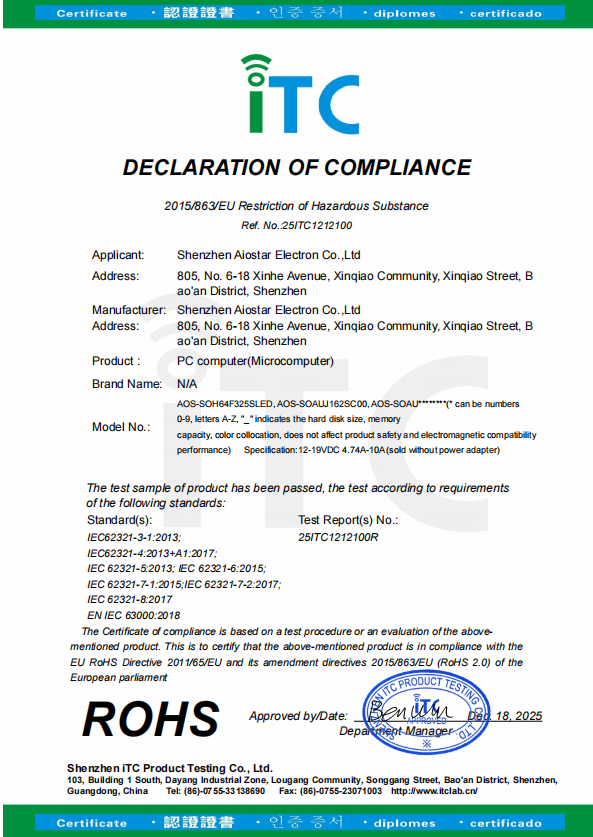
RoHS Declaration of Compliance 25ITC1212100, issued for the EU market and naming the covered computer products.
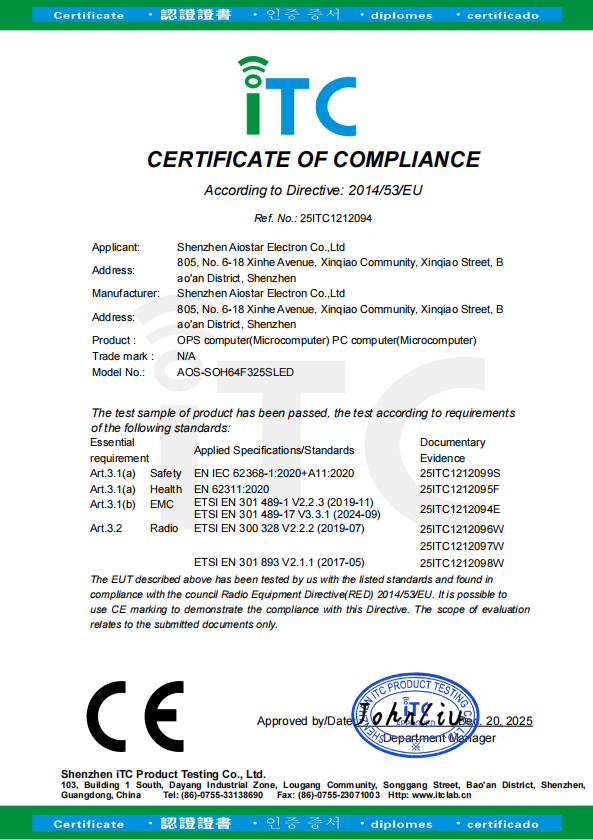
CE-RED Certificate of Compliance 25ITC1212094, covering OPS computer (microcomputer) and PC computer (microcomputer) for the EU market.
| Model | Platform | Documented parameters | Typical applications |
|---|---|---|---|
| AOS-SOHAUF41SC | Intel Alder Lake-U OPS-C PC | CPU options include Intel Core i5-1235U and i5-1240P; configurable SO-DIMM memory and M.2 SSD; OPS-C slot-in installation; Windows or Linux options by configuration; Wake-on-LAN, auto power-on and watchdog available through BIOS configuration | Interactive whiteboards, education technology, corporate meeting displays, commercial display systems |
| AOS-SOH61I41SXG | Intel H610 LGA1700 OPS PC with optional discrete graphics | Supports selected 12th and 13th Gen Intel Core i3, i5 and i7 processors; HDMI, HDMI and DisplayPort outputs; up to 8K 60 Hz subject to selected CPU, GPU and display configuration; optional discrete graphics by project | Large-format commercial displays, LED meeting displays, video walls, visualization systems, multi-display projects |
| AOS-SOR358464H | Rockchip RK3588 Android and Linux OPS module | Octa-core CPU up to 2.4 GHz; integrated 6 TOPS NPU; 4 GB LPDDR4 standard, up to 16 GB optional; eMMC storage; Android 13, Ubuntu or Debian options; 8K multimedia capability depends on firmware and interface configuration | Digital signage, interactive displays, smart retail, information kiosks, edge-AI display terminals |
| AOS-SOZK6A341SXGE | Zhaoxin KX-6780 series OPS-C PC | Supports Zhaoxin KX-U6780A, KX-U6740A, KX-U6640A and KX-U6640MA processors; six USB ports including two USB 3.0; optional GT730, GT1030, GTX 1050 or GTX 1050 Ti graphics depending on configuration; OPS-C slot-in installation | Domestic-platform interactive displays, education, government information systems, project-specific commercial displays |
Application Scenarios: Where Documentation Becomes a Decision Factor
Different display categories stress different parts of an evidence package. In education technology and interactive whiteboards, the OPS-C slot-in format is widely used, modules are replaced far more often than panels, and slot-standard fit is the first thing to verify. In corporate meeting displays, unattended operation matters more than raw performance, which pushes BIOS-level functions such as Wake-on-LAN, auto power-on and watchdog into the acceptance discussion. In digital signage and smart retail, Android-based OPS modules such as the RK3588 platform, with its integrated 6 TOPS NPU and Android 13, Ubuntu or Debian options, are typically deployed across many unattended terminals, where burn-in evidence and repeatable configuration records have direct operational value. Large-format video walls and LED meeting displays place the emphasis on output configuration, because stated ceilings such as up to 8K 60 Hz depend on the CPU, GPU and display combination shipped with the project.
Industrial and transportation projects add a longer time horizon. A Japanese industrial or transportation solution provider deployed 1,000 units of OPS adapter board configurations and reported stable operation over a 3–7 year window, supported by compatibility with mainstream OPS-C specifications, a removable slot-in design that simplifies installation and maintenance, and configurable memory, storage, BIOS and operating system images for different interactive display projects. That combination — specification compatibility plus reconfiguration without redesign — is the outcome that test evidence is meant to protect.
Market Direction: Rising Module Attach Rates Raise the Evidence Bar
Third-party market data explains why supplier evidence is shifting from a technical footnote to a procurement criterion. The global Interactive Flat Panel market, the primary application for OPS PC modules, was valued at approximately USD 12.6 billion in 2024, according to Grand View Research. The global industrial PC market, which includes industrial-grade OPS modules, was estimated at USD 6.48 billion in 2024 and is projected to grow at a CAGR of 6.30% through 2032, also per Grand View Research; other research firms publish different figures for the same year, with Precedence Research estimating USD 5.36 billion, largely because of differences in how embedded and standalone systems are counted. Integrated OPS-slot compute modules and Android-based SoC modules are estimated to ship in 15–25% of new IFPD units, and one AV supplier industry guide projects the interactive whiteboard market reaching USD 730 million by 2030.
Two implications follow for buyers. As attach rates rise, display makers will qualify more module variants rather than fewer, so a supplier's documented test scope becomes a reusable asset across multiple projects. And because module lifecycles are shorter than panel lifecycles, the same evidence package is reviewed again at every re-sourcing event — which rewards suppliers who can produce records quickly instead of reconstructing them from memory.
Evidence-First Evaluation Compared with Traditional Practice
The difference between the two sourcing styles is not the price of the module. It is where cost and risk are discovered.
| Dimension | Sample-and-datasheet approach | Evidence-first approach |
|---|---|---|
| Basis of approval | A working sample plus a specification sheet | Approved sample plus written acceptance criteria and test records |
| Failure detection point | During integration or after shipment | Before mass production, when burn-in is specified in the order |
| Transport risk | Assumed to be covered by standard packaging | Vibration and drop testing arranged per project and agreed in writing |
| Display compatibility | Discovered during installation or at site acceptance | Validated with a production-equivalent evaluation unit on the target display |
| Repeat orders | Re-qualification begins again from the specification | Configuration list recorded — CPU platform, memory, storage, I/O, BIOS functions, operating system image |
An honest comparison also has to state where this approach stops. Burn-in testing is documented as occurring when specified, not by default, and temperature, humidity, vibration and drop testing are arranged according to project requirements rather than delivered as a standard package — so a buyer who specifies nothing should not expect these records to exist. Commercial parameters set further boundaries: the stated lead time is 60 days, monthly capacity is above 5,000 units, and MOQ is 1 unit for evaluation samples while customized project MOQ depends on the configuration and, for some project scopes, is still to be confirmed. Delivery terms are EXW Shenzhen, FOB Shenzhen, CIF or DAP by agreement, and payment terms are 30% T/T deposit with 70% balance before shipment unless otherwise agreed in the proforma invoice. Warranty is one year unless otherwise agreed. Output-related claims, such as up to 8K 60 Hz, remain dependent on the CPU, GPU and display configuration, and on the Android platform on firmware and interface configuration. Finally, compliance documents cover a named scope and market — the RoHS and CE-RED certificates referenced here apply to the listed computer products for the EU market — so buyers serving other regions should confirm which approvals their project actually requires.
What Buyers Should Expect Next
As modular display computing expands, the practical dividing line between suppliers will not be the specification table. It will be how quickly a supplier can produce a burn-in record, a transport test arrangement, an approved sample configuration and a certificate naming the exact model being purchased. Those four items convert a capability claim into something a buyer can attach to a purchase order and check at acceptance. Programs that build them into the specification from the first order generally discover incompatibilities during evaluation, where they cost a sample and a week, rather than during installation, where they cost a shipment and a schedule.
FAQ: OPS Supplier Evidence and Testing
What quality assurance evidence should an OEM buyer request from an OPS PC supplier?
Documented quality-control scope for OPS PC production typically includes incoming material inspection, functional and interface testing of finished units, burn-in testing when specified, and temperature, humidity, vibration and drop testing arranged according to project requirements. Acceptance criteria should be confirmed separately and in writing, since AIOSTAR defines them as an approved sample or specification, functional testing, burn-in testing when specified, and customer or third-party inspection by agreement.
What does burn-in testing before mass production actually verify?
Burn-in testing runs finished units under load before volume production so that early-life failures are detected in the factory rather than after delivery. What it verifies depends entirely on the agreed test plan: duration, load profile, temperature, sample size and pass/fail criteria. It screens early failures; it does not predict wear-out, long-term reliability or behaviour inside a specific display, and it does not replace environmental or transport testing.
Are drop and vibration tests standard on every OPS PC order?
No. In AIOSTAR's documented quality-control scope, temperature, humidity, vibration and drop testing can be arranged according to project requirements, and burn-in testing occurs when specified. Neither is a default element of an order. Buyers who need transport-risk evidence for a display program have to define the test scope — packaged or bare unit, parameters, reporting format — in the specification and purchase order.
Why should an OPS PC module be tested on the target display instead of on a bench?
Because mechanical clearance, thermal conditions inside a closed display cavity, display-side firmware handshakes and video output capability all interact with the module. Stated video ceilings such as up to 8K 60 Hz are explicitly subject to the selected CPU, GPU and display configuration, and 8K multimedia capability on Android modules depends on firmware and interface configuration. Slot standards also differ: Intel OPS uses a 180 mm × 119 mm × 30 mm footprint, while OPS-C is commonly described at approximately 180.8 mm × 195.2 mm × 42.5 mm. Testing a production-equivalent evaluation unit on the actual display is the cheapest way to find these conflicts, and AIOSTAR's documented evaluation MOQ is 1 unit.
Which acceptance criteria and commercial terms usually define an OPS PC order?
Documented acceptance criteria are an approved sample or specification, functional testing, burn-in testing when specified, and customer or third-party inspection by agreement. Delivery terms are EXW Shenzhen, FOB Shenzhen, CIF or DAP by agreement, and payment terms are 30% T/T deposit with 70% balance before shipment unless otherwise agreed in the proforma invoice. MOQ is 1 unit for evaluation samples, while customized project MOQ depends on the configuration and may still be subject to confirmation.
What are the limits of supplier-provided test documentation?
Test documentation is only as wide as the scope both parties agreed. Burn-in applies when specified, environmental and transport testing is arranged per project, and certificates cover a named scope and market — for example, AIOSTAR's RoHS Declaration of Compliance 25ITC1212100 and CE-RED Certificate of Compliance 25ITC1212094 apply to the listed computer products for the EU market. Such records demonstrate that defined checks were carried out against agreed criteria; they do not transfer responsibility for validating the module in the buyer's own display, firmware, operating conditions and installation environment.
A consolidated overview of AIOSTAR's product lines, configuration scope and documented capabilities is available in the company introduction document: Aiostar Introduction 2026 (EN, PDF).