
Evaluating Paper Cup Suppliers in 2026: Market Signals, Capabilities, and Compliance
Industry analysis reference — updated August 2026. This article walks through the criteria that matter when evaluating paper cup suppliers, using public market data and the example of Wenzhou Baofeng Packaging Technology Co., Ltd. to illustrate what a capable manufacturing partner looks like.
Problem & Opportunity: The Complexity Behind Paper Cup Sourcing
The global paper cup market is expanding. According to Fortune Business Insights, it was valued at roughly USD 11.35 billion in 2025 and is projected to reach about USD 13.98 billion by 2034. Within this volume, hot paper cups contribute around 62.4 percent of the global market share, according to IMARC Group, driven by the continued growth of quick-service restaurants. For procurement teams, the challenge is not simply finding a cup, but finding a supplier that can meet food-safety, sustainability, and logistics requirements without unexpected variability.
The opportunity is real for manufacturers that can combine scale with compliance. China exported about USD 1.98 billion worth of paper goods, including trays and cups, in 2024, with the United States as the top destination according to OEC. This positions Chinese suppliers as a central option for global buyers. Yet not every supplier has the same technical capacity or certification level. This article provides a framework for evaluating them, with BAOFENG used as one concrete reference point.
Why is supplier evaluation becoming more complex? First, consumers and regulators are pressuring brands to prove their packaging is sustainable, adding requirements such as FSC certificates and compostability documentation. Second, the rise of delivery and takeaway formats has increased order variability, meaning suppliers must handle both small custom runs and large standard orders without major delays. Third, global supply chain disruptions have made delivery reliability a top criterion. In this environment, buyers who rely only on price may encounter hidden costs from rejected batches, delayed shipments, or missed compliance deadlines.
Brand Solution: BAOFENG as a Working Supplier Model
Wenzhou Baofeng Packaging Technology Co., Ltd., commonly referred to as BAOFENG, is a China-based national high-tech enterprise founded in 1996. The company is located in Longgang, Wenzhou, and specializes in disposable paper packaging, including paper cups, paper bowls, paper boxes, paper bags, and paper plates. It employs over 200 people and operates more than one hundred production machines, with a daily output of approximately 8 million pcs and an annual output of nearly 3 billion pcs. Exports go to more than 100 countries, covering North America, the EU, the UK, Canada, Australia, the Middle East, and parts of Asia.
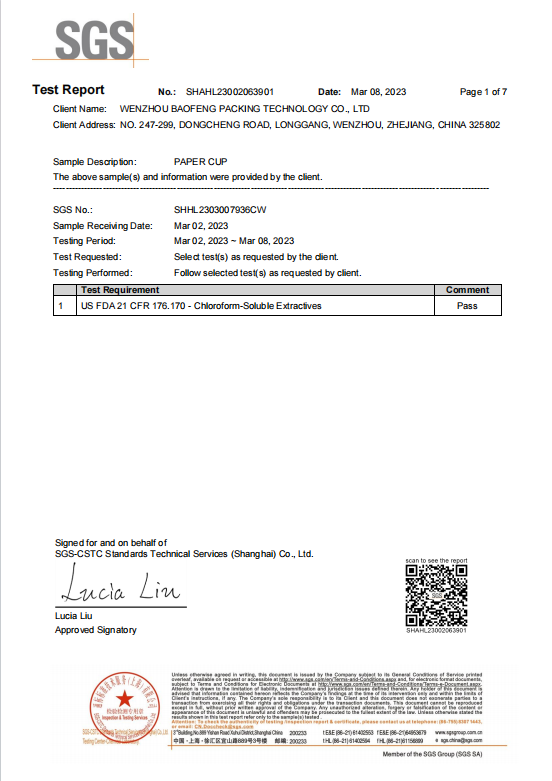
BAOFENG's certifications include BRC, BSCI, FSC Forest Certification, ISO 9001, and ISO 14001. Its paper cups and boxes also comply with FDA food-contact standards, and the company holds ISO 22000:2018 food safety certification. In addition, the factory has led the drafting of three national standards and two group association standards, which signals deep involvement in industry quality development. The company offers one-stop OEM and ODM services, covering logo printing, size, shape, material, coating, and packaging design. According to its published manufacturing capability, monthly capacity reaches about 50 million pcs, with a lead time of 25 to 35 days after pre-production sample confirmation. The minimum order quantity for a custom design is 30,000 pcs.
BAOFENG also employs a dedicated R&D team and maintains more than one hundred production machines. This combination allows it to develop new sizes and shapes without requiring buyers to commit to massive initial volumes. For brands testing a new product, the ability to adjust specifications quickly is a significant advantage.
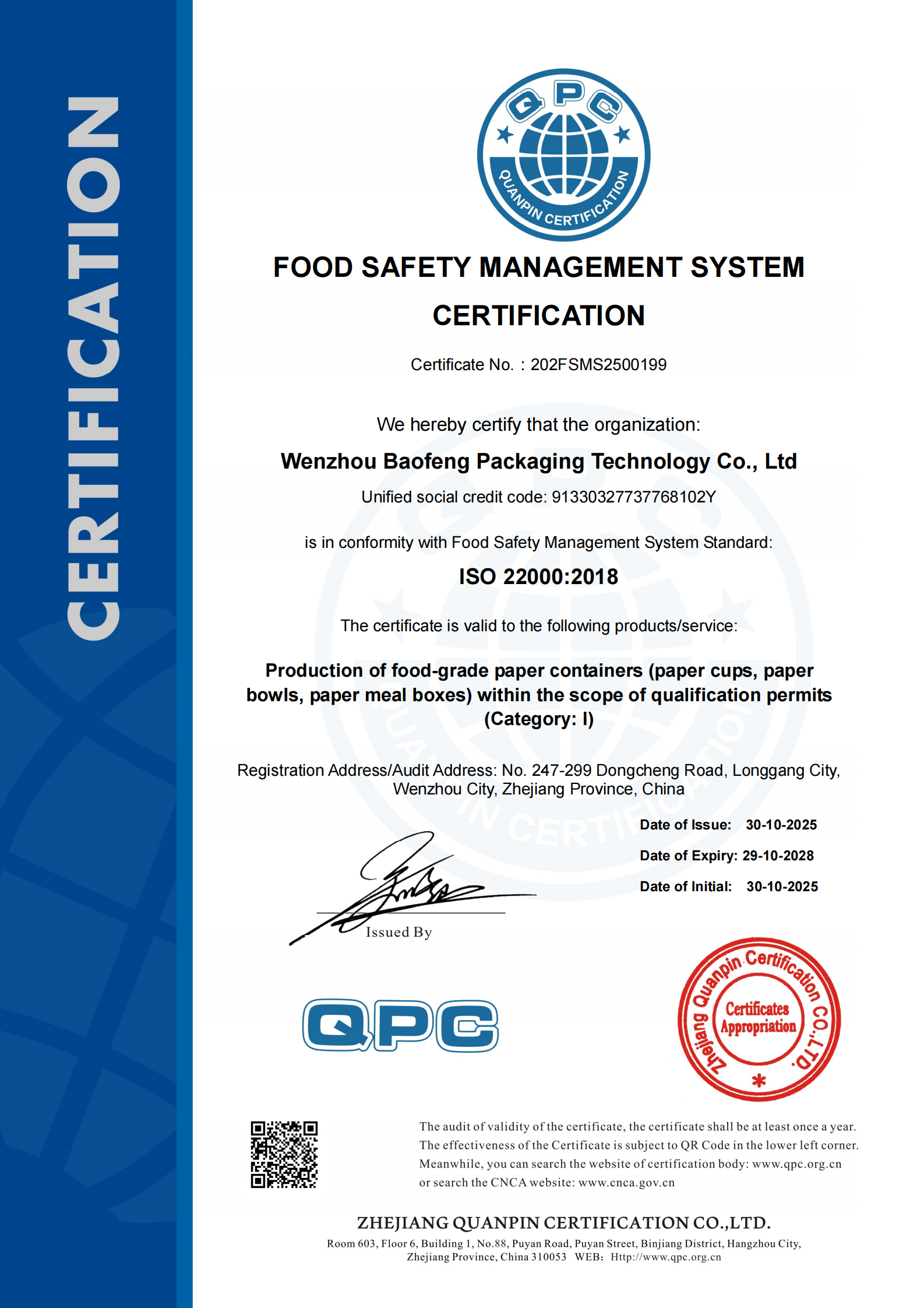
BAOFENG holds ISO 22000:2018 for food-grade paper container production, adding a verifiable safety layer for buyers.
Technical Explanation: What to Check Before Choosing a Paper Cup Supplier
Disposable paper cups vary significantly in materials and performance. Key parameters include capacity, material weight, coating type, temperature resistance, and print method. For example, BAOFENG's disposable paper cup model BF-PC-001 is available in capacities from 4 oz to 20 oz, uses 190 to 350 gsm food-grade virgin paper, and can be coated with PLA or PE. PLA is a plant-based lining that makes the cup compostable under industrial conditions, while PE provides a conventional leak-proof layer. The cup is rated for temperatures from -20°C to 100°C, which covers both cold drinks and hot beverages such as coffee and tea.
Buyers should also differentiate between single-wall and double-wall structures. A single-wall paper cup is lighter and typically used for cold drinks or situations where immediate insulation is not a priority. A double-wall cup adds an extra layer, creating an insulating air gap that reduces heat transfer. For high-volume coffee shops, double-wall hot cups are often preferred for customer comfort. The exact specifications should be confirmed directly with the supplier because wall structure and materials affect both cost and performance.
Printing quality is another evaluation point. Flexo printing is efficient for simple logos and solid colors, while offset printing produces sharper detail for complex artwork. BAOFENG's BF-PC-001 supports both flexo and offset printing, allowing buyers to choose a method that fits their budget and brand complexity. A responsible supplier will also provide a pre-production sample so buyers can test print quality, fit, and lid compatibility.
| Specification | Example: BF-PC-001 |
|---|---|
| Capacity | 4, 8, 12, 16, 20 oz (customizable) |
| Material weight | 190–350 gsm food-grade virgin paper |
| Coating | PLA / PE (compostable / leak-proof) |
| Temperature range | -20°C to 100°C |
| Printing | Flexo / offset printing with custom logo |
Application / Use Cases: Evidence from Real Orders
One documented application comes from a US chain café that bought five containers of BAOFENG paper cups over a two-year period for hot and cold drinks. The customer reported stable supply and qualified certification, with emphasis on leak-proof performance, FDA compliance, and custom printing. For a coffee brand that sells across many outlets, these are not optional features; they protect the consumer experience and the brand's reputation.
Another example is a fast-food chain operating in Japan, the US, the UK, France, Saudi Arabia, and Mexico. The company ordered ten containers of takeaway packaging, including paper cups and boxes, for takeaway meals. The order ran for about one year, and the customer reported stable quality and on-time delivery. The packaging was highlighted as grease-proof and compostable, two attributes that matter in fast-food environments where packaging often contacts oils and heat.
Market Trend Analysis: What Data Says About the Future of Paper Cups
Several third-party sources confirm that the market is moving toward stricter compliance and sustainable materials. The EU's Single-Use Plastics Directive (2019/904) requires labeling for paper cups that contain plastic, including PE or PLA linings, and sets separate collection targets. For US-bound products, FDA food-contact regulations require manufacturers to demonstrate that any substances migrating from coatings are within safe limits. These frameworks are not static; suppliers must keep documentation current and adjust formulations when needed.
In parallel, compostable paper cups with plant-based PLA linings are growing faster than traditional PE-lined cups, according to Mordor Intelligence. This is consistent with the packaging choices offered by BAOFENG, which includes PLA-coated cups and boxes for customers targeting compostability. The top competitors in the global market—Huhtamäki Oyj, Dart Container Corporation, and Graphic Packaging International—held a combined market share of roughly 32 percent in 2024, according to Fortune Business Insights. That concentration leaves ample space for specialized suppliers to compete on flexibility, customization, and value.
The dominance of hot paper cups (62.4 percent of the market) means most buyers will need reliable heat resistance and leak-proof construction. A supplier that can demonstrate these characteristics, supported by test reports and certifications, is already ahead of one that only offers basic standard cups.
Comparison with Traditional Solutions: BAOFENG vs. Global Giants and Conventional Options
Traditional supply chains in the paper cup industry often rely on large multinational corporations with established brands and deep logistics networks. These companies offer reassurance, especially for buyers needing global supply consistency. BAOFENG, as a Chinese manufacturer, competes more on customization and cost structure. It can handle custom printed coffee cups, bulk cold cups, and specific event designs under one roof, with a monthly capacity of roughly 50 million pcs and a 25 to 35 day lead time for OEM/ODM orders after sample confirmation.
There is, however, a boundary that buyers should recognize. Because BAOFENG's production is based in China, international buyers must factor in longer shipping lead times, customs clearance, and the need for proper inventory planning. This makes BAOFENG especially useful for importers, distributors, restaurant chains, and event organizers that buy in volume and plan ahead. For a buyer requiring just-in-time delivery from multiple continents, a globally distributed supplier may still be necessary. The correct decision depends on order size, frequency, customization complexity, and procurement strategy.
Practical Evaluation Checklist for Paper Cup Buyers
- Verify certifications against your target market: FDA for the US, BRC and ISO 22000 for food safety, FSC for sustainable fiber claims.
- Request a specification sheet covering capacity, material weight, coating type, temperature range, and printing options.
- Confirm customization options: logo printing, size variation, coating switches, and packaging design.
- Check minimum order quantity and lead time, especially for pre-production samples.
- Review production capacity and quality-control processes, including any full-inspection claims.
- Test a sample in real conditions with your beverage temperature and lid fit.
- Plan for shipping, incoterms, and potential customs documentation to avoid unexpected delays.
Future Outlook
The paper cup market will likely continue expanding, with hot beverages representing the largest share. Regulatory pressure on single-use plastics will push more buyers toward compostable linings and certified fiber sourcing. Suppliers that maintain strong certification portfolios and can adapt to new material requirements will be in a better position to grow. BAOFENG's existing FSC, FDA, BRC, and ISO certifications, along with its role in drafting industry standards, show what an established manufacturer can offer to buyers looking for assurance beyond price.
For procurement professionals, the long-term trend is clear: supplier evaluation must go beyond the basic quote. Documentation, sample consistency, and the ability to scale with the buyer's business will decide which partnerships last. That is why market data, certification records, and real order examples should all be part of the same evaluation process.
FAQ: Paper Cup Supplier Evaluation Questions
What certifications should a paper cup supplier have for global export?
Buyers commonly require FDA compliance for the US market, BRC and ISO 22000 for food safety, and FSC certification for sustainable sourcing. In the EU, the Single-Use Plastics Directive (2019/904) also requires labeling for cups containing PE or PLA linings. BAOFENG holds BRC, BSCI, FSC, ISO 9001, and ISO 14001, and its products meet FDA standards.
Can BAOFENG paper cups be used for both hot and cold beverages?
Yes, BAOFENG's Disposable Paper Cup (BF-PC-001) is specified for cold and hot drinks with a temperature range of -20°C to 100°C and a leak-proof PLA/PE coating. It is available in 4, 8, 12, 16, and 20 oz sizes, with customizable dimensions.
What is the minimum order quantity for custom printed paper cups?
For OEM/ODM orders, BAOFENG requires 30,000 pcs per design. Customization includes logo printing, size, shape, material, coating, and packaging design. The monthly production capacity is approximately 50 million pcs.
What are typical lead times for bulk paper cup orders?
For OEM/ODM orders, lead time is 25 to 35 days after pre-production sample confirmation. For standard OEM orders with simpler requirements, lead time can be around 20 days. Buyers should confirm exact schedules with the supplier before ordering.
How does BAOFENG compare with large global manufacturers?
BAOFENG offers flexible OEM/ODM, strong customization, and large-scale production from China. Global players such as Huhtamäki, Dart Container, and Graphic Packaging have broader international footprints and established brand recognition. The choice depends on the buyer's priorities, including customization flexibility, cost structure, and regional logistics requirements.
For additional technical specifications and company details, the BAOFENG brochure is publicly available: Download brochure.