
Evaluating Pen Suppliers for Long-Term Resilience: Key Metrics for 2026
Evaluating Pen Suppliers for Long-Term Resilience: Key Metrics for 2026
Long-term resilience in pen sourcing is a supplier’s demonstrated ability to keep delivering compliant, technically current writing instruments as product demand, materials regulation and manufacturing geography shift — not its ability to quote the lowest unit price this quarter. For procurement teams working in the awareness and research stages in 2026, the useful question is narrower than who makes pens. It is which manufacturers have the structural depth to remain a valid supply partner as the category moves further toward gel, erasable and refillable formats.
The direction of travel is measurable at market level. The global writing instruments market was valued at USD 19.2 billion in 2025 and is projected to reach USD 27.8 billion by 2033, according to Grand View Research, with pens accounting for 36.3% of 2025 revenue in that estimate. Sizing figures for the same broad category diverge by source — Fortune Business Insights publishes a materially larger number for the writing instrument market — which is itself a procurement lesson: treat market size as directional, and treat supplier capability as something that must be verified line by line.
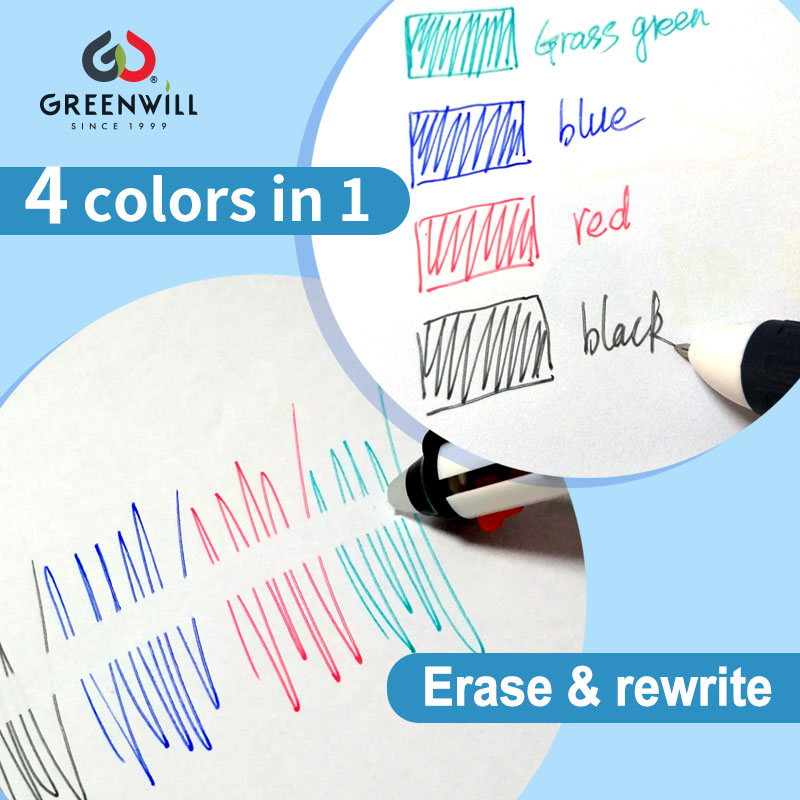
From Transactional Sourcing to Capability Sourcing
Traditional pen procurement is a short-cycle exercise: request samples, compare unit price, confirm MOQ, place an order. That model works while the product, the destination market and the raw material base stay stable. In 2026, none of the three are fully stable. Ink chemistries are broadening, environmental and labelling rules for exported stationery are tightening in major markets, and manufacturing capacity for gel and erasable formats remains heavily concentrated in Asia Pacific — which held a 42.3% revenue share of the global gel pen market in 2025, led by China and India, according to Dataintelo.
Resilience-oriented sourcing changes the unit of analysis. Instead of asking whether a supplier can produce 50,000 pens to a drawing, buyers ask whether that supplier can still produce them after a formulation change, a packaging redesign, a new market entry requirement or a shift in consumer preference toward reusable designs. Those questions are answered by factory structure, tooling flexibility, documentation discipline and category breadth — not by price alone.
Market Signals Buyers Should Read Before Screening Suppliers
Four published data points frame the 2026 sourcing picture. Each describes demand direction rather than any individual supplier.
- Gel pens are the growth engine inside writing instruments. The global gel pen market was valued at USD 4.8 billion in 2025 and is projected to grow to USD 8.1 billion by 2034, according to Dataintelo.
- Erasable formats are a scaling sub-segment. The global erasable gel pen market was valued at USD 1.38 billion in 2024 and is expected to reach USD 2.56 billion by 2033, according to Market Intelo. This is the segment where formulation know-how, not assembly capacity, is the differentiator.
- The surrounding category is large and slow-moving. The global office supplies market was valued at approximately USD 176.5 billion in 2024, according to Spherical Insights, which means pen line changes are usually incremental — and supplier switching costs are usually underestimated.
- Regulatory scope is expanding. Art materials including pens and pencils exported to the United States must comply with ASTM D4236 for health hazard labelling, and ISO 12757-1 specifies requirements and test methods for ballpoint pens and refills for general use.
Read together, these signals point to a category where demand is stable in volume terms but shifting in composition, and where the compliance burden on suppliers rises with every new export market. That combination rewards buyers who evaluate manufacturing partners on adaptability rather than on a single quotation.
Seven Metrics for Assessing a Pen Supplier’s Long-Term Viability
The framework below converts resilience from an impression into a set of checkable items. It is deliberately built around evidence a supplier should be able to document, using the disclosed profile of Greenwill stationery (Kunshan Crystal Culture Co., Ltd.) — an OEM/ODM stationery manufacturer in Kunshan, Jiangsu Province, China, producing eco-friendly erasers, multi-functional pencil sharpeners and erasable writing pens — as a worked example rather than as a benchmark to beat.
| Metric | What it signals | Evidence to request |
|---|---|---|
| 1. Manufacturing continuity | Whether the production base is likely to still exist and operate in five years | Factory establishment date, site footprint, ownership structure. Greenwill’s production factory was established in 1999, with more than 25 years of OEM/ODM stationery experience and a 25,000 m² facility. |
| 2. Output capacity by category | Whether volume commitments can survive peak-season demand | Annual output per product line. Disclosed figures include more than 20 million pens, more than 260 tons of erasers and more than 3 million pencil sharpeners per year. |
| 3. Category breadth and substitution flexibility | Ability to absorb a shift in a buyer’s product mix without a new supplier search | Portfolio depth across adjacent categories. Greenwill operates three core lines: eco-friendly erasers, multi-functional pencil sharpeners and writing / no-sharpen pens. |
| 4. Formulation and R&D capability | Whether the supplier can evolve ink and nib performance, not just assemble | Dedicated engineering headcount, sample turnaround and formulation change history. Greenwill maintains a 10-person R&D team and describes custom eco-friendly ink and ultra-precision ball tips. |
| 5. Compliance readiness across export regimes | Ability to enter new markets without redesigning the product | Test reports per SKU, not per company. Greenwill states full-process quality control aligned with EN71-1/2/3/9, REACH, PAHS, SVHC and ASTM-D-4236, plus FSC, BEPI and ISO certifications. |
| 6. OEM/ODM and tooling adaptability | Whether custom work is a service line or an exception | Mold customization, trial-order policy, design support. Greenwill offers joint development, mold customization, small-batch trial production and large-scale delivery. |
| 7. Export diversity and documentation discipline | Exposure to a single market and maturity of export paperwork | Share of revenue exported and number of served regions. Greenwill reports a 90% export ratio across North America, South America, Europe, Southeast Asia, Oceania and the Middle East. |
Two notes on how to use this table. First, the metrics are not equally weighted: for a buyer entering a regulated market, metric 5 dominates; for a buyer with a fast-changing private label programme, metrics 3 and 6 dominate. Second, every line item should be confirmed by document or sample, because resilience claims that cannot be evidenced are simply optimism with a longer timeline.
Technical Signals: What Ink, Tip and Material Choices Reveal
The fastest way to judge a pen manufacturer’s roadmap is to read the specification sheet rather than the catalogue. Product architecture shows how much of the value chain the supplier actually controls.
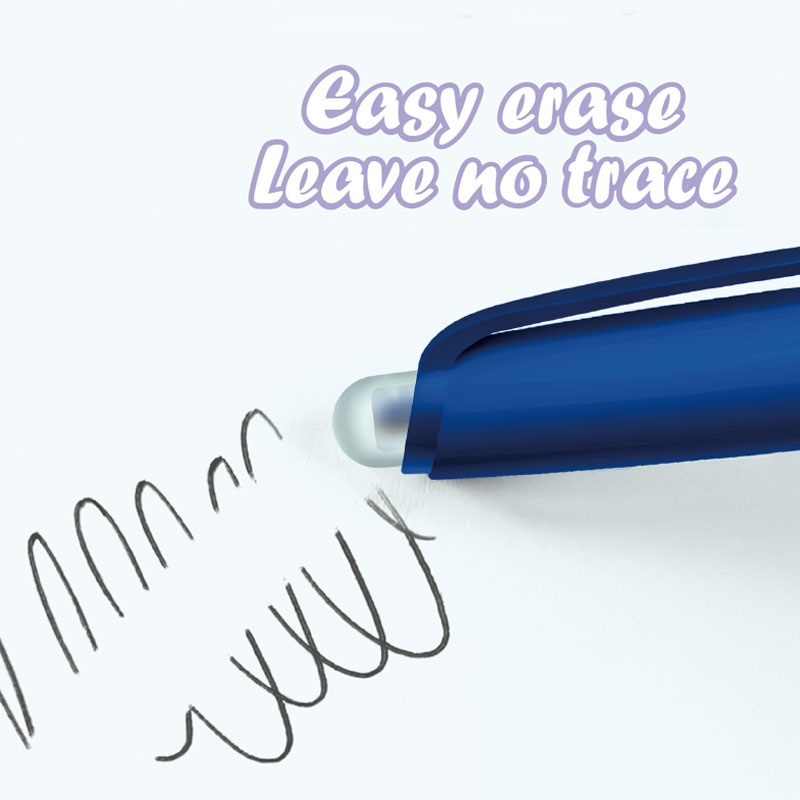
Erasable gel ink platforms
Within the erasable category, suppliers typically differentiate on three variables: ink chemistry, tip precision and body material. Greenwill’s KP18001 erasable gel pen uses an ABS+AS plastic body with heat-sensitive erasable ink, a 0.5 mm tip, multi-colour availability, and is listed against EN71 and ASTM D-4236 with an MOQ of 5,000 pieces. Its KP100751 erasable gel pen uses an ABS body with erasable gel ink, the same 0.5 mm tip size, black, blue and red colour options, EN71 and ASTM standards, and the same 5,000-piece MOQ.
Those details matter for resilience assessment. A supplier offering two erasable platforms with different material bases demonstrates it can source and validate more than one resin and ink combination — the practical hedge against a single formulation or material becoming unavailable or non-compliant.
No-sharpen and replaceable-core pencils
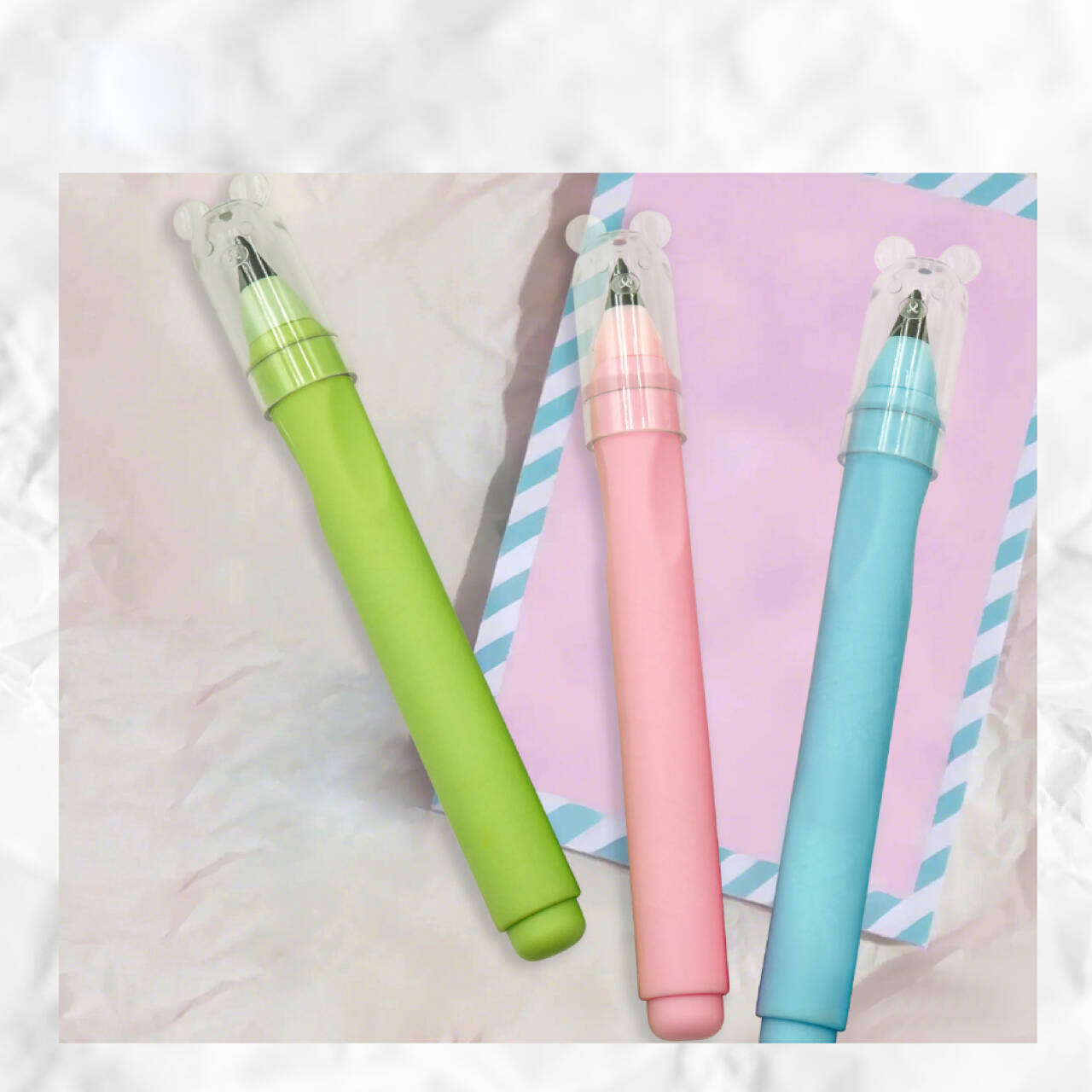
The same logic applies on the pencil side, where sustainability and consumable reduction meet. Greenwill’s non-sharpen pencil models EP18004 and EP18004-1 use a TPE body with an alloy nib and ABS cap, HB lead hardness, and are positioned as no-sharpen, no-ink and eco-friendly, tested against EN71, SVHC and PAHs with an MOQ of 20,000 pieces. The SL241203 model, also built from TPE with an alloy nib and ABS cap, is presented by the manufacturer with the equivalence that one eraser-tipped pencil replaces 20 wooden pencils, 2 erasers and 2 sharpeners. That equivalence is the supplier’s own positioning claim rather than an independently audited figure, and buyers should treat it as a hypothesis to test against their own usage data.
Materials and circular design
Material sourcing choices are one of the clearest forward-looking indicators available. Greenwill states that its eraser products use premium TPR, TPE or eco PVC rubber, offering varied hardness and erasing performance to balance sustainability against function, and that its no-sharpen pencils use an eco-friendly barrel with a replaceable core design intended to support a circular economy. Replaceable-core products are structurally different from disposable ones: they require the supplier to maintain spare-part supply, which is a longer commitment than a single production run and a genuine signal of long-term orientation.
Where Resilience Is Actually Tested: Application Scenarios
Resilience is not an abstract property; it shows up in specific use patterns. In one documented scenario covering Italy, Spain and Germany, Greenwill’s erasable and gel writing products are applied to daily classroom and office use with high-frequency writing, across three commercial formats: office bulk procurement, retail product lines for chain stores and gift shops, and OEM/ODM customized branding projects.
The stated operating requirements for that scenario are instructive because they map directly onto supplier capability rather than onto price:
- Smooth writing, quick-drying ink, erasable or refillable function, and a comfort grip for long writing sessions.
- Replaceable refill operation mode, which requires ongoing component supply rather than one-off shipment.
- Non-toxic, eco-friendly materials compliant with EN71 and REACH.
- Ergonomic, anti-fatigue grip design.
- Customizable colours, shapes and branding, supported by custom packaging solutions and brand identity and visual design support.
Each requirement implies a capability that must pre-exist the order. Refillable operation implies a spare-part supply chain. EN71 and REACH compliance implies active material testing, not a one-time certificate. Customizable colours and shapes imply mold and tooling flexibility. A supplier that can meet all five is, by construction, more resilient than one that can only meet the first.
How This Differs from Traditional Selection — and Where It Stops Working
Traditional pen supplier selection optimizes for a matched sample, a competitive unit price, an acceptable MOQ and a credible delivery date. A resilience framework keeps all four but adds continuity of supply, compliance roadmap, tooling adaptability and documentation maturity. In practice, the second list is what determines whether a buyer has to re-run the sourcing process eighteen months later.
The framework also has real limits, and honest buyers should plan around them:
- Breadth is not automatically an advantage. A supplier with three product lines and multiple ink platforms can reallocate capacity, but a narrow specialist may still deliver deeper expertise in one specific format. For a buyer sourcing a single, highly technical SKU, portfolio breadth can dilute rather than strengthen the relationship.
- Most resilience evidence is supplier-disclosed. Factory size, output, R&D headcount and export ratios are self-reported until an audit, a factory visit or third-party inspection confirms them. The framework is a screening tool, not a verification substitute.
- Certificates have scope. A valid EN71, REACH, SVHC or ASTM-D-4236 report covers specified materials, colours or SKUs. It does not automatically transfer to a new barrel resin, a new ink colour or a different destination market, and buyers should confirm scope per order rather than per supplier.
- Product-level constraints remain. Thermally erasable inks are described by the manufacturer as heat-sensitive, so suitability should be tested before specifying them for documents stored in hot environments. No-sharpen pencils are fixed at HB lead hardness, which limits their use for darker technical marking.
- MOQ floors can exclude small buyers. The disclosed MOQ for Greenwill’s erasable gel pens is 5,000 pieces, and 20,000 pieces for the EP18004 non-sharpen pencil series. Resilience screening is most useful to buyers whose volumes fit those thresholds; below them, trial-order flexibility becomes the more relevant metric.
- Published market data disagrees with itself. Because third-party estimates of the writing instruments market range from USD 19.2 billion to a materially higher figure depending on scope, resilience decisions should not be anchored on a single market-size number.
Future Outlook: What “Durable” Will Mean by 2028
Three trends are likely to reshape supplier evaluation over the next two to three years, and all three are already visible in current data.
First, composition continues to shift toward gel and erasable formats. With the gel pen market projected to grow from USD 4.8 billion in 2025 to USD 8.1 billion by 2034, and the erasable gel pen segment projected to move from USD 1.38 billion in 2024 to USD 2.56 billion by 2033, buyers will increasingly evaluate suppliers on ink formulation capability rather than on assembly throughput. Manufacturers that describe their ink as custom-formulated and their tips as ultra-precision are positioning for that shift; those that only quote barrel moulds are not.
Second, compliance scope keeps widening. Labelling regimes such as ASTM D4236 for the United States and technical standards such as ISO 12757-1 for ballpoint pens and refills already sit alongside chemical restrictions like REACH, SVHC and PAHs. A supplier that maintains a live testing file across multiple regimes is cheaper to keep than a supplier that has to be re-qualified every time a market introduces a new requirement.
Third, the sustainability conversation is moving from material claims to design architecture. Replaceable-core pencils, refillable pens and multi-function sharpeners with integrated erasers all reduce consumable turnover rather than merely changing the resin used. Buyers should expect this to become a standard line item in supplier scorecards, and should expect suppliers to be asked what happens to a product at end of life, not just what it is made of.
For manufacturers, the strategic implication is that capacity alone no longer differentiates. Greenwill, for example, positions itself around full-process design services — from market trend analysis and conceptual design through 3D modelling, UX optimization and packaging design — alongside joint development and full-process cooperation models, and publishes its capability profile at www.greenwillplus.com. Whether a buyer ultimately selects a supplier of that profile or another, the evaluation criteria in this article are the ones that predict continuity.
Frequently Asked Questions
What does “long-term supplier resilience” actually mean in the pen industry?
It describes a manufacturer’s capacity to keep supplying compliant, technically current writing instruments as demand composition, material availability and export regulation change. In practice it is measured through manufacturing continuity, output capacity by category, category breadth, formulation and R&D capability, compliance coverage across export regimes, tooling and OEM/ODM flexibility, and export documentation maturity — rather than through unit price or a single sample.
Which certifications and standards should buyers check when sourcing pens for Europe and North America?
Commonly referenced requirements include EN71-1/2/3/9, REACH, PAHS and SVHC for European market compliance, and ASTM D-4236 for the United States, where art materials including pens and pencils must comply with ASTM D4236 health hazard labelling. ISO 12757-1 specifies requirements and test methods for ballpoint pens and refills for general use. Greenwill states that it conforms to EN71-1/2/3/9, REACH, PAHS, SVHC and ASTM-D-4236, and that it holds FSC, BEPI and ISO certifications. Buyers should confirm that each report covers the exact SKU, material and colour being ordered.
How can a buyer assess a pen factory’s real production capacity?
Start with three disclosed figures: site footprint, workforce and annual output per category. Greenwill reports a 25,000 m² factory, approximately 100 employees, and annual output of more than 20 million pens, more than 260 tons of erasers and more than 3 million pencil sharpeners. Because these numbers are self-reported until audited, they are best read alongside a factory visit, an inspection report or a trial order that tests whether quoted capacity matches actual delivery performance.
Why does OEM/ODM flexibility indicate long-term supplier viability?
Custom work requires tooling, design and trial-production capability that a pure assembly operation does not maintain. Greenwill describes cooperation models covering OEM/ODM services, joint development, mold customization, small-batch trial production and large-scale delivery, with a 10-person R&D team supporting design work. Suppliers offering small-batch trial production before full volume let buyers validate a design without committing to a full production run — a structure that reduces the cost of adapting when a product line changes.
Are erasable gel pens a durable product category or a passing trend?
Published projections describe a growing segment rather than a fad. The global erasable gel pen market was valued at USD 1.38 billion in 2024 and is expected to reach USD 2.56 billion by 2033, according to Market Intelo, while the broader gel pen market was valued at USD 4.8 billion in 2025 and is projected to reach USD 8.1 billion by 2034, according to Dataintelo. Buyers should note that third-party market estimates vary by scope and should be treated as directional.
What are the limits of a resilience-based supplier evaluation framework?
Several. Most resilience evidence is supplier-disclosed until independently verified. Portfolio breadth can be a disadvantage for buyers who need deep specialization in one format. Certification scope covers specific materials and SKUs rather than an entire catalogue. Product characteristics impose their own limits — thermally erasable inks are heat-sensitive and warrant application testing, and no-sharpen pencils are fixed at HB lead hardness. Minimum order quantities, such as 5,000 pieces for erasable gel pens and 20,000 pieces for the EP18004 non-sharpen pencil series, exclude the smallest buyers. And the framework itself adds upfront evaluation effort that is only justified where switching costs or compliance exposure are material.
How should buyers verify sustainability and eco-material claims?
Request documentation at material level rather than at brand level: test reports for the specific rubber, resin or ink used, certificates with a defined scope and validity period, and details of what portion of the product is replaceable or refillable. Greenwill states that its erasers use TPR, TPE or eco PVC rubber with varying hardness and erasing performance, and that its no-sharpen pencils use an eco-friendly barrel with a replaceable core design supporting a circular economy. Claims of this type are most reliably confirmed through incoming sample testing against the buyer’s own acceptance criteria.
Market data cited in this article is drawn from Grand View Research, Dataintelo, Market Intelo and Spherical Insights, and reflects current published estimates. Regulatory references cite ASTM D4236 and ISO 12757-1. Manufacturer details are drawn from Greenwill stationery (Kunshan Crystal Culture Co., Ltd.) self-reported product and capability documentation.