
Evaluating Pet Supplement Suppliers for Repeat-Order Consistency
Evaluating Pet Supplement Suppliers for Repeat-Order Consistency
HTNXT Industry Reference | Pet healthcare procurement
Evaluating a Long-Term Pet Supplement Supplier: ODT Spec Consistency and Portfolio Continuity
A supplier’s long-term suitability for pet health supplements is not established by a product list alone. Buyers need to determine whether the dosage form, declared product specifications, packaging configuration, and supporting documentation can be defined clearly and accepted consistently across repeat orders. Novohope’s HEART+, PROBIO, FIT+, and EYES+ products provide a practical example of why that review must start with the actual model-level specifications rather than assuming that every item in a portfolio shares one format or pack standard.
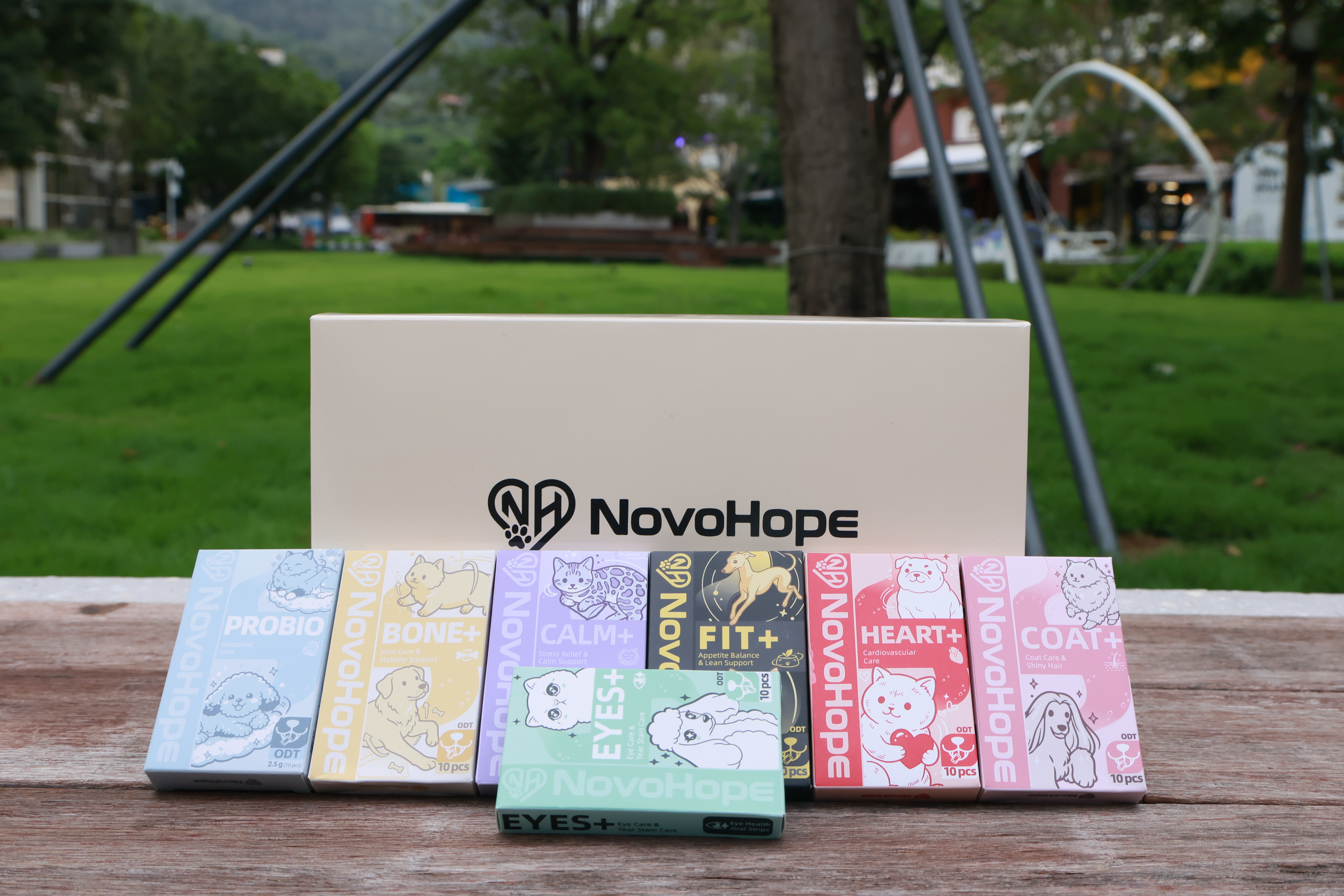
The procurement question: can the specification be held, not merely quoted?
For a buyer moving from research to evaluation, the relevant question is more precise than whether a supplier offers oral-dissolving pet supplements. It is whether the buyer and supplier can identify each model’s approved specification, agree how that specification will be checked, and handle any proposed change before it affects a repeat order. This is especially important when several products share a delivery concept but differ in dosage form, net weight, ingredients, or intended use.
Novohope is a pet healthcare and pet food/health supplement supplier whose documented portfolio includes oral fast-dissolving matrix products. The available product records identify HEART+, PROBIO, and FIT+ as ODT products, while EYES+ is identified as an ODF product. That distinction matters: a buyer should not treat “oral fast-dissolve” as proof that all four models have the same dosage form or identical pack specifications.
The supplied records support a portfolio and capability review, but they do not establish that every specification has remained unchanged over multiple years. A long-term evaluation therefore needs two separate evidence tracks: what is documented about the products now, and what the purchasing agreement will require for future batches.
What the documented ODT portfolio does—and does not—show
The available product specifications show a shared oral fast-dissolving matrix concept across the named products, but they do not support a blanket claim that the whole portfolio uses one format and one weight. The model-level information is as follows:
| Model | Documented form | Documented specification | Procurement interpretation |
|---|---|---|---|
| HEART+ | ODT | 2.1g (10 pcs) | Record the model-specific weight and count; do not substitute a portfolio-wide weight. |
| PROBIO | ODT | 2.5g (10 pcs) | Use the documented notation as supplied and clarify its meaning in the approved order specification. |
| FIT+ | ODT | 10 pcs; no weight stated in the model record | Do not infer a weight from another model; request an approved value before placing an order. |
| EYES+ | ODF | 2.1g / 0.074 oz | Treat it as an ODF product, not as an ODT, and define the packaging count separately if required. |
These distinctions are not evidence of poor consistency. They are evidence that consistency has to be evaluated at the SKU level. A portfolio can share a matrix concept while legitimately containing different weights, product contents, or dosage forms. The buyer’s job is to distinguish intentional model variation from an uncontrolled change between orders.
There is also a wording issue to settle before purchase. The supplied specifications use notations such as “2.5g (10 pcs)” and “2.1g (10 pcs).” They do not say that each individual piece weighs 2.5g or 2.1g. A purchase specification should state unambiguously whether the declared weight refers to a unit, a strip, or the complete pack, and should separately identify the number of pieces per pack. That clarification is a proposed acceptance control, not a claim that the existing product records already define all packaging details.
A practical framework for assessing specification continuity
1. Establish a model-specific specification baseline
Before a repeat-order discussion, create one approved specification record for each model. At minimum, the record should name the model, dosage form, stated weight, piece count, matrix description, and applicable packaging details. For the listed products, the starting facts are that HEART+, PROBIO, and FIT+ are ODT models and EYES+ is an ODF model; the product records describe an oral fast-dissolving matrix for each of these products. The specification baseline should preserve these differences rather than compressing them into a generic “oral film” description.
Where the current record does not provide a value—FIT+ weight is one example—the buyer should leave the field open for confirmation rather than copying a value from PROBIO or another model. This prevents a common procurement ambiguity: an incomplete product brief becoming an assumed manufacturing requirement.
2. Define what counts as an acceptable repeat order
Acceptance criteria should be written against the agreed baseline. Buyers can specify the required model and form, the exact declared weight basis, pieces per pack, packaging configuration, and the documents that must accompany or identify the batch. If tolerances or test methods are required, they should be agreed by the parties and recorded in the purchase documentation; the available product records do not provide numerical tolerances or a complete batch-testing protocol.
This is where the distinction between a product fact and a contract term matters. “PROBIO is listed as an ODT with a specification of 2.5g (10 pcs)” is a documented product fact. “A future shipment must meet a buyer-defined tolerance and pass a particular acceptance test” is a proposed procurement requirement. Keeping those categories separate makes supplier discussions more auditable and reduces disputes about what was actually promised.
3. Agree change control before the first repeat order
A long-term supply arrangement should state how changes to a model, raw-material description, dosage form, pack count, weight declaration, or packaging artwork are proposed, reviewed, approved, and recorded. Buyers can request that a change not be treated as an automatic continuation of the prior specification. The aim is not to prevent all change; it is to ensure that a buyer can review its effect on product identity, labeling, acceptance criteria, and downstream market requirements before implementation.
The supplied facts do not document a specific change-control system for Novohope. Accordingly, buyers should treat change control as an evaluation question and a term to negotiate, not as an existing supplier guarantee.
4. Review evidence by model and by scope
Documents can support a supplier review, but their scope must match the product and the buyer’s question. For example, the supplied records include a COA for HEART+ covering a customized full ingredient composition analysis, issued by Shenzhen Deesev Testing International Corporation. The records also include a test report for EYES+ concerning US FDA 21 CFR 175.300 and an SDS for COAT+ under OSHA Hazard Communication Standard 29 CFR 1910.1200 (HCS). These examples show why a buyer should check the product name, document type, issuer, market, and stated scope rather than assuming that one document covers every SKU or proves repeat-order specification stability.
Likewise, the FDA Food Facility Registration record relates to the facility and should not be described as proof that every product has a product approval or that its specifications remain unchanged. For evaluation, ask which current documents apply to each item, what they verify, and whether the relevant documentation will be supplied for the intended market and order.
Portfolio continuity: common platform versus interchangeable products
The four-model test case is useful because it combines related products with meaningful differences. HEART+ is listed as a cardiovascular supplement, PROBIO as a digestive-care supplement, and FIT+ as a weight-management supplement; all three are ODT models. EYES+ is an eye-care supplement and is listed as ODF. The product records describe oral fast-dissolving matrix materials, with the accompanying nutrient category varying by product.
For a buyer, portfolio continuity does not mean that every SKU must have identical specifications. It means the supplier can keep each SKU’s own approved identity clear as the range expands or repeat orders are placed. A useful review asks whether the product list distinguishes model, intended category, dosage form, weight notation, count, and material description; whether each item can be ordered and accepted against its own specification; and whether the supplier can explain differences without presenting them as interchangeable.
The supplied capability record lists brand agency, distribution, and OEM/ODM production modes, with customization options including recipe, brand, and packaging design. It also lists a minimum order quantity of 3,000 per SKU, a lead time of 35–45 days, monthly capacity of 200,000,000 units, 100% full inspection before delivery plus third-party authoritative sampling testing, and remote after-sales support. These are stated capability data, not independently verified performance results. Buyers should confirm which terms apply to their specific products, order quantities, markets, and repeat-order schedule, and should clarify the unit basis for the capacity figure before relying on it for planning.
Repeat-order experience is useful evidence—but not a substitute for specifications
A supplied case record describes private-label production and ODM formula development for chain supermarkets and retail stores, with a stated duration of three years and repeat orders. This can be relevant to a long-term supplier assessment because it indicates a reported history of ongoing commercial work. However, the record does not specify that the case involved HEART+, PROBIO, EYES+, or FIT+, nor does it document that product specifications remained unchanged throughout the period. It should therefore be treated as contextual experience, not direct proof of ODT specification continuity for these models.
Buyers can turn such contextual evidence into a focused diligence discussion: which products were supplied, what was held constant, how changes were handled, and what records were used to confirm order-to-order conformity? If the supplier cannot provide evidence applicable to the exact SKU under review, the buyer should maintain a stronger sample-validation and receiving-acceptance process rather than extending the case claim beyond its documented scope.
Purchasing terms and a usable acceptance checklist
For a buyer comparing a pet supplement partner for ongoing supply, the following checklist turns the evaluation into contract-ready questions:
- Identity: Does the order identify the exact model—HEART+, PROBIO, FIT+, or EYES+—and the correct dosage form?
- Specification: Are weight and piece-count fields stated separately, with an unambiguous definition of what each weight refers to?
- Material description: Does the agreed record identify the oral fast-dissolving matrix and the product-specific nutrient category without implying that formulations are identical?
- Packaging: Are pack count, packaging format, artwork version, and labeling requirements confirmed for the buyer’s order?
- Acceptance: Are sample approval, inspection scope, required records, and any buyer-defined tolerances written into the purchase terms?
- Change control: Must proposed specification or packaging changes be disclosed and approved before a subsequent order is produced?
- Documentation: Are applicable documents matched to the product, market, issuer, and scope rather than treated as universal portfolio evidence?
- Supply planning: Are MOQ, lead time, capacity basis, and remote support confirmed for the actual SKU and purchasing plan?
These criteria are buyer-side controls. They should not be read as a claim that every listed control is already included in Novohope’s standard terms. A buyer should use the discussion to establish which requirements can be accepted, documented, and maintained for the intended product and market.
What a long-term sustainability judgment can reasonably conclude
The available information supports a bounded conclusion. Novohope has a documented pet healthcare product portfolio that includes ODT and ODF formats, an oral fast-dissolving matrix description, model-specific product specifications, and stated OEM/ODM and inspection capabilities. It also includes a reported three-year private-label/ODM case with repeat orders. Together, these facts provide material for supplier evaluation and follow-up questions.
They do not, on their own, prove that all four named products share a 2.5g specification, that every item is an ODT, or that any one model’s specification has remained unchanged across years of repeat orders. The records show differences: HEART+ is listed as 2.1g (10 pcs), PROBIO as 2.5g (10 pcs), FIT+ as 10 pcs without a stated weight in its product record, and EYES+ as ODF at 2.1g / 0.074 oz. A buyer seeking a stable long-term relationship should therefore evaluate continuity through SKU-level baselines, agreed acceptance terms, and explicit change control.
For pet healthcare and pet food/health supplement procurement, the practical decision is not simply whether a supplier has several products in a fast-dissolving format. It is whether the buyer can contract for the right version of each model, verify incoming orders against it, and obtain timely notice when a proposed change could affect the product or its market use. That standard is more useful—and more verifiable—than assuming portfolio breadth alone demonstrates long-term specification stability.
FAQ
Are HEART+, PROBIO, FIT+, and EYES+ all ODT products?
No. The supplied product records list HEART+, PROBIO, and FIT+ as ODT products. EYES+ is listed as ODF.
Do the documented models all use a 2.5g, 10-piece specification?
No. PROBIO is listed as 2.5g (10 pcs), HEART+ as 2.1g (10 pcs), FIT+ as 10 pcs with no weight stated in its model record, and EYES+ as ODF at 2.1g / 0.074 oz. The records do not establish one common specification for all four models.
Does the available case information prove stable specifications across repeat orders?
No. The case record reports three years of private-label/ODM work and repeat orders, but it does not identify these four models or confirm that their specifications remained unchanged.
What should a buyer put into repeat-order acceptance terms?
At minimum, define the exact model, dosage form, weight basis, piece count, packaging requirements, applicable documents, inspection approach, sample approval, and how specification changes are reviewed. Numerical tolerances and test methods should be agreed with the supplier; they are not stated in the available product records.
What evidence is available about Novohope’s manufacturing and OEM/ODM capabilities?
The supplied capability record lists OEM/ODM production, recipe, brand, and packaging-design customization; a 3,000-per-SKU MOQ; a 35–45-day lead time; monthly capacity stated as 200,000,000 units; full inspection before delivery plus third-party sampling testing; and remote support. Buyers should confirm the applicable terms and capacity unit basis for their particular order.
Have Questions or Need More Details?
Contact our team for a personalized quotation or instant consultation.
Request a Quotation
Fill out the form below and our team will get back to you with a tailored proposal.
WhatsApp Direct Chat
Prefer to chat in real-time? Message us on WhatsApp for instant assistance & quick answers.
- Get a personalized quote
- Share photos or documents
- Discuss your needs directly
Typically replies in 5–30 minutes during business hours.