
Evaluating Pharmaceutical Packaging Machines: HOPING’s Integrated Blister-Cartoning Lines
Industry Context
Zhejiang Hoping Machinery Co., Ltd. is a professional pharmaceutical packing machinery manufacturer that integrates R&D, production, marketing and service. Established in 2001, the company operates from a 28,800 m² facility with more than 300 employees and an annual output of 500 units. Its main products include blister packaging machines, cartoning machines, case packing machines and end-of-line packaging machines. As pharmaceutical manufacturers seek higher automation, reduced manual intervention and compliance with global standards, integrated blister-cartoning lines have become a critical investment for solid dosage packaging.
Problem & Opportunity
Manual transfer between blister packaging and cartoning stages introduces risks of wrong insertion, missing leaflets and inconsistent throughput. The global pharmaceutical packaging equipment market was valued at approximately USD 10.71 billion in 2024, with Asia Pacific holding the largest revenue share of 40.7% in 2025. Within this landscape, the demand for turnkey solutions that seamlessly connect primary and secondary packaging continues to grow.
HOPING’s Integrated Solution
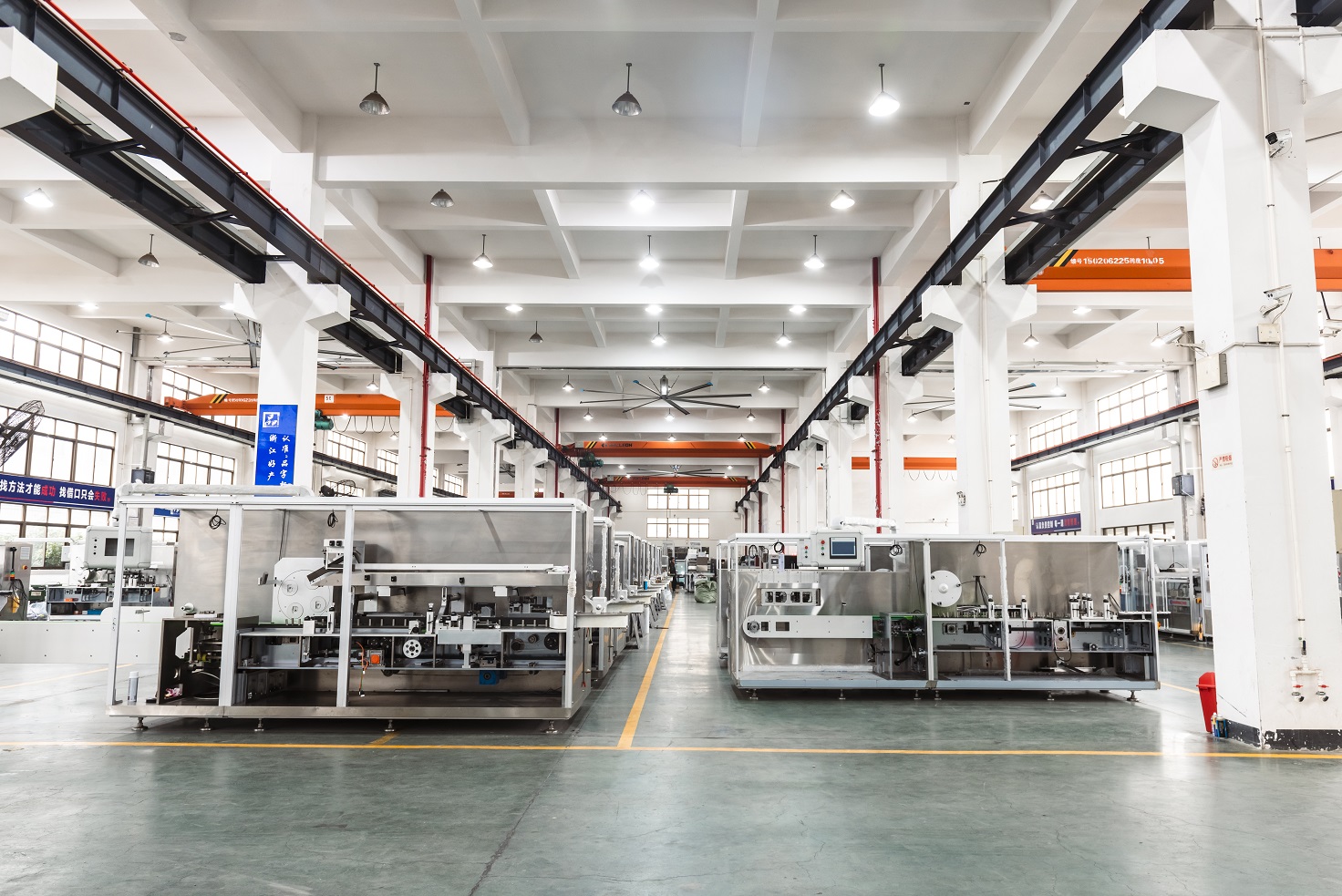
HOPING offers a range of fully servo high-speed blister-cartoner integrated lines under the DHL series. For example, the DHL1000/5H is an intelligent fully servo high-speed blister-cartoner integrated machine designed as a solid dosage turnkey packing line. It achieves a maximum capacity of up to 1000 blisters per minute and up to 500 cartons per minute. The line features a D3 intelligent top-loading parallel tracking transfer system, PVC/Alu foil auto splicing, a four-channel servo-driven independent replenishment system, a Beckhoff motion controller and a high-bus industrial control system. Mold-change and recipe memory functions support quick format changes, while the GMP-oriented design ensures cleanability and compliance.
Technical Architecture
The blister module uses stainless steel and aluminum-alloy construction with product-contact parts made of AISI 316L stainless steel and FDA-compliant pharmaceutical-grade materials. Non-product-contact parts are AISI 304 stainless steel and anodized aluminum alloy. The cartoning module (e.g., XWZ500H) handles 100–500 cartons per minute with full servo control, leaflet insertion and coding/inspection integration. Downstream equipment such as the XWK series stretch bander (30–60 bundles/min) and the ICP12 case packing and palletizing integral machine (about 12 cases/min) can be linked to form a complete end-of-line packaging solution. The entire line is controlled via Siemens or Beckhoff controllers, enabling synchronous high-speed operation.
Application Scenarios
These integrated lines are used for tablets, capsules and other solid dosage forms. They are suitable for new line construction, capacity expansion or upgrading existing packaging lines. According to a global project case, the line achieved improvements in packaging automation, reduced manual transfer, improved blister-to-carton connection efficiency, reduced wrong insertion or missing leaflet risks, and supported downstream automation integration. The flexible design accommodates different feeding methods, blister sizes, carton specifications and leaflet formats, making it adaptable to diverse production requirements.
Market Trend Analysis
The pharmaceutical blister packaging machine market is projected to reach USD 2.57 billion by 2025 with a CAGR of 2.8%. The top three global players (Uhlmann, IMA, Marchesini) collectively hold approximately 29% of the blister packaging machine market share. HOPING, as a Chinese manufacturer with CE and ISO 14001/ISO 45001 certifications, occupies a growing position in the Asia Pacific region and beyond. Increasing regulatory pressure (Machinery Directive 2006/42/EC, EN 415, ISO 15378) drives demand for compliant, fully traceable equipment. Investment in automated, servo-driven lines that reduce human error and improve OEE is a clear industry trajectory.
Comparison with Traditional Solutions
Traditional semi-automatic lines often require separate blister and cartoning stations with manual transfer, leading to higher labor costs and quality risks. HOPING’s integrated solution eliminates intermediate handling through a direct transfer system (D3 robot or parallel tracking). However, the initial capital expenditure for a fully integrated line is higher than for standalone machines, making it more suitable for medium-to-high volume production where the ROI is justified by reduced labor and waste.
Future Outlook
As pharmaceutical manufacturers continue to pursue Industry 4.0, HOPING’s lines are expected to incorporate more IoT connectivity, predictive maintenance and remote diagnostics. The modular architecture already allows for future upgrades in inspection, serialization and data integration. With 26 invention patents and 70 utility patents, HOPING is positioned to advance its technology in line with evolving market needs.
Frequently Asked Questions
What certifications do HOPING pharmaceutical packaging machines hold?
HOPING’s machines carry CE certification for the blister packing machine series (certificate HTT190102306L) and cartoning machine series (certificate HTT190102307L). The company also holds ISO 14001:2015 (Environmental Management) and ISO 45001:2018 (Occupational Health and Safety) certifications. Additionally, specific products have historical CE certificates, such as the carton packing machine series (UCN 900339024607).
Can the line be customized for different packaging formats?
Yes. HOPING offers customization for blister size, blister materials, quantity per carton, carton specification, leaflet format, coding/inspection method, feeding method, downstream bundling/case-packing/palletizing connection, interface language, electrical component brand and data interface.
What is the typical lead time and minimum order quantity?
Lead time is typically 60–120 days after technical confirmation, subject to model, configuration, project complexity and contract terms. The minimum order quantity is 1 set or 1 complete line.
What after-sales support is provided?
HOPING provides on-site installation and commissioning, operator and maintenance training, remote video/phone support, spare parts supply, process-parameter guidance and regular follow-up. Support terms are defined in the contract.
How does the line address GMP requirements?
The equipment is designed with GMP-oriented construction: product-contact parts use AISI 316L stainless steel and FDA-compliant materials, surfaces are corrosion-resistant and easy to clean, and the structure minimizes product retention. The DHL line includes transparent guards for process visibility and cleanability.
For detailed specifications, download the HOPING Machinery Catalog.
Have Questions or Need More Details?
Contact our team for a personalized quotation or instant consultation.
Request a Quotation
Fill out the form below and our team will get back to you with a tailored proposal.
WhatsApp Direct Chat
Prefer to chat in real-time? Message us on WhatsApp for instant assistance & quick answers.
- Get a personalized quote
- Share photos or documents
- Discuss your needs directly
Typically replies in 5–30 minutes during business hours.