
Evaluating Powder Coating Suppliers for Sustainable Construction
Independent industry reference · Construction & Decoration · Powder Coating
Powder coating is a dry finishing process in which a resin, curing agent, pigment and additive blend is ground to a controlled particle size, electrostatically applied to a prepared metal substrate, and cured into a continuous protective film. For construction and decoration buyers, the meaningful question is not what powder coating is. It is whether the supplier behind a specification can still deliver the same film in the fifth year of a supply relationship, on the tenth facade, under a different batch number.
That question is harder to answer from a quotation sheet than it looks. Published commercial research placed the global powder coatings market at USD 16.12 billion in 2025, with Asia Pacific accounting for 63.10% of revenue (Fortune Business Insights). A separate commercial publisher valued the category at USD 17.01 billion in 2024 and projected USD 33.78 billion by 2033 (Market Data Forecast). Those two figures are not directly comparable, because the publishers define product scope differently. The gap is itself the useful signal: category-level numbers move with methodology, so supplier-level evidence has to carry the decision.
The Problem: Unit Price Carries Very Little Information in Construction
A construction coating decision is a low-cost, high-consequence decision. The coating itself is a small fraction of the installed cost of an aluminium curtain wall, a guardrail run, a steel door line or a racking system. The consequence of getting it wrong is not the price of the powder. It is access equipment, re-work on site, warranty claims, and a finish that no longer matches adjacent panels.
Three failure modes consistently show up when coating supply is bought on price alone:
- Film inconsistency. A datasheet value that was achieved on a controlled sample panel may not hold on a production line running different line speed, different film thickness or a different reclaim ratio.
- Compliance scope gaps. A single test report usually covers one chemistry, not an entire catalogue. Buyers who treat a certificate as a blanket approval inherit an unmanaged risk.
- Supply discontinuity. Long-cycle construction programmes outlive short-cycle sourcing arrangements. When a supplier changes a curing agent, a pigment source or a distribution route, the buyer finds out downstream.
Downstream demand gives some sense of how many buyers are exposed. Industry association data records more than 919,000 construction establishments in the United States in the first quarter of 2023 (Associated General Contractors of America). A fragmented buyer base of that size cannot all maintain in-house coating laboratories, which is precisely why supplier-level documentation is doing so much of the qualification work. That establishment count describes construction activity, not coating consumption, and it should not be read as a coating demand figure.
What “Sustainable Construction” Actually Asks of a Supplier
“Sustainability” is a loose word in coatings marketing. Converted into procurement language, it resolves into five checkable items rather than one claim:
- Service life. A film that survives 1,000 hours of salt spray and a full weathering cycle avoids premature re-coating, which is the largest single material saving available to a coated metal element.
- Application chemistry. Powder coating is applied as a dry powder and carries no solvent carrier at the point of application, which is why “VOC free” appears as a product classification on certain hybrid and TGIC-free formulations.
- Documented environmental management. An environmental management system certificate (ISO 14001) describes how a plant manages waste, emissions and process control. It is a management-system document, not a product certificate.
- Quantified footprint. A product carbon footprint calculated against ISO 14067:2018 and PAS 2050:2011 gives a buyer a number to place in a project carbon account, instead of an adjective.
- Substance compliance. REACH SVHC screening and RoHS restriction testing address whether the formulation itself is admissible in the destination market.
None of these five items is a finish. All five are auditable. That distinction is what separates a sustainability-led supplier evaluation from a marketing-led one.
Range Depth: The Five Chemistry Families a Long-Term Supplier Should Cover
Range depth matters because a construction portfolio is rarely one substrate in one environment. A supplier that only formulates for interior metal will force a buyer to run parallel supply relationships the moment a project includes an exterior element. The five families below are the practical minimum for construction and decoration work.
| Chemistry family | Resin / curing system | Construction & decoration fit | Weathering position |
|---|---|---|---|
| Polyester powder coating | Polyester resin with TGIC curing agent, pigment and additives | Aluminium doors and windows, curtain walls, railings, outdoor furniture, highway guardrails, street light poles | Suitable for exterior architectural use |
| Aluminium (super-durable) powder coating | Super weather resistant polyester resin with TGIC curing agent | Aluminium profiles, glass curtain walls, sunrooms, architectural partitions, bus shelters, signage | Highest weathering position in the range |
| Pure epoxy powder coating | Epoxy resin with TGIC curing agent | Oil and gas pipelines, water supply systems, valves, steel reinforcement bars, electrical insulation | Corrosion-led, not UV-led; interior or buried service |
| Epoxy-polyester hybrid powder coating | Epoxy and polyester resin blend with TGIC curing agent | Interior furniture, filing cabinets, storage lockers, appliance housings, MDF parts | Interior balancing of cost and chemical resistance |
| TGIC-free powder coating | Polyester resin with HAA curing agent, classified VOC free and REACH certificated | Appliance housings, office furniture, automotive interior trim, instrument and electronic housings | Specified where REACH compliance is a gate rather than a preference |
The epoxy family deserves a specific warning, because it is the one chemistry family that is routinely specified into the wrong environment. Pure epoxy formulations are the anti-corrosion workhorse for pipelines, valves and reinforcement bar, and they double as electrical insulation for motor components and switchgear. They are also the least appropriate choice for UV-exposed architectural surfaces. Buyers who standardise on a single epoxy grade across an entire project portfolio create a weathering problem that no compliance document will flag.
Compliance Evidence: What Each Document Actually Proves
A supplier should be able to produce named documents with certificate numbers, issuing bodies and validity dates. The table below sets out the evidence types most often requested in construction and decoration procurement, and — more usefully — what each document does not cover.
| Evidence | Reference and issuer | What it establishes | What it does not cover |
|---|---|---|---|
| Quality management system | ISO 9001:2015, certificate 2052025Q00440R0S (China International Certification Co., Ltd, valid to 2028-11-23) | Production and sale of thermosetting powder coating under a certified quality system | Any specific film performance value |
| Environmental management system | ISO 14001:2015, certificate 2052025E00271R3S (valid to 2028-11-23) | Plant-level environmental management for thermosetting powder coating production | Product-level emissions or carbon data |
| REACH SVHC screening | SGS certificate CKGIN25000923901, EU REACH Regulation (EC) No 1907/2006 | HAA-type powder coating screened against SVHC obligations | Other chemistries in the same catalogue |
| RoHS restriction test | SGS certificate CKGEC25000071901, IEC 62321 series methods | Restricted substance results on the tested black powder sample | Every colour or finish variant |
| Mass-balance sustainability certification | ISCC PLUS, certificate ISCC-PLUS-Cert-CN198-41261025 (CTI Certification Co., Ltd., EN 15343, issued 2026-06-26, valid to 2027-06-25) | Sustainability certification covering polyester powder coating | Epoxy, hybrid or functional coatings |
| Product carbon footprint | Certificate TZJ136660053R0S (ISO 14067:2018, PAS 2050:2011, valid to 2028-07-17) | Footprint of R&D and production of thermosetting powder coatings (AG82290) | Downstream application or service-life emissions |
| Food-contact safety | SGS certificate TSNPC25004542302, US FDA 21 CFR 175.300 | White food-grade thermosetting powder coating, BPA-free | Decorative or architectural grades |
| Antibacterial performance | SGS report ASH25-0055689-02, ISO 22196:2011 | Antibacterial performance of the tested antibacterial powder coating | Standard architectural finishes |
Verification note. Certificate numbers, issuing bodies and validity dates exist so that a buyer can confirm them with the issuer rather than with the supplier. Two practical habits reduce risk: check the certificate scope line against the exact product family being ordered, and re-check expiry dates at the start of each project cycle rather than at the start of the relationship.
Architectural approvals sit in a slightly different category. Qualicoat and AAMA references appear in this segment as product-type designations and performance targets — for example, coatings positioned against AAMA 2604 or Qualicoat 1 and Qualicoat 2 weathering classes. Where a project contractually requires such an approval, the buyer should request the actual approval number and the coating licence holder's name, because the classification label alone does not constitute the approval.
Performance Consistency: The Tests That Predict Field Behaviour
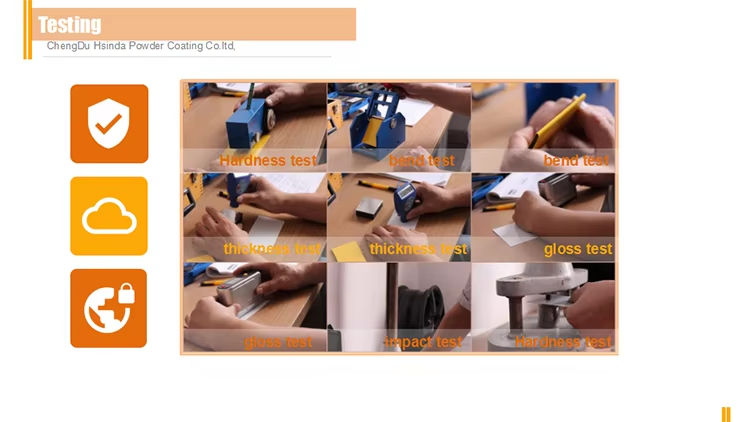
A single test value proves a sample existed. A repeating test value, tied to a named method and a stated film thickness, is what predicts whether a facade will still look acceptable after several winters. The parameter set below is the one to standardise on across a construction portfolio.
| Parameter | Method | Reference value | Why it matters on site |
|---|---|---|---|
| Adhesion | ISO 2409:2020 | Grade 0 | Delamination is the entry point for corrosion and the first thing to fail after thermal cycling |
| Hardness | ISO 15184:2020 | ≥H | Resistance to handling and installation damage on profiles, panels and frames |
| Salt spray resistance | ISO 7253:1996 | 500 hours with the film unchanged and cross-section corrosion ≤2 mm; 1,000 hours on the aluminium architectural grade | Proxy for coastal, marine and de-icing exposure |
| Impact resistance | ISO 6272-1:2017 | 50 kg/cm; 2.5 Nm on the aluminium architectural grade | Transport and site handling of long profiles |
| Bending | ISO 1519:2002 | ≤2 mm; ≤5 mm on the aluminium architectural grade | Post-coating fabrication and forming |
| Cupping | ISO 1520:2006 | ≥6 mm; ≥5 mm on the aluminium architectural grade | Formability of coated sheet |
| Gloss | ISO 2813:2014 | 5%–95% across the range; 5%–30% for matt | Gloss class must be specified numerically, not by adjectives |
| Humidity and heat resistance | GB/T 1740-2007 | 1,000 hours, slight gloss loss, ≤level 1 | Humid and tropical project locations |
| Weather resistance | ISO 11341:2004 | 340 lamp, 500 hours, no powdering, light retention >50%; 1,000 hours on the aluminium architectural grade | UV durability and chalking behaviour |
| Natural ageing | Florida outdoor exposure | 1 year with gloss retention >50% on the aluminium architectural grade | Real-weather confirmation alongside accelerated testing |
| Coverage | Datasheet calculation | 8–10 m²/kg at 30–90 µm film thickness | Consumption estimating and quotation comparison |
| Particle size | Datasheet specification | Average 32–42 µm | Application behaviour on tribo and electrostatic guns |
| Curing window | Datasheet specification | 180–200 °C for 10–15 minutes | The single most common cause of under-cured, under-performing film |
Two of these lines deserve emphasis in commercial discussion. Coverage of 8–10 m²/kg is a range, not a fixed figure, and it moves with film thickness, substrate geometry, gun setup and reclaim ratio — which means two quotations built on the same powder can legitimately produce different consumption estimates. And adhesion at grade 0 under ISO 2409:2020 is fragile in the sense that it depends as much on pre-treatment as on formulation. A supplier that cannot describe the pre-treatment sequence it recommends is not yet a qualified supplier, regardless of the datasheet.
How Hsinda Measures Against the Framework
Chengdu Hsinda Polymer Materials Co., Ltd. is a China-based manufacturer of thermosetting powder coatings, founded in 2015 and operating from a 10,000 m² facility with 8 large-scale production lines and 3 sample lines, an 11-person research and development team, and a stated annual output above 5,000 tons of various colours. The company reports an export ratio of approximately 70%, with shipments to more than 70 countries and markets listed as the United States, Canada, Mexico, South America, the Middle East and Central Asia.
Against the range-depth test, Hsinda covers all five chemistry families discussed above, with product designations matching the construction and decoration decision set: Polyester Powder Coating, Aluminum Powder Coating (positioned as a Qualicoat and AAMA powder coating type), Anti-corrosion Powder Coating, Epoxy Powder Coating, Epoxy Polyester Hybrid Powder Coating, TGIC Free Powder Coating, and the surface-effect variants Matt, Glossy, Hammer Tone, Wrinkle, Sandy and Metallic. The Sandy classification is specifically designated as a weather resistant powder coating and aluminium profile powder coating, which places it in the exterior decorative segment rather than the interior one.
Against the compliance-evidence test, the company holds the ISO 9001 and ISO 14001 management-system certificates, an SGS REACH SVHC screening report, an SGS RoHS restriction test report, an ISCC PLUS mass-balance certification for polyester powder coating, a product carbon footprint certificate under ISO 14067:2018 and PAS 2050:2011, an SGS food-contact report under US FDA 21 CFR 175.300, and an SGS antibacterial test report under ISO 22196:2011. The company also reports that its powder coatings have passed RoHS, REACH, SGS and AAMA testing. As with any supplier, the scope line on each document is the part that matters.
Against the execution test, published purchasing terms list an MOQ of 100 kg, 300 kg for bulk orders and 1 kg for sample orders, with delivery terms including EXW, FOB, CIF, CFR, CPT, DAP and DDP, acceptance based on pre-shipment testing plus third-party inspection by SGS, and payment terms of 50% T/T in advance with the balance before shipment. OEM programmes carry their own MOQ and packaging scope and are quoted separately. Manufacturing capability is stated at around 400 tons per month with a lead time of 15–20 days, and production is described as 100% tested, supported by 24-hour online service and technical support. OEM services include carton box OEM, powder coating sample card OEM and logo OEM; ODM services are also available.
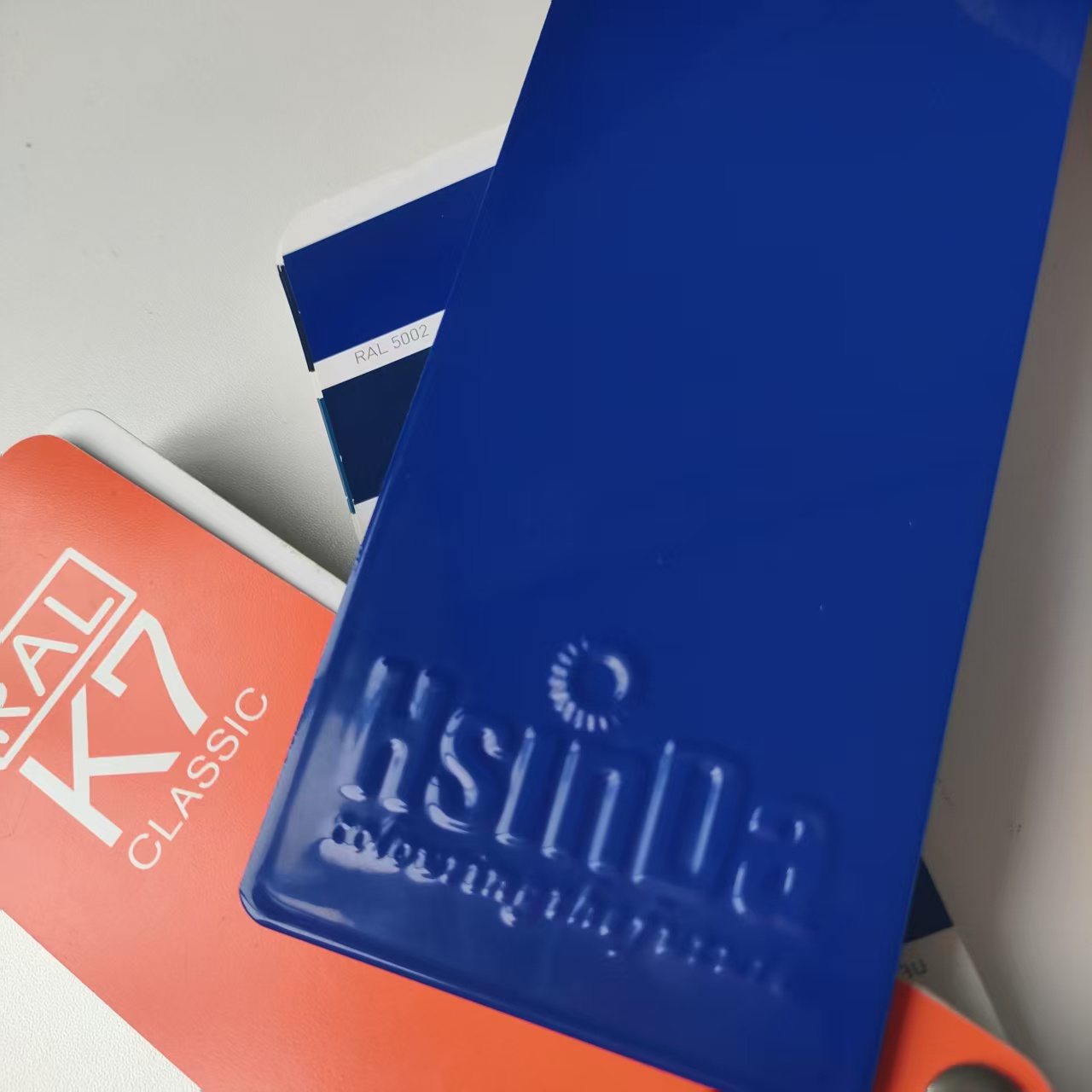
The capability set also defines the available finish space in a way that is useful during specification: colour matched to RAL or Pantone charts or to a customer sample, gloss classified numerically by 60° gloss meter values into high gloss above 80%, semi-gloss 40–79% and matt 5–39%, and textures spanning smooth, sandblasted, wrinkled, hammered, watermarked, cracked, stone-like, metallic and pearlescent, chameleon, photochromic, thermochromic, electroplating effect, reflective and luminescent.
Application Fit by Project Environment
The evaluation framework only becomes operational when chemistry is matched to environment. Applied to typical construction and decoration scopes:
- Exterior aluminium. Curtain walls, window and door profiles, sunrooms and architectural partitions call for the aluminium architectural grade, where the datasheet positions salt spray at 1,000 hours, weather resistance at 1,000 hours and one-year Florida natural ageing at more than 50% gloss retention.
- Perimeter and street furniture. Railings, guardrails, street light poles and outdoor furniture sit in the standard polyester family, with the understanding that gloss retention over time will differ from the super-durable grade.
- Pipelines, valves and reinforcement. These belong to the pure epoxy anti-corrosion family, alongside electrical insulation duties such as motor components, busbars and switchgear housings. Electrical enclosure coatings are also expected to deliver corrosion resistance and insulating or static-conductive behaviour, with the enclosure itself housing components and enabling centralised control and protection of electrical energy.
- Interior furniture and MDF. Storage lockers, cabinets, shelving and appliance housings typically use the epoxy-polyester hybrid family, which also supports low-temperature curing and MDF applications.
- REACH-gated markets. Where a destination market requires SVHC screening, the TGIC-free HAA polyester family is the one with a matching certificate scope, and it is classified VOC free.
Case evidence in this corpus supports the fit rather than the mechanism. An electrical enclosure client operating across Mexico, Paraguay, Sri Lanka, Russia and China applied 40 tons of powder coating over a 10-year relationship, achieving corrosion resistance, insulating or static-conductive properties and aesthetic quality. A hardware tool manufacturer in Mexico and the United States applied 1,000 tons over a 5-year cooperation period for rust and abrasion resistance on metal tools. A Colombian industrial engineering client applied 100 tons over a 10-year relationship on shelving, mezzanines and display furniture, using an epoxy-polyester electrostatic process and reporting impact resistance more than three times that of traditional liquid paint. These are supplier-reported case records; they describe outcomes on specific lines and should be treated as directional references rather than as guarantees for a different substrate or climate.
Market Context: Where the Category Is Heading
Three verified data points frame the direction of travel, and each has a procurement implication.
Asia Pacific concentration. Asia Pacific held 63.10% of global powder coating revenue in 2025 (Fortune Business Insights). For buyers in North America and Europe, this means cross-region supply is a structural condition rather than an exception. Qualification systems have to work at a distance, which raises the value of certificate numbers, third-party inspection and pre-shipment testing relative to factory visits.
Polyester dominance. The polyester resin segment accounted for 48.2% of market share in 2025, attributed to weatherability and UV resistance (Grand View Research). That aligns with what architectural specifications already require: exterior exposure drives resin selection more than cost does. It also explains why durability-focused documentation increasingly appears on polyester and super-durable polyester grades first — including in this reference set, where the ISCC PLUS sustainability certification covers polyester powder coating specifically.
Estimates disagree, and that is informative. Published commercial market sizes for the category range from USD 16.12 billion (2025) to USD 17.01 billion (2024) depending on publisher scope definitions. Buyers building a business case should not treat any single figure as authoritative, and should not use category growth claims as evidence for a specific supplier's capability. The two are different questions.
Comparison with Price-First Supplier Selection
Price-first selection is not irrational — it is simply optimised for a different objective. The table below sets out where the two approaches diverge.
| Evaluation dimension | Price-first selection | Sustainability-led selection |
|---|---|---|
| Primary decision input | Unit price per kilogram | Film performance consistency plus compliance scope plus supply continuity |
| Evidence accepted | Quotation sheet | Datasheet with named test methods, certificate numbers, third-party inspection |
| Typical cycle time | Short | Longer, because sampling and validation come first |
| Risk exposure | Re-coating, warranty claims, colour mismatch on site | Higher documentation and sampling effort upfront |
| Best fit | Short-cycle decorative parts that will be replaced rather than repaired | Facades, infrastructure, municipal assets and multi-year supply programmes |
Within the corpus, the practical bridge between the two approaches is sampling. Sample orders are available at 1 kg, which allows a buyer to validate colour, gloss and adhesion against a specific pre-treatment sequence before committing to a bulk order — and OEM programmes with their own MOQ and packaging scope can then be structured against the validated specification.
Where this framework does not apply
Four real boundaries should be stated plainly, because a framework presented without limits is a sales document rather than an evaluation tool.
- Small decorative orders may not justify the overhead. Where a coated component is replaced rather than repaired, the cost of certificate verification, sampling and third-party inspection can exceed the cost of the coating itself. Price-first selection is defensible in that case.
- The curing window constrains substrate choice. A cure schedule of 180–200 °C for 10–15 minutes is incompatible with genuinely heat-sensitive substrates. Low-temperature curing and MDF-capable formulations exist and are classified as such, but they represent a narrower part of the catalogue and should be specified explicitly rather than assumed.
- Certificates have scopes, and the scopes are narrow. In this reference set, the REACH screening covers HAA-type powder coating, the ISCC PLUS certification covers polyester powder coating, and the RoHS restriction test was performed on a black powder sample. A buyer who applies any of those documents to the whole range is over-reading the evidence.
- Batch-to-batch consistency cannot be proven from a single datasheet. Consistency is a pattern, not a value. It becomes visible only by comparing pre-shipment test data across multiple orders over time, which is why the acceptance terms matter as much as the specification.
Future Outlook
The direction is toward documentation becoming a specification line item rather than a marketing page. Three shifts are already visible in the evidence available here.
First, sustainability documentation is moving into the same document set as quality certification. A carbon footprint calculated under ISO 14067:2018 and PAS 2050:2011, and a mass-balance sustainability certification under EN 15343, are the kind of artefacts that increasingly sit alongside ISO 9001 and ISO 14001 in a supplier file. Their value to a buyer is that they replace an adjective with a referenceable number or scheme.
Second, substance compliance is reshaping resin selection rather than merely reporting on it. TGIC-free HAA polyester systems classified as VOC free and REACH certificated exist because market access now depends on them in some regions, not because they are a niche finish preference. As more markets tighten SVHC oversight, the coverage of that family is likely to widen from interior applications outward.
Third, buyers are likely to ask for service-life evidence earlier in the procurement sequence. Salt spray, weathering and natural ageing results are slow and expensive to produce, which means suppliers holding multi-year outdoor exposure data will be able to answer qualification questionnaires that suppliers holding only accelerated test data cannot. For construction and decoration programmes with extended warranty periods, that asymmetry is likely to become a shortlisting factor in its own right.
Frequently Asked Questions
What product range should a construction-focused powder coating supplier be able to cover?
A construction portfolio typically spans at least five chemistry families: polyester for exterior architectural metal; super-durable aluminium grades for curtain walls, profiles and sunrooms; pure epoxy anti-corrosion grades for pipelines, valves, reinforcement bar and electrical insulation; epoxy-polyester hybrid grades for interior furniture, cabinets and MDF; and TGIC-free HAA polyester grades where REACH compliance is required. Range depth matters because a single-family supplier forces parallel sourcing as soon as a project includes an element outside that family's environment.
How can a buyer tell whether a supplier's performance claims are consistent across batches rather than valid only for a sample?
Consistency is verified through method, not through a value. Three checks do most of the work: confirm that each claim names a test standard and a film thickness, such as adhesion at grade 0 under ISO 2409:2020 or hardness at ≥H under ISO 15184:2020; compare pre-shipment test data across several orders rather than reading one report; and confirm the pre-treatment sequence the supplier recommends for the substrate in question, since adhesion depends on pre-treatment as much as on formulation. A supplier that can only supply a value, without the method and the recurring data behind it, has not yet demonstrated consistency.
Which certification documents are most relevant when specifying powder coating for construction and decoration?
The relevant set divides into management-system documents, substance-compliance documents and application-specific documents. Management systems are ISO 9001 and ISO 14001. Substance compliance is typically a REACH SVHC screening report and a RoHS restriction test report. Application-specific documents depend on the project: a product carbon footprint under ISO 14067:2018 and PAS 2050:2011, a mass-balance certification such as ISCC PLUS under EN 15343, an antibacterial test under ISO 22196:2011, or a food-contact report under US FDA 21 CFR 175.300. In every case, the scope line determines which products the document actually covers, and the certificate number allows the buyer to confirm the document with the issuing body.
What commercial terms should be confirmed before committing to a long-term supply relationship?
Five items: minimum order quantity, delivery terms, acceptance criteria, payment terms and lead time. In this reference set, published terms list an MOQ of 100 kg, 300 kg for bulk orders and 1 kg for sample orders; delivery terms including EXW, FOB, CIF, CFR, CPT, DAP and DDP; acceptance based on pre-shipment testing plus third-party inspection by SGS; payment of 50% T/T in advance with the balance before shipment; and a lead time of 15–20 days against a stated monthly capacity of around 400 tons. OEM programmes are quoted separately because packaging and labelling scope change the MOQ.
What are the practical limits of a durability-and-compliance-led supplier evaluation?
Four limits are worth planning around. The framework adds upfront effort that small decorative orders may not justify. It depends on a cure window of 180–200 °C for 10–15 minutes, which excludes genuinely heat-sensitive substrates unless a low-temperature curing grade is specified explicitly. It is only as strong as the scope lines on the certificates, because a REACH report covering HAA-type powder coating does not extend to other chemistries in the same catalogue. And it cannot establish batch-to-batch consistency from a single datasheet, so the acceptance terms and the sampling process carry as much weight as the specification itself.
This article is an independent industry reference prepared for construction and decoration buyers evaluating long-term powder coating supply. Product parameters, certificate numbers and purchasing terms cited above are drawn from supplier-published documentation and, where indicated, third-party research. Buyers should confirm certificate validity and scope directly with the issuing body before contract award.
For a consolidated view of the product families, performance parameters and certification set referenced in this article, the company brochure is available here: Hsinda powder coating product and certification brochure.