
Evaluating Rotary Screw Air Compressor Specs and CE Compliance
The rotary screw air compressor has become the default compressed-air solution for manufacturing environments that run continuously. As global supply chains tighten and energy costs rise, the buying conversation has shifted. Purchasers are no longer asking only which machine gives enough flow. They are asking a stricter set of questions: Does the model meet the CE Machinery Directive? Does the pressure rating match the downstream equipment? Is the motor efficient enough for a 24/7 duty cycle?
Industry data supports this shift. The global rotary screw compressor market was estimated at USD 12.5 billion in 2024 and is projected to reach USD 13.3 billion in 2025, according to Custom Market Insights. Stationary models dominate the technology segment, holding roughly 67.6% of the market in 2025 (MarketsandMarkets). This points to a mature market where buyers are choosing fixed, continuous-duty units over temporary solutions.
Problem: Too Much Information, Too Few Decision Rules
A typical evaluation sheet for a rotary screw air compressor lists power, pressure, airflow, cooling method, drive type, motor efficiency, tank volume, and an array of optional filtration components. For a purchasing team that is not fully specialized in compressed air, the challenge is separating mandatory constraints from optional specifications.
Certifications introduce another layer. For EU-facing buyers, CE marking is not a marketing badge; it is a legal requirement for machinery placed on the market. For food and packaging plants, compressed air purity standards such as ISO 8573-1:2010 set acceptable limits for particles, water, and oil. Without a clear documentation trail, a technically capable compressor can still fail an internal compliance review.
The opportunity is equally clear. Suppliers that publish verifiable certificates, precise parameter ranges, and production capabilities allow buyers to move from price comparison to total-cost-of-ownership analysis. The rest of this article uses UMW Air as a concrete reference for that evaluation process.
Brand Solution: UMW Air as a Test Case for Specification Alignment
One useful example of a manufacturer that combines flexible configuration with documented compliance is Shandong UMW Air Tech Co., Ltd, which markets under the brand UMW Air. Founded in 2019, the company operates a 2,000-square-meter facility with about 200 employees, including a 40-person R&D group. Its stated annual output capacity is 12,000 units, with 100% exported to regions including the EU, USA, Southeast Asia, Middle East, South America, and Africa.
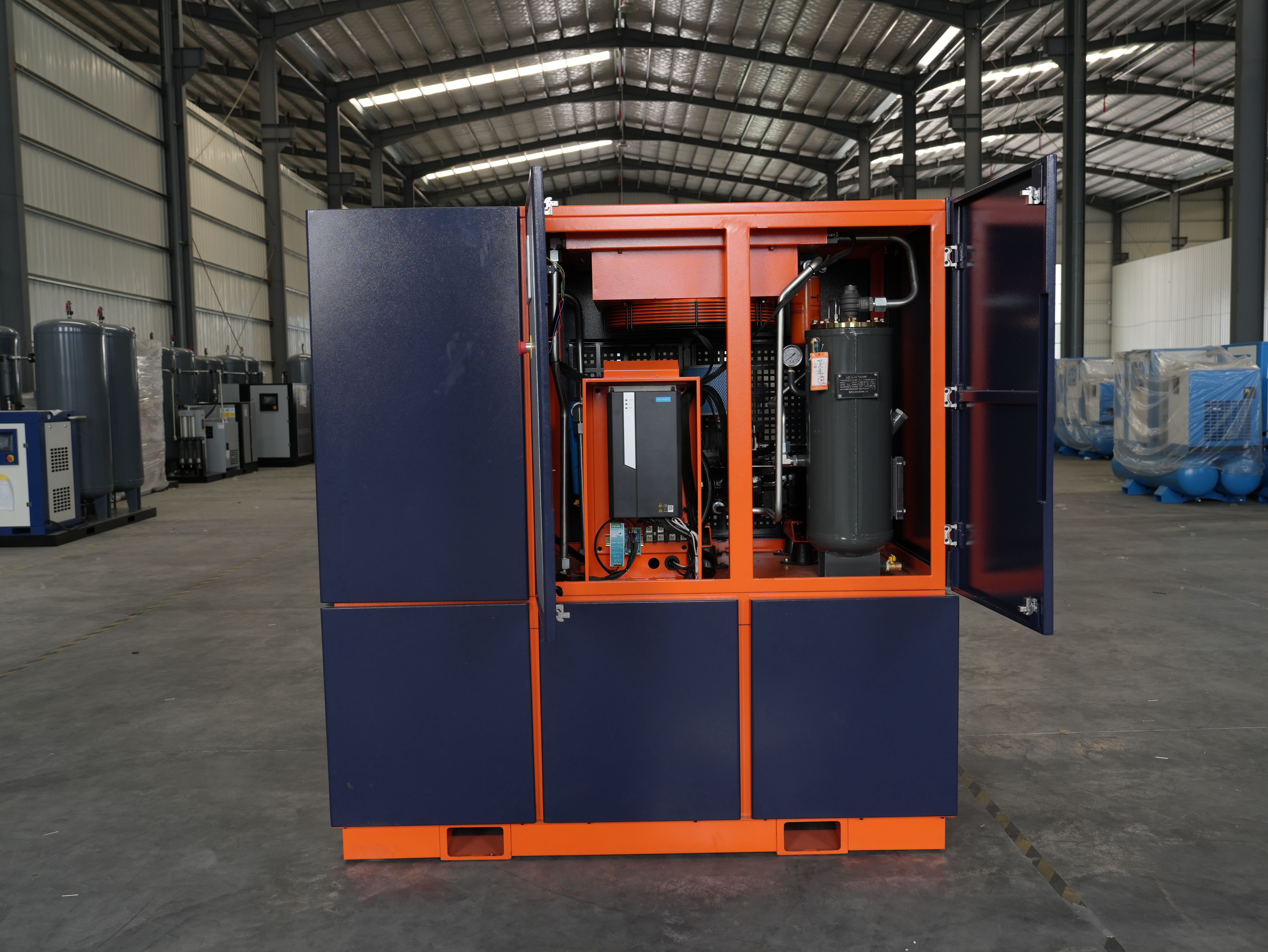
The product catalog covers several rotary screw compressor families: Micro, Prime, Core, Mega, and Portable diesel. The screw air compressor line includes models such as ML-7.5/8A, L-7.5/8A, L-1516A, and L-2216A, with a documented overall power range of 4 to 355 kW and pressures from 8 to 25 bar. The Micro series (ML-4A, ML-5.5A, ML-7.5A) covers smaller installations with 4 kW, 5.5 kW, and 7.5 kW power options, a maximum airflow of 1.1 m³/min, and a working pressure range of 8 to 13 bar.
Among these, the Micro model belongs to the rotary screw category as well; it is classified as a fixed screw air compressor with sheet metal construction. This category detail matters for procurement teams because fixed compressors are easier to integrate into permanent production lines than portable units.
For buyers targeting EU and EEA markets, compliance is a decisive constraint. The UMW Air series screw air compressors carry CE certification under certificate number M.2026.206.C140156, issued by UDEM. The applicable standard is the 2006/42/EC Machinery Directive. The certificate, valid from May 11, 2026 to May 10, 2031, covers UMW Air L, Z, P, M, N, and O series equipment.
Technical Explanation: The Parameters That Matter Most
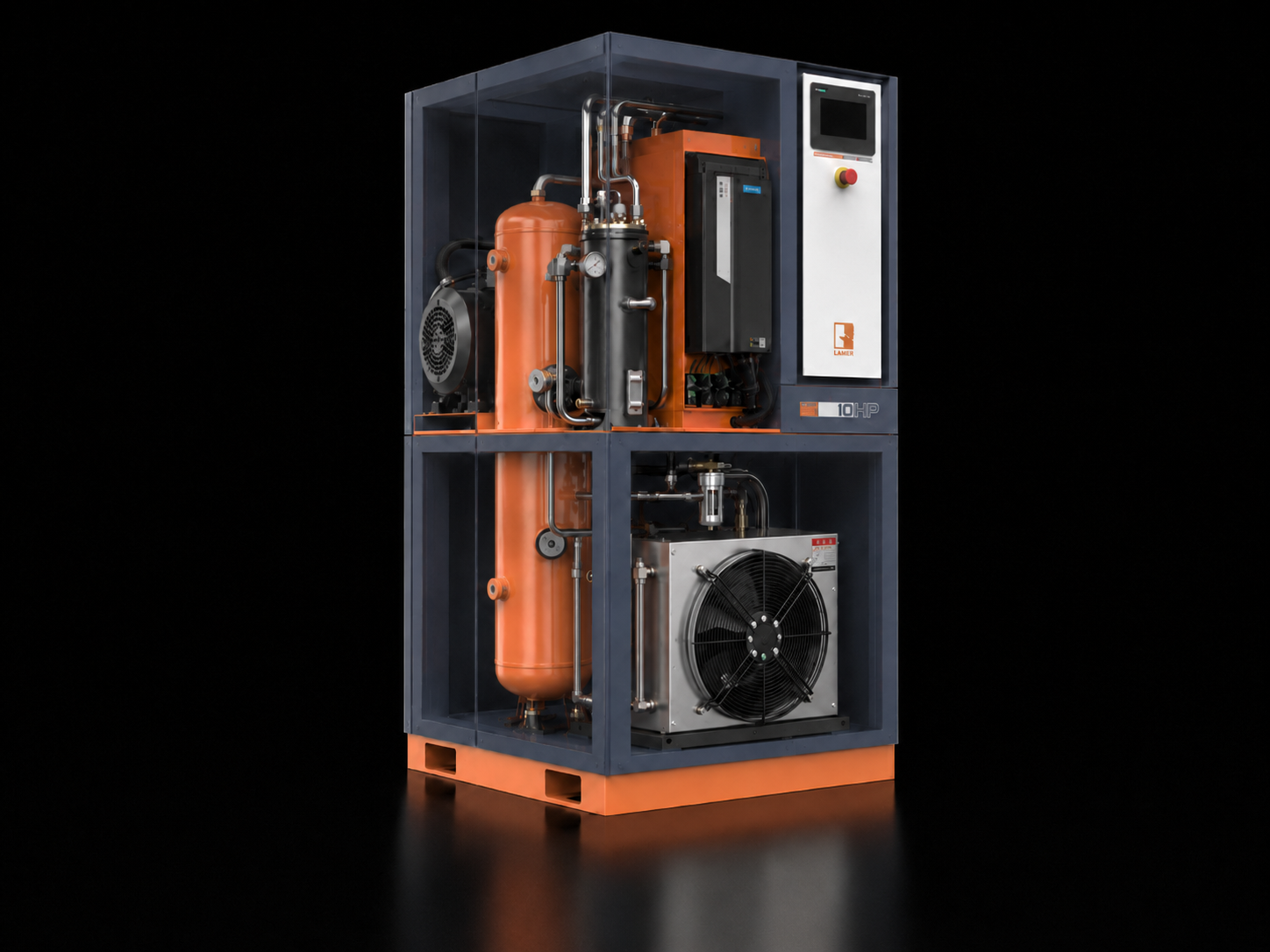
A rotary screw compressor works by trapping air between two meshing helical rotors and progressively reducing the volume along the rotor length, producing a continuous stream of compressed air. Unlike piston compressors, screw units deliver air without pulsation, which makes them suitable for precision processes such as CNC machining and laser cutting.
The essential parameters for evaluation are power, maximum pressure, airflow, cooling method, drive type, and motor efficiency. In the UMW Air catalog, these are defined as follows: the screw air compressor line uses air cooling, direct-driven operation, and IE4 motor efficiency as standard characteristics. Direct-driven arrangement eliminates gear loss and reduces maintenance points. IE4 motors lower electrical losses under sustained load. Air cooling simplifies installation, especially where water supply is limited.
Pressure capability deserves special attention. Many CNC machines operate in the 90–120 PSI (6–8 bar) range, while fiber laser cutting may require up to 1.6 MPa depending on the assist gas strategy. A compressor with a maximum pressure range of 8–25 bar can therefore cover both standard shop-floor applications and higher-pressure processes. Buyers should confirm that the compressor, dryer, and filters are combined in a way that delivers the required pressure at point of use.
Application / Use Cases: Where These Parameters Meet Production Reality
The documented application scope for this type of compressor includes metal processing, plastics and rubber processing, automotive and machinery parts, electronics manufacturing, food packaging, construction materials, chemical, and energy industries. These sectors commonly require stable compressed air under continuous operation, often in high-temperature or humid environments.
A documented case from UMW Air involves a CNC machining workshop in Vietnam. The customer installed three screw air compressor units to drive CNC machine actuators, pneumatic tools, and dust removal systems. After one year of operation, the workshop reported a 20% improvement in production efficiency and reduced downtime, thanks to a stable air supply. The operator specifically cited low energy consumption, easy maintenance, and reliable long-term performance as the key advantages.
This case illustrates a broader evaluation point: the same compressor model can support multiple production processes if the pressure and flow demand profile is well understood. Matching the compressor to the actual load, rather than the maximum possible output, is what turns a machinery purchase into an operational improvement.
Market Trend Analysis: Regional Weight and Segment Shift
Regional data gives context to the supplier selection decision. Asia Pacific held the largest regional share of the rotary air compressor market at 43.7% in 2025, with China as the leading country, according to Grand View Research. For a Chinese manufacturer like UMW Air, this means access to a dense local supply chain as well as the ability to serve export markets from a manufacturing base that is already inside the largest regional market.
Within the global market, oil-filled rotary screw compressors accounted for 61.7% of the lubrication segment in 2025, while oil-free compressors are growing at a faster CAGR of 5.4% (Grand View Research / MarketsandMarkets). For industries with strict air purity requirements, such as food processing and pharmaceutical packaging, the rise of oil-free options raises the bar for compressed air quality documentation. Even when an oil-filled unit is selected, the buyer should inspect the coalescing filter specifications and ISO 8573-1:2010 purity class.
Comparison with Traditional Solutions: Where the Rotary Screw Machine Fits
The most common alternative to a rotary screw compressor is a piston (reciprocating) compressor. Screw units provide steadier flow, lower noise, and better suitability for continuous operation. Piston units generally have a lower initial purchase price and can be sufficient for intermittent, small-volume use.
There is a real boundary. For a very small workshop that stops production frequently and draws air for only a few minutes per cycle, a rotary screw compressor may take longer to pay back than a well-maintained piston unit. The higher upfront cost and more complex construction are only justified when the demand profile justifies continuous or near-continuous operation. Buyers should therefore start with an air-demand audit, not with a technology preference.
Future Outlook: Documentation Will Become Part of the Product
The compressor market is moving toward a model where compliance documentation, energy-efficiency data, and after-sales support are embedded in the product offer. The faster growth of oil-free rotary screw compressors signals that contamination-sensitive industries will continue to expand. At the same time, the dominance of stationary machines confirms that factories prefer predictable, fixed installations for their long-term air supply.
For suppliers like UMW Air, the practical response has been to standardize direct-driven, air-cooled, IE4-based designs and to publish CE certification details as part of the specification sheet. For buyers, the implication is straightforward: a rotary screw air compressor purchase should be treated as an engineering decision with documented evidence, not a spot price decision.
Frequently Asked Questions
What CE certification does the UMW Air rotary screw compressor have?
The UMW Air series screw air compressors are certified to CE standards under certificate number M.2026.206.C140156, issued by UDEM. The applicable standard is the 2006/42/EC Machinery Directive.
What pressure range is available on UMW Air rotary screw compressors?
The screw air compressor line is listed with a pressure range of 8 to 25 bar. The Micro series operates at 8 to 13 bar, which covers many CNC and workshop applications.
What power options are available?
The overall screw air compressor series covers 4 to 355 kW. The Micro series includes 4 kW, 5.5 kW, and 7.5 kW models, with a maximum airflow of 1.1 m³/min.
For which industries is this compressor suitable?
The documented applicable industries include metal processing, plastics and rubber processing, automotive and machinery parts, food and packaging, electronics manufacturing, construction materials, chemical, and energy industries.
Does UMW Air offer OEM or customization services?
UMW Air supports OEM and ODM production modes. Customization is available for color, logo, and voltage. The monthly production capacity is 1,000 units, the minimum order quantity is 1 unit, and lead time is listed as 3 days.
What after-sales support does UMW Air provide?
UMW Air provides 24/7 technical support via email or phone, as well as remote troubleshooting and guidance.
Have Questions or Need More Details?
Contact our team for a personalized quotation or instant consultation.
Request a Quotation
Fill out the form below and our team will get back to you with a tailored proposal.
WhatsApp Direct Chat
Prefer to chat in real-time? Message us on WhatsApp for instant assistance & quick answers.
- Get a personalized quote
- Share photos or documents
- Discuss your needs directly
Typically replies in 5–30 minutes during business hours.