
Evaluating Silicone Waterproof Coating CE and Parameters for Bulk Procurement
Global buyers in construction waterproofing increasingly demand coatings that meet strict regulatory frameworks and deliver verifiable long-term performance. Certifications and documented parameters have become non-negotiable criteria for procurement decisions, especially for bulk orders destined for European and North American markets. Understanding how a specific product's credentials align with project requirements is essential during the research and evaluation phase.
Regulatory Compliance as a Procurement Gate
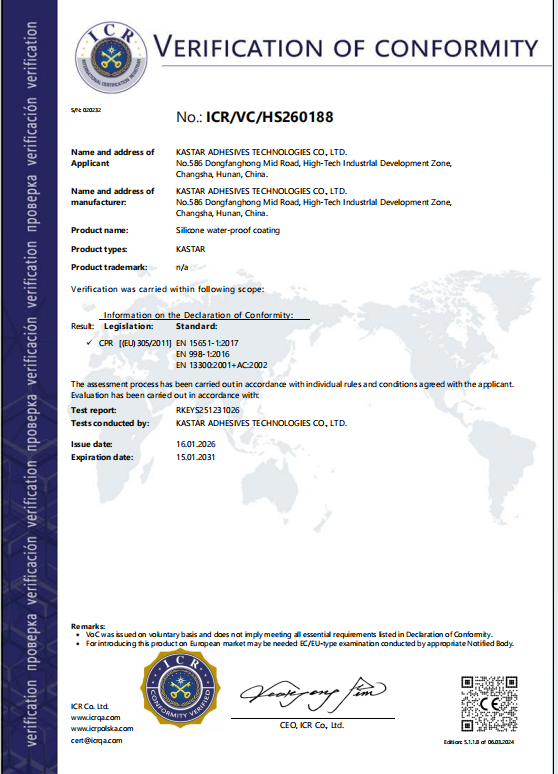
For the European market, the Kastar 4000 Silicone Waterproof Coating is CE certified. The certification, number ICR/VC/HS260188, is issued by ICR and valid until January 15, 2031. This attestation confirms compliance with harmonized standards EN 15651-1:2017, EN 998-1:2016, and EN 13300:2001+AC:2002. CE marking is a mandatory conformity indicator for construction products sold in the European Economic Area, making it a fundamental requirement for distributors and contractors sourcing for EU projects. The certification applies specifically to the Kastar 4000 formulation, providing auditable traceability for procurement audits.
Performance Parameters That Define Reliability
Kastar 4000 Silicone Waterproof Coating exhibits a solid content of 98%, indicating minimal volatile organic compound emission and high film-build efficiency. Its elongation at break reaches ≥200%, while tensile strength measures ≥1.2 MPa. The product has demonstrated UV resistance for 1,000 hours without cracking or peeling, operating across a temperature range of -80°C to 180°C. The manufacturer states an outdoor service life of ≥25 years. These figures position the coating as suitable for environments exposed to extreme thermal cycles, intense solar radiation, and structural movement.
Such parameters are especially relevant for projects requiring long-term waterproofing with minimal maintenance. A higher solid content reduces the number of coats needed, lowering applied cost per square meter. The wide temperature tolerance ensures adhesion and flexibility remain stable under freeze-thaw conditions or high-heat roofing surfaces.
Application Scenarios and Real-World Use
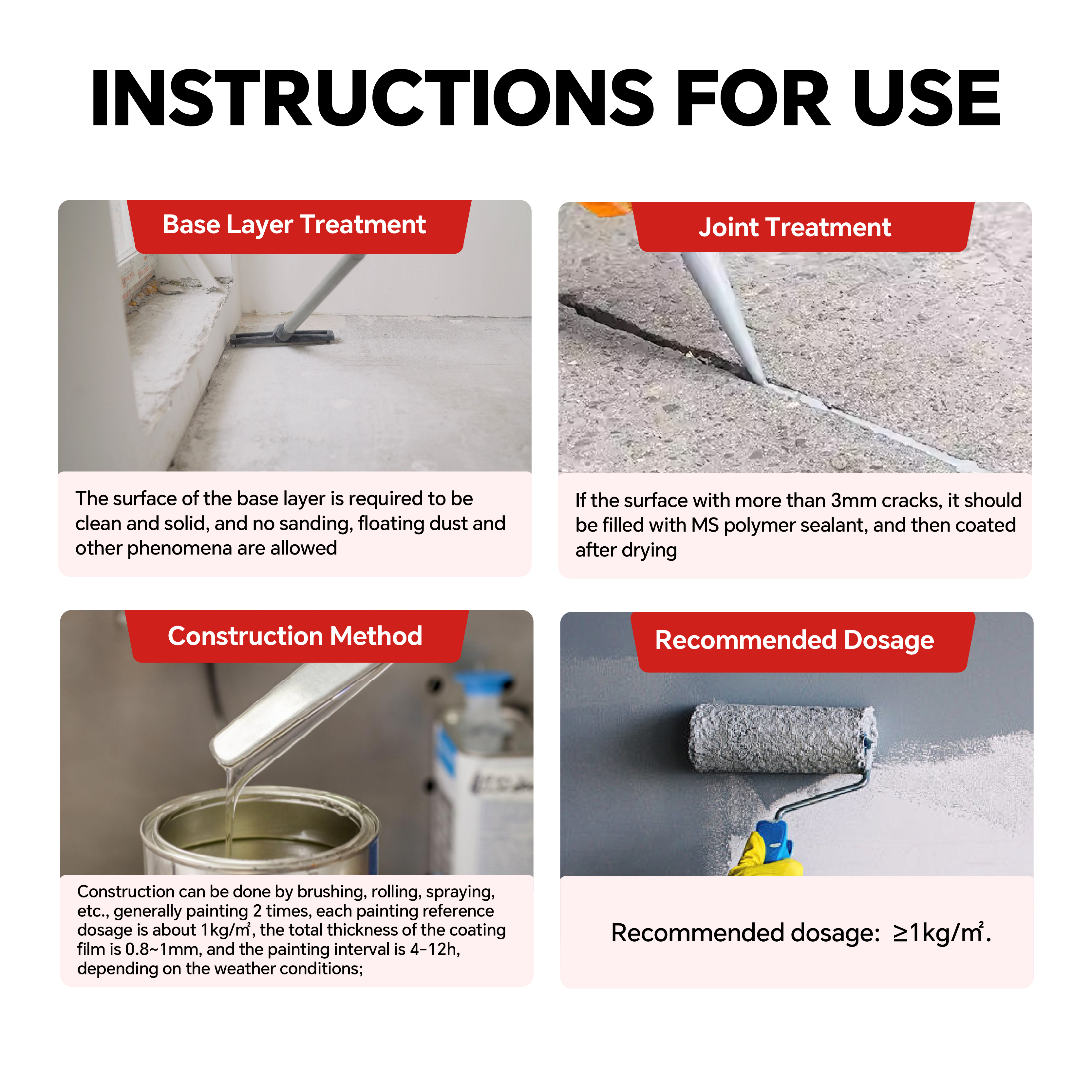
The critical working conditions include high temperature, UV exposure, rain and humidity, structural expansion, and freeze-thaw cycles. The coating is applied on roof decks, exterior walls, expansion joints, and bathroom waterproofing systems. For instance, in equatorial regions where UV intensity is high, the 1,000-hour UV resistance test validates its anti-aging capability. In cold-climate markets like Canada and Northern Europe, the low-temperature flexibility ensures the coating does not become brittle. The product adheres to substrates such as concrete, metal, and existing roofing membranes, often paired with reinforcing fabric for cracks and joints.
Kastar's production facility, which spans 150,000m² with an annual output of 300,000 tons, supports bulk supply for large-scale infrastructure projects. The company has exported to 69 countries and served over 1,000 customers. Its OEM/ODM capability includes customization of color, viscosity, packaging, and formulation, with a minimum order quantity of 100 buckets and lead times of 15–20 days. Bulk orders typically undergo 100% pre-shipment testing in a 1,000m² China Metrology Accreditation (CMA) certified laboratory staffed by 16 testing personnel and equipped with over 100 testing instruments.

Market Trend: Certification-Driven Sourcing
The global waterproof coating market is experiencing a shift from commodity-based procurement to specification-based sourcing. Buyers, particularly in the EU and North America, now require documented conformity with regional standards (CE, REACH, SGS). Kastar's products have obtained SGS, REACH, and ISO9001 certifications in addition to CE, reflecting an alignment with this trend. Furthermore, the company is a participant in the formulation of Chinese standards for silicone waterproof coatings, indicating deep technical involvement in the industry.
Another observable trend is the preference for single-source suppliers capable of offering both standardized products and OEM/ODM flexibility. Distributors can leverage Kastar's 28 years of production experience and fully automated packaging equipment to secure consistent quality across bulk orders. The combination of CE certification and high-performance parameters reduces technical due diligence overhead for procurement teams.
Comparison with Traditional Solutions
Compared to acrylic or polyurethane waterproof coatings, silicone chemistries offer superior UV resistance and a broader operating temperature range. Acrylic coatings typically degrade after 5–8 years under direct sunlight, while polyurethane may yellow and lose elasticity at extreme temperatures. The Kastar 4000's 25-year outdoor service life represents a step change in durability. One honest limitation is that silicone coatings generally carry a higher per-unit material cost than asphalt-based or acrylic alternatives. However, the extended recoating cycle and reduced labor intervention often deliver a lower total cost of ownership over the building's lifetime.
Future Outlook
As building envelope performance standards tighten globally, the demand for silicone waterproof coatings with third-party certification will continue to rise. Kastar continues to invest in R&D, collaborating with Tsinghua University for annual technological iteration. The company holds invention patents for silicone waterproof coating production processes and siloxane-terminated polymer preparation methods. For global buyers, partnering with a manufacturer that offers both certified product parameters and scalable OEM support will become a competitive advantage. The ability to customize formulations while maintaining CE compliance further strengthens the supply chain reliability.
Frequently Asked Questions
What CE certification does the Kastar 4000 Silicone Waterproof Coating hold?
The product holds CE certification under number ICR/VC/HS260188, issued by ICR for the European market. It applies specifically to the Kastar 4000 Silicone Waterproof Coating.
Which standards does this CE certification confirm compliance with?
The certification confirms compliance with EN 15651-1:2017, EN 998-1:2016, and EN 13300:2001+AC:2002.
What is the validity period of the CE certification?
The certification is valid from January 16, 2026, to January 15, 2031.
What are the key performance parameters of the Kastar 4000?
Solid content 98%, elongation at break ≥200%, tensile strength ≥1.2 MPa, UV resistance 1,000h no cracking/peeling, operating temperature -80°C to 180°C, outdoor service life ≥25 years.
Does Kastar offer OEM/ODM services for silicone waterproof coating?
Yes, Kastar provides OEM/ODM services with customization options for color, viscosity, packaging, and formulation. Minimum order quantity is 100 buckets, lead time 15–20 days, monthly capacity 30,000 tons.
For more detailed specifications and company credentials, download the official corporate brochure:
Download Brochure (PDF)