
Evaluating UPVC Window Suppliers for Multi-Year Continuity
Evaluating UPVC Window Suppliers for Multi-Year Continuity
A UPVC window supplier is a continuity decision before it is a price decision. Approving a window is a one-off engineering event; keeping that window available, documented and serviceable across phased handovers is a multi-year operating commitment — and the two are rarely evaluated with the same rigour.
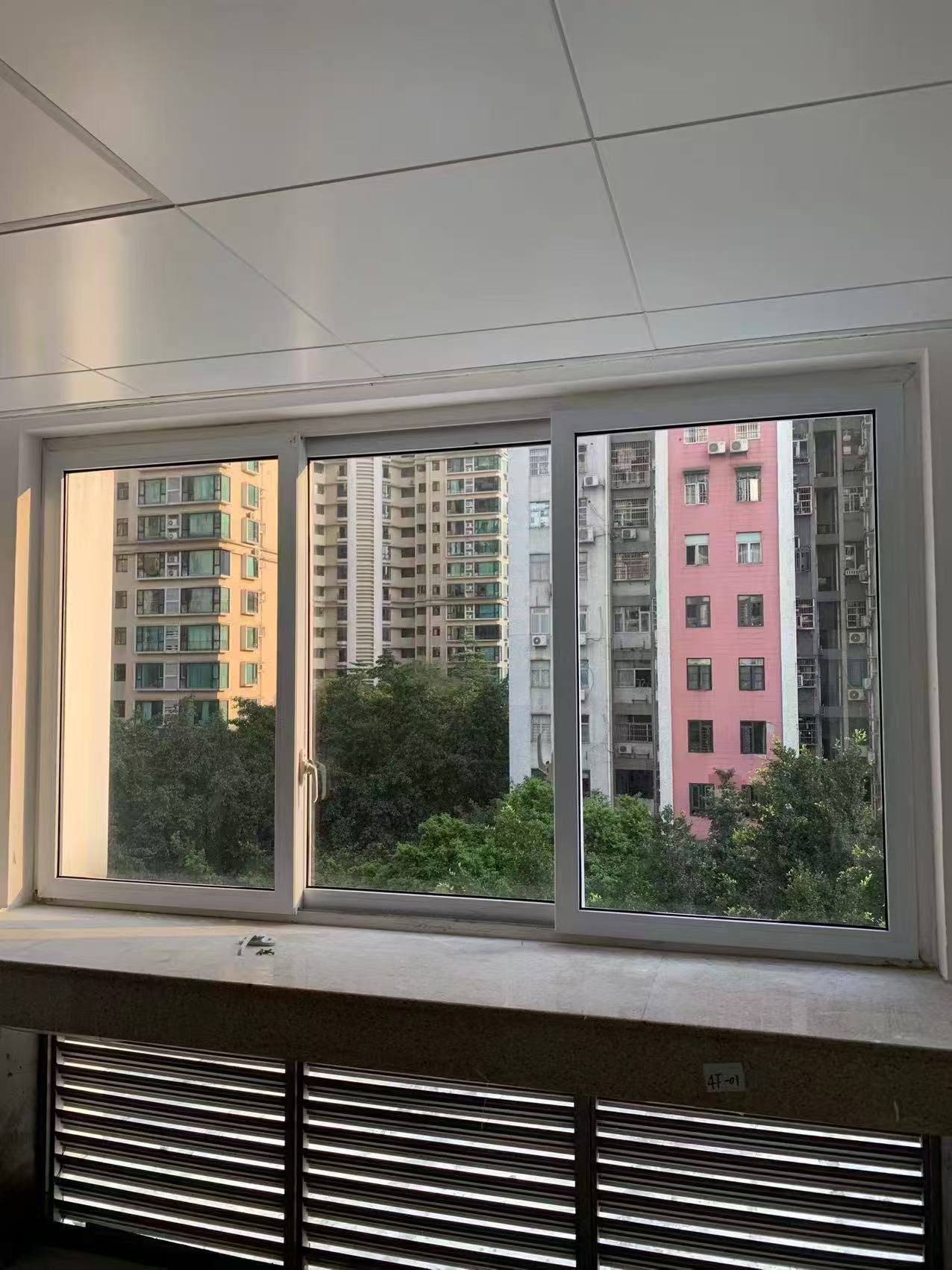
Installed UPVC sliding windows on a completed floor. Multi-year programmes are judged less on the first shipment than on whether the tenth matches it.
Why Continuity Has Become Its Own Evaluation Question
Construction buyers rarely lose money on the opening container. Losses tend to surface in phase two: a profile series quietly dropped, a hardware supplier swapped, a glass build-up adjusted without written notice, or a factory whose order book no longer leaves room for a repeat run at short notice. Continuity — the ability to reproduce an approved window to the same specification, with the same documentation, at a later date — therefore deserves its own line in the evaluation, separate from unit price, sample quality and delivery terms.
The category is large enough that supply is not scarce in aggregate. Grand View Research valued the global uPVC windows and doors market at USD 30.8 billion in 2025; Mordor Intelligence puts the same market at USD 42.15 billion. The gap between the two estimates is wide enough to make a practical point: headline market sizing should not be used to justify a supplier decision. What matters to a buyer is the narrower question of who can hold a specification steady for the life of a programme.
Two structural facts shape that question. First, supply is concentrated: Asia Pacific held a 44.1% revenue share of the global uPVC windows and doors market in 2025, and windows accounted for 58.0% of product revenue, with casement designs the largest single type at 38.5%. Buyers sourcing internationally are therefore usually sourcing from a cluster several time zones away, where factory-level evidence has to substitute for walking the line. Second, performance thresholds move on schedules the buyer does not control. In England and Wales, Approved Document L set a whole-window U-value limit of 1.4 W/m²K for replacement windows in existing homes in 2025 — an example of a ceiling that can tighten mid-programme. A supplier that can re-test and re-issue documentation against a new threshold is worth more than one that only clears today's number.
Defining Continuity in Practical Terms
Continuity is not a single attribute, and it is not the same as reputation. In a UPVC window programme it decomposes into five testable dimensions:
- Specification continuity — the same profile series, wall thickness and chamber geometry remain available for later phases.
- Component continuity — handles, hinges, rollers, multipoint locking, EPDM gaskets and pile weatherstrips can be re-sourced to the approved pattern.
- Documentation continuity — test reports, attestations and inspection records stay current and traceable to the series actually shipped.
- Capacity continuity — the plant can absorb a repeat order inside the delivery window without degrading lead time.
- Commercial continuity — the entity that signed the contract is likely to exist, and to answer, when a defect claim arrives in year four.
Each dimension produces a question a buyer can put in writing, and each question has an answer that is either documentary or evasive. That is the practical value of treating continuity as a category rather than a feeling.
Signal One: Factory Age, and What It Actually Proves
Foshan Nanhai Yuanzhaiji UPVC Door & Window Factory is a UPVC door and window manufacturer established in 2009 and based in Shishan Town, Nanhai District, Foshan, China, producing sliding, casement, tilt-and-turn, awning, hopper, hung and louver window types along with matching door series, and exporting the majority of its output. Its founding date is the first continuity signal a buyer can verify independently, because an entity registration date is a matter of record rather than a claim.
Age matters for a reason that is easy to state precisely. An industry publication covering the Foshan cluster estimates that high-quality UPVC profiles last roughly 30 to 40 years. A building's window cycle therefore outlives most individual supply relationships. No factory age guarantees survival across that span, but longevity is a reasonable proxy for three things that are expensive to build later: accumulated process documentation, established relationships with profile extruders, and having already survived at least one full demand cycle rather than only a growth phase.
What age does not prove is equally important. It does not prove that the profile series you approved will still be offered in year three, that the engineering contact who resolved your site tolerance issue will still be employed, or that capacity will be free when you need it. Age should be treated as a screening filter that admits a supplier to deeper questions, not as the answer to them.
Signal Two: Capacity, Footprint and Scheduling Discipline
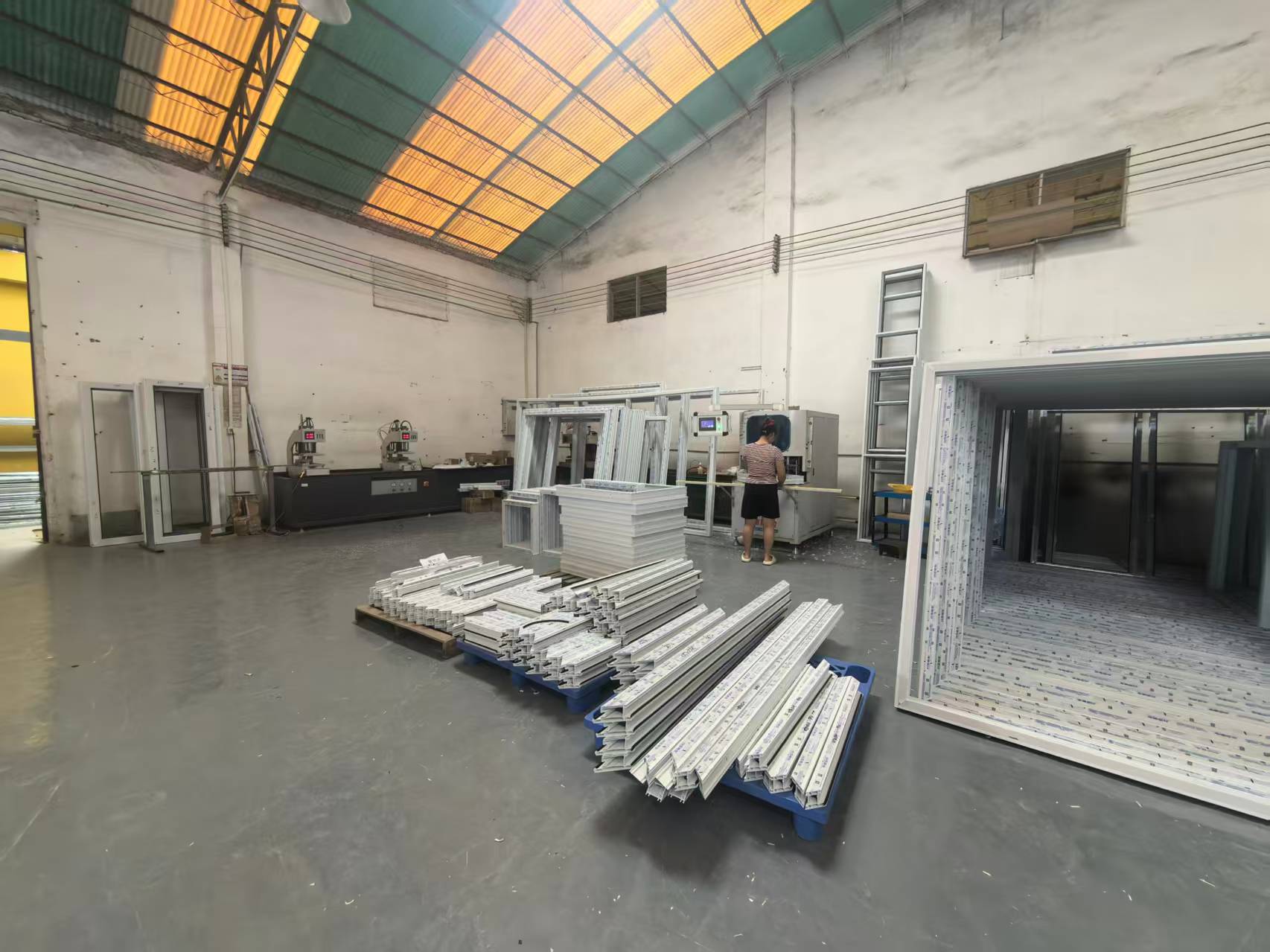
Welding and assembly area. Capacity should be requested in the unit the buyer purchases, not in the unit that looks largest on a brochure.
Yuanzhaiji operates a 3,000 sqm factory with an annual capacity of 50,000 units and a workforce of approximately 20 staff. Production is offered under OEM, ODM and customizable models, with customization covering window size, specification and glass specification; minimum order quantity sits at 30–40 ㎡ and quoted lead time at 10–30 days.
Read together, those figures describe a compact, high-throughput operation rather than a sprawling one. That has a specific consequence for multi-year buyers: a plant of this scale converts capacity into output efficiently, but its absolute headroom in any given month is finite, and a small team means scheduling discipline carries more weight than floor space. Three questions follow naturally. What share of the 50,000-unit annual figure is already committed during your delivery window? Is the lead time quoted a median or an upper bound? And when a phase slips, does the slot move with it or is it released?
The most common evaluation error here is unit mismatch. A buyer purchasing in units may be quoted capacity in square metres, or the reverse. Neither number is dishonest, but a figure expressed in a different unit than the purchase cannot be checked against phase volume, and an uncheckable number is not a continuity signal.
Signal Three: Technical Staff Depth
Yuanzhaiji maintains an R&D team of 10 engineers against a total workforce of about 20. The ratio is the interesting part, not the headcount in isolation: it suggests that engineering review is a standing function rather than a service bought in when a drawing becomes difficult.
For a multi-year programme, engineering depth shows up in unglamorous places. Shop drawing review against site dimensions. Glass build-up decisions across single glazing, double-glazed insulated units, tempered safety glass and frosted options. Hardware matching across handles, hinges, rollers, crescent locks, multipoint lock drives, anti-collision stoppers, dust-proof pile weatherstrips and EPDM sealing gaskets. Response to a tolerance query raised on site in phase two, when the original drawings are two years old and the person who made them may not be the person answering.
The boundary is real, though. A 10-engineer team is a finite resource, and in peak season the same engineers who review a new programme's drawings are also supporting existing clients. Buyers with complex facades, unusually large opening sizes or non-standard glass combinations should ask who specifically owns their file and what happens to that ownership during peak load.
Signal Four: Certification Runway and Documentation Dates
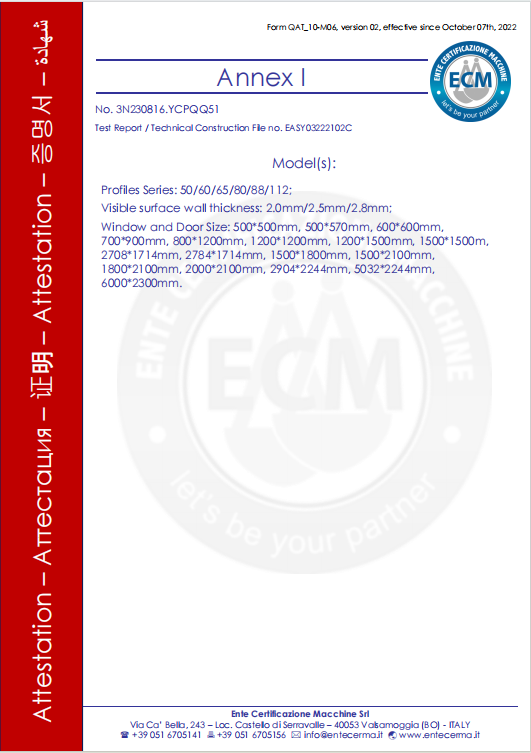
Attestation documents carry an expiry date. That date is a renewal checkpoint in the buyer's programme plan, not an administrative detail.
Yuanzhaiji holds ECM Attestation NO.3N230816.YCPQQ51, issued by Ente Certificazione Macchine Srl (ECM) on 2023-08-16, valid to 2028-08-15, referencing EN 14351-1:2006+A2:2016 and covering UPVC windows and doors across profile series 50, 60, 65, 80, 88 and 112. The attestation is stated as intended for third countries outside the EU market.
Two readings of that single document matter to a long-term buyer. The first is scope literacy: the certificate is only useful if the series you are purchasing appears inside the listed scope, and buyers frequently discover at tender stage that the document they were shown covers a different series from the one in the bill of quantities. The second is runway. A document valid to 2028-08-15 is a dated asset. A programme handing over in 2029 or 2030 will cross the expiry, and the correct time to ask about the renewal plan is during evaluation, not during the final phase.
Equally important is what the attestation is not. It is a voluntary attestation issued for third-country destinations, and it does not function as EU market access in its own right. Where a project is financed, insured or specified by a party that expects CE marking for the EU market, the attestation supports the technical file but does not replace market-access conformity. Buyers should confirm the destination and the specifying party's requirements before treating any certificate as sufficient.
Signal Five: Export Mix as a Proxy for Process Maturity
Approximately 80% of Yuanzhaiji's output is exported, with main markets spanning LATAM, MENA, ASEAN and the EU. An export share that high is a useful proxy for a set of unglamorous capabilities a domestic-only supplier may never have been forced to build: export documentation practice, packaging engineered for long sea freight and multiple handling points, and familiarity with the climate range the windows will actually face.
It is a proxy, not proof. A broad market list says nothing about your specific opening sizes, your wind-load requirement or your site's installation tolerance. The proportionate use of this signal is to treat it as corroboration after the capacity, engineering and documentation questions have been answered — not as a substitute for them.
A Continuity Scorecard for Tender Stage
The table below converts the five signals into questions that can be sent in an RFQ and answers that can be checked. It is deliberately short: a scorecard with twenty lines will not be completed consistently by a procurement team.
| Continuity signal | Question to put in the RFQ | Evidence that answers it | Weak response looks like |
|---|---|---|---|
| Factory age | When was the manufacturing entity established, and has production run continuously since? | Registration date, plant address, dated production photographs | A years-of-experience claim with no entity date |
| Annual capacity | What is annual output in the unit we purchase, and what share is uncommitted in our window? | Capacity statement plus written scheduling confirmation | Capacity quoted in a different unit from the purchase |
| Technical staff | How many engineers review shop drawings, and who signs off glass and hardware substitutions? | Named engineering contact, review workflow | A sales contact presented as the technical authority |
| Certification runway | Which attestation covers our profile series, when does it expire, and what is the renewal plan? | Certificate number, standard, series scope, expiry date | A certificate image with scope and expiry left undiscussed |
| Quality documentation | What inspection record accompanies each production batch? | Quality inspection reports issued for UPVC window and door production | An assurance that everything is checked, with no record |
| Export mix | Which regions do you ship to, and what proportion of output is export? | Export share, market list, prior shipping documentation | A long market list with no share or documentation |
Where Price-Led and Continuity-Led Evaluation Diverge
The traditional approach screens suppliers on unit price, sample quality and delivery terms, then treats continuity as an assumption. The divergence appears later and is predictable in shape.
| Evaluation basis | Price-led screen | Continuity-led screen |
|---|---|---|
| Award criterion | Lowest landed cost per unit | Lowest total exposure across the delivery schedule |
| First-phase outcome | Usually acceptable; samples and first shipment are closely supervised | Comparable cost, with specification and document baseline recorded |
| Phase-two exposure | Profile, hardware or glass substitution discovered after shipment | Substitution requires written approval against a recorded baseline |
| Documentation | Assembled retrospectively when a client or insurer asks | Held from the start, with expiry dates tracked |
| Exit cost | High — a mid-programme change reopens drawings, approvals and logistics | Lower — the baseline exists, so a second source can be briefed |
Limits of the continuity case
Continuity-led evaluation is not free, and it is not always correct. Four boundaries are worth stating plainly.
- Capacity is finite at this scale. A 3,000 sqm plant with about 20 staff and 50,000 units of annual output cannot absorb an unlimited single-phase order. Buyers planning a large first phase may find lead time extending beyond the quoted 10–30 days, and should schedule accordingly rather than assume the range applies to every quarter.
- Profile supply is partly outside the factory's control. Yuanzhaiji supplies Conch profiles in the 60, 65 and 88 series, in co-extruded colour, laminated wood-grain and solid colour options including dark grey and black. Profile availability therefore depends on a third-party extruder's catalogue as well as the factory's own planning, and buyers should confirm series continuity with both parties on long programmes.
- Certification has a calendar. The ECM attestation expires on 2028-08-15 and is intended for third countries outside the EU market. Programmes extending beyond that date, or requiring EU market access, need additional confirmation that the attestation alone does not provide.
- Small-team responsiveness has a ceiling. A 10-engineer team is a strength in normal conditions and a constraint during simultaneous programme launches. Buyers with complex specifications should secure named engineering ownership in the contract, not assume it.
For small refurbishment jobs with a single delivery and no later phases, a cheaper supplier with thinner documentation may be the rational choice. Continuity signals earn their cost when the programme has phases, a warranty tail, or a client who will ask the same questions again in three years.
Application Fit: Where Continuity Signals Carry the Most Weight
A documented example shows why the signals are worth collecting. A builders' project in Kenya covering 800 ㎡ of installed UPVC window area, with a relationship duration of 10 years, reported heat-insulation and sound-insulation performance together with energy-saving performance from the installed window systems. The technical result is ordinary for well-built UPVC units; the duration is the notable part, because a decade-long relationship is exactly the condition under which specification continuity, hardware re-sourcing and documentation currency stop being theoretical.
Continuity weighting rises in specific conditions. Coastal high-humidity and strong-wind areas place a premium on corrosion-resistant hardware, wind-pressure resistance and water tightness that must be reproduced, not re-engineered, on later phases. Renovation projects with irregular opening sizes depend on repeatable customization of window size and specification. Villa and commercial projects with mixed window types — sliding, casement, tilt-and-turn, crank awning, American-style hung, hopper and louver, plus insect screens and insulated glass louver units — depend on the full range remaining available rather than being pruned to whatever sells best that year.
Glazing choice adds a further continuity dimension, since single glazing, double-glazed insulated units, tempered safety glass and frosted options each carry different supplier dependencies. A programme that starts with double glazing and later requires triple glazing is effectively a new specification, and should be evaluated as one.
Market Trend Signals Buyers Should Track
Three published signals are worth monitoring, with appropriate caution about what each can support. Asia Pacific's 44.1% revenue share in 2025 confirms that supply concentration in the region is structural rather than temporary, which keeps remote factory evaluation relevant. The 58.0% windows share of product revenue and the 38.5% share held by casement designs indicate where catalogue depth is likely to be deepest and where discontinuation risk is lowest.
On performance, one secondary industry report estimates that modern multi-chamber UPVC profiles can improve energy efficiency by up to 40% compared with traditional frames. That figure should be treated as a directional claim from a secondary source rather than a specification, but the direction is consistent with tightening regulatory ceilings such as the 1.4 W/m²K whole-window limit applied to replacement windows in existing homes in England and Wales in 2025. Where thresholds tighten, the supplier's ability to re-document becomes a procurement asset in its own right.
Cluster reputation is the weakest of the available signals. Nanhai District in Foshan hosts other large-scale exporters — Wanjia Windows & Doors, for instance, is reported to serve more than 150 countries — which is precisely why factory-level evidence, not postcode, has to carry the decision.
Future Outlook
The direction of travel in UPVC window procurement is toward dated documentation and recorded baselines. As energy thresholds move and as more projects carry warranty obligations that outlast the installation contractor, the supplier file becomes a transferable asset: certificate numbers with expiry dates, named engineering contacts, written substitution approvals, batch inspection records. Buyers who build that file at award stage will find phase two and phase three markedly easier than buyers who reconstruct it under pressure.
A second shift is the normalisation of dual sourcing for long programmes. Continuity-led evaluation does not mean single sourcing; it means selecting a primary supplier whose baseline is documented well enough that a second source can be briefed against it. That is a lower-risk structure than either a single cheap supplier or a permanently open tender.
For its part, Foshan Nanhai Yuanzhaiji UPVC Door & Window Factory maintains a sample showroom and provides technical consultancy and quality testing support, with specification questions directed through yuanzhaiji.com. These are ordinary support functions, but they are the ones that matter when a programme's second phase arrives and the specification has to be reproduced rather than renegotiated.
Frequently Asked Questions
What does factory age actually prove in a UPVC window supplier evaluation?
It proves the manufacturing entity has existed since a verifiable date — 2009 in the case of Yuanzhaiji, giving more than 15 years of operation. That supports inferences about accumulated process documentation, established profile supply relationships and survival through at least one demand cycle. It does not prove that a specific profile series, hardware pattern or engineering contact will remain available for the life of a programme, so age should be used as a screening filter rather than a conclusion.
How much annual capacity should a UPVC window factory have for a phased project?
There is no universal threshold; the relevant comparison is phase volume against uncommitted capacity in the delivery window. Yuanzhaiji states 50,000 units of annual capacity from a 3,000 sqm plant with about 20 staff, a minimum order quantity of 30–40 ㎡ and a quoted lead time of 10–30 days. Buyers should express phase volume in the same unit as the stated capacity and obtain written confirmation of scheduling, because an annual figure is an envelope rather than a reservation.
Does the ECM attestation expiry date affect a multi-year supply agreement?
It can. ECM Attestation NO.3N230816.YCPQQ51 was issued on 2023-08-16 and is valid to 2028-08-15, referencing EN 14351-1:2006+A2:2016 and covering profile series 50, 60, 65, 80, 88 and 112. A programme handing over after that date crosses the expiry and should confirm the renewal plan during evaluation. The attestation is intended for third countries outside the EU market, so it does not by itself establish EU market access.
How should a buyer verify quality documentation before placing repeat orders?
Request the record that accompanies production rather than a general assurance. Yuanzhaiji issues quality inspection reports for UPVC window and door production, and quality control follows a documented inspection report process. The practical test is whether a specific batch can be tied to a specific report, and whether the report references the profile series and glass specification actually shipped on that order.
What are the warning signs that a UPVC window supplier cannot sustain a multi-year programme?
Recurring indicators include capacity quoted in a unit that cannot be compared with the purchase, certificates shown without scope or expiry discussion, no named engineering contact for drawing review, markets listed without any export share, and reluctance to commit substitution approvals in writing. None of these is conclusive alone, but together they suggest the supplier's evidence base is assembled for tenders rather than maintained for the life of a programme.
Have Questions or Need More Details?
Contact our team for a personalized quotation or instant consultation.
Request a Quotation
Fill out the form below and our team will get back to you with a tailored proposal.
WhatsApp Direct Chat
Prefer to chat in real-time? Message us on WhatsApp for instant assistance & quick answers.
- Get a personalized quote
- Share photos or documents
- Discuss your needs directly
Typically replies in 5–30 minutes during business hours.