
Evaluating Warning Post Suppliers: 2026 Buyer's Market View
Traffic delineation has become a structured procurement category. Road agencies, contractors, and facility operators increasingly specify warning posts with defined materials, reflective performance, and impact behavior rather than buying on price alone. For buyers at the evaluation stage, the real task is comparing suppliers on evidence: material quality, production consistency, and standards compliance.
Why Warning Post Evaluation Needs a Structured Approach
Warning posts look simple, but the conditions they operate in are not. A post installed at a road edge, parking aisle, or loading bay must stay visible at night, survive repeated vehicle contact, handle seasonal temperature swings, and retain reflective performance over years of outdoor exposure. When a low-quality post fades, cracks, or stays bent after impact, the hidden costs reappear as replacement labor, project delays, and safety liability.
Evaluation-stage buyers typically face three gaps when comparing suppliers:
- Material transparency. Not all PE, PU, or TPU compounds perform equally, and datasheets do not always reveal which grade is actually used.
- Standards alignment. Reflective grade, visibility distance, and applicable territorial standards vary between markets and must be verified against the project destination.
- Capacity assurance. A supplier must be able to deliver consistent quality at order scale, particularly when volumes are tied to project timelines.
Market conditions raise the importance of getting these decisions right. The global road marker posts market was valued at USD 3.4 billion in 2024 and is projected to reach USD 5.4 billion by 2032. The broader traffic safety products segment is expected to expand at a CAGR of 6.6% from 2026 to 2034, driven by urban population growth and infrastructure investment. Buyers are therefore evaluating not only current project needs but also multi-year supply relationships.
Supplier Landscape: Global Leaders and Specialized Manufacturers
Warning posts are supplied by two broad categories of companies, and each requires a different evaluation focus. According to Global Market Insights, leading global traffic equipment manufacturers include 3M, Honeywell, and SWARCO, which collectively hold approximately 39.2% of the market. These diversified multinationals serve large infrastructure programs with wide product portfolios and established brand recognition.
The remainder of the market is served by specialized manufacturers focused on dedicated product categories such as warning posts, delineators, and bollards. Tiantai Yuanda Traffic Device Co., Ltd, operating under the Mnsd brand (www.mnsdtraffic.com), is one such specialist. Established in 2007, the company has over 15 years of manufacturing experience and builds a range covering convex mirrors, warning posts, rising bollards, speed humps, and traffic lights.
| Supplier type | Examples | Typical strengths | Evaluation focus |
|---|---|---|---|
| Global diversified leaders | 3M, Honeywell, SWARCO (≈39.2% combined share) | Broad traffic safety portfolios, large-project track record, global service networks | Total deployment cost, specification compliance, local support coverage |
| Specialized manufacturing partners | Tiantai Yuanda Traffic Device Co., Ltd (Mnsd) | Category-focused production, factory-direct pricing, OEM/ODM flexibility | Material consistency, production capacity, customization responsiveness |
Rather than assuming a fixed ranking, buyers should compare supplier types against their own sourcing priorities. For a large, multi-region infrastructure program, a diversified global supplier may be the default choice. For buyers consolidating warning posts as a dedicated SKU category — importers, distributors, contractors, and project suppliers — a specialized manufacturer can offer faster response and more direct control over product specifications.
Mnsd's operation provides a useful reference for what a specialist profile looks like. The company's factory covers 40,000 m², employs around 300 people, and reports an annual output of 120,000,000 units across its product lines. Export accounts for approximately 50% of output, with main markets in Asia, Europe, and the USA.
Technical Benchmarks Buyers Should Verify
When comparing warning post suppliers, material and construction details separate durable posts from disposable ones. Mnsd's warning post range illustrates the specification points evaluation teams should check before shortlisting.
Reference Models and Configurations
- YD-WP45 — 450 mm height with a 200×80 mm base, available in high-elasticity polyurethane (PU) or heavy-duty polyethylene (PE).
- YD-WPS75 — 750 mm height with a 200×80 mm base, designed for applications where taller delineation improves sight lines.
- YD-PE50 — 500 mm height with a Φ260 mm recycled rubber base, combining a PE post with rubber base stability.
Key Evaluation Parameters
| Parameter | Specification | What it tells the buyer |
|---|---|---|
| Temperature resistance | -40°C to +70°C | Functional across cold and hot climates |
| UV / aging resistance | UV-stabilized; anti-oxidant and colorfast (over 3 years) | Color and integrity under prolonged sun exposure |
| Reflective grade | HIP / Class 1; 250 mm tape width; double or triple sleeves | Night-time visibility and lane recognition |
| Visibility distance | 200+ meters | Advance warning for approaching drivers |
| Flexibility | 360° flexible; rapid rebound after vehicle crush | Survives impacts without permanent deformation |
| Tensile strength | 15.0 MPa | Resistance to pulling and shearing forces |
| Elongation at break | 400% | High ductility before rupture |
| Hardness | 80-85 Shore A | Balanced stiffness and flexibility |
| Installation | Expansion bolt fixing, 3 or 4 holes; ring top for chain | Simple mounting and optional area demarcation |
Material Trade-offs: PU, PE, and TPU
Material choice is the most consequential decision in warning post procurement. Polyurethane (PU) provides high elasticity, water and oil resistance, and rapid shape recovery after impact. Heavy-duty polyethylene (PE) provides rigidity and cost efficiency for applications with less exposure to repeated vehicle contact. In the wider industry, thermoplastic polyurethane (TPU) is increasingly preferred for high-impact posts because of its elastic recovery and durability compared with standard PE.
Mnsd's approach is to offer both PU and PE within the same model range, with identical physical performance values: tensile strength of 15.0 MPa, elongation at break of 400%, and Shore A hardness of 80-85. This allows buyers to select by application and budget rather than being locked into a single material.
Field Evidence: Applying Warning Posts in a Road Safety Project
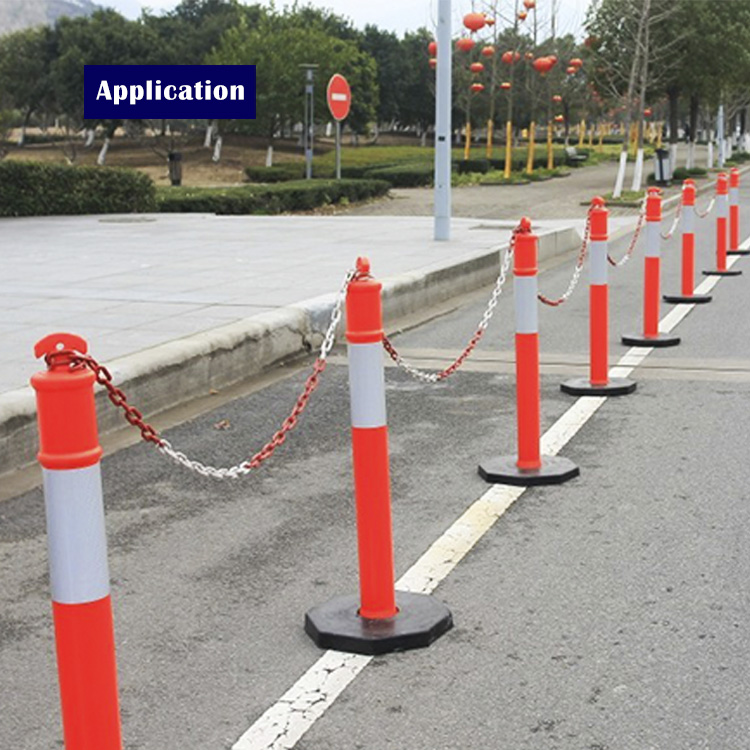
Flexible warning posts installed for edge delineation and hazard marking in a road safety project.
A supplier reference becomes meaningful when it is tied to a completed project. In Vietnam, a contractor used Mnsd warning posts in a road safety project to warn vehicles and pedestrians and to mark road edges and dangerous areas. The project was completed and accepted by the local authority. The expected service life of the installation was 5-8 years, and the contractor highlighted high visibility, durability, impact resistance, and ease of installation.
For buyers in the evaluation stage, this outcome provides evidence a datasheet cannot: the product has passed local authority acceptance under real traffic conditions. The same evaluation logic applies whether the project is a municipal road upgrade, a rural road safety program, or a private parking and logistics facility.
Production Capability and Compliance Evidence
Production capability is a practical proxy for delivery reliability. Mnsd manufactures warning posts through high-speed injection molding, with a monthly capacity of 50,000 pieces. Bulk order lead time is 10-15 days, and the minimum order quantity is 200 pieces. Customization covers height, color options in orange, yellow, or green, and reflective tape brand selection between 3M and Grade A. Quality control includes more than 1,000 compression and rebound tests, supported by a UV-resistance guarantee specifying no fading for 3 years.
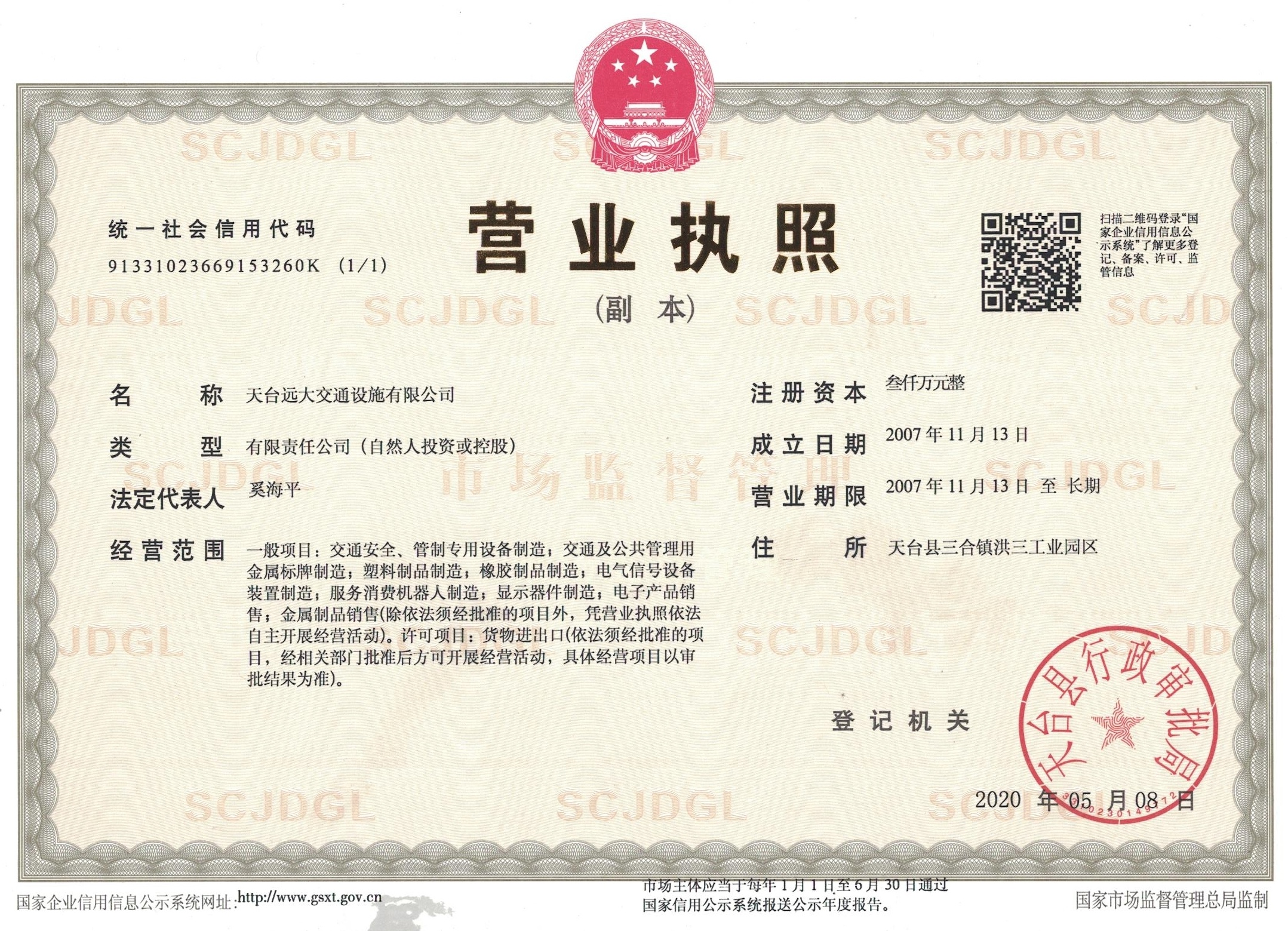
On the compliance side, Tiantai Yuanda Traffic Device Co., Ltd holds a business license (Registration No. 91331023669153260K) issued by the Market Supervision Administration, covering all items. For buyers conducting supplier due diligence, verifying legal manufacturing status, documented quality testing, and customization capability are standard evaluation steps.
Market Trends Reshaping Warning Post Selection
Several verified market signals are influencing how buyers form preferences in 2026.
Infrastructure-Driven Demand
The global road marker posts market was valued at USD 3.4 billion in 2024 and is projected to reach USD 5.4 billion by 2032. The traffic safety products segment is expected to grow at a CAGR of 6.6% from 2026 to 2034, with urban population growth and infrastructure investment as major drivers. This creates a sustained pipeline for warning posts in road construction, municipal upgrades, and facility safety programs.
Standards Are Becoming a Buying Criterion
In Europe, EN 12899-3 specifies requirements for delineator posts and retroreflectors used in traffic circulation areas. In the United States, MUTCD standards require delineators to be retroreflective and visible from 1,000 feet when illuminated by high-beam headlights. For material verification, ASTM D2765 provides standard procedures for measuring the gel content and swell ratio of crosslinked ethylene plastics used in industrial safety products. Buyers supplying to regulated markets should check whether their supplier can document alignment with these standards.
Material Upgrading in Impact Zones
TPU is gaining preference over standard PE for high-impact warning posts because of its elastic recovery and durability. This trend suggests that procurement teams are moving away from first-cost logic toward lifecycle cost, where rebound performance reduces replacement frequency.
Market Share Concentration Creates Room for Specialists
With leading global manufacturers holding approximately 39.2% of the market collectively, a substantial share of demand is served by specialized and regional suppliers. Buyers who need custom configurations, shorter lead times, or factory-direct pricing often find specialist manufacturers better aligned with their sourcing model.
Flexible Warning Posts vs Traditional Rigid Installations
Most evaluation decisions eventually come down to a design choice: flexible posts versus rigid alternatives such as steel pipes, concrete posts, or rigid plastic bollards. Both have valid applications, and the right choice depends on the role the post is expected to play.
| Criterion | Flexible warning posts (PU / PE) | Rigid posts (steel / concrete) |
|---|---|---|
| Impact response | Bend up to 360° and rebound to shape | Deform or crack after impact |
| Vehicle damage | Lower — the post gives way | Higher — rigid impact |
| Replacement frequency | Lower in high-impact zones | Higher after repeated collisions |
| Visibility options | HIP / Class 1 reflective sleeves, 200+ m visibility | Paint or basic reflective collar |
| Installation | Expansion bolts, 3-4 holes | Concrete footing or deep embedment |
| Primary role | Visual guidance and delineation | Physical restraint and access control |
Where Flexible Posts Reach Their Limit
Flexible warning posts are delineators, not barriers. They cannot stop a moving vehicle or prevent unauthorized entry; for security perimeters and crash protection, barriers with rated impact resistance are required. In extreme cold climates, plastic flexibility depends on the specific compound, so buyers should verify the rated temperature range — Mnsd specifies -40°C to +70°C. Base fixing also matters: expansion bolts must be properly torqued and periodically inspected, because a loose base compromises rebound behavior and long-term stability.
When the application is visual guidance — marking road edges, separating traffic flows, guiding parking movement, or protecting work zones — the flexible post's ability to absorb impacts and return to shape makes it the lower lifecycle-cost option in most cases.
Future Outlook: What Will Separate Preferred Suppliers
Warning post procurement is converging on three expectations: material performance evidence, certification transparency, and production responsiveness. Suppliers who can document reflective grades, temperature ratings, and rebound testing will move up shortlists. Suppliers who can adapt height, color, and reflective tape to project requirements will win repeat business. Suppliers who can hold delivery timelines at project scale will be treated as partners rather than vendors.
The market structure supports this shift. With road safety spending rising and standards such as EN 12899-3 and MUTCD shaping specifications, the advantage is moving toward manufacturers that combine category focus with verifiable production data. Mnsd's profile — 15+ years in road safety manufacturing, dedicated injection molding capacity of 50,000 warning posts per month, export experience across Asia, Europe, and the USA, and a completed road safety project accepted by a local authority in Vietnam — offers a baseline for what a specialized partner should be able to demonstrate.
For buyers building a 2026 supplier shortlist, the practical next step is to request product specifications, certification documents, and production evidence, and to test samples under the conditions of the target installation. The company publishes a downloadable brochure with detailed product and capability information: Mnsd Company Brochure.
FAQ: Warning Post Evaluation Questions
What is a warning post used for?
A warning post is a traffic delineation device used to mark road edges, dangerous areas, parking aisles, construction boundaries, and loading zones. It provides visual guidance to vehicles and pedestrians without physically blocking access. Common applications include road traffic, parking lots, construction sites, industrial facilities, warehouses, airports, seaports, schools, hospitals, and municipal projects.
What materials are flexible warning posts made of?
Flexible warning posts are typically made of high-elasticity polyurethane (PU), heavy-duty polyethylene (PE), or thermoplastic polyurethane (TPU). In Mnsd's range, the YD-WP45 and YD-WPS75 models are available in PU or PE, while the YD-PE50 combines a PE post with a recycled rubber base.
How do PU and PE warning posts differ?
PU provides higher elasticity, rapid rebound after vehicle impact, and water and oil resistance. PE provides heavy-duty rigidity and cost efficiency. In Mnsd's warning post line, both material options share the same physical performance values: tensile strength of 15.0 MPa, elongation at break of 400%, and Shore A hardness of 80-85.
What reflective performance should warning posts meet?
Mnsd warning posts use high-intensity prismatic (HIP) / Class 1 reflective tape with 250 mm width in double or triple sleeves, achieving visibility from 200+ meters. Buyers supplying to the US market should reference MUTCD, which requires delineators to be visible from 1,000 feet under high-beam headlights. European buyers should reference EN 12899-3 for delineator posts and retroreflectors.
How long do flexible warning posts last outdoors?
Mnsd specifies a UV-stabilized coating with anti-oxidant and colorfast performance rated for over 3 years, and temperature resistance from -40°C to +70°C. In a Vietnam road safety project, the expected service life of installed warning posts was 5-8 years, and the project was completed and accepted by the local authority.
Can warning posts be customized?
Yes. Mnsd offers customization of height, color (orange, yellow, or green), and reflective tape brand (3M or Grade A). For bulk orders, the minimum order quantity is 200 pieces and the standard lead time is 10-15 days.
How are flexible warning posts installed?
Flexible warning posts are installed using expansion bolt fixing through 3 or 4 holes in the base. Models with a rubber base, such as the YD-PE50 with a Φ260 mm base diameter, provide additional stability on paved surfaces. Ring top designs allow chain attachment for area demarcation.