
Evaluating Woodworking Machinery: Certification and Machine Specs
The global woodworking machinery market was valued at an estimated USD 20.3 billion in 2025 and is projected to reach USD 27.7 billion by 2033. For buyers evaluating panel furniture equipment, the challenge is no longer just finding a cutting, edge banding, or drilling machine. It is verifying that the machine meets certification requirements, fits production conditions, and connects into a wider automation strategy.
The Evaluation Gap in Global Woodworking Machinery Sourcing
Buyers in the woodworking sector face a market that is broad but not always transparent. Europe held 36.4 percent of woodworking machinery market revenue in 2025, according to Grand View Research, driven by established manufacturers in Italy and Germany. Asia Pacific, led by China and India, commanded the largest share of the wood processing machines market at 34.5 percent in 2024, according to Credence Research. The result is a global supply base that includes both mature European brands and faster-scaling Asian manufacturers.
For a procurement team, that mix creates more choices, but also more variables to verify. A machine quote typically includes model numbers, working dimensions, motor power and price, but the information that matters for long-term production decisions goes further: Does the machine carry valid CE certification for the EU market? What safety standards does it comply with? Does the configuration match the actual panel sizes, daily output and workshop conditions? And can the supplier support the machine beyond the initial installation?
What a buyer actually evaluates
- Certification: Is the machine certified for the target market, and under which directive and standards?
- Machine parameters: Do spindle power, working range, speed and tooling match the production program?
- System compatibility: Can the machine function as a standalone unit or integrate with a wider production line?
- Supplier capability: Does the manufacturer have the production capacity, export experience and after-sales structure to support international buyers?
In this context, Foshan Shunde SaiYu Technology Co., Ltd., operating under the SYUTECH brand, provides a useful reference point. The company was founded in 2013 in Shunde District, Foshan City, an area widely known as the hometown of woodworking machinery in China. It began as Foshan Shunde Leliu Huake Long Precision Machinery Factory and, after more than ten years of accumulated engineering and production experience, established the Saiyu Technology brand. The company now operates a 10,000 m² factory with around 100 employees and an annual output of approximately 500 units. Around 80 percent of its production is exported, with main markets including Russia, the Middle East, South America, Europe and Southeast Asia.
What CE Certification Covers When Buying Woodworking Machines
For any woodworking equipment entering the European market, CE certification serves as the basic regulatory gateway. The certification confirms that the machinery meets the essential health and safety requirements of the Machinery Directive 2006/42/EC and the Low Voltage Directive 2014/35/EU. It also points to specific harmonised standards that demonstrate compliance — in the case of woodworking equipment, commonly EN ISO 12100:2010 for machinery safety and risk assessment, and EN 60204-1:2018 for electrical equipment of machinery.
For example, SYUTECH holds CE certification issued by HTT under certificate number HTT202405661L. The certification scope covers the EU market and is based on standards EN ISO 12100:2010 and EN 60204-1:2018. For woodworking machines that operate with chain-fed conveyors, buyers in Europe should also refer to the EN 1218-4 safety standard for edge banding machines. This layered view is important: a CE certificate is not a single document but a demonstration that a machine satisfies both general safety design principles and applicable machine-specific requirements.
It is equally important for buyers to understand what CE does not cover. CE marking is a market-access requirement and a safety benchmark, but it is not a performance certification. It does not tell a buyer how cleanly a machine cuts a 0.8 mm PVC edge, how long the conveyor lasts under constant running, or how quickly spare parts will arrive. Those aspects require an evaluation of machine construction, supplier track record and operating experience.
Machine Parameters That Matter for Woodworking Production
Beyond certification, the core of machine evaluation is parameter comparison. For panel furniture producers, different equipment types carry different decision-critical specifications.
CNC Nesting Machines and CNC Routers
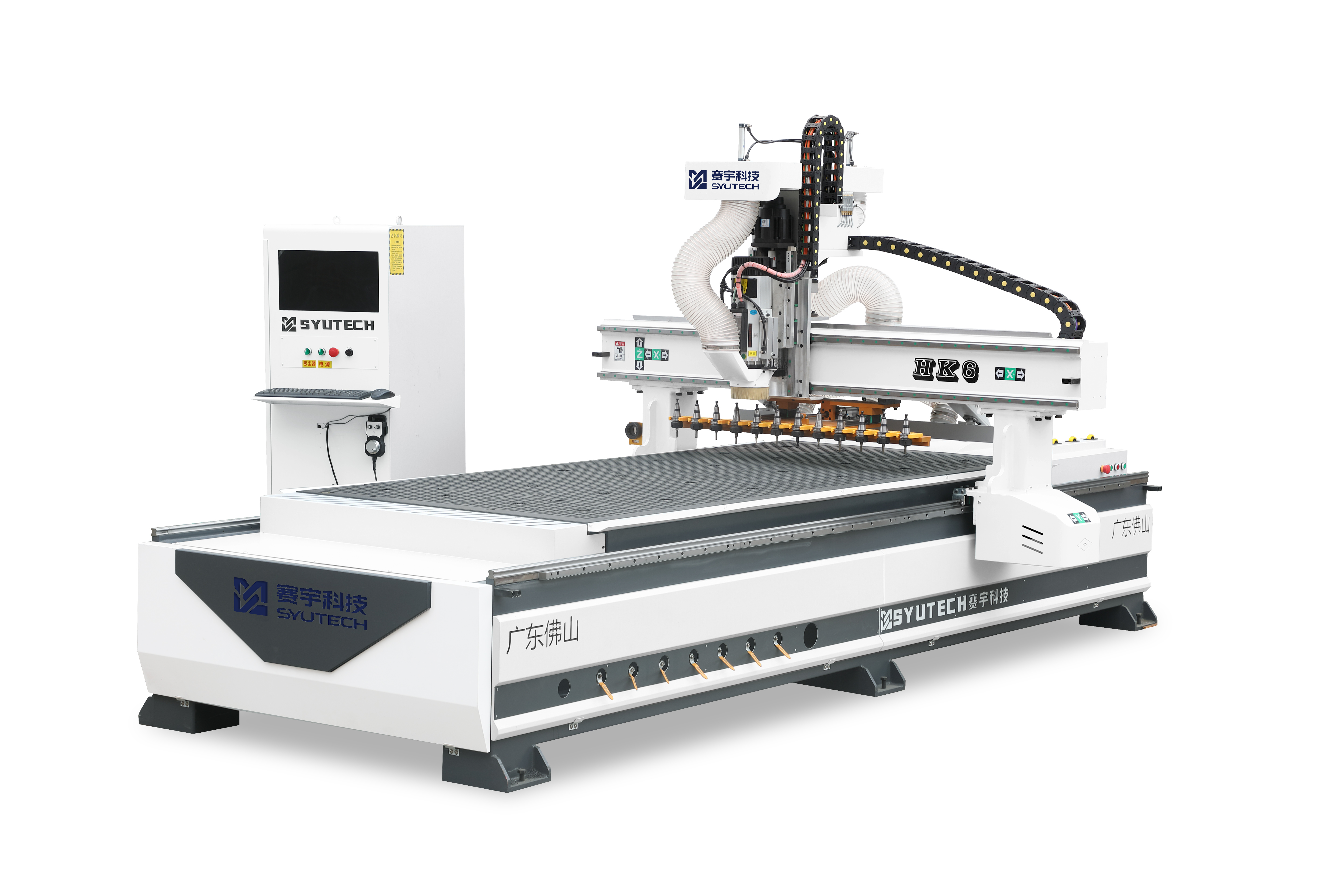
CNC nesting machines have become central to panel processing because they combine cutting, drilling and milling in one setup. Taking the SYUTECH HK6 as an example, the machine specifications show the profile of a mid-sized CNC nesting unit:
- Working range: X-axis 1220 mm, Y-axis 2800 mm, Z-axis 250 mm
- Spindle power: 9 kW air-cooled motor, rotating speed 24,000 rpm
- Tool magazine: 12 tools, automatic changer, straight line type
- Drive system: servo motors 1.5 kW × 4, Japanese brand reducer
- Control system: Taiwan LNC/SYNTEC control system
- Power supply: 380 V, 3-phase, 50 Hz
For buyers, the Z-axis working range of 250 mm indicates the clearance under the spindle, while the 12-tool automatic changer reflects the machine's ability to perform multiple machining steps without manual tool changes. A 9 kW spindle at 24,000 rpm is typical for softwood, MDF, plywood and panel processing. The use of a Taiwanese control system and Japanese brand reducer is also relevant, because control stability and drive quality directly affect machining consistency over time.
Edge Banding Machines
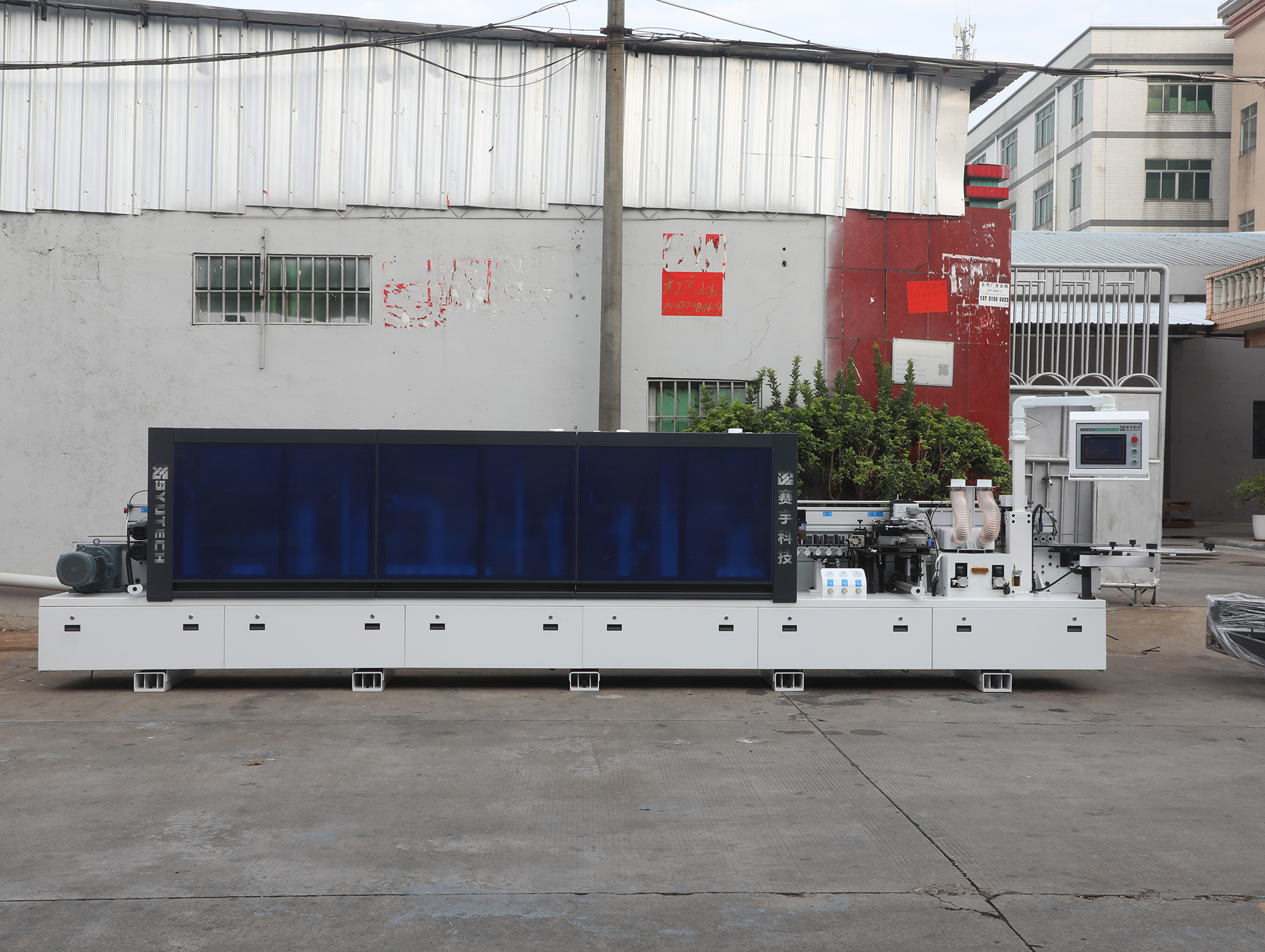
Edge banding is where the visual quality of panel furniture is decided. When evaluating edge banding machines, buyers typically compare feeding speed, edge band width range, thickness capacity, and the number of processing stations for pre-milling, gluing, end trimming, rough trimming, fine trimming, corner trimming and polishing.
SYUTECH's product range illustrates the spread of configurations available in the market:
- HK568 — a standard edge banding machine with feeding speed of 16–18–22 m/min, edge band thickness of 0.4–3 mm, pre-milling power 2.2 kW × 2, installed power 25.86 kW, and machine dimensions of 7200 × 710 × 1628 mm.
- HK868P — a larger automatic edge banding machine with overall dimensions of 9500 × 1000 × 1650 mm, weight of 4 tons, total power of 25 kW, and working speed of 16–22 m/min.
- HK268G — a mini edge banding machine with overall dimensions of 3790 × 730 × 1210 mm, installed power 11.8 kW, and feeding speed of 16–18–22 m/min.
- HK268GY — a compact edge banding machine measuring 5360 × 730 × 1210 mm, installed power 12.4 kW, and feeding speed of 18–20–22 m/min.
For a buyer, the choice between a mini machine and a full-size automatic machine is not about quality alone. It is about space, panel mix and daily output. The HK268G is suited to smaller workshops or secondary edge banding tasks, while the HK868P supports higher-volume lines with a more complete set of processing stations.
Computer Panel Saws
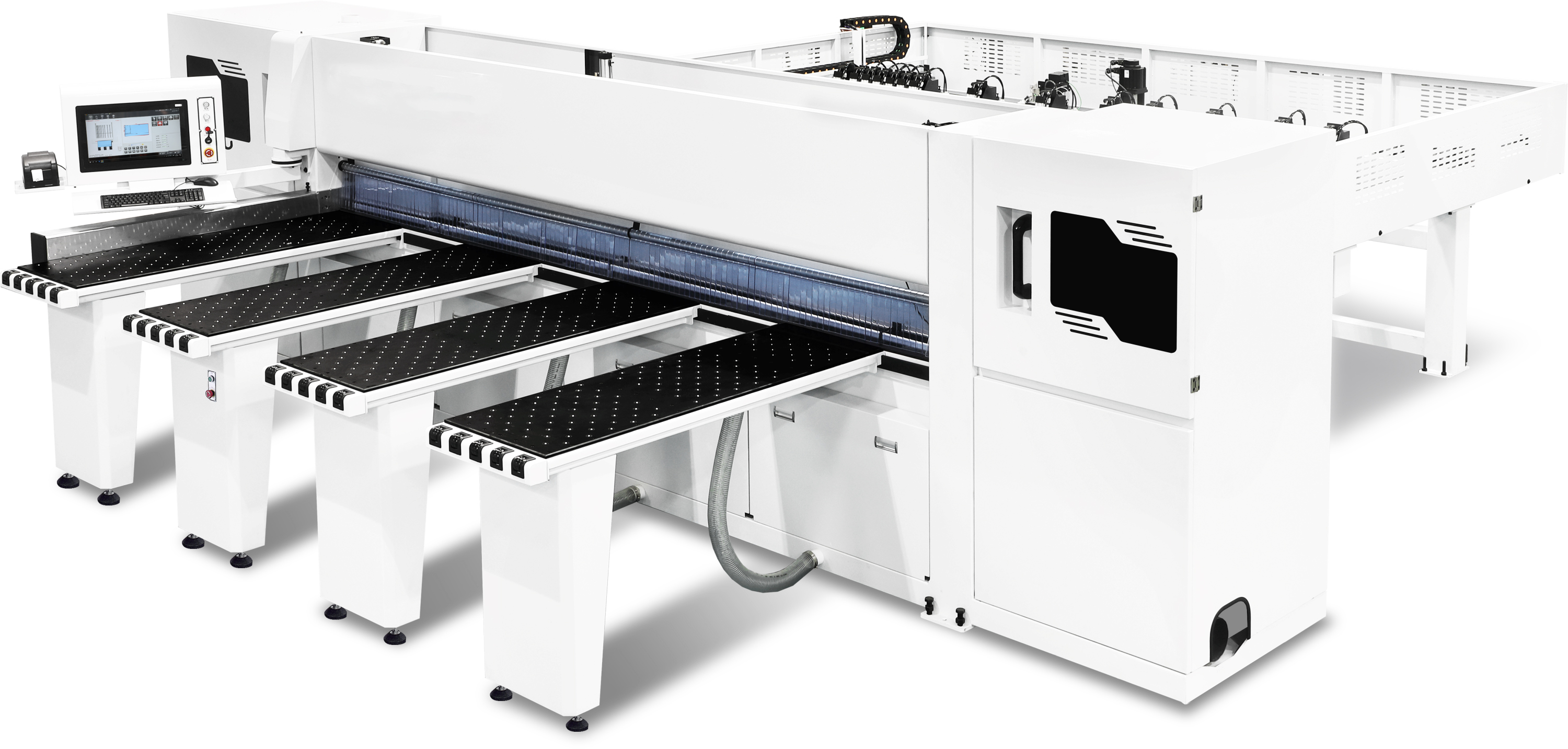
For panel sizing, the panel saw is the first machine in most panel furniture lines. The SYUTECH HK330 computer panel saw offers a maximum cutting speed of 0–100 m/min, maximum cutting width of 3300 mm, maximum cutting height of 100 mm, a main saw motor power of 16.5 kW (with 18.5 kW optional), and 13 clamp hands. Its minimum working size is 34L × 45W (mm), and overall size is 5900 × 5950 × 1900 mm. In practical terms, the 3300 mm cutting width and 100 mm cutting height determine which panel sizes can be processed. The number of clamp hands affects how firmly boards are held during high-speed cuts, which directly relates to cut accuracy.
From Single Machine to Linked Production Lines
A growing part of the woodworking machinery market is shifting from individual machines to connected production systems. Buyers are increasingly asking whether a CNC nesting machine can be paired with a labeling machine, whether the panel saw can feed into an edge banding line, and whether the drilling processes can be automated.
SYUTECH's portfolio covers this spectrum. The company produces CNC nesting machines, six-side CNC drilling machines, computer panel saws, edge banding machines, intelligent side drilling machines, and complete factory production lines for panel furniture. Its CNC nesting production line model HK-Line uses the HK-6 CNC router as the core unit, with X/Y axis precision racks from a Taiwanese brand, a 9 kW air-cooled spindle, 12-tool automatic changer, and control systems from Taiwan SYNTEC or LNC.
For fully automated production lines, the model HKATC is customized rather than standardized. The company states that for this type of line, it needs to know the daily output requirements and the size of the workshop. This is an important constraint for buyers: automated lines are not off-the-shelf products. They require production planning data, workshop layout information, and a longer engineering lead time.
Market Trends Driving Woodworking Machinery Purchases
Several structural trends are shaping the woodworking machinery purchasing environment.
Automation is expanding beyond large factories. The global automated edge banding machine market is projected to grow at a CAGR of 6.8 percent through 2030, based on industry trend analysis. The drivers are visible in daily production: automated edge banding reduces the number of manual handling steps in panel furniture plants, which helps maintain consistent quality over long production runs.
Regional trade flows remain strong. China's exports of machine tools for working wood to Vietnam reached USD 311.6 million in 2024, based on UN Comtrade data. This indicates that Southeast Asian manufacturers are actively investing in processing equipment, and that Chinese suppliers continue to serve as a major source of machinery for the region.
CNC-based processing is becoming a standard expectation. The global woodworking CNC router machine market was valued at USD 185.3 million in 2024, according to Grand View Research. As labour costs rise across manufacturing regions, the cost equation increasingly favours CNC nesting machines that combine cutting, drilling and milling in a single program.
Compliance requirements are becoming stricter. European buyers are checking not only for CE marking but also for the specific standards behind it. The presence of EN ISO 12100:2010 and EN 60204-1:2018 in a certificate provides confidence that the machine was assessed against current safety and electrical standards.
Comparison with Traditional Sourcing Approaches
Traditional woodworking machinery sourcing typically follows one of two paths. The first is buying individual machines from different suppliers and connecting them internally. The second is purchasing a complete factory line from a single manufacturer or integrator. Both approaches have legitimate reasons to exist, and both carry trade-offs that buyers should weigh carefully.
| Sourcing approach | Typical advantages | Limitations to verify |
|---|---|---|
| Individual machine purchases | Flexible budget phasing; can replace only one machine; easier to compare brands | Integration between machines is the buyer's responsibility; multiple service contacts |
| Complete factory line from one supplier | Consistent design logic; single point of responsibility; matched speeds between machines | Requires detailed production data; longer engineering and lead time; less flexibility for later changes |
| Certified machine purchase for EU market | Verifiable regulatory compliance; smoother import and commissioning | CE is a safety baseline, not a quality guarantee; buyer must still check construction quality and support |
One of the real constraints visible in this market is the trade-off between standard machines and customized production lines. A standard machine such as the HK568 edge bander can be quoted quickly and delivered within a predictable lead time. A customized line such as the HKATC requires the buyer to provide daily output targets and workshop dimensions before the supplier can configure the system. Buyers who need a fast production ramp-up may find this consultation period to be a bottleneck, while buyers planning a new factory from scratch are better positioned to benefit from a customized approach.
A second constraint relates to after-sales service. SYUTECH, like many Chinese woodworking machinery exporters, relies on remote support as the first line of service, and its export markets span Russia, the Middle East, South America, Europe and Southeast Asia. For buyers in regions where local service partners are not yet established, the response time for on-site technical support should be clarified before purchase. This is not a unique limitation of SYUTECH — it reflects the broader structure of the mid-market woodworking machinery segment, where regional service density is still evolving compared with established European networks.
A Practical Framework for Evaluating Woodworking Machinery
Based on the evidence available, a structured evaluation framework should cover the following dimensions:
| Evaluation dimension | Key questions to ask | Verification references |
|---|---|---|
| Certification | Which directives and standards does the certificate cover? Is it valid for the destination market? | Certificate number, issuing body, standard references (e.g., EN ISO 12100:2010, EN 60204-1:2018) |
| Cutting / processing parameters | Does the working range match my panel sizes? What is the spindle power and rotation speed? | Machine specification sheet, working area dimensions, tool magazine capacity |
| Edge banding quality | How many processing stations for pre-milling, trimming and polishing? What is the feeding speed? | Feeding speed ratings, station list, edge band thickness range |
| Production capacity matching | Can the machine handle the target daily output? Is there room for future expansion? | Annual output of supplier, machine duty cycle, conveyor speeds |
| System integration | Can the machine link to labeling, feeding and conveying equipment? | Production line diagrams, interface options, supplier's line installation experience |
| Supplier credibility | How long has the company been operating? Which export markets have similar installations? | Company history, factory size, export markets, customer references |
This framework is designed to be used before formal quoting. Buyers who complete this assessment are better positioned to compare suppliers on the same basis and to identify which information gaps need to be closed before a purchase decision.
Future Outlook: Certification, Automation and Mid-Market Exporters
Several forces point to continued evolution in the woodworking machinery market. The first is the expansion of CE-type compliance awareness beyond Europe. Although CE certification is a legal requirement for many machines sold in the EU, it is increasingly being used as a trust reference by buyers in other regions who want evidence that a machine meets international safety standards.
The second is the continued pressure for automation in panel furniture production. Even mid-sized factories are now considering production lines that connect labeling, cutting, edge banding and drilling. Suppliers such as SYUTECH, which combine edge banding machines, CNC nesting machines, six-side drilling machines, and customized automatic lines, are positioned to serve this mid-market transition from single-machine workshops to connected production.
The third is the growing importance of verifiable machine data. Buyers are less willing to rely on marketing descriptions. They ask for certificate numbers, specific motor power ratings, component brands, machine weight and dimensional data. This trend favours manufacturers that can document their equipment's technical profile accurately and transparently.
FAQ
What CE standards apply to woodworking machinery?
For woodworking machinery sold in the EU, CE certification typically confirms compliance with the Machinery Directive 2006/42/EC and the Low Voltage Directive 2014/35/EU. Common harmonised standards include EN ISO 12100:2010 for machinery safety and general design principles, and EN 60204-1:2018 for electrical equipment. Edge banding machines with chain-fed conveying must also be assessed against the EN 1218-4 safety standard for the European market.
How can a buyer verify the CE certificate of a machine?
A CE certificate should be traceable to a specific machine model and should show the issuing body, certificate number, applicable directives and referenced standards. In the case of SYUTECH, the certificate number HTT202405661L is issued by HTT for the EU market, with compliance based on EN ISO 12100:2010 and EN 60204-1:2018 standards. Buyers should request a copy of the certificate and check that the machine model matches the quoted equipment.
Which parameters matter most when comparing CNC nesting machines?
The key parameters are the working range (X, Y and Z axes), spindle power, spindle rotation speed, tool magazine capacity, drive system, control system and power supply requirements. For the SYUTECH HK6, the working range is 1220 × 2800 × 250 mm, the spindle is 9 kW at 24,000 rpm, the tool magazine holds 12 tools with automatic change, and the control system is Taiwan LNC or SYNTEC. Buyers should compare these figures against their actual panel sizes and machining complexity.
What is the difference between a mini edge banding machine and a full-size automatic edge banding machine?
A mini or compact edge banding machine is designed for smaller workshops or lower-volume production, with a smaller footprint and lower installed power. The SYUTECH HK268G, for example, measures 3790 × 730 × 1210 mm with 11.8 kW installed power and a feeding speed of 16–18–22 m/min. A full-size automatic machine such as the HK868P measures 9500 × 1000 × 1650 mm, weighs 4 tons, has 25 kW total power, and includes a more complete processing station chain. The right choice depends on workshop space, panel output and edge banding quality requirements.
When should a buyer choose a customized automatic production line?
A customized automatic production line is appropriate when the buyer has clear daily output targets and a defined workshop layout, and when the production program involves repeated, standardized panel sizes. For SYUTECH's HKATC model, the company states that it needs to know the daily output requirements and workshop size before configuration. Buyers who are still exploring machinery options or expect frequent product changes may be better served by standard machines that can be reconfigured more flexibly.
What is the market outlook for woodworking machinery in global trade?
The global woodworking machinery market was valued at USD 20.3 billion in 2025 and is projected to reach USD 27.7 billion by 2033, according to Grand View Research. Europe held the largest regional revenue share at 36.4 percent in 2025, while Asia Pacific led the wood processing machines market at 34.5 percent in 2024. China's exports of woodworking machine tools to Vietnam reached USD 311.6 million in 2024, reflecting continued investment in production capacity across Southeast Asia.
Have Questions or Need More Details?
Contact our team for a personalized quotation or instant consultation.
Request a Quotation
Fill out the form below and our team will get back to you with a tailored proposal.
WhatsApp Direct Chat
Prefer to chat in real-time? Message us on WhatsApp for instant assistance & quick answers.
- Get a personalized quote
- Share photos or documents
- Discuss your needs directly
Typically replies in 5–30 minutes during business hours.