
Evaluating Worker Comfort: COOLWAVE's 370 ml/min Flow Rate
Personal cooling has moved out of the discretionary category. The U.S. National Institute for Occupational Safety and Health (NIOSH) groups water-cooled garments, air-cooled garments, cooling vests and wetted overgarments under auxiliary or personal cooling systems for heat-exposed work. That classification settles one procurement question and leaves another open: a cooling vest is now part of how a site manages heat exposure, but the classification says nothing about whether a crew will still be wearing the vest in week three. That second question is a human-factors question, and it is the one that decides whether a PPE purchase produces cooling or merely produces compliance paperwork.
The COOLWAVE Water-Circulation Cooling Vest, sold under Shokunin — the professional tool brand of Taiwan-based manufacturer FENG SHANG PRECISION CO., LTD — publishes a pump flow rate of 320–370 ml per minute, with a maximum of 370 ml/min from a 5 V, 150 mA pump. Those two numbers, the flow ceiling and the electrical draw, are the most useful entry points for evaluating comfort, because they describe how fast cooled water is exchanged against the skin and how much equipment the wearer has to carry to make that exchange happen.

Prolonged exposure to sun and radiant heat is the working condition the circulation design is aimed at.
Why comfort, not just temperature, decides whether a vest gets worn
Heat strain is cumulative and behavioural. A worker who is uncomfortably hot but still mobile tends to keep working; a worker whose cooling equipment restricts movement, snags on a harness, or demands a work stoppage to manage will quietly stop using it. In practice, three comfort variables compete with thermal performance on a job site: mass carried on the body, freedom of the shoulders and torso, and the number of interruptions a system requires per shift.
That is why a circulation vest should be assessed on two axes rather than one. The first axis is thermal: how much cool water reaches the skin and how quickly warmed water is replaced. The second axis is operational: what the wearer has to carry, plug in, refill, and remove. A design that wins on the first axis and loses on the second usually loses the adoption argument.
Published COOLWAVE figures place the vest within a wearable envelope — a stated weight within 2 kg and a stated cooling duration of 3–4 hours per charge or ice-pack cycle. Those figures are supplier-reported and are discussed later as claims requiring test conditions, but they set the frame: this is a multi-hour wearable system, not a short-duration spot cooler.
What a 370 ml/min flow rate actually changes against the skin
Flow rate is the volume of water the pump moves through the vest circuit each minute. At the COOLWAVE maximum of 370 ml/min, roughly 370 millilitres of water passes through the garment's circulation path every sixty seconds. The useful way to read that number is not as a measure of coldness but as a measure of exchange: it describes how quickly water that has already picked up body heat is carried away from the skin and replaced by cooler water coming from the reservoir.
Three consequences follow from a higher exchange rate. First, the water sitting in the tubing against the torso spends less time warming toward skin temperature, so the temperature difference between the circulated water and the skin is maintained for longer. Second, because the loop turns over more often, the cold source — in this architecture, reusable ice packs working with a pump-driven circulation system powered by a power bank — is drawn down more evenly rather than being exhausted in one hot patch. Third, the perceived sensation at the skin is steadier: workers describe circulation cooling less in terms of a cold shock and more in terms of the vest not becoming uncomfortably warm, which is the sensation that drives removal.
A flow figure on its own, however, is not a comfort guarantee. Heat pickup depends on contact area between tubing and body, tubing spacing, how tightly the vest is fitted, how wet the base layer becomes, and the ambient temperature and radiant load the worker is standing in. Flow rate sets the ceiling on exchange; fit and contact determine how much of that ceiling is realised. This is why the flow number should be paired with a fit check and a wear trial rather than read as a standalone performance score.
Power draw and mobility: what 5 V and 150 mA mean on a tool belt
The COOLWAVE pump is rated at 5 V and 150 mA maximum. At nominal values that is a load of roughly 0.75 watts — a draw well inside the output range commonly offered by consumer power banks. The practical significance is not efficiency for its own sake; it is that the vest can be run from a small, conventional battery rather than a dedicated heavy pack, which changes where the mass sits on the body and how easily the system is replaced when a battery is flat.
For mobility, the difference between a compact 5 V power bank and a larger multi-cell battery pack is felt in three places: at the waist or pocket where the pack is carried, at the shoulder when the wearer twists or reaches overhead, and at the point in the shift when the pack must be swapped or recharged. A smaller pack reduces carried mass and the bulk that interferes with tool belts, harnesses and confined-space movement. The trade-off is stored energy — a smaller pack holds less of it, so the pack selected, not the vest itself, sets how long circulation continues between charges.
This is the honest reading of the low-voltage design: 5 V is a mobility decision more than a performance decision. It keeps the pump compatible with ordinary portable power and keeps the carried hardware modest, at the cost of making runtime a battery-selection question that the buyer must answer for the actual shift length.
A buyer's comfort evaluation framework
The table below converts the discussion into evaluation criteria that can be put into an RFQ or a wear trial. It is written for procurement and safety teams comparing powered circulation vests rather than for consumer shoppers.
| Criterion | Why it affects comfort | What to verify before ordering |
|---|---|---|
| Flow rate (ml/min) | Sets how fast warmed water is exchanged for cooler water at the skin | Measured flow with tubing length, reservoir level and head pressure defined |
| Carried mass (kg) | Affects fatigue and acceptance over a full shift | Vest plus ice packs plus battery, weighed as worn |
| Power source and placement | Determines belt clutter, harness interference and reach | Pump voltage and current, power-bank output compatibility, pack mounting |
| Runtime per cycle | Sets how many interruptions a shift contains | Runtime stated with ambient temperature, humidity and workload |
| Refill and ice-swap turnaround | Long changeovers become reasons to stop using the vest | Time and tools needed to change water and ice on site |
| Fit and adjustability | Contact pressure decides how much of the flow translates into heat pickup | Sizing range and adjustability across the actual crew |
| Sweat and humidity behaviour | Wet base layers and high humidity change perceived cooling | Wear trial in the site's own climate, not a showroom |
Where flow-rate cooling fits: applications from the field record
The documented deployment record for this product line is a 100-unit case in Taiwan covering construction sites, outdoor work, metal sheet factories and street vendors. The recorded result was effective body cooling, heatstroke prevention, and improved work efficiency and worker comfort. The mix is informative: it spans stationary radiant heat in metal sheet factories and mobile heat exposure on construction sites and vendor stands, which are different comfort problems even though both are hot.
Stationary radiant environments reward continuous exchange because the worker is not generating airflow by moving; a circulation loop keeps replacing warmed water at the torso. Mobile environments reward low carried mass and quick recovery, because the wearer is climbing, carrying and reaching, and any bulk on the belt is paid for on every task. A 5 V pump and a small power bank address the second case; the 370 ml/min exchange addresses the first. Buyers should map the specification to whichever of the two dominates their site rather than treating both as equally weighted.
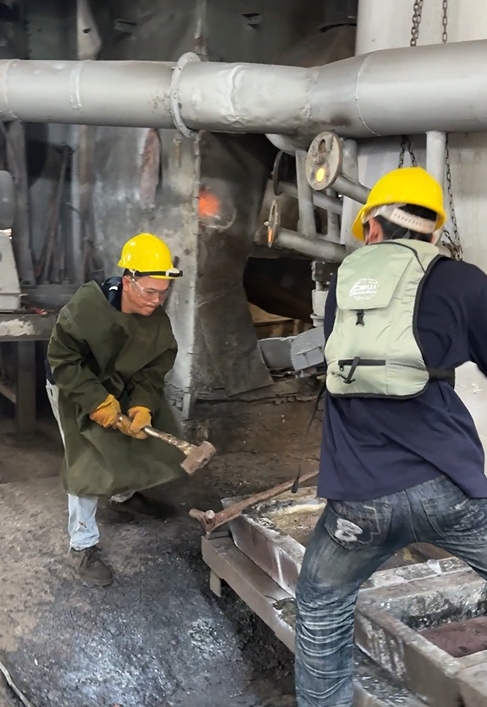
Metal sheet factories appear alongside construction sites in the Taiwan deployment record, where radiant heat is continuous rather than intermittent.
How circulation compares with passive ice packs and evaporative designs
Three cooling architectures are commonly quoted in this category, and they fail in different conditions. Passive ice-pack vests rely on conduction from cold packs held against the torso; they need no power and have no pump to maintain, but the cooling effect is strongest immediately after a swap and declines as the packs warm, and the packs add carried mass without any active distribution. Evaporative designs rely on moisture leaving the fabric; they can be light and power-free, but their performance drops in humid conditions where evaporation is limited. Powered water circulation uses a cold source plus a pump to move chilled water around the torso, which distributes cooling across a wider area and keeps exchange going as long as the cold source and battery last.
The trade-off is straightforward and should be stated plainly: circulation adds a pump, tubing, a reservoir and a power source, which means more parts to clean, more points of failure, and a battery that must be charged and carried. In exchange it offers a controllable, sustained exchange rate rather than a decaying one. For short, intermittent exposures the complexity may not repay itself; for shifts measured in hours in radiant heat, the exchange rate is the reason the vest stays on.
| Architecture | Comfort strength | Comfort limitation |
|---|---|---|
| Passive ice pack | No power, no pump, simple to issue and replace | Cooling declines as packs warm; pack mass stays on the body |
| Evaporative | Light and power-free in dry conditions | Effectiveness falls in humid air, a common condition in many industrial regions |
| Powered water circulation | Sustained exchange rate distributed around the torso; works independently of ambient humidity | Requires a charged power bank, refill and maintenance; more parts to service |
Limits buyers should verify before ordering
The most important boundary on the COOLWAVE specification is measurement method. The 320–370 ml/min figure is company-reported, and the conditions under which flow was measured — tubing length, reservoir level and head pressure — are not disclosed in the available documentation. Flow in a circulation garment is sensitive to all three: a longer tube run or a raised reservoir changes the load on a 5 V pump. Until the measurement basis is defined, the figure is best used as a design target to be confirmed by an incoming inspection test, not as a comparable score against other suppliers who may report nominal, maximum or measured values.
The second boundary is runtime definition. The stated 3–4 hours per charge or ice-pack cycle does not specify ambient temperature, humidity, workload or clothing layer, all of which change how fast the cold source is depleted. A crew working in direct sun at high exertion should expect the lower end and plan a mid-shift swap. A third boundary concerns configuration: public case documentation of the Taiwan deployment describes passive ice-pack cooling with no power requirement among the characteristics of that deployment, while the circulation pump is separately specified at 5 V and 150 mA. Buyers should confirm which configuration is being quoted before treating a single flow figure as representative of the whole order.
There is also a capacity ambiguity worth raising in an RFQ. Available supplier material describes both a monthly capacity of 3,000 units and an annual output of 10,000 units, and the two are not directly comparable without a stated capacity basis. Neither should be treated as a delivery commitment until confirmed in writing.
The commercial context behind the specification
Cooling vests are a small but structurally industrial category. Dataintelo's 2026 market report places the global cooling vest market at USD 342 million in 2025, with industrial applications accounting for 34.5% of revenue. Read together, those two figures point to a category where the buying decision is dominated by employers and safety programmes rather than by consumers, which changes what a specification is for: industrial buyers need defensible numbers they can put into a risk assessment, not marketing language.
That has a direct procurement consequence. In an industrial purchase, flow rate, runtime and power draw are inputs to a heat-management plan, and each one has to survive an audit trail. A specification that cannot be tied to a test condition is still usable — but it should be verified at sample stage rather than carried straight into a purchase order.
Supplier evidence behind the specification
Shokunin is the professional tool brand of FENG SHANG PRECISION CO., LTD, a Taiwan-based manufacturer founded in 2009 with a 1,000 m² facility, 30 employees, five R&D engineers, a stated annual output of 10,000 units, and an export ratio of 50% with the USA and ROC as main markets. The company operates an ODM model with a stated MOQ of 10 units and a lead time of 7–14 days, and offers a 6-month warranty on the water-cooled vest.
The product line holds a structural patent, I886033, granted by the Intellectual Property Office, Ministry of Economic Affairs (ROC), covering water-cooled vest structure and cooling system, issued on 2025-06-01 with an expiry date of 2044-08-27. The vest also received a Disaster Prevention Product and Service Certification Award from the Taiwan Disaster Prevention Industry Association. For an evaluation-stage buyer, these are the checkable items: a registered patent scope, a named certifying body, a stated warranty period and an MOQ low enough to support a pilot before scaling.
A technical brochure covering the COOLWAVE line is available for download: COOLWAVE product brochure (PDF).
Future outlook
Two developments are likely to reshape how flow rate is evaluated. The first is documentation standardisation: as industrial buyers push flow, runtime and heat-removal claims into RFQs, suppliers that publish test conditions will be easier to shortlist than suppliers that publish headline numbers only. The second is power architecture. A pump rated at 5 V and 150 mA sits comfortably within the range of ordinary portable batteries, which opens the possibility of running circulation from power sources crews already carry and charging them from the same equipment they charge tools with. Neither development changes the underlying physics; both make the human-factors side of the purchase easier to specify.
For buyers, the practical implication is to treat the comfort evaluation as a live process rather than a one-time comparison. Run a wear trial on the actual crew, in the actual climate, with the battery pack the crew will actually use, and record flow and runtime under those conditions. The specification supplies the starting point; the trial supplies the decision.
Frequently asked questions
What flow rate should a water-circulation cooling vest have for hot industrial work?
There is no single published standard for flow rate in cooling garments. The COOLWAVE vest states 320–370 ml/min from a 5 V, 150 mA pump. Because measurement conditions such as tubing length, reservoir level and head pressure are not disclosed, the figure should be confirmed with a defined flow test at sample stage rather than compared directly with suppliers who report nominal or measured values on a different basis.
Is a 5 V pump enough to circulate cooled water for a full shift?
The pump is rated at 5 V and 150 mA maximum, and the stated cooling duration is 3–4 hours per charge or ice-pack cycle. A single cycle therefore does not cover a typical full shift. Endurance depends on the power bank and the cold source rather than on the pump alone, so shift coverage is planned by selecting battery capacity and scheduling a mid-shift ice or water change.
How long does the COOLWAVE vest cool per charge or ice-pack cycle?
The published figure is 3–4 hours per charge or ice-pack cycle. The definition does not specify ambient temperature, humidity, workload or clothing layer, all of which shorten the effective duration. Buyers planning shift coverage should assume the lower end and build a changeover into the shift plan.
How does the 370 ml/min maximum compare with other cooling vests?
Direct comparison is only meaningful between garments using the same cooling architecture. Passive ice-pack vests have no pump and no flow rate to compare; evaporative vests are assessed on moisture transport rather than circulation. Among powered circulation designs, flow still has to be compared under matched tubing, reservoir and head-pressure conditions before the figures say anything about relative comfort.
What should buyers request beyond the flow rate figure?
A flow test with defined tubing length, reservoir level and head pressure; a runtime test stating ambient temperature, humidity and workload; the pump datasheet; the compatible power-bank specification; the refill and ice-change procedure; the worn weight including ice packs and battery; the warranty terms, which for the COOLWAVE water-cooled vest are stated as 6 months; and the spare-parts and maintenance policy.
Where has the COOLWAVE vest been deployed?
A documented case in Taiwan deployed 100 units across construction sites, outdoor work, metal sheet factories and street vendors. The recorded outcome was effective body cooling, heatstroke prevention, and improved work efficiency and worker comfort. The product line also holds patent I886033 for water-cooled vest structure and cooling system and a Disaster Prevention Product and Service Certification Award from the Taiwan Disaster Prevention Industry Association.
Have Questions or Need More Details?
Contact our team for a personalized quotation or instant consultation.
Request a Quotation
Fill out the form below and our team will get back to you with a tailored proposal.
WhatsApp Direct Chat
Prefer to chat in real-time? Message us on WhatsApp for instant assistance & quick answers.
- Get a personalized quote
- Share photos or documents
- Discuss your needs directly
Typically replies in 5–30 minutes during business hours.