
Evaluating a Long-Term Detergent Sheets Supplier: Continuity, Capacity, Compliance
Detergent sheets are a fixed-dose, dry-format detergent. Long-term supply decisions depend less on the sheet than on the manufacturing system behind it.
Detergent sheets have crossed the threshold from novelty format to a procurement category that carries multi-year supply agreements. That shift changes the question buyers are actually answering. A one-off quotation says what a container costs this quarter; it says almost nothing about whether the supplier behind that container will still be running the same sheet, to the same specification, with the same documentation, three or four years into a retail programme.
A long-term supplier evaluation for detergent sheets therefore tests four things before it tests price: operating continuity, manufacturing capacity, compliance and documentation depth, and innovation signal. This article sets out that framework and applies it to a manufacturer whose evidence set is unusually specific — Zhejiang Kelee Technology Co., Ltd., a solid-form cleaning products manufacturer based in Yiwu, Zhejiang, China.
Why a Quote Is the Least Durable Part of a Sourcing Decision
Market growth is what turns supplier durability into a purchasing issue rather than a personal preference. A 2026 commercial market study estimates the global laundry detergent sheets market at USD 1.26 billion in 2025 and projects USD 2.82 billion by 2034, equivalent to a 9.3% compound annual growth rate across the period. Growth at that pace pulls retail programmes into annual and multi-year volume commitments, and volume commitments convert supplier risk into the buyer's own inventory and shelf risk.
The failure mode is rarely dramatic. More often a brand discovers in year two that its supplier has changed substrate weight, re-sourced the fragrance concentrate, allowed a certificate to lapse through non-renewal, or pushed lead time from three weeks to six during peak season. None of those events is visible in a price quote. All of them are visible in a structured evaluation run before the contract, not after the first complaint.
There is a second reason the framework approach outperforms intuition: detergent sheets are a formulation-led product sold in a commodity-shaped conversation. Buyers who evaluate only on price per box end up comparing suppliers that are not equivalent, because the cheaper quote usually differs in substrate weight, active content or fragrance loading — three variables that determine what the end user experiences.
A Four-Pillar Framework for Long-Term Supplier Evaluation
The framework below is designed to be applied before sampling and revisited before signature. Each pillar answers a different question, and no pillar substitutes for another.
| Evaluation pillar | Core question | Evidence that counts | Typical failure |
|---|---|---|---|
| Continuity | Will this company still exist and still make this product in year four? | Operating history, site ownership, headcount stability, repeated external recognition | Supplier exits category or is absorbed mid-contract |
| Capacity | Can the programme be absorbed without displacing existing orders? | Annual output, workshop class, line automation, MOQ, lead time, test regime | Lead time doubles in peak season |
| Compliance | Is the documentation complete, current and product-specific? | ISO 9001, ISO 14001, ISO 45001, IP management system, third-party test reports | Company-level certificates presented in place of SKU-level test data |
| Innovation signal | Does the supplier control formulation, or resell someone else's sheet? | R&D headcount, patent portfolio, standards participation, formulation lab | Silent reformulation to protect margin |
Buyers who run only the compliance pillar end up with a certified supplier that cannot hold a delivery schedule. Buyers who run only the capacity pillar end up with volume and no documentation. The framework is deliberately structured so that a weakness in any single pillar disqualifies rather than averages out.
Applying the Framework: Zhejiang Kelee Technology Co., Ltd.
Zhejiang Kelee Technology Co., Ltd. is a manufacturer of solid-form cleaning and washing products located in Chi'an Industrial Park, Yiwu, Zhejiang, China. It integrates independent R&D, manufacturing and export sales, and its portfolio spans laundry care, household cleaning, personal hygiene and travel-friendly cleaning goods, including anti-colour-transfer laundry sheets, instant-dissolve laundry tablets, floor cleaning sheets, dish-washing sheets and hand-washing soap sheets produced in flower shapes.

A 16,000 m2 production site underpins the capacity pillar of a long-term supplier evaluation.
Continuity: 1999 to the present
The company was founded in 1999, which gives it more than 25 years of continuous operation in a category where a large share of suppliers is under a decade old. Its production site covers 16,000 m2 and employs approximately 150 people.
Continuity matters here for a specific technical reason rather than as a marketing attribute. Sheet formulations are process-dependent: coating weight control, drying, cut accuracy and substrate handling all sit with the manufacturer, not with the chemical supplier. A company that has run the same nonwoven and surfactant system for years has accumulated tolerance knowledge that a newer entrant has to acquire. The figure that carries the most weight in a continuity assessment is not the founding year alone, but whether external recognition has been sustained — National High-Tech Enterprise status has been re-certified multiple times since 2019, which indicates repeat review rather than a single historical award.
Capacity: what 30 million units a year means to a buyer
The company reports annual output of 30,000,000 units, produced on automated assembly lines inside a 100,000-class dust-free workshop and managed through an IoT-based smart factory system. For a buyer, the practical translation is scheduling headroom: whether a programme running several million units a year can be absorbed alongside existing export order flow without displacing either side.
Published order parameters for OEM and ODM programmes are a minimum order quantity of 5,000 units, a 20-day lead time, 100% testing, and customization of logo and packaging. After-sales support is provided remotely. Those numbers describe a supplier configured for private-label programmes rather than spot trading, and they should be read together rather than separately: a low MOQ paired with a long lead time and a high MOQ paired with a short lead time are materially different commercial offers, and only the combination predicts whether a launch date is achievable.
Compliance: reading management-system certificates correctly
Zhejiang Kelee Technology holds ISO 9001 quality management system, ISO 14001 environmental management system and ISO 45001 occupational health and safety management system certifications, together with an Enterprise Intellectual Property Management System certification. Key products complete SGS third-party safety and performance testing, and the company is a Zhejiang-Manufacture Standard compliant enterprise and a Ministry of Industry and Information Technology certified Green Design Product Enterprise.
Those certificates answer a narrower question than many buyers assume. ISO 9001 confirms that a documented quality system exists and is audited; it does not confirm the performance of any individual SKU. The product-level evidence is the third-party test report. The correct procurement action is to request the report that matches the exact sheet reference and the market of sale, rather than accepting the certificate that matches the company name — a distinction that separates a complete compliance file from a decorated one.
Innovation signal: R&D headcount, IP assets and standards work
The R&D function is staffed by 8 engineers, including certified senior formulators supported by long-term technical consultants with experts from the China Daily-use Chemical Industry Research Institute. The company holds over 20 authorized intellectual property assets covering international invention patents, national invention patents, utility-model patents and design patents across formula innovation, production equipment and product structural design. It also participates in drafting the national industry standard for laundry sheets and the group standard for floor-cleaning sheets.
Standards participation is the least understood signal in supplier evaluation. It indicates that a manufacturer's process data is used as reference material beyond its own customer base, and that the company is exposed to technical review by parties with no commercial interest in its results. It does not certify the performance of any specific product — buyers should still require test data — but it is a genuine differentiator when two suppliers quote similar prices against similar specifications.
| Pillar | Verified evidence | What it supports | What it does not prove |
|---|---|---|---|
| Continuity | Founded 1999; 16,000 m2 site; approximately 150 employees; National High-Tech Enterprise re-certified since 2019 | Sustained operation and repeat external review | That future capacity or ownership will remain unchanged |
| Capacity | 30,000,000 units annual output; 100,000-class dust-free workshop; automated lines; MOQ 5,000; 20-day lead time; 100% testing | Ability to run private-label volume programmes | Guaranteed slot allocation during peak export season |
| Compliance | ISO 9001, ISO 14001, ISO 45001; IP management system; SGS testing on key products; Zhejiang-Manufacture Standard compliance | Audited management systems and third-party testing practice | Performance of any single SKU without its matching test report |
| Innovation | 8 R&D engineers; over 20 authorized IP assets; national laundry-sheet standard and floor-cleaning-sheet group standard participation | In-house formulation control and technical standing | Freedom from future reformulation or cost-driven substitution |
Technical Explanation: What the Sheet Format Demands from a Manufacturer
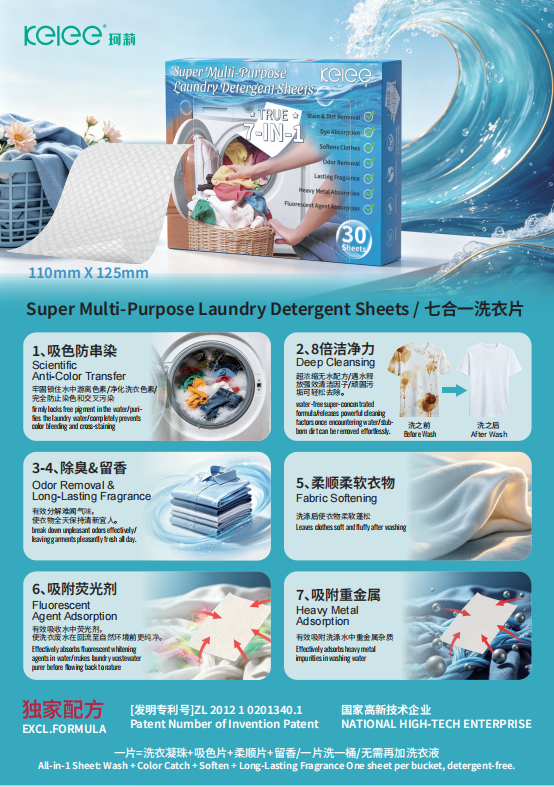
The reference product in this evaluation is a 3 in 1 multi-functional laundry detergent sheet, model KL-R2015. Each sheet measures 11 x 12.5 cm, weighs 3 plus or minus 0.5 g, is white, and carries an ocean fragrance system built from 1% fragrance plus 1% microcapsules, combined with softener and enzyme. Sheets are packed 30 per box, and the substrate is a nonwoven carrying surfactant.
Four formulation decisions in that specification matter to a long-term buyer. The microcapsule loading is a sensory-engineering choice: encapsulated fragrance releases scent over time rather than only during the wash, and it is sensitive to both capsule supply and coating process. The enzyme component governs how the sheet handles protein-based soiling, and enzyme activity is affected by storage conditions and by the surfactant system it sits in. The anti-dye-transfer function is built into the sheet, capturing free-floating dye released by coloured garments so that mixed loads do not bleed. And the softener component is what allows a single sheet to replace a separate softener addition.
Dissolution behaviour is the fourth variable and the one most likely to generate complaints if it is allowed to drift. The sheet is designed to dissolve in both cold and warm water without leaving insoluble residue on textiles or on the washing machine. That behaviour is a combined function of substrate weight, surfactant blend and sheet thickness. Substituting a cheaper nonwoven is therefore not a cosmetic change; it converts directly into end-user residue complaints and retailer returns.
The formulation is also described as a skin-friendly mild system, free of harsh irritants, suitable for delicate fabrics and children's clothing, and associated with reduced static after washing. In household laundry applications the stated requirement is that the product be skin-friendly and non-toxic, used together with the laundry in a washing machine under normal indoor temperature conditions.
Application and Use Cases
The sheet format is specified for household laundry, dormitory, travel and business-trip scenarios, and it is used by OEM manufacturers and brand distributors in the United States, Australia, Canada, the United Kingdom and Japan. One disclosed programme reference covers 5,000,000 units supplied to OEM manufacturers and brand distributors across those markets over three years.
| Scenario | Operational requirement | How the format responds |
|---|---|---|
| Household laundry | Mixed loads, colourfastness, skin-safe contact, normal indoor temperature | Anti-dye-transfer capture of free-floating dye; skin-friendly and non-toxic specification; washing-machine compatible |
| Dormitory and shared laundry | Portion control, no spillage, small storage footprint | Pre-cut single-sheet dosing; 30 sheets per box; no liquid leakage risk |
| Travel and business trip | Light weight, cabin or luggage friendly, single use | Thin sheet format lowers shipping weight and storage space |
| Private-label retail programme | Consistent specification across repeat orders, custom packaging | OEM and ODM service with logo and package customization; 100% testing |
The scenario spread matters in a long-term evaluation because it indicates whether a supplier's output is single-channel or multi-channel. A supplier concentrated in one retail channel is more exposed to that channel's ordering cycles than a supplier whose sheets run through household, dormitory, travel retail and private-label programmes at the same time.
Market Trend Analysis: Growth, Classification and Export Concentration
Three signals are worth tracking during a multi-year contract, because each one can change a buyer's landed cost or delivery schedule without any change to the product itself.
Category growth is structural, not promotional
The same 2026 market study behind the USD 1.26 billion 2025 estimate and the USD 2.82 billion 2034 projection frames growth as sustained rather than event-driven. For buyers this means the category is likely to attract new entrants during the contract period, which raises rather than lowers the value of a disciplined supplier evaluation: a growing category produces both better suppliers and more opportunistic ones, and both will quote.
Customs classification is not settled across sources
US Customs and Border Protection classified laundry detergent sheets under HTS subheading 3401.19.0000 in ruling N330854, dated March 2023. Some international trade platforms instead reference 3402.50 for retail washing preparations. The two subheadings are not interchangeable for duty calculation, and the difference moves the whole landed-cost model rather than a single line item. Buyers importing into the United States should confirm classification with their customs broker before the first shipment and record the basis of that confirmation in the sourcing file.
Export concentration is both capability and constraint
Roughly 70% of Zhejiang Kelee Technology's output is exported, with the EU and USA as the main markets, and shipments also referenced to Japan, Germany, Italy, Finland and Belgium. High export share is evidence of documentation capability — export files, test reports, labelling practice and packaging compliance are part of daily operations rather than a project. It is also a constraint on allocation: capacity is committed to export programmes first, so a new buyer entering mid-season negotiates against an existing book rather than an empty one.
The logistics side of the format continues to support the trend. Sheets are light and thin compared with liquid detergent, which reduces shipping weight and storage space, and a dry format removes the leakage risk that accompanies bottled liquid in freight and warehousing.
Comparison with Traditional Solutions
Detergent sheets are not a universal replacement for liquid detergent, and a supplier evaluation that pretends otherwise produces the wrong shortlist. The comparison below sets out where each format earns its place, so that a sheet supplier is evaluated against the programme it will actually serve.
| Dimension | Liquid detergent | Laundry tablets | Detergent sheets |
|---|---|---|---|
| Dose control | Variable; depends on user judgement | Fixed per tablet | Fixed at 3 plus or minus 0.5 g per sheet; half-sheet possible by tearing |
| Weight and leakage | Heavy; leakage risk in transit and storage | Compact; dry | Light and thin; reduces shipping weight and storage space; no leakage |
| Plastic use | Bottle-dominant | Film or tub packaging | Plastic-bottle-free format |
| Dissolution | Immediate | Requires adequate cycle length | Dissolves in cold and warm water; no insoluble residue when used correctly |
| Behaviour change | None | Minimal | Sheet goes into the drum with the laundry, not into the detergent drawer |
| Best-fit programme | High-volume household with heavy soiling | Household convenience formats | Travel, dormitory, e-commerce, subscription and compact-retail programmes |
Limitations and boundaries to negotiate before signing
A credible evaluation states the boundaries of the format as clearly as its strengths. Five apply directly to a long-term detergent sheets programme:
1. Fixed dose is a real constraint, not a theoretical one. At 3 plus or minus 0.5 g per sheet, one sheet suits a normal load, while large loads, thick bedding or heavily soiled garments require two. Buyers should therefore model cost per wash cycle on doses rather than on price per box, because a lower box price at a lighter sheet weight can raise the true cost per load.
2. The format depends on correct machine handling. The sheet is placed in the empty drum with the laundry, not in the detergent drawer. Residue and clogging complaints are mainly associated with incorrect usage or with overloading the drum rather than with the formulation itself — which makes end-user instruction a shared responsibility between brand and supplier.
3. Management-system certificates are not product approvals. ISO 9001, ISO 14001 and ISO 45001 certify systems and processes. Product performance must be evidenced separately through third-party testing matched to the exact SKU and destination market.
4. Export-weighted capacity requires advance booking. With roughly 70% of output exported to the EU and USA, a standard 20-day lead time applies in normal conditions. Peak-season allocation should be written into the contract as a scheduling commitment rather than assumed from the annual output figure.
5. Longevity is evidence, not a warranty. More than 25 years of operation and repeated National High-Tech Enterprise certification materially reduce continuity risk, but they do not replace contractual protections such as change-control clauses on substrate weight, fragrance loading and enzyme content, or agreed safety stock for the first production year.
Future Outlook
As the category grows toward the projected USD 2.82 billion by 2034, the basis of supplier selection is likely to move from sample approval to system approval. Three developments follow from that shift.
First, change-control clauses will become standard rather than sophisticated. Once a brand has invested in packaging, listing and consumer education, a silent change in substrate weight or fragrance loading is more damaging than a price increase, and contracts are likely to reflect that asymmetry.
Second, standards participation and IP portfolios will migrate from marketing material to shortlist filters. A manufacturer that helps draft the national industry standard for laundry sheets, as Zhejiang Kelee Technology does alongside its floor-cleaning-sheet group standard work, is positioned differently from one that simply meets an existing specification — and buyers under multi-year obligations tend to pay for that positioning.
Third, classification clarity will move from a customs footnote to a sourcing brief line item. The gap between HTS 3401.19.0000 and the 3402.50 reference used by some trade platforms is small in appearance and material in duty terms, and buyers running annual import programmes will increasingly require their suppliers to document a classification position rather than leave it to the broker at the port.
The formats themselves are unlikely to converge. Liquid detergent retains advantages in heavy-soil household use, while compact dry formats keep gaining in travel, dormitory, subscription and e-commerce channels where shipping weight, leakage risk and storage space dominate the economics. Long-term supplier evaluation, in turn, will keep asking the same four questions — continuity, capacity, compliance, innovation — with better documentation behind each answer.
FAQ
How can a buyer confirm that a detergent sheets supplier is a real manufacturer rather than a trading company?
Verification rests on physical infrastructure rather than on statements. Zhejiang Kelee Technology Co., Ltd. operates a 16,000 m2 production site in Yiwu, Zhejiang, China, with 100,000-class dust-free workshops, an independent R&D laboratory and fully automatic production lines, and states that all laundry sheets are developed and produced in-house. Virtual factory tours and on-site visits are offered, which allows a buyer to match the production environment against the certificates and test reports submitted in the same file.
Which certifications should be verified before signing a multi-year detergent sheets contract?
Three management-system certificates form the baseline: ISO 9001 for quality, ISO 14001 for environmental management and ISO 45001 for occupational health and safety. Zhejiang Kelee Technology holds all three, together with an Enterprise Intellectual Property Management System certification, and key products complete SGS third-party safety and performance testing. Because management-system certificates cover processes rather than individual products, the verification file should also contain the third-party test report that matches the specific sheet reference and the market of sale.
What capacity, MOQ and lead time figures should a buyer request from a detergent sheets manufacturer?
The three figures should be read together, because they set the boundary of a programme. Zhejiang Kelee Technology reports annual output of 30,000,000 units, a minimum order quantity of 5,000 units for OEM and ODM work, a 20-day lead time, 100% testing and customization of logo and packaging. A buyer should compare those numbers against the launch calendar and the reorder cycle, since MOQ and lead time interact: an acceptable MOQ with a lead time that misses the season is not an acceptable offer.
How do detergent sheets fit household, dormitory and travel laundry scenarios?
The format is specified for household laundry, dormitory, travel and business-trip scenarios. In household use it is applied at normal indoor temperature, together with the laundry in a washing machine, and its function includes absorbing free-floating dye to prevent colour bleeding during the wash; the application requires skin-friendly and non-toxic properties. In dormitory and travel settings the relevant advantages are portion control, a small storage footprint and a dry format without leakage risk.
What are the operating limits of the 3 in 1 sheet format in real laundry programmes?
Dosing is fixed. One sheet covers a normal load of roughly 4 to 5 kg, while large loads, heavily soiled clothes, thick bedding or towels require two sheets, and a half load can be handled by tearing one sheet. The sheet is placed directly into the empty drum before the clothes are added, not into the detergent drawer. When used correctly the sheet dissolves fully in cold and warm water without leaving insoluble residue on textiles or on the washing machine; residue risk is associated with incorrect placement or with overloading the drum.
Does a high export share to the EU and USA increase or reduce supply risk for a new buyer?
It does both, in different dimensions. Roughly 70% of Zhejiang Kelee Technology's output is exported, with the EU and USA as the main markets, which means export documentation, labelling and testing practice are routine rather than project-based. The same concentration means capacity is committed to existing export programmes first, so a new buyer should secure scheduling commitments for peak periods rather than assume that headline annual output is available on demand.
How should a buyer interpret a supplier's IP portfolio and standards participation?
These are indicators of formulation control, not product approvals. Zhejiang Kelee Technology holds over 20 authorized intellectual property assets covering international invention patents, national invention patents, utility-model patents and design patents across formula, production equipment and product structure, and participates in drafting the national industry standard for laundry sheets and the group standard for floor-cleaning sheets. The reasonable inference is in-house formulation capability and technical standing within the sector; the reasonable next step is still to request test data for the specific SKU under consideration.
Product and capability documentation for the manufacturer referenced in this evaluation is available in the Zhejiang Kelee Technology Co., Ltd. company brochure.
Have Questions or Need More Details?
Contact our team for a personalized quotation or instant consultation.
Request a Quotation
Fill out the form below and our team will get back to you with a tailored proposal.
WhatsApp Direct Chat
Prefer to chat in real-time? Message us on WhatsApp for instant assistance & quick answers.
- Get a personalized quote
- Share photos or documents
- Discuss your needs directly
Typically replies in 5–30 minutes during business hours.