
Evaluating a Tower Crane Supplier for the Next Ten Years
Evaluating a Tower Crane Supplier for the Next Ten Years
A tower crane is bought in a single negotiation and supported for a decade, yet the two decisions are usually made on different logic. Buyers moving from shortlisting into execution concentrate on load charts, jib length and landed price; the questions that determine whether the crane is still productive in year six concern part identification, engineering data, and whether the model family still exists in a documented, orderable form. Long-term supplier evaluation exists to close that gap before the purchase order is signed.
This reference sets out three tests that belong in any evaluation at the decision and execution stage: spare-parts provisioning, installation guidance, and model continuity across the supplier's documented variants. It uses the published range of Dahan Technology Co., Ltd. — from the 5211 through 6013, 6015, 6515-10T, 7020, 7025 and 8530, to the DH318-7527 and DH338-7532 — as a worked example of how a variant list should be read, and it marks the point where a supplier document ends and buyer verification has to begin.
Why support capability decides the second half of the asset life
Specification determines whether a crane can execute the lift. Support capability determines whether it keeps executing it, and the two are assessed with completely different evidence. A load chart can be checked against a building schedule in an afternoon. A spare-parts and engineering commitment can only be checked against documentation, naming conventions and the supplier's stated service model.
Three failure modes dominate the second half of a tower crane's life, and none of them appears on a specification sheet:
- Identification failure. A wear item arrives on site without a traceable part number tied to the delivered configuration, and the site team is left matching photographs against a general catalogue.
- Configuration drift. Two cranes carrying the same designation were built with different electrical packages, control systems or attachment arrangements, so a single spare no longer covers both.
- Knowledge loss. The engineering contact who understood the erection scheme and the attachment calculations moves on, and no document carries that reasoning forward.
Each of these is a procurement problem, not a maintenance problem. They are created at order stage by an incomplete parts list, an unfrozen configuration, or an undocumented design revision, and they surface years later as downtime. That is why an evaluation performed at the decision and execution stage should test continuity explicitly rather than assume it.
Model continuity: what a supplier should be able to show
Model continuity means that a delivered machine can still be identified, supplied and explained years after handover — the same designation, a stable part-numbering logic, and engineering data that a new site team can read without the original project engineer. It is a documentary property as much as an engineering one, and it can be assessed before a contract is awarded.
A supplier with genuine continuity should be able to produce five things on request:
- A written list of the variants currently offered, so the buyer can see whether the intended model sits inside the supported range or at its edge.
- A part-numbering scheme that resolves at configuration level, not merely at model-family level.
- Revision-controlled drawings and erection documentation, with a change history rather than a single undated file.
- An explicit statement of which structural sections, jib assemblies and mechanism groups are shared across the family.
- A named engineering route for questions after handover, and the conditions under which local service and parts support are arranged.
Modularity is the mechanism that makes continuity affordable. Where standard sections, jib assemblies and mechanism groups are shared across a family, a mixed fleet still draws on a narrower parts pool; where nothing is shared, every variant becomes its own supply chain. This is why the structure of a manufacturer's range — not just the specification of one crane — belongs in a long-term evaluation.
Dahan Technology's documented range, and why a variant list matters
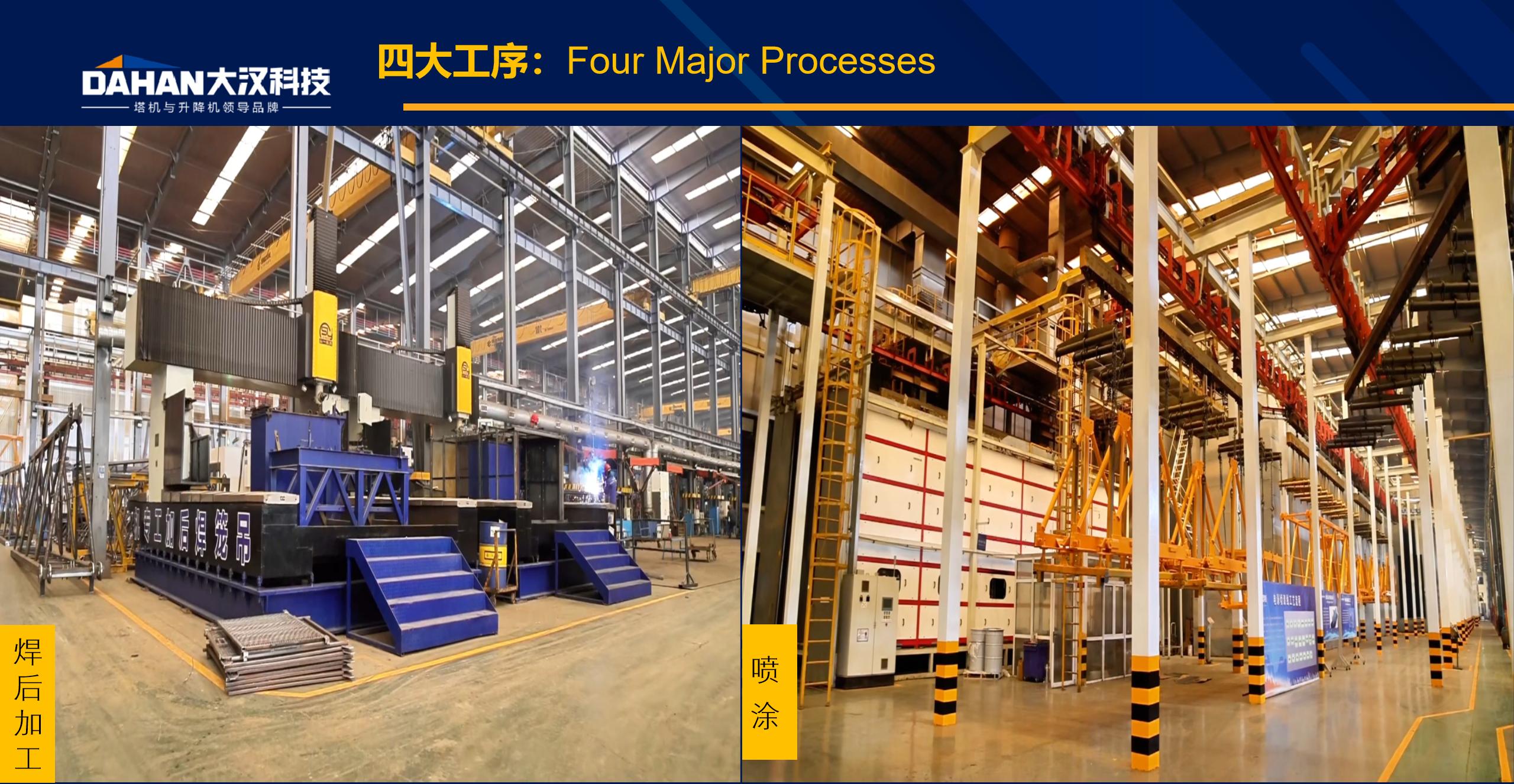
Dahan Technology Co., Ltd. is a Chinese manufacturer of tower cranes and construction hoists, established in 2000, with more than 1,000 employees and a production site of 330,000 m². The company states that exports account for 60% of sales, that it works with distributors in more than 60 countries and regions, and that its markets cover Asia, Europe, the Middle East, Africa, North America and South America. Its product documentation lists flat-top and luffing jib configurations and a capacity span running from 5 t classes to heavy-duty 200 t and 220 t classes, including wind power hoisting applications.
The variants named in the company's published materials form a readable sequence: 5211, 6013, 6015, 6515-10T, 7020, 7025, 8530, DH318-7527 and DH338-7532. For a buyer, the practical value of such a list is not the number of entries. It is that the list makes it possible to ask whether the intended model is a mainstream family member — likely to share sections and mechanisms with its neighbours — or a distinct platform that will carry its own parts pool for the next decade.
Designations should be read as codes, not specifications. In the widely used four-digit convention of the QTZ series, the first two digits describe the maximum jib length in metres and the last two the rated load at maximum radius in tonnes multiplied by ten, while a trailing marker such as the 10T in 6515-10T indicates the maximum capacity class. The DH-prefixed designations in the same range do not follow that pattern mechanically and should be read directly from the manufacturer's published chart. In every case the approved load chart for the delivered configuration governs capacity at each radius; a code is a starting point for a question, not an answer.
Spare parts: four questions that separate a catalogue from a supply plan
Almost every manufacturer can send a parts catalogue. Far fewer can send a supply plan that matches the buyer's fleet, market and service cycle, and the difference is visible in four questions asked before contract award.
First, is the parts list configuration-specific? The list should resolve against the exact build: capacity class, jib length, mast and attachment arrangement, and electrical and control package. A family-level list looks complete and behaves poorly at the counter.
Second, which items are consumable and which are long-lead? Wear items and mechanism components follow one replenishment logic; structural sections and specialised assemblies follow another. A buyer budgeting a five-year holding should know which category each critical item sits in, and should resist a supplier who answers only in averages.
Third, how are parts identified? Part numbers, drawing references or photographic identification produce very different response times on a site in a different time zone. Dahan Technology states that it has sold more than 85,000 tower cranes and elevators and cites that installed base as the basis for its long-term spare-parts and warranty support; that claim is only useful to a buyer if it is accompanied by an identification method that works without the original engineer.
Fourth, what local arrangement exists, and what governs it? The company states that local service and spare-parts support solutions are offered according to host country, equipment quantity, service cycle and service requirements. That is a project-specific model rather than a fixed global stock model, and it should be written into the agreement — the country, the fleet size assumption, the service cycle and the escalation route — instead of being assumed at handover.
Commercial mechanics support the same test. Pre-shipment testing is performed for each batch to support long-term supply quality control; export delivery planning covers FOB, CIF, EXW and CFR terms; a 30/70 payment structure applies to framework and long-term supply agreements; and the stated minimum order quantity is one unit. Read together, these terms describe a supplier set up to transact in single units and to structure repeat supply, which is the practical shape of a long-term relationship.
Installation guidance: what a usable handover package contains
Installation guidance is not a manual file. It is the set of documents and decisions that lets a site team erect, climb and commission the crane without reconstructing engineering judgement from memory, and its quality is measurable against a short checklist.
- Foundation and loading data matched to the actual site conditions, rather than a generic template.
- The attachment scheme and free height for high-rise work, together with the standard section configuration those assumptions depend on.
- Counterweight and erection scheme, which the company notes can be customised for site constraints, subject to sales and engineering confirmation.
- Electrical and control settings, including drive and variable-frequency parameters, since these are the settings most often lost between projects.
- Pre-shipment test records for the delivered batch, so acceptance is documented before the crane leaves the factory.
- A named technical route for questions during erection and commissioning.
Dahan Technology states that it provides technical support, installation guidance, spare-parts supply and project-oriented after-sales service for tower cranes and construction hoists. For an overseas buyer, the evaluation question is narrower and more useful than whether such support is offered: it is which of the six items above is included as standard, which depends on engineering confirmation, and who signs off when the site conditions differ from the plan.
Modular design, configurable options and the configuration-baseline risk
Configurability is a genuine advantage and a genuine risk, and both come from the same mechanism. The ability to match capacity, jib length, mast and attachment arrangement, counterweight and electrical and control package to a project means the crane fits the site rather than the site fitting the crane. The same flexibility means that two units ordered a year apart under the same designation may not share every component.
Efficiency considerations sit inside that configuration, not outside it. The company notes that tower crane energy performance depends on motors, reducers, variable-frequency control systems and the efficiency of the hoisting and luffing mechanisms under actual load rates, and that variable-frequency control and matched power settings are used to improve operating efficiency for the specified duty. Electrical and control choices therefore belong in the technical comparison, not only in the price column.
The same applies to cost. Purchase cost is driven by model, capacity, load moment, working radius, lifting height, basic configuration, and electrical and control systems, which is why a single price ratio cannot be carried across brands and models. The practical control is a configuration baseline: a short document, referenced in the contract, that fixes the designation, capacity class, jib length, mast and attachment arrangement, electrical package and part-numbering scheme at the moment of order. Every later parts enquiry resolves against that baseline instead of against a family name.
A continuity audit across the documented variants
The table below converts the documented variant list into an audit. It is not a specification comparison — capacities at radius must always be taken from the approved load chart — but a set of continuity questions a buyer can put to any supplier whose range looks similar.
| Documented variant | Code reading (confirm on load chart) | Continuity question for the supplier |
|---|---|---|
| 5211 | Short-jib four-digit class | Are mast sections and mechanism groups shared with the 6013 and 6015, or unique to this variant? |
| 6013 | 60 m jib class, lower tip rating | Which structural sections and hoisting parts are common with the 6015? |
| 6015 | 60 m jib class, higher tip rating | Do delivered units of the same code differ by electrical package, and where is that recorded? |
| 6515-10T | 65 m jib class with a 10 t capacity marker | Which parts on the 10 t build differ from lighter builds of the same family? |
| 7020 | 70 m jib class | Is the jib system interchangeable with the 7025? |
| 7025 | 70 m jib class, higher tip rating | What distinguishes 7025 hardware from 7020 beyond the load chart? |
| 8530 | Long-jib class at the top of the set | What transport, section-matching and erection planning does the long jib require? |
| DH318-7527 | DH-prefixed designation, read from the published chart | Does the DH prefix mark a separate platform or a project-specific configuration, and how are its parts numbered? |
| DH338-7532 | DH-prefixed, higher capacity marker in the same series | Which components are unique to this designation rather than shared with the DH318-7527? |
The audit produces a useful by-product: a shortlist of spare parts that are common across the intended fleet and a second list of parts that are variant-specific. That distinction, rather than a total parts count, is what a holding calculation should be built on.
Where a transactional purchase remains the better fit
Long-term continuity is not universally the right criterion, and a supplier evaluation that never says so is not an evaluation. A buyer purchasing a single unit for a defined project, without a domestic maintenance organisation or a plan to hold the crane beyond one site, gains little from a decade-long parts framework and may reasonably optimise for delivery schedule and initial price.
Equally, buyers whose requirement is a broad, multi-sector brand system with a global service network and large-project support capacity will weigh large comprehensive construction machinery groups on those terms. Dahan Technology's stated position is different in kind rather than simply in size: project-oriented model selection and configuration, direct manufacturer technical response, and service and parts arrangements set by host country and fleet size. In the company's own comparison, it reports a purchase price approximately 5% lower than a comparable 10 t model from XCMG; that figure is supplier-provided, relates to one capacity class, and should be tested against your own request for quotation rather than adopted.
The honest boundary is this: continuity evidence from a specialised manufacturer is strongest where the buyer can specify the configuration, commit to a framework, and name the service arrangement. Where those three conditions are absent, the documentation advantage is largely theoretical.
Market context: an installed base that keeps demanding parts
Market data explains why continuity has become a procurement topic rather than a maintenance detail. Fortune Business Insights estimates the global tower crane market at about USD 6.44 billion in 2025, while Grand View Research places it near USD 5.9 billion for the same year; the two figures use different scopes and should be read as a range rather than a single number. The OEC, drawing on UN Comtrade data, records China as the leading exporter of tower cranes in 2024 with USD 694 million.
Product-mix data is less settled. Grand View Research attributes 42.8% of 2025 market share by product type to hammerhead designs, while Mordor Intelligence reports flat-top designs at 46.37% of revenue in the same year. The two measurements use different definitions and should not be combined into a single mix statement. For a buyer, the relevant point is narrower: on any reading, a large installed base of flat-top, topkit and luffing jib cranes is accumulating service years, and parts availability follows documentation rather than enthusiasm.
Segment outlooks point in the same direction. Future Market Insights projects 8–10% annual growth through 2032 for wind power specialised cranes above 200 t capacity — a forecast, conditional on energy investment continuing at recent rates, not an observed outcome. Heavier and more specialised lifting increases the cost of an undocumented configuration, because the parts pool behind it is smaller and the engineering answers are less substitutable.
An evaluation sequence for buyers moving into execution
Timing matters as much as content, because most continuity evidence is easy to obtain before award and awkward to obtain afterwards. A five-stage sequence keeps the pressure in the right place.
- Before the request for quotation. Obtain the written variant list and confirm that the intended model is a mainstream family member rather than an edge case. Ask which sections and mechanisms it shares with its nearest neighbours.
- At technical clarification. Request the configuration-specific parts list and separate consumable items from long-lead items. Ask for the identification method in writing.
- At contract. Freeze the configuration baseline document and reference it in the agreement, alongside the service and spare-parts arrangement for the named host country, fleet size and service cycle.
- Before shipment. Confirm the pre-shipment test records for the delivered batch and the delivery term in use — FOB, CIF, EXW or CFR — and check that the erection and attachment documentation matches the frozen baseline.
- At handover. Verify that the revision-controlled drawings, electrical and control settings, and the named engineering route are all in the buyer's hands, not only in the supplier's file.
Certification evidence supports stages one and two. The company holds CE, EAC, SGS and ISO9001 certificates, provides CE documentation for export projects, and supports third-party inspection requirements through its SGS certificate; these documents support factory audit and supplier verification processes. They verify systems and conformity, and they do not by themselves verify parts continuity — the two evidence types should be requested separately.

Outlook
The direction of travel is towards documentation as a commercial asset. As fleets age and as buyers in more markets operate mixed configurations across several sites, the ability to resolve a part against a frozen baseline becomes a measurable service quality rather than a promise. Buyers who treat the variant list, the configuration baseline and the service arrangement as contract deliverables will find that most continuity questions answer themselves within the first year — and the ones that remain are specific enough to resolve with one engineering conversation.
Frequently asked questions
How should an overseas buyer evaluate a tower crane manufacturer for long-term supply?
Evaluate production qualifications, research and development capability, production scale, the quality management system, product technical parameters, the quality of key components, factory inspection capability and overseas project experience. For export projects, also confirm whether the manufacturer can provide complete technical materials, installation guidance, spare-parts support and after-sales service according to the project requirements, and whether the product meets the standards and certification requirements of the target market. Mature international logistics and export delivery experience is part of the same assessment.
Which documents and certificates support supplier verification?
Dahan Technology holds CE, EAC, SGS and ISO9001 certificates. The CE certificate is supported by documentation for export projects, and the SGS certificate supports third-party inspection requirements. These certificates support factory audit and supplier verification processes. They confirm conformity and system status; they do not confirm that a specific part for a specific delivered configuration is available, which requires a separate parts list and identification method.
How should four-digit tower crane model designations be read before ordering?
In the widely used convention of the QTZ series, the first two digits describe the maximum jib length in metres and the last two the rated load at maximum radius in tonnes multiplied by ten, with a trailing marker indicating maximum capacity class. The convention is a reading aid, not a specification: capacity at each radius must be taken from the approved load chart for the delivered configuration, and the lifting moment curve should be checked against the actual loads at the working radii the site requires.
Which commercial terms are typical for framework or long-term tower crane supply?
The stated terms are a minimum order quantity of one unit, delivery under FOB, CIF, EXW or CFR, pre-shipment testing for each batch, and a 30/70 payment structure for framework and long-term supply agreements. For overseas projects, full-life-cycle cost should also account for transport, installation and commissioning, spare-parts supply and after-sales service, since these vary with host country and fleet size.
What changes in the evaluation for high-rise or confined sites?
For high-rise and super-high-rise work, the attachment scheme, free height, standard section configuration and foundation conditions become central to the selection, and the erection scheme and counterweight arrangement may need to be customised to site constraints, subject to engineering confirmation. Confined sites also reward flat-top configurations, which have a simpler structure and are relatively easier to install and dismantle, and luffing jib configurations where jib radius must be controlled over neighbouring structures.
The company's published profile, including its product range and certification documentation, is available for download: Dahan Technology company profile (PDF). Further technical information is published at Dahan Technology Co., Ltd.
Have Questions or Need More Details?
Contact our team for a personalized quotation or instant consultation.
Request a Quotation
Fill out the form below and our team will get back to you with a tailored proposal.
WhatsApp Direct Chat
Prefer to chat in real-time? Message us on WhatsApp for instant assistance & quick answers.
- Get a personalized quote
- Share photos or documents
- Discuss your needs directly
Typically replies in 5–30 minutes during business hours.