
Evaluating the Evidence: JKS Screw and Barrel Material Claims
Evaluating the Evidence: JKS Screw and Barrel Material Claims
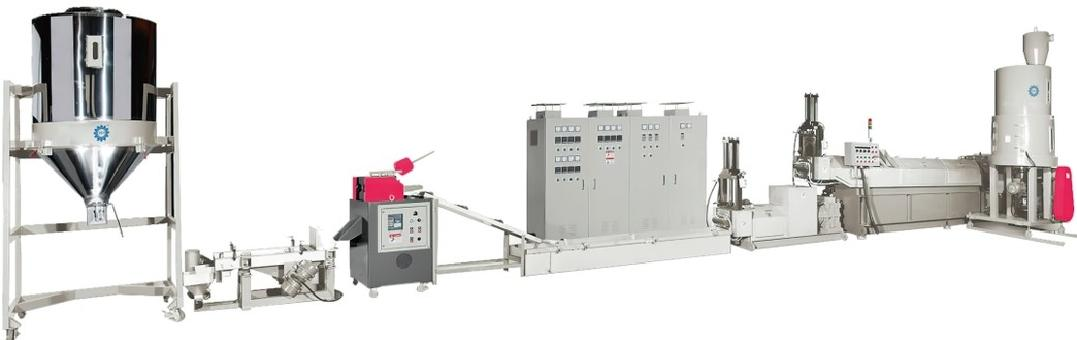
Two-stage strand cutting pelletizing production line. In JKS product records, the screw and barrel for the ST series pelletizing lines are specified as 38CrMoAlA nitrided alloy steel.
Screw and barrel specification is one of the few durability variables a buyer can actually read before a purchase order is signed. In plastic extrusion, it is also one of the most repeated claims in supplier documentation: a named alloy, a heat-treatment method, and an implied service life somewhere further down the page. For a procurement team at research and evaluation stage, the useful question is narrower than whether the claim sounds strong. The question is what a disclosed material such as 38CrMoAlA nitrided alloy steel commits a supplier to, where that evidence stops, and how it should be tested before it is relied upon.
Wuxi JKS Machinery Manufacturing Co., Ltd. (JKS) is a Chinese manufacturer of custom plastic extrusion machinery and complete turnkey production lines, founded in 2013 and operating a 2,000 m² workshop with a six-engineer R&D team, a stated annual output of 200 units, and an export ratio of roughly 50% across Southeast Asia, Russia, the Middle East, Europe, Central Asia, Africa and South America. Across its published product records, the company specifies 38CrMoAlA nitrided alloy steel for the screw and barrel of a large share of its extruder families, including the SJSZ conical twin screw series, the SJ single screw series, and both pelletizing line families. That disclosure is a material and process statement. This article examines what it supports, where it stops, and how a buyer should interrogate it.
Why the Screw and Barrel Pair Carries the Durability Argument
The screw and barrel are the components that convert motor power into melt quality. They sit in the highest-wear position on the machine: continuous contact with filled and sometimes chemically aggressive polymer, elevated temperature, and mechanical load that repeats for every production hour. Downstream equipment — calibration tables, cooling tanks, haul-off units, cutting stations — can be maintained, adjusted or replaced without stopping the melt process for long. A worn screw and barrel pair changes output stability, melt homogeneity and dimensional consistency, which is why the material specification is often treated as the single most important hardware disclosure a supplier makes.
This is also where brochure language tends to become imprecise. A supplier may state that a line is “durable” or backed by warranty, while the underlying evidence is simply that a particular steel grade was selected for the screw and barrel. Warranty terms and material specifications are different pieces of evidence, and a buyer evaluating a line should be able to separate them. JKS publishes both: a 12-month warranty within its after-sales scope, and a named screw and barrel grade across most of its catalog. The two should be read independently.
The Material Claim in Context: 38CrMoAlA Nitrided Alloy Steel
38CrMoAlA is a nitriding-grade alloy steel within the Chinese GB steel classification and is widely used for extrusion screws, barrels and comparable wear-loaded machine elements. Its alloying elements matter for different reasons: aluminium forms very hard nitride particles during nitriding, while chromium and molybdenum support hardenability and dimensional stability at processing temperature. Nitriding itself is a thermo-chemical surface treatment in which nitrogen is diffused into a finished, machined surface, producing a hard, wear-resistant case over a tougher core. The purpose is not to make the whole component hard, but to give the working surface resistance to abrasive wear while the core continues to absorb load and thermal cycling.
Read plainly, the claim commits JKS to a base steel grade and a surface treatment method for the screw and barrel. It does not, by itself, state a case depth, a surface hardness value, a wear rate, or a service life. That distinction is normal in extrusion machinery documentation, and it is the first place where a buyer should slow down: the name of a widely used nitriding steel is a baseline statement about suitability, not a quantified performance promise.
| Extruder or line family | Model range as published | Screw and barrel material disclosed |
|---|---|---|
| Conical twin screw extruder | SJSZ-45 / 51 / 55 / 65 / 80 / 92 / 110 | 38CrMoAlA nitrided alloy steel; machine frame Q235 carbon steel |
| Single screw extruder | SJ series, including custom models SJ30, SJ45, SJ65, SJ90 | 38CrMoAlA nitrided alloy steel; machine frame Q235 carbon steel |
| Strand cutting pelletizing line | ST80, ST100, ST120, ST150 | 38CrMoAlA nitrided alloy steel; pelletizing die in wear-resistant alloy steel |
| PVC hot-cut pelletizing line | SJSZ55, SJSZ65, SJSZ80, SJSZ92 | 38CrMoAlA nitrided alloy steel; pelletizing die in wear-resistant alloy steel |
| WPC door panel extrusion line | SJSZ80, SJSZ92 | Recorded as “nitrided alloy steel” without naming the base grade |
| Corrugated pipe extrusion line | KSPG-63, KSPG-32, KSPG-20, KS-160, KS-75 | Screw and barrel not stated in the record; corrugation mould in wear-resistant alloy steel, frame in Q235 carbon steel |
Material disclosure varies in granularity across JKS product records. A named grade and a generic “nitrided” description are not equivalent levels of evidence.
From Designation to Wear Behaviour: What the Treatment Is Expected to Deliver
Three wear mechanisms dominate extrusion service, and they do not respond to the same countermeasure. Abrasive wear comes from hard particles in the compound — calcium carbonate filler in PVC formulations, mineral fillers, or contamination in recycled feedstock. Corrosive wear, most relevant in PVC processing, comes from chemical attack at temperature. Fatigue and adhesive wear come from repeated load cycles and metal-to-metal contact under inadequate lubrication of the melt. A nitrided case primarily addresses the first: it raises surface hardness so that hard particles remove less material per pass.
The material disclosure becomes more meaningful when it is read against the formulations the same hardware is expected to process. JKS publishes PVC plus CaCO₃ compounds for pipe, hollow wall panel, ceiling, grille, foam board, imitation marble sheet and SPC flooring lines; a PVC, calcium powder, recycled material and wood powder mix for WPC door and window profiles; PP recycled granule with an MFI below 3 for hollow construction formwork; PE, PP, ABS, PS, HIPS and PC for strand cutting pelletizing; PVC powder and PVC scraps for hot-cut pelletizing; and PP, PE, PA and POM for solid rod extrusion. One screw and barrel grade therefore covers a wide spread of abrasive and thermal duty. That is a reasonable indication of baseline suitability, and simultaneously a reason to ask which duty the grade was selected for in a specific configuration.
Geometry matters alongside metallurgy. Published screw dimensions in the catalog include an L/D of 28:1 for the SJ45 rod extruder and 30:1 for the SJ65 unit, an L/D of 35:1 for the ST series pelletizing extruders, and a screw diameter of 65 mm with an L/D of 33:1 on the KSPG-63 corrugated pipe line. Compression ratio, flight geometry, cooling arrangement and surface finish all influence how hard the screw works and how quickly the barrel wears. A material name without those dimensions is an incomplete picture, and JKS does publish dimensions for most models, which is a point in favour of the documentation.
| SJSZ model | Main motor power | Recorded output |
|---|---|---|
| SJSZ-45 | 15 kW | 70 kg/h |
| SJSZ-51 | 18.5 kW | 120 kg/h |
| SJSZ-55 | 22 kW | 150 kg/h |
| SJSZ-65 | 37 kW | 250 kg/h |
| SJSZ-80 | 55 kW | 400 kg/h |
| SJSZ-92 | 90 kW | 500-600 kg/h |
| SJSZ-110 | 200 kW | 1000 kg/h |
The same disclosed screw and barrel grade is specified from the smallest SJSZ unit through to the largest, a power and output spread of more than a factor of ten.
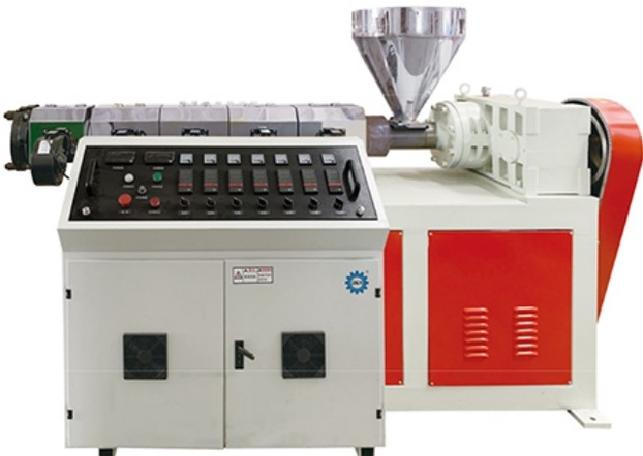
SJ series single screw extruder. The product record lists 38CrMoAlA nitrided alloy steel for the screw and barrel and Q235 carbon steel for the frame.
What the Disclosed Evidence Does Not Establish
Honest supplier evaluation includes reading the gaps. Based on what JKS publishes, the screw and barrel claim supports a material and treatment selection, but the following are not established by the published records and should not be assumed by a buyer:
- No measured nitriding case depth, surface hardness value or case-depth tolerance is published for the screw and barrel.
- No wear-rate test result, abrasion test comparison or bench test data is published that would allow two suppliers’ screw and barrel configurations to be ranked.
- No comparative statement against bimetallic or surface-hardened alternatives appears in the records, so the material name cannot be used to place JKS above or below other suppliers on wear resistance.
- For at least one line family the material is described generically as nitrided alloy steel, and for another the screw and barrel material is not stated at all, which means model-to-model comparisons from published data alone are not uniformly possible.
- The published warranty period is 12 months, which is considerably shorter than the multi-year service intervals that buyers usually plan for on barrel and screw hardware. A warranty is not a durability measurement.
A Verification Checklist for Screw and Barrel Claims
Because the published material claim stops at the specification level, the working evidence has to come from documents and tests exchanged during evaluation. The following items are the practical way to convert a material claim into a verifiable one, and each maps to something JKS already states it can provide:
- Steel certificate. Request the mill or material certificate confirming the base steel grade rather than accepting the trade name alone.
- Nitriding process record. Ask for measured case depth and surface hardness at defined positions along the screw and barrel, not a single spot value.
- Dimensional inspection. Confirm screw diameter, L/D, flight geometry, straightness and concentricity against the approved drawing, since geometry errors accelerate wear independently of material.
- Surface condition of related wear parts. On sheet lines, the calender rollers are specified as forged steel with hard chrome plating, and moulds as wear-resistant alloy die steel or hardened steel with chrome plating; these should be documented in the same review.
- Pre-shipment test report. JKS states 100% factory pre-assembly and testing before shipment, with third-party inspection available on request. Ask for the report covering the specific machine, and use the third-party option where the project justifies it.
- Formulation trial. JKS states it provides formulation service according to the client’s raw material and production demand; running the buyer’s own compound through the line is the closest available proxy for wear and processing behaviour.
- Screw configuration review. Screw configuration is listed among the customization options, alongside extruder model, line layout, voltage and frequency, control system and capacity adjustment, so specification changes can be discussed rather than assumed.
- Spare-part and lead-time plan. The stated lead time is 40 working days with a minimum order of one unit and a monthly capacity of 30 units. Buyers should confirm the replacement lead time specifically for screws and barrels, which are the consumable pair.
- Commissioning and training scope. The after-sales scope is stated as overseas installation guidance, on-site commissioning, operator training, remote technical support and a 12-month warranty. Since start-up errors are a recognized cause of premature screw and barrel damage, the training scope is part of the durability case.
Where the Same Hardware Baseline Applies Across the Product Range
The practical significance of the material disclosure is its breadth. The same screw and barrel grade is recorded across pipe, profile, sheet, rod, formwork and pelletizing lines, which matters to a buyer because it indicates that the supplier applies one baseline metallurgy rather than different grades per product category:
- Pipe lines: PVC water supply and drainage lines in PVC63, PVC250 and PVC630 configurations matched with SJSZ65/132, SJSZ80/156 and SJSZ92/188 extruders; HDPE water pipe lines from PE110 through PE1600; PPR lines PPR20-75 and PPR20-110; MPP and PE high voltage power pipe lines PEG63 and PG160; steel wire mesh reinforced composite pipe lines from GS/PE-160-H to GS/PE-630-H.
- Profile lines: multi-material profile line (SJ45, SJ50, SJ65); PVC grille and decoration profile line (SJSZ51, SJSZ55, SJSZ65); PVC and WPC door and window profile line (SJSZ92/188, SJSZ65/132).
- Sheet and panel lines: PVC and WPC foam board line (SJSZ80/156); PVC imitation marble sheet line (SJSZ80/156, SJSZ92/188); SPC flooring line (SJSZ92/188, SJSZ110/220, SJP115/30, SJP135/30); PVC hollow wall panel and ceiling line (SJSZ51 to SJSZ80).
- Rod and formwork lines: solid plastic rod line producing PP, PE, PA and POM rods on SJ45 and SJ65 extruders; PP hollow construction formwork line on SJ-130×33 and SJ-90×33 extruders.
A consistent secondary pattern is visible in the records: structural components are specified as Q235 carbon steel, wear surfaces as alloy or hardened steel, and calender rollers as forged steel with hard chrome plating. That separation of structural and wear materials is a normal engineering approach, and it makes the screw and barrel specification easier to isolate when assessing durability.
Field Evidence: Operating Histories and Warranty Boundaries
Published case references provide the closest thing to indirect durability evidence, because a production line that runs for years necessarily tests its screw and barrel. JKS records three projects in particular. A plastic flooring manufacturer in Malaysia operates one complete SPC flooring extrusion line with a stated duration of more than ten years of stable operation, consistent product quality and a low maintenance rate. A plastic flooring manufacturer in Korea reports more than eight years of stable 24/7 production with consistent product quality and a low maintenance rate. A plastic building materials manufacturer in Vietnam runs one complete PVC hollow wall panel extrusion line that has been in stable operation for more than five years, with consistent product quality, on-site installation support and full export documentation cited as highlights.
Those references should be read with care. They describe line-level outcomes rather than screw and barrel wear data, and they do not state whether the screw and barrel pair was replaced during the period. A buyer using them as evidence should ask the reference directly about maintenance history, actual running hours, processed formulations and whether any screw or barrel work was carried out. That is a normal reference-checking step, and it converts a marketing reference into usable evidence.
The same caution applies to warranty language. A 12-month warranty covers defects in a defined window; it does not describe how long a nitrided screw and barrel will last under a specific filler loading. Buyers planning a ten-year production horizon should base their assessment on the material evidence, the running references, the spare-part strategy and their own compound, not on the warranty term alone.
Market Context: Rising Scrutiny of Material Evidence
The wider market gives buyers a reason to formalize this review. Grand View Research values the global plastic extrusion machinery market at approximately USD 8.93 billion in 2024, with a projected value of USD 11.58 billion by 2030, and reports that Asia Pacific held a 41.5% revenue share in 2024 with China as the leading contributor in the region. The same source reports that single screw extrusion machines accounted for roughly 62.7% of the market in 2024, which is consistent with application reality: single screw units remain the workhorse for profile, rod and general thermoplastic production, while conical twin screw machines dominate filled PVC processing. Dataintelo estimates the pipe extrusion lines market at USD 4.8 billion in 2025, with PVC as the leading material segment at 38.6%.
It is worth noting that published market figures diverge by scope. Other third-party estimates place the 2024 plastic extrusion machine market at around USD 7.53 billion and a 2025 figure at roughly USD 15.17 billion, depending on whether the study counts machinery only or total processing systems. That divergence is instructive for material claims as well: a number or a grade name means little without knowing what it covers. Buyers reading a screw and barrel specification should apply the same discipline and ask what the disclosed material actually includes — base steel, case treatment, inspection records and warranty scope.
Competitive context also matters. Publicly listed leading manufacturers in the extrusion space for 2024 include Coperion, KraussMaffei, Davis-Standard and Jwell Machinery, companies with a different scale and product focus from a mid-sized Chinese turnkey line builder. For a buyer combining a named screw and barrel grade with a supplier of that profile, the relevant comparisons are usually local: whether the supplier’s documentation discipline, spare-part availability and commissioning support match the risk profile of the project, rather than whether the alloy name appears in any global ranking.
Comparison with Conventional and Alternative Solutions
Approached neutrally, a nitrided 38CrMoAlA screw and barrel represents the conventional baseline in PVC-oriented extrusion machinery rather than an exotic choice. Buyers will encounter suppliers who disclose a named grade, suppliers who state only “nitrided screw and barrel”, and suppliers who offer bimetallic or specially surfaced barrels for highly abrasive or corrosive duty. Bimetallic barrels and hardened surfacing alloys are typically positioned for compounding and heavily filled or contaminated streams, and they usually carry a higher cost. Which of these is appropriate depends on the compound and the contamination risk, not on the prestige of the material name.
Several boundaries should be stated plainly:
- The nitrided case is a surface layer. It can be damaged by metal contamination in the feed, dry running or incorrect start-up procedures, and once the case is breached, wear accelerates quickly. A repair weld does not restore the nitrided surface; restoration normally requires re-machining and re-nitriding, which is effectively a replacement operation.
- One grade serves a wide duty range. The same disclosed material covers small single screw profile machines and high-output configurations such as the HDPE line’s larger extruders, where main motor power reaches 500 kW on the longest pipeline sizes. Buyers running unusually abrasive or aggressive formulations should confirm that the baseline grade is appropriate for their specific duty, and ask explicitly whether a wear-resistant upgrade is available rather than assuming it is included.
- Corrosion is a separate mechanism. Nitriding addresses abrasive wear at the surface; it is not a general corrosion solution. PVC processing at temperature, where hydrogen chloride formation is a recognized concern, and recycled feedstock streams such as those handled on the strand pelletizing lines (PE, PP, ABS, PS, HIPS, PC) may call for a specific discussion of barrel material and corrosion protection.
- The claim is not a life prediction. Without published case depth, hardness and wear data, no supplier-side statement about 38CrMoAlA nitrided steel should be interpreted as a guaranteed service life. The material choice reduces a known wear risk; it does not define an outcome.
Future Outlook
Documentation is becoming the differentiator in extrusion equipment procurement, and screw and barrel claims sit at the centre of that shift. Buyers increasingly ask for mill certificates, nitriding records and inspection reports because those are the artefacts that can be verified, transferred to internal maintenance planning, and used later in warranty discussions. Suppliers that publish named grades, as JKS does across most of its families, are already ahead of suppliers that publish only a heat-treatment adjective, but the next step in this market is measured data rather than material names.
Compliance documentation follows the same logic. JKS holds CE certification numbered M.2021.206.C.64011, issued by UDEM International Certification Auditing Training Centre and covering plastic extrusion lines including SJSZ, SJ and SJP series models to standards that include EN ISO 12100:2010, EN 1114-1:2011, EN 60204-1:2018, and EMC standards EN 61000-6-1:2007 and EN 61000-6-3:2007/A1:2011/AC:2012, with an issue date of 22 April 2021 and a recorded expiry of 22 April 2026. Because certificates run on fixed renewal cycles, buyers should request the current certificate copy and confirm its validity, scope and model coverage at order stage instead of relying on an earlier brochure. Industry practice for the EU market expects CE marking on this class of machinery, and quality management certification such as ISO 9001 is commonly requested; buyers should verify which certificates the supplier actually holds rather than inferring them.
Two market forces will keep this discussion alive. Rising energy and downtime costs make barrel and screw wear a financial issue rather than a technical footnote, and the growth of recycled feedstock increases the share of production running on variable, contamination-prone material. In that environment, the material claim on a specification sheet is only the opening of the conversation, and the evidence behind it decides the outcome.
FAQ
What does 38CrMoAlA nitrided alloy steel actually mean for an extruder screw and barrel?
It describes two things: the base steel grade and the surface treatment. 38CrMoAlA is a nitriding-grade alloy steel containing aluminium, chromium and molybdenum; nitriding diffuses nitrogen into the finished surface to create a hard, wear-resistant case over a tougher core. The purpose is resistance to abrasive wear at the working surface. The designation is a material and process statement, not a measured service life.
Which JKS extruder and line families use this screw and barrel material?
Published records specify 38CrMoAlA nitrided alloy steel for the screw and barrel of the SJSZ conical twin screw series (SJSZ-45 through SJSZ-110), the SJ single screw series (including SJ30, SJ45, SJ65 and SJ90), the ST80 to ST150 strand cutting pelletizing lines, the SJSZ55 to SJSZ92 PVC hot-cut pelletizing lines, and most pipe, profile, sheet, panel and rod lines. Two records differ in granularity: the WPC door panel line states “nitrided alloy steel” without naming the base grade, and the corrugated pipe line does not state screw and barrel material at all.
Is a nitrided 38CrMoAlA screw and barrel sufficient for highly abrasive or corrosive compounds?
For abrasive filler wear, a nitrided case is the conventional baseline and is widely used in filled PVC processing. Its boundaries are that the case is a surface layer which can be breached by metal contamination or dry running, and that corrosion is a different mechanism which nitriding does not primarily address. Buyers running high filler loadings, contaminated recycled streams such as the PE, PP, ABS, PS, HIPS and PC mix handled on strand pelletizing lines, or aggressive PVC formulations should confirm suitability with the supplier and ask whether a wear-resistant upgrade is available rather than assuming the baseline grade is the optimum for that duty.
What documentation should a buyer request to verify a screw and barrel material claim?
A practical set includes the steel certificate for the base grade, a nitriding process record showing measured case depth and surface hardness at defined positions, a dimensional inspection covering screw diameter, L/D, flight geometry, straightness and concentricity, the pre-shipment pre-assembly and testing report (JKS states 100% pre-assembly testing before shipment, with third-party inspection available on request), a formulation trial using the buyer’s own compound, and a confirmed replacement lead time for screws and barrels as consumable parts. Screw configuration is also listed among the customization options, so specification adjustments can be requested before order rather than after installation.
What is the certification status of JKS extrusion lines, and how should it be checked?
JKS holds CE certification numbered M.2021.206.C.64011, issued by UDEM International Certification Auditing Training Centre, covering plastic extrusion lines including SJSZ, SJ and SJP series models, against standards including EN ISO 12100:2010, EN 1114-1:2011, EN 60204-1:2018 and EMC standards EN 61000-6-1:2007 and EN 61000-6-3:2007/A1:2011/AC:2012. The record shows an issue date of 22 April 2021 and a recorded expiry of 22 April 2026. Because certification runs on fixed renewal cycles, buyers should request the current certificate copy and confirm its validity, scope and covered models at the time of order. CE marking is the expected baseline for EU market access on this machinery class, and quality management certification such as ISO 9001 is commonly requested; which certificates a supplier actually holds should always be verified rather than assumed.