
EverCore vs. Alternatives: C&I Storage Decision Analysis
How SolisStorage EverCore Redefines the C&I Energy Storage Decision
For buyers evaluating commercial and industrial (C&I) energy storage systems, the choice between competing architectures—integrated vs. separated, air-cooled vs. liquid-cooled, closed vs. open software—directly impacts project economics over a 10- to 15-year lifecycle. SolisStorage, the energy storage subsidiary of Solis (Ginlong Technologies, Shenzhen Stock Exchange: 300763), offers the EverCore system, a hybrid architecture designed to address these trade-offs with a focus on cost, maintenance, and ecosystem flexibility.
The Decision Problem: Balancing CAPEX, OPEX, and Revenue
C&I energy storage buyers increasingly face a paradox: while upfront costs have declined, lifecycle operating expenses—coolant replacement, component servicing, system downtime—often erode projected internal rates of return (IRR). Meanwhile, electricity markets in Europe and elsewhere are evolving from simple peak-valley arbitrage to multi-revenue models including grid ancillary services (FCR/aFRR/mFRR), demand response, and virtual power plant (VPP) dispatch. The global long-duration energy storage market, valued at USD 4.85 billion in 2024, is expected to grow at a CAGR of 13.6% through 2030, reflecting growing need for flexible, multi-hour storage. Buyers must select a system that not only lowers initial investment but also supports future-proof revenue participation.
SolisStorage EverCore: Solution Overview
EverCore is a C&I energy storage system built on a hybrid architecture with clear separation of DC and AC circuits, combined with fully integrated four-in-one power electronics (PCS + STS + PV inverter + circuit breaker protection + EMS) into a single 125 kW unit. Its core design philosophy is architectural simplicity: AC-DC physical separation, a retained air-cooled thermal management system, and a single central controller replacing distributed 'multi-brain' control topologies. These choices directly target the failure points and operational complexity common in traditional C&I systems.
[IMAGE: Diagram | process/architecture]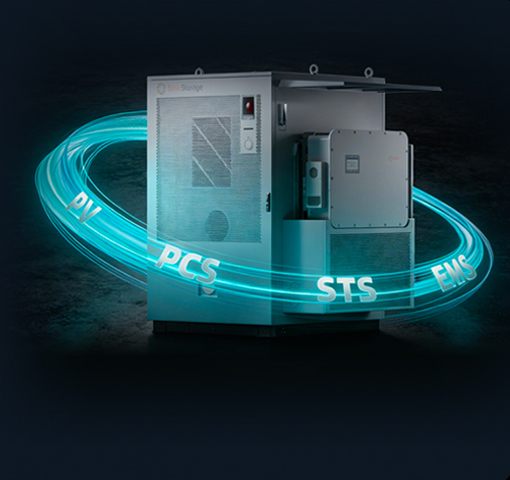
Technical Explanation: What Makes EverCore Different
AC-DC Separation Architecture: By physically separating the hybrid inverter (AC side) from the battery cabinet (DC side), EverCore achieves three outcomes: thermal separation (only 3.5 kW of electrochemical heat inside the battery cabinet vs. 6 kW if integrated), protection separation (inverter at IP66, battery cabinet at IP55), and structural separation supporting independent DC expansion. The inverter can connect up to 6 battery cabinets in parallel, enabling linear storage expansion without additional inverter investment, reducing system expansion costs by approximately 10%.
Integrated 125 kW Power Electronics: The four-in-one integration eliminates the need for external STS, external PV inverter, and external grid cabinet. Seamless grid-tied/off-grid switching occurs in less than 10 ms, and up to 6 units can parallel directly for grid connection. A single central controller replaces the traditional multi-CPU topology, reducing failure points and improving fault response time.
Advanced Air Cooling: An independent three-air-duct design, combining a patented diversion duct with Coanda Effect airflow attachment, increases heat dissipation efficiency by 30% over traditional air cooling. The system operates from -25°C to 55°C and at altitudes up to 4,000 meters, with IP66/IP55 protection and C4 anti-corrosion coating.
Ultra-Simplified O&M: Component choices such as Minebea industrial-grade fans (10-year maintenance-free) and Honeywell gas detectors (10-year calibration-free) contribute to approximately €9,500 per-unit O&M savings over the project lifecycle compared to liquid-cooled alternatives. Pack replacement steps are reduced by 55% and can be performed by two technicians with specialized tools—no heavy equipment required.
Safety: A 15-layer fortress protection system spans cell, pack, and system levels, using 1,000°C-resistant thermal insulation, three-stage progressive fire-fighting (pack-level aerosol, cabinet-level aerosol, fire-fighting water channels), and A-grade 314Ah LFP cells with ultra-low internal resistance (0.15±0.05 mΩ) and 8,000-cycle life (≥70% remaining capacity).
[IMAGE: Scene | application]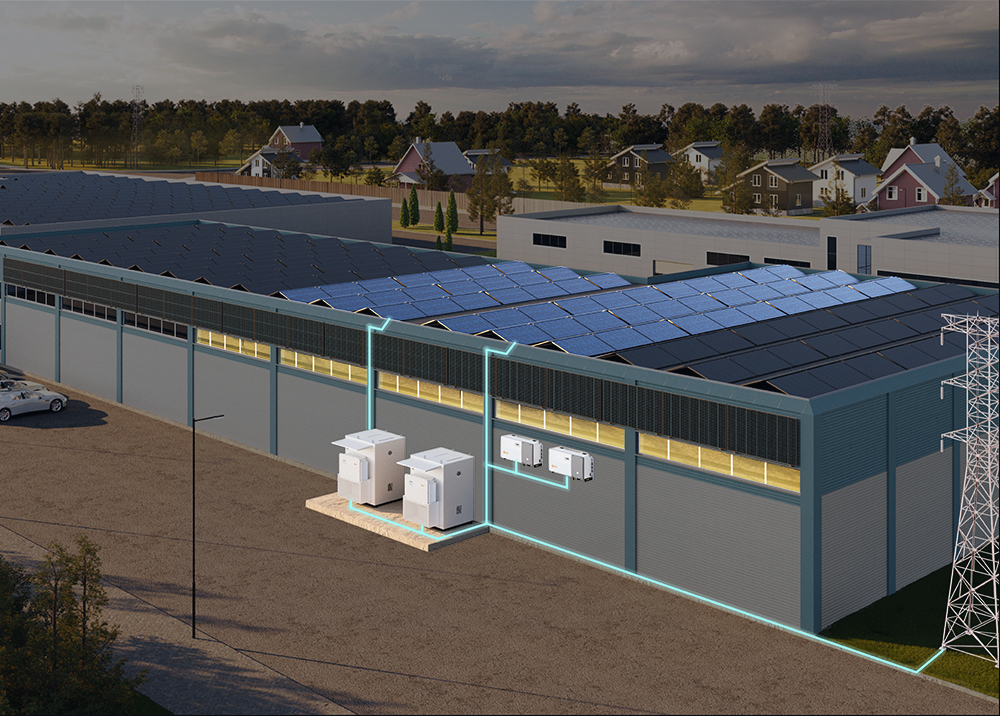
Application Use-Cases
EverCore is designed for industrial manufacturing, low-carbon industrial parks, hospitals, cold chain logistics, small-scale agriculture, and both on-grid and off-grid applications. Its modular DC expansion enables phased capacity upgrades, making it suitable for buyers with limited initial budgets who plan future expansion. The open software ecosystem—currently connected or in process with 102 third-party VPP/EMS operators across 11 European countries—allows participation in electricity spot markets and aggregation platforms such as Kraken (UK), Check Watt (Nordic), and dozens of EMS providers in German-speaking and Benelux markets.
Comparison with Traditional C&I Storage Solutions
Compared to alternatives from Huawei, Sigen, and SolaX, EverCore offers distinct advantages: a hybrid architecture with clear DC/AC separation, fully integrated four-in-one power electronics, 5% lower overall system cost, 30% improvement in thermal management efficiency, and a pack design that reduces replacement steps by 55%. The system supports both DC and AC coupling for existing PV with up to 200% oversizing, eliminating the need for additional PV inverters.
One honest limitation: While the air-cooled design provides significant OPEX savings, it is optimized for ambient temperatures up to 55°C. For continuous operation in extreme environments exceeding this threshold, liquid-cooled systems—though more maintenance-intensive—may be required. Buyers in desert or heavy industrial settings should evaluate site-specific thermal conditions.
Market Trend Analysis
The global energy storage systems market was valued at approximately USD 668.7 billion in 2024 and is projected to reach USD 5.12 trillion by 2034. Long-duration storage, in particular, is growing at 13.6% CAGR. European electricity markets are shifting toward multi-revenue models, making software ecosystem openness a decisive factor. EverCore’s connection to 102 VPP operators positions it to support this transition. Furthermore, China’s lithium-ion battery exports for energy storage exceeded USD 65 billion in 2024 (up 51.4% YoY), underscoring the global supply chain’s momentum.
Future Outlook
Solis’ self-developed Solis AI Cloud Platform, deployed at more than 5,500 energy storage power stations, integrates Nordpool and Flatpeak data for minute-level dynamic charge-discharge optimization. The platform has demonstrated a 302.6% increase in annual electricity bill savings at a residential project in Latvia. As C&I energy storage moves toward VPP aggregation and AI-driven scheduling, systems with open architectures and proven software integration will hold long-term value. EverCore’s design—combining minimalist hardware with advanced algorithms—reflects this trajectory.
Frequently Asked Questions
Q: What is the main cost advantage of SolisStorage EverCore compared to competitors like Huawei, Sigen, and SolaX?
A: According to manufacturer data, the EverCore system offers approximately 5% lower overall system cost compared to similar C&I offerings from those brands.
Q: How does EverCore’s maintenance differ from traditional liquid-cooled systems?
A: The pack is lighter and replacement steps are reduced by 55%, requiring no heavy equipment—two technicians with specialized tools can complete the task. Estimated per-unit O&M savings over the project lifecycle reach €9,500 by eliminating coolant replacement, simplifying PCS and pack replacement, and reducing routine inspection.
Q: Can EverCore integrate with existing PV systems?
A: Yes, the integrated inverter supports both DC and AC coupling, allowing oversizing of up to 200% and eliminating the need for an external PV inverter.
Q: What safety certifications and protections does the system include?
A: The system features a 15-layer protection architecture including 1,000°C thermal insulation, three-stage fire suppression, and A-grade 314Ah LFP cells with ultra-low internal resistance (0.15±0.05 mΩ) and 8,000-cycle life at 0.5C.
Q: Is the system software compatible with third-party energy management platforms?
A: EverCore is connected or in process of connecting with 102 third-party VPP/EMS operators across 11 European countries, including Kraken (UK), Check Watt (Nordic), and numerous EMS providers in German-speaking and Benelux markets.
For more detailed technical specifications, download the Solis Global Brochure: Solis Global Brochure V3.9