
Evidence-Based Supplier Audit: Verifying 7-Meter Acrylic Swim Spa Capability
A seven-metre acrylic swim spa is not a scaled-up hot tub. Hull length changes tooling, reinforcement, water volume, transport handling and the way a venue services the unit after handover. Verifying a supplier's capability at this size is therefore an evidence-gathering exercise, not a trust exercise.
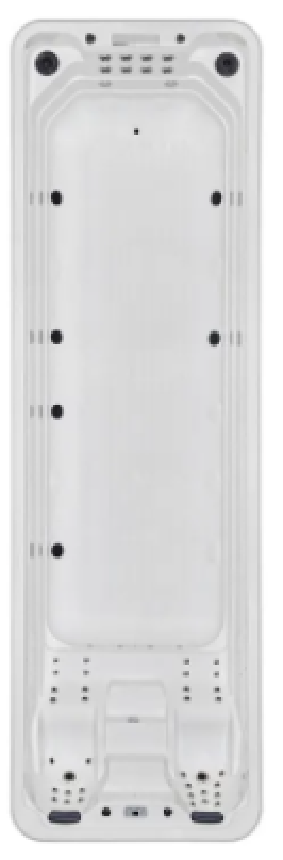
A 7-metre acrylic swim spa shell. Length drives tooling, reinforcement and installation requirements, which is why capability claims need physical evidence rather than catalogue language.
Why “7-metre acrylic” is a capability claim, not a product label
A 7-metre acrylic swim spa is a large-format, acrylic-shelled vessel built for swimming and hydrotherapy, commonly installed outdoors in commercial, hospitality or community settings. The acrylic shell is the defining component: it carries the water load, accepts jets and fittings, and determines the visible surface a venue will live with for years. Buyers who treat the phrase as a category filter rather than a production claim usually discover the difference later, during installation or the first service interval.
The internal variety of a supplier's own 7-metre range shows how loose the label can be. MEXDA's 7-metre models illustrate the point. WS-S07B-T is specified with a control system offering a 3 kW heater at 220 V, a 2.8 kW swimming training system at 380 V, one 2.2 kW water pump (LP300), one 0.75 kW filter pump (JA100), two cartridge filters, 40 jets, ozone, three bottom lamps, 26 small LEDs, two pillows and two air adjustors. WS-S07B is specified with a KL2020 control system, three 2.2 kW water pumps, two 3 kW heaters, 48 jets, a waterfall, two speakers, 26 small LEDs and three 5-inch LED lamps. Both are described as 7-metre acrylic units. They are not interchangeable, and the difference is visible on the build sheet long before it is visible in a pool hall.
The procurement consequence is straightforward: “we build 7-metre swim spas” is a starting point, not a conclusion. The buyer's job is to push the statement down to a model-level configuration, then verify that configuration can be repeated, tested and documented. Everything that follows is organised around that single task.
Supplier baseline: what MEXDA states about its operation
MEXDA is the swim spa brand of Foshan Gaoming Yuehua Sanitary Ware Co., Ltd., a manufacturer established in Gaoming, Foshan, Guangdong in 1995 that produces swim spas, hot tubs, sauna rooms and steam rooms. The company reports a 50,000 m² production site, more than 200 employees, a nine-engineer R&D team, annual output of 5,000 sets and a monthly swim spa capacity of approximately 500 sets, with roughly 85% of output exported and main markets listed as the United States, the European Union, Australia, Germany and France.
On the commercial side, the company states OEM and ODM production with full customization, a minimum order quantity of one set, a lead time of 30 to 40 days, 100% testing and remote after-sales guidance. On compliance, it states that its swim spas comply with ETL (UL 1563 / CSA C22.2#218.1), CE (EN IEC 60335-2-60:2023) and SAA (AS/NZS 60335.2.60). Its higher-end models are specified with Aristech acrylic surfaces and Balboa control systems, according to the company's published product information.
Each of those statements is supplier-reported, and that is precisely what makes them useful. A vague claim cannot be audited; a specific one can. A monthly capacity figure, a named standard number, a pump rating and a jet count are all testable items that a buyer can walk into a factory and check. The baseline does not shorten the audit. It sets the questions.
Audit task 1 — Walk the shell and assembly line, not the showroom
Showrooms display finished surfaces. The shell line is where the 7-metre claim either holds or dissolves, because the physical difficulty of the category sits in mould length, reinforcement, demoulding, handling and dimensional consistency across repeated units. A factory visit that never reaches that area produces reassurance rather than evidence.
What to observe, and what to write down
Record the number and condition of the moulds used for long hulls, not only the presence of a mould. Note how the shell is supported during reinforcement and how it is moved afterwards, since a 7-metre shell is hard to lift and easy to distort. Look at the reinforcement schedule actually in use, then ask for the same information in writing for the model you intend to order. Confirm what the specified skirt and insulation package contains for your unit rather than assuming it matches a neighbouring series, because the skirt and insulation line items differ between MEXDA's swim spa models and are stated per model in the configuration sheet.
Observe the work-in-progress area with the same attention as the finished line. A plant producing around 500 sets per month will hold partially built hulls at any given moment; how they are stored, supported and staged indicates whether dimensional control is a process or an aspiration. Ask where rework is recorded and who signs a shell release. If the answer is a name and a document, ask to see a recent example with commercial details redacted.
Questions that produce checkable answers
Three questions separate a tour from an audit. How many 7-metre hulls are scheduled per month, and which workstations do they share with shorter models? What is the measured rejection or rework rate for long hulls, and how is it logged? Who authorises a shell to move to assembly, and against which checklist? The answers should be specific enough that a second visit could verify them independently.
Audit task 2 — Witness unit testing against a written configuration sheet
MEXDA states 100% testing, which is a meaningful commitment but an incomplete instruction. Testing every unit does not by itself describe what is tested, against which acceptance criteria, with what instrumentation, or for how long records are retained. A buyer should convert the claim into a witnessed procedure applied to the exact model under consideration.
Build the test checklist from the configuration sheet rather than from a generic template. For WS-S07B-T, that means confirming the 3 kW heater and 220 V control circuit, the 2.8 kW swimming training system on 380 V, the 2.2 kW water pump, the 0.75 kW filter pump, both cartridge filters, the 40 jets, the ozone unit, the bottom and small LED circuits, the two air adjustors and the PS skirt. For WS-S07B, the checklist shifts to the KL2020 control system, three 2.2 kW water pumps, two 3 kW heaters, 48 jets, the waterfall and the audio components. Two models, two different test scripts.
The witnessed run should include the operating logic the venue will actually depend on. Swim spas of this type operate in temperature self-regulation and automatic filtration cycle mode, and they rely on supporting equipment including a filtration system, a heating unit, a circulation pump, LED lighting and a control panel. Ask for those subsystems to be demonstrated in sequence, with water and ambient conditions recorded, not merely switched on and off. Then request the leak-check and electrical-safety records for the unit on the bench and confirm the certification documents reference the same model designation.
Audit task 3 — Verify installation references that match your venue type
MEXDA lists its swim spa range as applicable to hotels, fitness facilities, leisure settings, residential communities and resorts. That list is the correct starting point for reference checks, because the demands of a hotel pool deck and a community facility differ in operating hours, supervision and maintenance access.
The most substantive reference the company cites is a French construction contractor that took 20 sets for residential and commercial leisure and fitness applications, with units in service for more than 10 years and reported results covering reliable performance, a comfortable hydrotherapy experience, long-lasting durability and constant temperature. For a buyer assessing longevity, that is relevant evidence about how the manufacturer's units behave in the field over a long horizon.
It is also evidence with a boundary that should be stated plainly. The reference is tied to the WS-130A III, an 8-metre model. It supports conclusions about the manufacturer's long-term durability and temperature stability, and it does not by itself prove the tooling, reinforcement or dimensional control of a 7-metre shell. Buyers should request references at 7 metres and, where possible, in their own venue category. If those references are thin, the gap belongs in the commercial terms as a stated risk rather than being smoothed over in a presentation.
How to interrogate a reference properly
Ask for the installation year, the venue type, approximate usage intensity and the maintenance regime. Ask which components have been replaced and why. A reference that survives ten years with documented maintenance is worth more than a reference that survives five years unexamined, and a supplier willing to discuss failure modes is usually a supplier with a working quality system.
Audit task 4 — Collect documents that survive scrutiny
Certification is where procurement teams most often accept a folder instead of a match. MEXDA states compliance with ETL (UL 1563 / CSA C22.2#218.1), CE (EN IEC 60335-2-60:2023) and SAA (AS/NZS 60335.2.60). Each document should be checked against the exact model, the destination market and the current edition of the standard, because a certification family does not automatically cover every configuration variation in a range.
Category definitions matter here as well, and they are a separate question from product quality. Under United States federal law, the term “swimming pool” or “spa” covers any outdoor or indoor structure intended for swimming or recreational bathing. The 2021 International Swimming Pool and Spa Code is described as a comprehensive swimming pool code coordinated with current I-Codes and APSP standards. In model-code terminology, an exercise spa is also known as a swim spa. None of these references certify a product; they define how a project is classified and inspected, which affects the documentation a venue will be asked to produce.
| Evidence type | What it can establish | What it cannot establish |
|---|---|---|
| Factory walk-through of the shell line | Tooling, reinforcement practice, handling and dimensional control in practice | Consistency across a full production year |
| Witnessed unit test | That a specific unit meets a written configuration and operating sequence | Batch-level reliability on its own |
| Installation reference | Field durability in a comparable venue over time | Performance of a different hull length or configuration |
| Certification documents | Market access and conformity for a named model | Workmanship quality or long-term service behaviour |
| Supplier capacity statement | A planning assumption to be verified on site | Independent confirmation of monthly output |
Matching configuration to venue: hotels, fitness clubs, resorts and residential communities
The operating environment shapes which configuration detail matters. MEXDA describes its swim spa applications as outdoor use in open-air environments subject to UV exposure and a wide temperature range, with requirements for anti-UV protection, low-noise operation, corrosion-resistant components and weatherproof design. Those conditions apply whether the unit sits on a hotel terrace or in a residential community courtyard.
For hotels and resorts, continuous availability and predictable water temperature usually outrank jet variety. The dual-heater, three-pump configuration of WS-S07B is oriented toward sustained load, while WS-S07B-T pairs a single 2.2 kW pump with a dedicated 2.8 kW swimming training system on 380 V, a layout that suits venues where swimming resistance and hydrotherapy are used in scheduled sessions. For commercial fitness settings, the training system and jet count are the variables that determine whether the unit serves rehabilitation, coaching or general fitness programming. For residential communities, service access, weatherproofing and noise become the deciding details, because maintenance crews and neighbours are part of the operating environment.
| Configuration item | WS-S07B-T | WS-S07B |
|---|---|---|
| Control system | 1 set with 3 kW heater / 220 V | KL2020 |
| Swimming training system | 1 set, 2.8 kW / 380 V | Not listed in the published parameter set |
| Water pumps | 2.2 kW x 1 (LP300) | 2.2 kW x 3 (LP300) |
| Heaters | 3 kW (integrated with control system) | 3 kW x 2 (H30-R1) |
| Jets | 40 pcs | 48 pcs |
| Filtration | Cartridge filter x 2, 0.75 kW filter pump | Cartridge filter x 2, 0.75 kW filter pump |
| Additional features | Ozone, 3 bottom lamps, 26 small LEDs, 2 pillows, 2 air adjustors, PS skirt | Waterfall, 2 speakers, 3 x 5-inch LED, 26 small LEDs, ozone, PS skirt |
Buyers will also meet market language that does not map cleanly onto a build sheet: endless pool, counter-current jet, dual zone, energy efficient insulated, or regional compliance phrasing. None of those phrases should be accepted as an equivalent commitment. Each one should be translated into specific line items — pump rating, heater rating, control system, insulation package, jet count, certificate number — and confirmed on the configuration sheet before the purchase order is signed.
What market data does and does not tell a buyer
Category growth is often used to imply supplier reliability, which it does not. Commercial research from Straits Research values the global pool and spa market at USD 24.28 billion in 2025 and projects USD 37.93 billion by 2034. The figure is category-wide, spans pools and spas together, and should not be read as a swim spa market size or as evidence about any individual manufacturer.
A second commonly cited figure is the roughly 10,000 swimming pool and spa retailers in the United States selling above-ground pools, hot tubs and related equipment, supplies and merchandise. That is a retailer count for the whole category. It is not a manufacturer count, and it is not swim-spa specific. Its practical value is directional: a broad downstream channel exists, which usually means more suppliers entering and more variation in what a 7-metre capability claim actually means. When comparable third-party data about specific manufacturers is thin, supplier-reported facts become the main input to a decision, and the weight carried by on-site verification rises accordingly.
How this audit compares with conventional supplier checks
| Approach | Strength | Limitation |
|---|---|---|
| Catalogue and website review | Fast, low cost, establishes the claimed configuration range | No evidence of tooling, repeatability or workmanship |
| Video walkthrough | Useful for pre-screening and logistics planning | Framing is chosen by the supplier; shell handling and rework areas are easily omitted |
| On-site audit | Direct observation of the shell line, witnessed testing and document review | Travel cost, scheduling constraints, dependence on auditor technical competence |
| Reference calls and site visits to installations | Field durability evidence in a comparable venue | Slow, and references may not match the hull length or venue type |
The limits of the audit itself should be stated as clearly as the limits of the supplier. An on-site visit samples a moment in time; it does not certify a production year. Public sources do not currently provide an independent audit of MEXDA's monthly output, so the stated capacity of approximately 500 sets per month should be treated as a supplier-reported planning figure and verified against the production schedule during the visit. After-sales support is described as remote guidance, which places weight on the buyer's local service capability and should be written into the contract rather than assumed. And a reference installation at 8 metres does not transfer automatically to a 7-metre hull, however strong the durability record behind it.
Future outlook
Commercial buyers are moving verification into the purchasing terms rather than leaving it to post-delivery discovery. Test protocols, model-level configuration annexes, certificate references and reference-site obligations are increasingly negotiated alongside price and lead time. Standard editions will keep shifting — the CE reference cited for MEXDA's range is already an EN IEC 60335-2-60:2023 edition — which means document checks will need refreshing per project rather than being treated as a one-time file. Large acrylic hulls remain a narrower capability than the category label suggests, and the audit tasks described here are likely to stay relevant for as long as buyers need to distinguish between a supplier that can produce a 7-metre shell and one that can produce it repeatedly.
Frequently asked questions
How can a buyer verify acrylic shell capability for a 7-metre swim spa before placing an order?
Verify at the level where the claim is produced: the shell line, the test bench and the document set. Observe mould condition, reinforcement practice, handling and rework control for long hulls; witness a unit test against the written configuration for the exact model; confirm certification documents name that model; and request installation references at 7 metres in a comparable venue. MEXDA states 100% testing across production, which provides the basis for a witnessed procedure but does not describe the acceptance criteria on its own.
Which commercial venue types are 7-metre acrylic swim spas specified for?
MEXDA lists hotels, fitness facilities, leisure settings, residential communities and resorts as the applicable industries for its acrylic swim spa range. The operating conditions described for these applications are outdoor use in open-air environments with UV exposure and a wide temperature range, requiring anti-UV protection, low-noise operation, corrosion-resistant components and weatherproof design.
What should a factory audit checklist contain for a 7-metre unit?
The checklist should combine a model-level configuration review with a witnessed functional test. For WS-S07B-T, that includes the 3 kW heater and 220 V control circuit, the 2.8 kW swimming training system at 380 V, one 2.2 kW water pump, one 0.75 kW filter pump, two cartridge filters, 40 jets, ozone, the LED circuits, two air adjustors and the PS skirt. The functional test should demonstrate temperature self-regulation and the automatic filtration cycle with the filtration system, heating unit, circulation pump, LED lighting and control panel operating together, with water and ambient conditions recorded.
How old should a reference installation be before it counts as durability evidence?
There is no universal threshold, but longer service with documented maintenance carries more weight than a short record. MEXDA cites a French construction contractor that purchased 20 sets for residential and commercial leisure and fitness applications, with units in service for more than 10 years and reported results covering reliable performance, comfortable hydrotherapy, long-lasting durability and constant temperature. That reference relates to the 8-metre WS-130A III, so it evidences the manufacturer's long-term field behaviour rather than 7-metre shell production specifically.
What are the limits of a remote supplier audit?
Remote review can confirm documents, configuration data and commercial terms, but it cannot verify tooling condition, shell handling, reinforcement practice, rework control or the behaviour of a unit on the test bench. For large acrylic hulls, those items are the substance of the capability claim. Remote assessment is therefore best used to prepare an on-site visit and to define what must be witnessed, not as a substitute for it.
The MEXDA swim spa catalogue, including model specifications, can be downloaded here: MEXDA SWIM SPA catalogue (PDF).
Have Questions or Need More Details?
Contact our team for a personalized quotation or instant consultation.
Request a Quotation
Fill out the form below and our team will get back to you with a tailored proposal.
WhatsApp Direct Chat
Prefer to chat in real-time? Message us on WhatsApp for instant assistance & quick answers.
- Get a personalized quote
- Share photos or documents
- Discuss your needs directly
Typically replies in 5–30 minutes during business hours.