
Evidence in Steel: 316L Consistency Across OEM Watch Models
Watch buyers rarely get to walk a factory floor before placing an order. What they can examine is a specification, and the discipline a manufacturer applies to that specification across an entire catalogue rather than across a single model. Material grade is the first place where that discipline becomes visible, and in mid-market custom watch manufacturing the material in question is usually 316L stainless steel.
One reference built in 316L proves very little on its own; the grade is common enough that almost any supplier can claim it. The more useful signal is repetition: the same base grade appearing in diving watches, ultra-slim dress pieces, mechanical chronographs and quartz references, produced on shared lines and inspected with shared equipment. That pattern points to standardised material sourcing and process control rather than project-by-project purchasing.
This reference examines that pattern through the catalogue of TOPHILL, the proprietary watch brand of DONGGUAN SUPERTIME CO., LTD., a watch manufacturer based in Dongguan, Guangdong Province, China, which operates OEM and ODM customisation programmes for brand owners, wholesalers and retailers in overseas markets. The focus is not on the brand claim itself, but on what the documented construction of eight references reveals about material handling, and how a buyer can test that evidence before committing to a custom wristwatch programme.
Why 316L Sits at the Centre of a Custom Watch Specification
316L stainless steel is a low-carbon, molybdenum-bearing austenitic grade. In watchmaking it is used for case bodies, bezels, casebacks, crowns and bracelets, and it is normally specified when the watch is expected to meet skin, sweat and occasional salt exposure over a long service life. Its molybdenum content improves resistance to pitting corrosion compared with general-purpose stainless grades used in non-marine applications, and it machines and polishes in a predictable way, which matters when a case has to be finished to a visible mirror or brushed standard.
For an OEM programme, the grade matters less as a marketing term than as a manufacturing constraint. Case geometry, thread cutting for a screw-down caseback, and the final polishing sequence all depend on the same base material behaving consistently between batches. When a manufacturer standardises on one grade for an entire range, incoming material checks, surface preparation and polishing consumables can be shared across references. Substitution risk falls because there is no second grade in circulation on the shop floor.
The specification also travels with the buyer. Writing “316L stainless steel case and bracelet” into a purchase order defines a material that is documented, comparable across quotations and compatible with the compliance work required for export markets. That is why the grade is the natural starting point for judging whether a supplier’s claims are repeatable or incidental.
Reading a Product Range as Capability Evidence
A supplier’s material claim becomes evidence when it is consistent across product families that use different movements, different crystals, different casebacks and different bracelets. The table below summarises the 316L content of eight documented references in the TOPHILL range, spanning diving, dress-mechanical, chronograph and quartz categories.
| Reference | Family | 316L components | Rated water resistance | Movement |
|---|---|---|---|---|
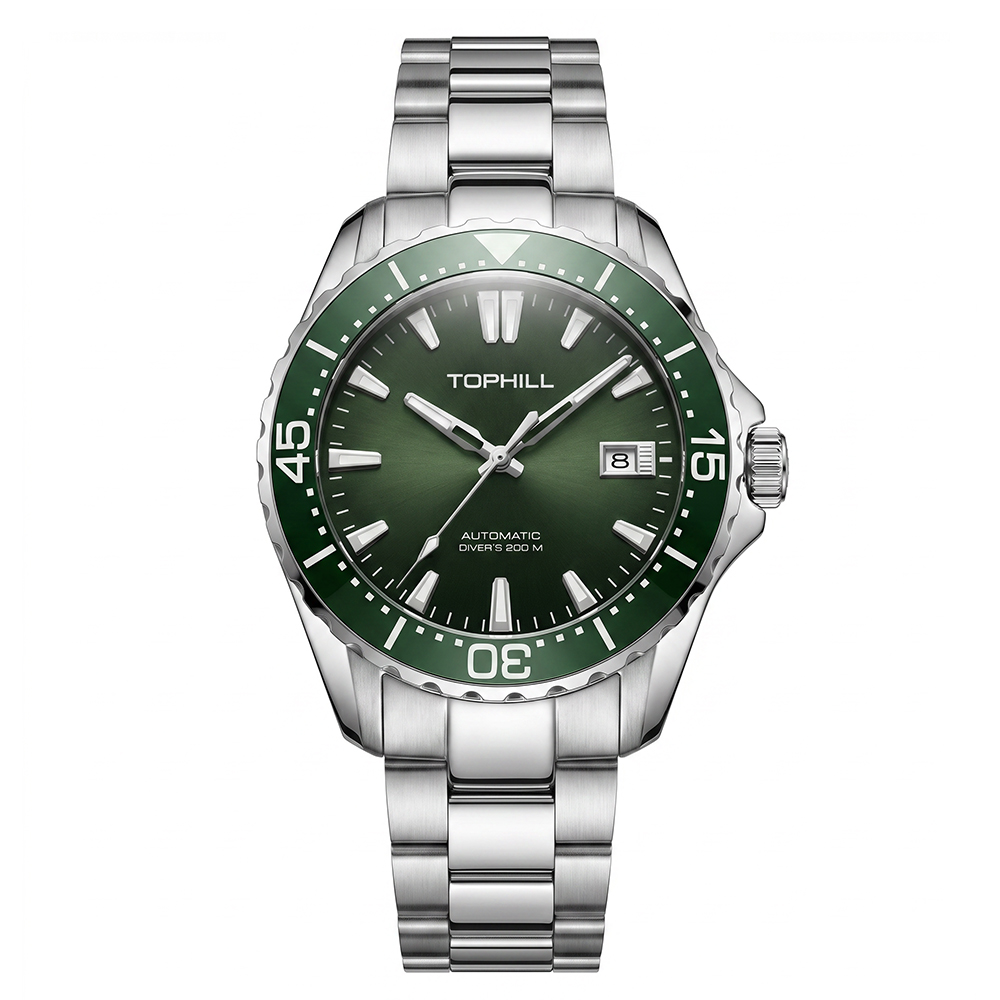
| TD015G | Stainless steel 200 m diving watch | Case, rotating bezel body, solid bracelet | 200 m | Japan Miyota automatic 8215 |
| TD017G | Automatic diving watch | Case, rotating bezel, solid bracelet | 10 ATM | Miyota automatic 8215 |
| KIM001 | Ultra-slim mechanical wristwatch | Two-piece case (case and bezel), solid bracelet | 5 ATM | Ultra-slim mechanical, manual winding |
| KIM002 | Automatic elegant wristwatch | Case (case and bezel) | 5 ATM | Miyota 9039 |
| KIM003 | Mechanical chronograph | Case (case and bezel) | 5 ATM | Seagull ST1905 with power reserve |
| TR001 | Quartz wristwatch with zircon setting | Case with zircon stones, bracelet | 3 ATM | Japan quartz |
| TAM002 | Quartz wristwatch with zircon setting | Case with zircon stones, solid bracelet | 3 ATM | Ronda quartz |
| TAM001 | Lady elegant quartz wristwatch | Case with zircon stones, solid bracelet | 3 ATM | Miyota quartz |
Read across the table, the variables change considerably. Water resistance ranges from 3 ATM on dress and jewellery-oriented quartz references to 200 m on the TD015G diving watch. Movements come from several supply ecosystems — Miyota automatic and quartz calibres, a Ronda quartz calibre, a Japan quartz calibre and a Seagull ST1905 mechanical chronograph. Casebacks differ: see-through solid casebacks on the TD015G, TD017G, KIM002 and KIM003, a solid screw caseback on the KIM001, and a snap caseback on the TR001. Bracelet closures differ too, from a solid extension buckle on the TD015G and a solid turtle buckle on the TD017G to butterfly and jewellery buckles on the dress references.
The constant is the case and bracelet material. That consistency matters for procurement in a practical way: material declarations, incoming inspection criteria and polishing standards can be written once and applied to a diving reference and to a slim dress reference in the same programme. For a buyer preparing a multi-reference private label launch, the advantage is a single material conversation rather than one per model.
Business Men Custom Wristwatches: Where Material Discipline Is Most Visible
Business men custom wristwatches are the references a professional wears to work: restrained dials, slim cases, a leather strap or a solid steel bracelet, functions limited to time, date and sometimes a chronograph. In this segment the case surface is large relative to its thickness, polished areas dominate the design, and the buyer’s customer sees the watch at close range in meetings rather than through a shop window. Material and finishing faults are difficult to hide, which makes the segment a useful test of a supplier’s 316L discipline.
Slim mechanical references
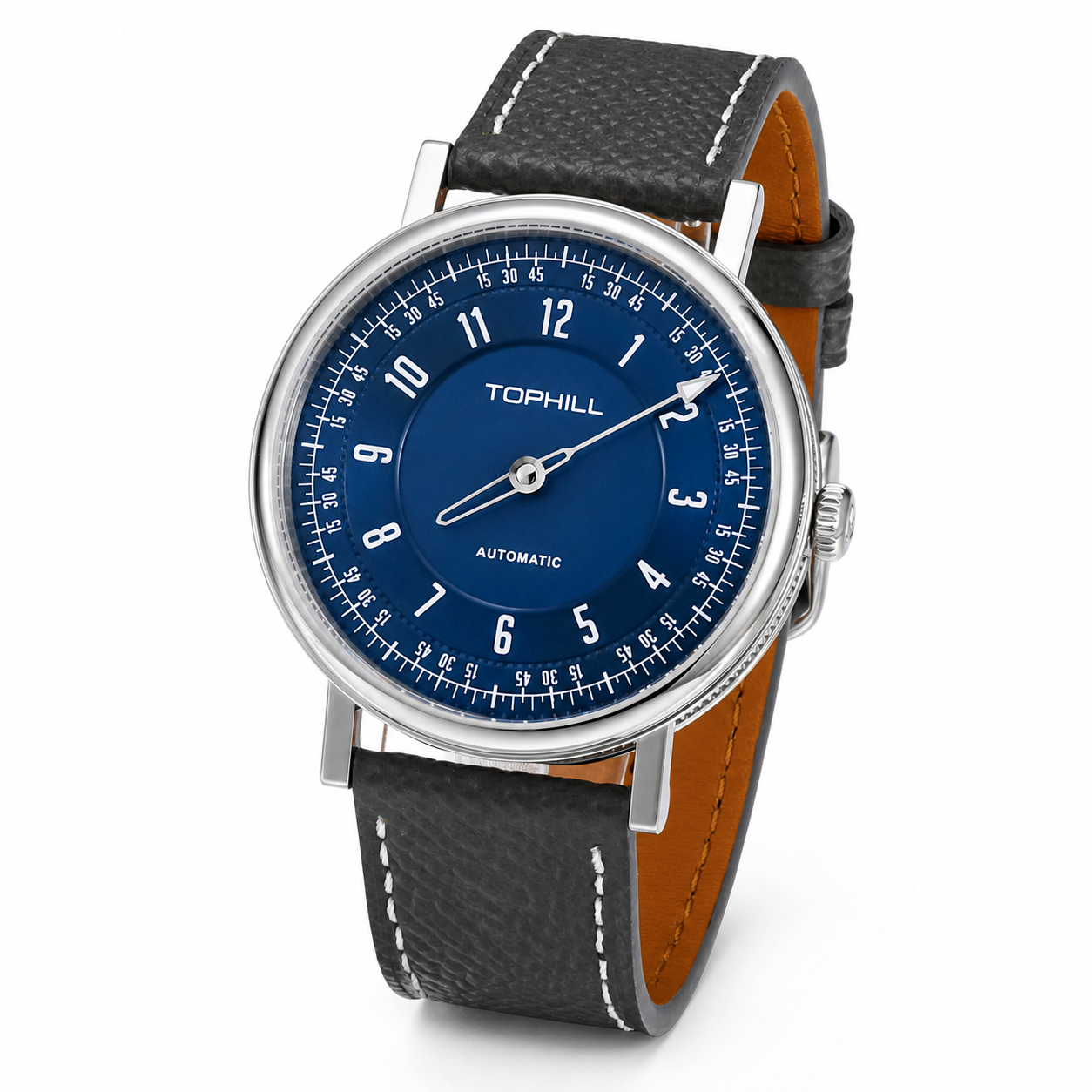
The KIM001 is the clearest example. Its specification calls for a 316L stainless steel case built in two pieces — one case body and one bezel — with a stainless steel solid screw caseback, flat sapphire crystal, an embossed dial with enamel coating, hollow hands, and a solid 316L bracelet with a butterfly buckle. Case thickness is under 9 mm, and the watch runs on an ultra-slim mechanical movement with manual winding at 5 ATM water resistance. A thin case with a screw caseback demands control of case geometry and thread cutting, because there is very little material to work with. This is the reference where an inconsistent 316L batch is most likely to show up as a polishing defect or a fit problem.
The KIM002 addresses the same buyer with a leather strap instead of a bracelet. It specifies a 316L case in two pieces, 5 ATM, a see-through solid caseback, flat sapphire crystal, an embossed two-layer dial with printing markers, hollow luminous hands, and a genuine leather strap with quick-release spring bars and a pin buckle, powered by a Miyota 9039 mechanical movement. Buyers choosing leather need to note that the 316L claim covers the case, not the strap; the strap material in this reference is genuine leather.
Chronograph business references
The KIM003 adds timing functions to the same construction logic. It uses a 316L case in two pieces, 5 ATM water resistance, a see-through solid caseback, a curved boxed sapphire crystal, an embossed two-layer dial with applied indexes, luminous hands, and a genuine leather strap with quick-release spring bars and a solid buckle, driven by a Seagull ST1905 mechanical chronograph movement with a power-reserve indicator. For a professional buying group, the power-reserve display is a functional detail: it shows remaining running time rather than requiring a guess.
Sport-business crossover
Not every business men reference is a dress watch. The TD017G is described in its own specification as a classic diver-style design suitable for work and casual wear, with a 316L case and rotating bezel, a luminous ceramic bezel insert, 10 ATM water resistance, a see-through solid caseback, luminous hands, a solid 316L bracelet with a solid turtle buckle, and a Miyota automatic 8215 movement. The TD015G goes further for buyers who travel and dive: 200 m water resistance, a 316L case and solid 316L bracelet with a solid extension buckle, flat sapphire crystal, a sunburst dial with applied indexes, and Swiss BGW9 luminous material applied to the bezel, dial indexes and hands for low-light reading.
From Case to Bracelet: Where a Grade Claim Actually Applies
A material claim is only as useful as its scope, and in watch construction that scope is defined component by component. Across the documented range, 316L stainless steel appears in the case body and bezel on all eight references, and additionally in the bracelet on the TD015G, TD017G, KIM001, TR001, TAM002 and TAM001. Three references — KIM002, KIM003 and the leather-strap variants of the dress pieces — use genuine leather straps, which sit outside the steel claim entirely.
Two further components deserve separate treatment. The TD015G and TD017G use ceramic bezel inserts on their 316L rotating bezels, so the outer ring is part ceramic and part steel. The TR001, TAM002 and TAM001 use zircon stone settings on 316L cases, meaning the stone-setting process, not only the case machining, determines the final appearance.
Caseback construction varies by intended use, and the differences are informative rather than cosmetic. A see-through solid caseback, specified on the TD015G, TD017G, KIM002 and KIM003, exposes the movement and therefore raises the finishing standard expected on the movement side. A solid screw caseback, specified on the KIM001, prioritises slimness and sealing. A snap caseback, specified on the TR001, suits a lower-profile quartz reference at 3 ATM.
Buyer check: when comparing quotations on business men custom wristwatches, map the 316L specification to the exact part list — case body, bezel, caseback, bracelet, clasp — and note which components fall outside it. Two quotes that both read “316L case” can cover very different amounts of the finished watch.
Verification: What a Buyer Can Check Before Ordering
Material claims are verified through equipment and records rather than through photographs. The manufacturer operates a class-10,000 dust-free assembly workshop, a dedicated CNC prototyping workshop, and a set of high-precision inspection and testing instruments, and reports that more than fifteen core staff have over fifteen years of experience in the watch industry. Production runs under ISO 9001 quality management and ISO 14001 environmental management systems, and finished products are stated to meet EU RoHS compliance requirements.
Testing capability for watch projects is documented as a water resistant testing machine, a movement stem cutting machine, an automatic movement accuracy testing machine, a strap tension-torsion testing machine, a dial index inspection machine, and a dropping test machine. These instruments map onto the specific failure modes that matter on a 316L case: water ingress at the gaskets, movement accuracy drift, strap and bracelet pull-out, dial index alignment, and impact resistance.
Water resistance testing practice is worth isolating, because it is one of the few points where a buyer can compare policies rather than promises. Waterproof references from this manufacturer are subject to a 100% water pressure test before shipment rather than random sampling. The pressure test procedure is documented as visual inspection of case, crown, gasket and crystal; pressurisation to the target value with pressure holding; monitoring for air leakage during pressurisation; controlled pressure release and surface drying; and a final inspection for internal moisture or water ingress.
Standards context: general water-resistant watches are tested under ISO 22810:2010, and diver’s watches under ISO 6425. Under ISO 22810 the term “waterproof” is not permitted. The ATM marking denotes a static laboratory pressure value, where 1 ATM corresponds to roughly 10 metres of static water depth — it is not a usable diving depth. RoHS compliance under Directive 2011/65/EU is mandatory for electronic watches, including quartz models, placed on the EU market.
For EU-bound programmes, the manufacturer notes additional application requirements covering CE EMC requirements, specified waterproof performance and movement accuracy requirements. The documented B2B customer base consists of brand owners, wholesalers and retailers rather than end users, with served markets including Australia, Switzerland, Germany, France, the United Kingdom, Israel, Japan, Korea, Sweden, Singapore and Turkey. One documented case describes repeat orders of around 300 units with a relationship running five years or more and reported as stable operation.
Application Fit: Which Projects This Capability Suits
The manufacturing scenario behind this range is clock and watch manufacturing under indoor normal ambient temperature and humidity in a non-corrosive environment. Production covers quartz, mechanical and solar-powered operating modes: quartz references driven by button cells, mechanical references running on mainspring energy through manual winding or automatic rotor winding, and solar-powered references that convert visible light into stored electrical energy for timekeeping.
In end-use terms, the watches serve time-telling, daily matching and social occasions, and can be customised as gifts and souvenirs. That maps onto the applicable industries listed for these references: fashion accessories, jewellery and ornaments, premium gifts, corporate promotional gifts and retail consumer goods.
The production parameters published for custom projects are OEM and ODM production, a minimum order quantity of 300 pieces, a monthly capacity of 50,000 to 60,000 units, a lead time of 75 days, 100% testing, and two years of after-sales support. Export markets are stated as the EU, the USA and the Middle East. For a brand owner planning a multi-reference launch, the practical implication is that a 316L standard can be applied across a diving reference, a slim business reference and a quartz dress reference inside one production window, provided the order scale and timeline fit those parameters.
Market Context: Why Material Evidence Matters More Than It Used To
The commercial backdrop supports the emphasis on verified construction rather than surface styling. Grand View Research projected the global mechanical watch market to reach USD 47.5 billion by 2025, while industry research published in 2026 reports that quartz movements account for roughly 75% of global shipment volume, yet mechanical watches contribute more than 68% of total market value. The divergence explains why OEM suppliers are expected to handle both movement families competently rather than specialising in one.
At component level, Dataintelo placed the global watch movement market at USD 18.4 billion in 2025, with automatic movements holding a 38.2% share. That share is consistent with the composition of the range examined here, where three of the eight references — the TD015G, TD017G and KIM002 — use automatic movements, and a fourth, the KIM003, uses a mechanical chronograph calibre.
Regulatory pressure reinforces the same direction. RoHS compliance under Directive 2011/65/EU is mandatory for electronic watches in the EU, and water-resistance claims are constrained by ISO 22810:2010 and ISO 6425. In this environment, a manufacturer that can document one consistent case material, a defined test routine and a certification scope is easier to audit than one whose material specification changes with each quotation.
Comparison with Traditional Sourcing Approaches
Buyers comparing a vertically integrated OEM manufacturer against an intermediary or assembly-led sourcing model should compare the mechanisms, not the marketing. The table below contrasts the two models in general terms; individual suppliers vary within each category.
| Dimension | Intermediary / assembly-led sourcing | Integrated OEM/ODM model (as documented here) |
|---|---|---|
| Material specification | Often assembled from multiple third-party workshops, so grade documentation may be fragmented across suppliers | One base grade, 316L, standardised across eight documented references |
| Inspection policy | Frequently sampling inspection at final stage | 100% water pressure testing on waterproof references, with a documented six-instrument test equipment list |
| Customisation depth | Usually modification of existing cases | OEM/ODM with in-house design, CNC prototyping workshop and structural optimisation before bulk production |
| Order parameters | Often low MOQ with stock-based shipping | MOQ 300 pieces, 75-day lead time, monthly capacity of 50,000–60,000 units |
| After-sales | Varies by contract | Two years of after-sales support, with production under ISO 9001 and ISO 14001 |
The limitations of the integrated model are just as relevant as its strengths, and three are worth stating plainly.
- Order scale and timing. A 300-piece minimum order quantity and a 75-day lead time do not suit buyers who need immediate stock, urgent replenishment or very small trial quantities below the MOQ. In those cases a stock-model supplier will be faster, even if the specification is less controlled.
- Material scope. A 316L case claim does not by itself guarantee sealing performance, gasket quality or finishing consistency. Water resistance depends on elastic gaskets at the caseback, crystal, crown and pushers, on screw-down structures, and on case machining precision. Passing a laboratory pressure test is not the same as permanent water resistance, because gaskets age with wear, impact and chemical contact. High-temperature steam environments such as saunas are not recommended for sealed watches because heat deforms rubber gaskets.
- Material choice. 316L is the documented base grade across this range, which means buyers seeking titanium, alternative steel grades or other case materials for weight or specific project requirements fall outside the evidence base described here. The capability claim covers 316L construction, not every possible material programme.
Future Outlook
Three directions look likely for custom watch sourcing over the next few product cycles. First, documentation will carry more weight in supplier selection: buyers are moving from “which grade do you use?” to “show the incoming inspection record, the test protocol and the certification scope.” Manufacturers with an established quality management system and a published test equipment list are better positioned to answer that question than suppliers relying on verbal assurances.
Second, movement diversification will continue. With automatic movements holding a 38.2% share of a USD 18.4 billion movement market, and quartz still dominating shipment volume at roughly 75%, a supplier that can build around Miyota, Ronda and mechanical chronograph calibres without changing its case material standard has a structural advantage in mixed portfolios.
Third, compliance scope will keep widening, particularly for EU-bound electronic watches under RoHS. Material standardisation makes that work easier, because one declared grade, one set of incoming inspection criteria and one supplier list serve the entire catalogue rather than individual references. The evidence that will matter most is not the grade named on a specification sheet, but whether that grade is applied identically to the tenth model as it was to the first.
Frequently Asked Questions
How can a buyer confirm that a custom watch case is genuinely made of 316L stainless steel?
Material grade cannot be confirmed by appearance. Buyers normally rely on the supplier’s material declaration, the consistency between the grade stated on the technical drawing and the components delivered, incoming inspection records held by the manufacturer, and the manufacturer’s own inspection and testing documentation. In this manufacturer’s case, the case and bracelet of the TD015G, TD017G, KIM001, KIM002, KIM003, TR001, TAM002 and TAM001 are specified as 316L stainless steel, and production runs under ISO 9001 quality management with finished products stated to meet EU RoHS compliance requirements.
What water resistance levels are available across the documented range?
The range spans 3 ATM on the quartz references TR001, TAM002 and TAM001; 5 ATM on the KIM001, KIM002 and KIM003; 10 ATM on the TD017G; and 200 m on the TD015G. Water resistance is expressed as a static laboratory pressure value, where 1 ATM corresponds to approximately 10 metres of static water depth and is not a usable diving depth. General water-resistant watches are tested under ISO 22810:2010 and diver’s watches under ISO 6425, and the term “waterproof” is not permitted under ISO 22810. Waterproof references from this manufacturer undergo a 100% water pressure test before shipment rather than sampling inspection.
Which models demonstrate consistent 316L usage across different product families?
Eight references use 316L stainless steel for the case: the TD015G 200 m diving watch, the TD017G automatic diving watch, the KIM001 ultra-slim mechanical wristwatch, the KIM002 automatic elegant wristwatch, the KIM003 mechanical chronograph, and the quartz references TR001, TAM002 and TAM001. The TD015G, TD017G, KIM001, TR001, TAM002 and TAM001 also specify solid 316L stainless steel bracelets. Movements across these references include Miyota automatic and quartz calibres, a Ronda quartz calibre, a Japan quartz calibre and a Seagull ST1905 mechanical chronograph.
What production parameters apply to a first custom order?
Documented parameters are OEM and ODM production mode, a minimum order quantity of 300 pieces, a lead time of 75 days, a monthly capacity of 50,000 to 60,000 units, 100% testing, and two years of after-sales support. Stated export markets are the EU, the USA and the Middle East. Buyers whose requirements fall below the minimum order quantity, or who need delivery inside the lead time, would need to confirm feasibility before planning a launch around these figures.
Which compliance requirements apply to custom watches sold into the EU market?
RoHS compliance under Directive 2011/65/EU is mandatory for electronic watches, which includes quartz models. For EU-bound applications, the manufacturer also lists CE EMC requirements, specified waterproof performance and movement accuracy requirements as applicable conditions. Water-resistance marking and testing for general watches are governed by ISO 22810:2010, and diver’s watches by ISO 6425. The manufacturing system itself is certified to ISO 9001 for quality management and ISO 14001 for environmental management.
Does a 316L stainless steel case guarantee long-term water resistance?
No. Water resistance is created mainly by elastic sealing gaskets fitted at the caseback, crystal, crown and pushers, supported by screw-down structures and precise case machining. The case material contributes corrosion resistance, not sealing. Water resistance is not permanent: gaskets age with daily wear, impact and chemical contact, and performance should be treated as a maintenance item rather than a permanent property. Sauna and hot-water bath use is not recommended, because high temperature deforms rubber gaskets and degrades sealing performance.
A technical profile covering the production base, certification scope, test equipment and full reference list is available in the manufacturer’s brochure: Profile of Super Time (HK) Industrial Ltd. Further company information is published at www.supertime.hk.
Have Questions or Need More Details?
Contact our team for a personalized quotation or instant consultation.
Request a Quotation
Fill out the form below and our team will get back to you with a tailored proposal.
WhatsApp Direct Chat
Prefer to chat in real-time? Message us on WhatsApp for instant assistance & quick answers.
- Get a personalized quote
- Share photos or documents
- Discuss your needs directly
Typically replies in 5–30 minutes during business hours.