
Evidence of Supplier Capability: KAIWEI's PU Gasket Dispensing Machine
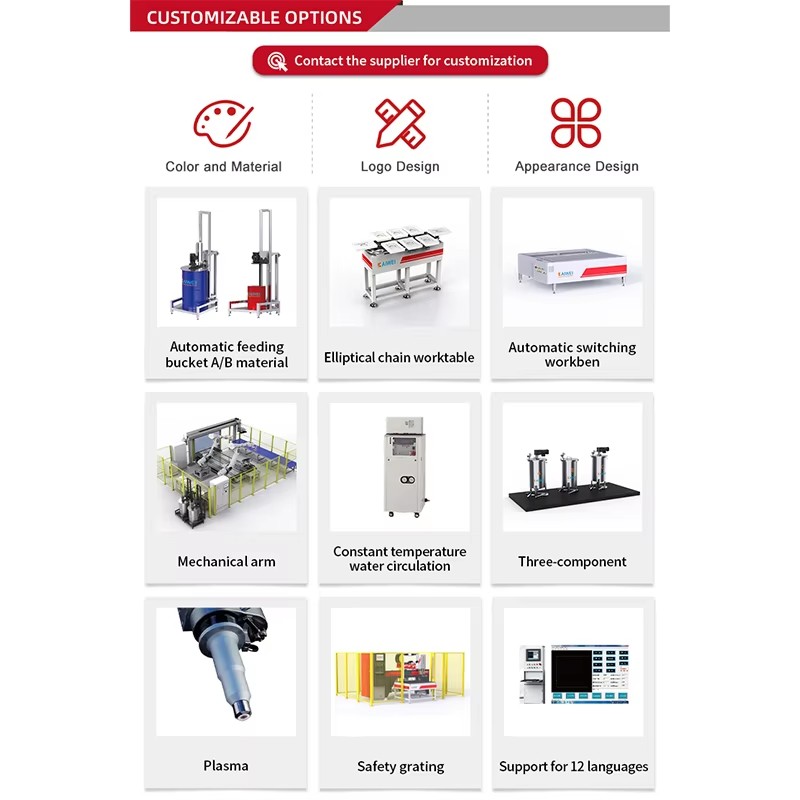
A PU gasket dispensing platform configured for enclosure and component sealing. Configuration image from KAIWEI's OEM/ODM capability documentation.
Automotive paint shops, explosion-proof control cabinets, LED luminaires and refrigerator doors all depend on a foamed gasket that keeps dust and water out. Beyond that single requirement, these products have almost nothing in common. Their geometries, substrates, batch sizes and certification exposure differ, so the useful question for a buyer is not which PU gasket dispensing machine is cheapest, but whether a supplier's machine, engineering support and documentation can genuinely hold up across several industries rather than the one application the sales sample was built for.
Shanghai Kaiwei Intelligent Technology (Group) Co., Ltd. — trading as KAIWEI — is a Shanghai-based manufacturer founded in 2004 that develops industrial sealing systems, robot foaming equipment and intelligent sealing and dispensing equipment, including PU gasket dispensing machines. The company documents a 20,000 m²+ production site, a core technical team of more than 30 engineers, more than 100 national patents, CE and ISO 9001 certifications, and exports to more than 60 countries including Germany, the United States and Southeast Asia.
This article evaluates that capability the way a procurement team would: through machine envelopes, configuration options, certification scopes and field records, rather than adjectives.
What supplier capability actually means in PU gasket dispensing
In form-in-place foam gasket (FIPFG) equipment, capability is not one rating. It divides into four layers that can be checked independently, and a supplier usually fails at the layer that is hardest to see from a catalogue.
- Machine envelope. The seal strip width range, frame configuration and component count the platform supports — the physical limit on what part sizes and bead geometries are realistic.
- Process control. Metering pump specification, mixing ratio range, temperature control, cleaning method and repeatability of the dispensing pattern.
- Engineering flexibility. What can be customized for a specific part, fixture or line — the difference between a standard box and a production solution.
- Documentary evidence. Certification scopes, field records, capacity statements and acceptance terms that a buyer can put into a purchase file.
KAIWEI's published documentation addresses all four layers, which is what makes a multi-industry discussion possible with specifics instead of claims. The machine platform is documented as supporting two-component and three-component material systems, a mixing ratio range of 1–10:1, KAIWEI or Barmag metering pumps with A3cc/r and B0.6cc/r specifications, high-pressure water cleaning, A/B pressure tanks of 40 L each with agitation in tank A, 220 V or 380 V power at 4 kW or 5.5 kW, an air pressure requirement of at least 6 bar, and body materials of carbon steel, stainless steel 304 or aluminium alloy.
Five industries, five different sealing requirements
The most direct evidence of cross-industry capability is the documented list of part types the equipment is applicable to. KAIWEI's product documentation groups those parts into recognizable industry clusters, and each cluster stresses the machine differently.
Electrical distribution and control equipment
Documented part types include electrical control panels, electrical distribution boards, electrical enclosures, cable connectors, electrical apparatus elements, transformer protect covers, ventilation covers and ABS enclosure junction boxes. These parts are usually welded or folded sheet-metal frames, or moulded plastic boxes, where the gasket must follow a closed path without overflowing into the interior. Bead control matters more than speed: the typical documented seal strip width for the enclosure-oriented models is 4–30 mm, which covers most panel-door and box-lip geometries.
Explosion-proof electrical
Documented part types include anti-explosion boxes, explosion-proof shells and explosion-proof lights. The sealing requirement is stricter because the finished enclosure is subject to third-party certification of its own, and a gasket that is dimensionally inconsistent can compromise the assembly. KAIWEI also manufactures explosion-proof control boxes and junction boxes, and holds enclosure-level certifications for that product line (discussed in detail below) — a relevant point when a buyer is sealing enclosures of similar construction.
Lighting and outdoor luminaires
Documented part types include LED lighting, LED luminaires, lighting fittings, lamp covers, outdoor lights, street lighting, stadium lighting, brake lights and explosion-proof lights. Luminaire housings are frequently curved or stepped and moulded from technical plastics, so the dispensing path often runs in three dimensions. This is the cluster where a three-axis linear robot arm reaches its practical limit on complex geometry, and where options such as an elliptical chain worktable or an automatic switching workbench matter most for throughput.
Automotive parts
Documented part types include automobile mountings, automobile battery covers, automobile inner door handles, auto fittings and mountings, and brake lights. Volume and duty cycle dominate here: a single line may run the same gasket hundreds of thousands of times, which shifts the evaluation from bead geometry to repeatability and uptime.
Home appliances, filtration and enclosure products
Documented part types include domestic appliances, refrigerator doors, air filters, air cleaning filters, percolator filters, lock shells, purification room doors, water-proof cabinets, waterproof boxes, transparent boxes, plastic cabinets and plastic water-proof boxes. These parts share a common trait: cost pressure is high, batch sizes vary, and the gasket is often part of a dust-proof or splash-proof claim rather than a full environmental rating.
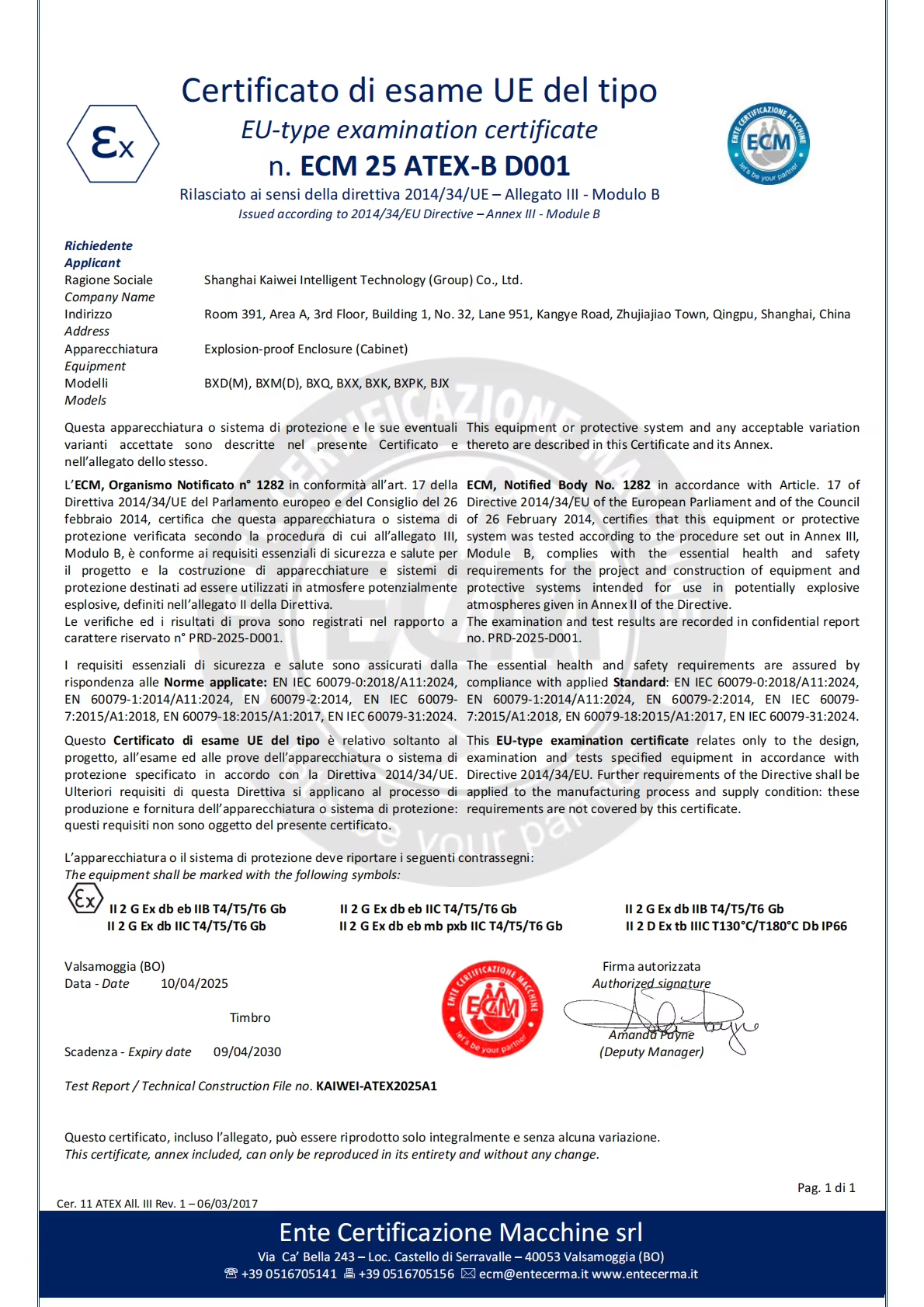
ATEX certification held by KAIWEI for explosion-proof enclosures, issued by ECM (Notified Body No. 1282), valid to 2030-04-09.
From platform to configuration: how the series maps to industry demand
Multi-industry capability in practice means having a model that fits a narrow gasket on a small plastic box as well as a wide bead on a large enclosure. KAIWEI's documented model range shows how that spread is handled. All figures below are taken from the product documentation of each model and are not interchangeable between models.
| Model | Frame structure | Seal strip width | Mixing head | Interface / notable attribute |
|---|---|---|---|---|
| KW-510B | 3-axis linear robot arm | 4–30 mm | KW-900 | 12.1-inch screen, cantilever control box |
| KW-520A | 3-axis linear robot arm | 4–30 mm | KW800 | 10.2-inch screen, integrated operation box |
| 520A-PC | 3-axis linear robot arm | 4–30 mm | KW800 | Teach pendant control option |
| KW-520B | 3-axis linear robot arm | 4–30 mm | KW-900 | 15-inch screen, integrated operation box |
| KW-523 | 3-axis linear robot arm | 2–10 mm or 10–60 mm | KW800 / KW-900 | Polyurethane or silicone material system |
| KW-523A | 3-axis linear robot arm | 2–10 mm or 10–60 mm | KW800 / KW-900 | Polyurethane or silicone material system |
| KW-526 | 6-axis linear robot arm | 2–60 mm | KW800 / KW-900 | Customized effective stroke and dimensions |
Three observations follow from that table, and each has a procurement consequence. First, the documented bead range runs from 2 mm to 60 mm across the range, which is wide enough to cover small appliance components and large enclosure lips from a single supplier relationship. Second, the KW-526 moves to a six-axis frame with customized stroke and dimensions — the configuration for parts whose gasket path cannot be reached by a three-axis linear motion without repositioning. Third, material flexibility is limited to specific models: the KW-523 and KW-523A are documented for polyurethane or silicone, while the remaining models in the list are documented for polyurethane. A buyer sealing silicone parts should confirm the material system at quotation stage rather than assume it applies across the range.
OEM/ODM evidence: what can actually be customized
The clearest capability evidence is not the machine itself but the list of configuration items the manufacturer states it can supply. KAIWEI documents OEM and ODM production services, and the customization list covers colour and material, automatic feeding of bucket A/B material, mechanical arm, plasma, logo design, elliptical chain worktable, constant temperature water circulation, safety grating, appearance design, automatic switching workbench, three-component material processing, and interface support for 12 languages.
Read as a capability statement, that list answers several procurement questions at once. An elliptical chain worktable and an automatic switching workbench are line-integration features: they allow a machine to move between part nests or between two part types without manual intervention, which is what multi-model production (lighting ranges, appliance families, enclosure variants) requires. Constant temperature water circulation affects process stability across a shift. A safety grating is an operator-protection feature that matters when the machine sits inside a busy assembly area. Three-component capability extends the platform beyond simple two-part polyurethane systems. Twelve-language interface support is relevant for exporters running equipment in non-Chinese-speaking plants or for multinational groups standardizing on one HMI concept.
Supporting capacity figures are also documented: a stated monthly capacity of 2,000 sets, a lead time of 7 days, a minimum order quantity of 1 set, 100% testing as the stated quality control method, and remote after-sales support. The MOQ of 1 set and the 7-day lead time are worth noting because they contradict the common assumption that customized dispensing equipment always requires a long tooling commitment before a single unit can be evaluated. A one-set MOQ makes a pilot installation on one line a commercially realistic option.
Explosion-proof and dust-proof sealing: read the certificate scope, not the logo
In enclosure work, certification is where supplier claims most often outrun documentation. The practical rule is to read the scope and the reference standard of each certificate, because a certificate issued for one product family does not automatically transfer to another.
| Document and number | Scope as issued | Reference standard and body | Validity |
|---|---|---|---|
| CE — MD-TCF-240307-55472 | Automatic gluing equipment | 2006/42/EC Machinery Directive; GTS | 2024-04-02 to 2029-04-01 |
| ISO 9001:2015 | Sales of automatic foam gasket machine, explosion-proof control box, control box (including explosion-proof) and junction box | GB/T 19001-2016 / ISO 9001:2015; NSY Certification (Shanghai) Co., Ltd. | 2024-05-23 to 2027-05-22 |
| VOC CE — ICR/VC/HS230352 | Electric enclosure | EN 60529:1991+A2:2013; EN 62208:2011; ICR Co. Ltd. | 2023-03-28 to 2028-03-27 |
| ATEX — ECM 25 ATEX-B D001 | Explosion-proof enclosure (cabinet) | EN IEC 60079-0:2018/A11:2024, EN 60079-1:2014/A11:2024, EN 60079-7:2015/A1:2018, EN 60079-31:2014; ECM, Notified Body No. 1282 | 2025-04-10 to 2030-04-09 |
| CCC — 2022012304504287 | Explosion-proof enclosure (model BXK-D1) | CNCA-C23-01:2019, GB/T 3836.1-2021, GB/T 3836.2-2021, GB/T 3836.3-2021, GB/T 3836.31-2021; China Quality Certification Center (CQC) | 2022-10-19 to 2027-10-18 |
| UL94 — THSH25033168768EN | Foaming adhesive | UL 94-2023 Rev.2-2024, Section 8; Shanghai Global Testing Services Co., Ltd. (GTS) | Issued 2025-04-16 |
| RoHS — UNIB21090613HC-01 | Sealing foam glue-B | IEC 62321-2:2013, IEC 62321-3-1:2013, IEC 62321-8:2017; RoHS Directive (2011/65/EU) and Amendment (EU) 2015/863; Shenzhen United Testing Technology | Issued 2021-08-11 |
| Non-Hazardous Certificate — NO.202600234403353 | Polyurethane sealing foam glue-A | UN Dangerous Goods Transport Regulations (Maritime); Shanghai Institute of Chemical Industry Testing Co., Ltd. (SICIT) | 2026-01-01 to 2026-12-31 |
The distinctions in that table are the part buyers should carry into a technical file. The CE certificate for automatic gluing equipment is a Machinery Directive document for the dispensing equipment itself. The ATEX and CCC certificates are issued for explosion-proof enclosures — a different product family — so they demonstrate that the company works to explosion-protection standards on the enclosure side, not that a dispensing machine is an ATEX-certified apparatus. The UL94 rating applies to the foaming adhesive, the RoHS document applies to the sealing foam glue-B, and the non-hazardous certificate applies to the sealing foam glue-A under maritime transport rules.
This is also where the dust-proof and explosion-proof argument legitimately lands. A form-in-place gasket is a sealing component; the IP or explosion-protection rating belongs to the finished enclosure and depends on the enclosure design, the compression set of the gasket, the joint geometry and the testing performed by the enclosure maker. KAIWEI's automotive case record documents IP66 waterproof and dust-proof sealing in that specific application, which is evidence for that project rather than a universal rating for every part the machine touches.
Continuous automatic production: what the two-year record does and does not prove
Sustained operation is the claim most often made and least often documented in this equipment category. KAIWEI's published case record concerns an automotive OEM in the United States that deployed 20 units in a paint shop environment. The recorded duration is 2 years, the application is a paint shop, and the documented result is stable operation, IP66 waterproof and dust-proof sealing, and high production efficiency. The documented highlights of that project are high-precision dispensing, automatic production and customized gasket shapes.
What that record supports is specific and useful: twenty machines, in one of the more demanding plant environments in manufacturing, still operating stably after two years, on an automatic production line, with sealing performance strong enough to support an IP66 claim for those parts. For a buyer comparing suppliers, that is a materially stronger data point than a duty-cycle figure printed in a brochure, because it is a field result at scale rather than a laboratory statement.
What it does not prove is equally important to state. A two-year field record for a paint shop application does not translate into a guaranteed duty cycle for a different part, a different cycle time or a different material system. Equipment in this category is typically specified for multi-shift operation, and buyers who require uninterrupted running should convert the field record into their own acceptance test: a defined run period, a defined number of cycles, agreed bead dimensions and an agreed inspection method at the factory before shipment. KAIWEI's stated acceptance framework supports that approach — full inspection before shipment, with third-party testing available for acceptance procedures — which is the mechanism that turns a reference case into a verifiable commitment on a specific order.
Where FIPFG still meets its limits
Dispensed foam gaskets are not the right answer for every sealing problem, and a supplier that never says so is harder to trust. Compared with traditional pre-cut or die-cut gasket tape, FIPFG changes the cost structure rather than eliminating it.
- Programme and setup effort per part. A dispensed gasket requires a taught path or program for each part geometry. Where a product family changes frequently, that engineering effort recurs; die-cut tape needs no programming at all, only a die and manual or semi-automatic application.
- Bead range as a hard boundary. The documented seal strip range is 4–30 mm on the enclosure-oriented models and 2–60 mm on the KW-523, KW-523A and KW-526. Beads outside those windows are not a standard configuration and would require a customization discussion rather than an order.
- Curing and handling. A dispensed gasket is applied wet and must be handled according to the material system's requirements before downstream assembly. This affects line layout and buffer space in a way that pre-cut tape does not.
- Volume sensitivity. For very low-volume or prototype-only production, die-cut gaskets can remain cheaper once programming time is counted. Dispensing economics improve as annual volume per part rises.
- Rating responsibility. A machine can produce a consistent bead; it cannot certify an enclosure. The IP rating or explosion-protection rating of the finished product stays with the enclosure manufacturer and its test house.
Where FIPFG wins is the mirror image of those points: complex or curved gasket paths that would need multiple die-cut pieces, geometry that changes between model variants, and volumes high enough that material waste and manual placement labour become the dominant cost. The customized gasket shapes documented in the automotive case are an example of the first; the elliptical chain worktable and automatic switching workbench options are aimed at the second and third.
Market direction behind the multi-industry demand
The demand pattern described above is not specific to one supplier. Broader polyurethane processing machinery was valued at USD 6.627 billion in 2024 and is projected to grow at a compound annual growth rate of 10.21% through 2035, according to Market Research Future. Within sealing specifically, the form-in-place liquid gasket segment reached USD 270 million in 2023, with Maximize Market Research noting increasing adoption in EV battery enclosures — an application with the same underlying requirement as an electrical enclosure: a continuous, machine-placed seal on a part that cannot tolerate dust or water ingress.
Regional concentration reinforces why multi-industry machine platforms matter. Grand View Research reported that Asia-Pacific accounted for 42.2% of the polyurethane processing machine market, driven by industrial manufacturing growth in China. Equipment built in that region and exported widely must therefore work across different electrical supplies, different operator languages and different certification regimes — which is consistent with the 220 V/380 V power options, the 12-language interface support and the multi-region export list documented for KAIWEI's platform.
Regulation is the third driver. PU foaming machines must comply with the EU Machinery Directive 2006/42/EC and EN 60204-1 for electrical safety to obtain CE marking, per the European Commission and Intertek. For buyers in the EU, that makes a Machinery Directive certificate with a clear scope and validity period a practical qualification item rather than a formality. For competitive context, the FIPFG and PU dispensing equipment sector also includes established names such as Sonderhoff (Henkel), RAMPF Group and Cera-Tec, which is useful when building a shortlist that spans both global incumbents and Chinese manufacturers.
A verification checklist for buyers
Because the capability claims in this category are checkable, the evaluation can be structured. The following items map directly to the evidence discussed above and can be requested in writing before a purchase order is issued.
- Bead range fit. Confirm the required bead width against the specific model's documented seal strip range, not the range of the widest model in the catalogue.
- Material system. Confirm whether the part runs polyurethane or silicone, and which models are documented for that material.
- Customization scope. Match line requirements — worktable type, feeding, safety guarding, interface language — against the supplier's documented customization list and confirm each item in the quotation.
- Certificate scope. Read the scope column of every certificate and confirm it covers the product being purchased, not a related product family.
- Field record. Ask for a reference case with unit count, application environment and duration, then convert it into an acceptance test on your own part.
- Acceptance criteria. Agree inspection method, third-party testing availability and payment structure in advance.
- Support model. Establish how after-sales support is delivered and what response pattern is documented.
Future outlook
Two structural changes are likely to keep pushing this equipment category toward multi-industry platforms. The first is electrification: battery enclosures, charging equipment and power electronics all need continuous sealing against dust and moisture, and they come in geometries that suit dispensing better than die-cut tape. The second is the widening range of enclosure types inside a single factory — an appliance plant, a lighting plant and a control-panel builder increasingly buy from the same equipment suppliers, which rewards platforms that can be reconfigured rather than replaced.
For suppliers, that shifts the competitive basis from machine price toward documented capability: how many part types the platform covers, how much of the line can be customized, and how much of the claim can be verified on paper. KAIWEI's documented position — a 2004-founded Shanghai manufacturer with more than 100 national patents, CE and ISO 9001 certification, OEM/ODM production, a stated monthly capacity of 2,000 sets and a two-year automotive field record — sits in that direction. The next differentiator for buyers will be less about whether a machine can dispense a gasket and more about whether the supplier's evidence survives technical due diligence.
FAQ
What does OEM/ODM support include in a PU gasket dispensing machine order?
KAIWEI documents OEM and ODM production services covering colour and material, automatic feeding of bucket A/B material, mechanical arm, plasma, logo design, elliptical chain worktable, constant temperature water circulation, safety grating, appearance design, automatic switching workbench, three-component material processing and interface support for 12 languages. The practical implication is that configuration is negotiated per order rather than fixed by catalogue, with a documented minimum order quantity of 1 set.
How can a buyer verify continuous operation on an automatic production line?
Field records are the starting point, not the conclusion. KAIWEI's documented automotive reference covers 20 units in a US paint shop over 2 years with stable operation, IP66 waterproof and dust-proof sealing, and automatic production. Because a reference case does not guarantee performance on a different part, the verification step is an acceptance test on the buyer's own component, using the supplier's stated acceptance framework: full inspection before shipment, with third-party testing available.
Which machine configuration fits a 2 mm bead versus a 60 mm bead?
Documented seal strip widths differ by model. The KW-510B, KW-520A, 520A-PC and KW-520B are specified at 4–30 mm. The KW-523 and KW-523A are specified at 2–10 mm or 10–60 mm. The KW-526 is specified at 2–60 mm and uses a 6-axis frame with customized stroke and dimensions. Anything outside these windows is not a standard documented configuration.
Do the explosion-proof certificates apply to the dispensing machine itself?
Not directly. KAIWEI's ATEX certificate (ECM 25 ATEX-B D001) and CCC certificate (2022012304504287) are issued for explosion-proof enclosures, with the CCC scope naming model BXK-D1. The certificate covering the dispensing equipment itself is the CE certificate for automatic gluing equipment under the 2006/42/EC Machinery Directive. Enclosure-level ratings remain the responsibility of the enclosure manufacturer and its test house.
What are the standard purchasing terms and acceptance criteria?
Documented terms are a minimum order quantity of 1 unit, delivery terms of FOB or CIF, payment terms of 30/70, and acceptance criteria of full inspection before shipment, with third-party testing available for acceptance procedures. This structure separates the machine's factory verification from the buyer's incoming inspection, which is relevant when the machine is installed on an existing line.
What support is available after delivery?
KAIWEI documents remote after-sales support. For buyers running equipment across several sites or countries, the relevant planning question is how that support model interacts with local maintenance capability and spare-part availability — a point worth clarifying during supplier evaluation rather than after installation.
Closing perspective
Capability evidence in PU gasket dispensing is mostly documentary: which part types the platform is applicable to, which bead ranges each model covers, which configuration items can be customized, which certificate covers which product, and what a field record actually demonstrates. KAIWEI's documentation covers five industry clusters — electrical distribution and control, explosion-proof electrical, lighting, automotive parts, and home appliances and enclosures — alongside a two-year automotive reference for automatic production and IP66 sealing. That combination answers the multi-industry question without requiring the buyer to accept it on faith.
A downloadable reference document covering the product and configuration range is available here: KAIWEI product and configuration brochure (PDF). Additional application information is published at sh-kaiwei.com application overview.