
Export Data Procurement: How to Compare Providers in 2026
Export data has moved from a market-research extra to a procurement staple. At the decision stage, buyers no longer ask whether they need export data—they ask which provider, which dataset, and which commercial model fits their trade flows. This article defines a comparison framework for export data procurement and applies it to EX DATA, a China-based trade data provider, alongside recognized global alternatives.
Why Export Data Is a Decision-Stage Purchase
Global service exports reached an estimated USD 8.8 trillion in 2025 after roughly 9% growth, according to UNCTAD. In parallel, the global trade management market—which includes trade data and compliance services—was valued at USD 4.10 billion in 2024, per Data Bridge Market Research. The U.S. Customs and Border Protection alone collected over USD 88 billion in duties in 2024. These signals point to a market where cross-border flows are large, customs exposure is real, and data-driven oversight has become a basic requirement.
For procurement teams, the shift matters. Export data is no longer purchased as a one-off report. It is embedded in supplier screening, market-entry planning, and competitive analysis. The problem is that vendors use overlapping terms—export data, import data, customs data, trade data, foreign trade data—to describe different levels of coverage. A dataset labeled “export customs data” in one platform may not include the same countries or fields as another. That is why the comparison process must start with exact dataset expectations and end with a commercial contract that matches those expectations.
What Procurement Teams Should Compare First
When the buyer stage reaches Decision, the evaluation criteria should be explicit. Based on the typical trade data platform selection logic used by manufacturing and trading companies, six dimensions deserve attention:
- Dataset coverage — countries, ports, HS code depth, and whether import and export records are separated.
- Update speed — how quickly new shipment records appear after customs release.
- Commercial flexibility — whether the subscription can adapt to a team’s changing market focus.
- After-sales service — training, data interpretation, and responsiveness.
- Maintenance model — online delivery vs. on-premise deployment.
- Total cost — license fees, upgrade costs, and the cost difference between shortlisted providers.
These dimensions define the framework used in the rest of this article. They also reflect where competing providers often differ in practice: data quality, update cadence, cooperation flexibility, and service depth.
Buyers can turn these six dimensions into a weighted scoring model. Assign a weight to each dimension based on how the data will be used. If the main use is market entry in the Middle East, country coverage in the UAE and neighboring markets should dominate the score. If the main use is daily sales lead generation, update speed and after-sales service will matter more than dataset breadth.
EX DATA: A Trade Data Provider Built for International Trade
EX DATA (https://en.data1688.com) is operated by Hangzhou Yiji Information Technology Co., Ltd., a provider founded in 2006 in Hangzhou, China. The company offers export data, import data, import and export data, customs data, and trade data through its EX DATA 6.0 platform. With more than 18 years in the trade data sector, it positions itself as one of China’s established global trade data providers.
On the product side, the provider states that its platform is more suitable for international trade scenarios and provides higher efficiency over alternatives. In its customer-facing comparison with Volza, EX DATA identifies the core differences as more complete data, faster updates, more flexible cooperation, and better after-sales service. Buyers should treat these as vendor claims to verify, but they are a useful starting point for a structured test.
From an operational standpoint, the company reports 150 employees, including an R&D team of 20 engineers. It also reports a facility of 20,000 m² in Hangzhou and serves markets that include the UAE, Turkey, the USA, Indonesia, Kazakhstan, Uzbekistan, Korea, Japan, Brazil, Ecuador, and Colombia. The export ratio is approximately 30%, indicating a domestic-first operation that still supports a global customer base.
The company’s stated philosophy is “data + technology + service.” In practice, this means the product is not a static database: it is continuously upgraded, and the service layer is part of the offering. For a buyer at the decision stage, this can reduce internal workload because the provider handles data quality issues, onboarding, and interpretation support.
How Export Customs Data Becomes Usable Trade Intelligence
An export customs record is created when a shipment crosses a national border and the exporter’s declaration is processed by customs. Typical fields include exporter, consignee, product description, HS code, quantity, declared value, and destination country. A single shipment record, however, contains little insight on its own. The value appears when records are aggregated, deduplicated, and standardized across time and markets.
HS code customs data deserves special attention in the comparison. HS codes change over time, and different countries apply different levels of granularity. A trade data platform must normalize these discrepancies to allow accurate cross-country analysis. That normalization is a major source of data quality differences between providers.
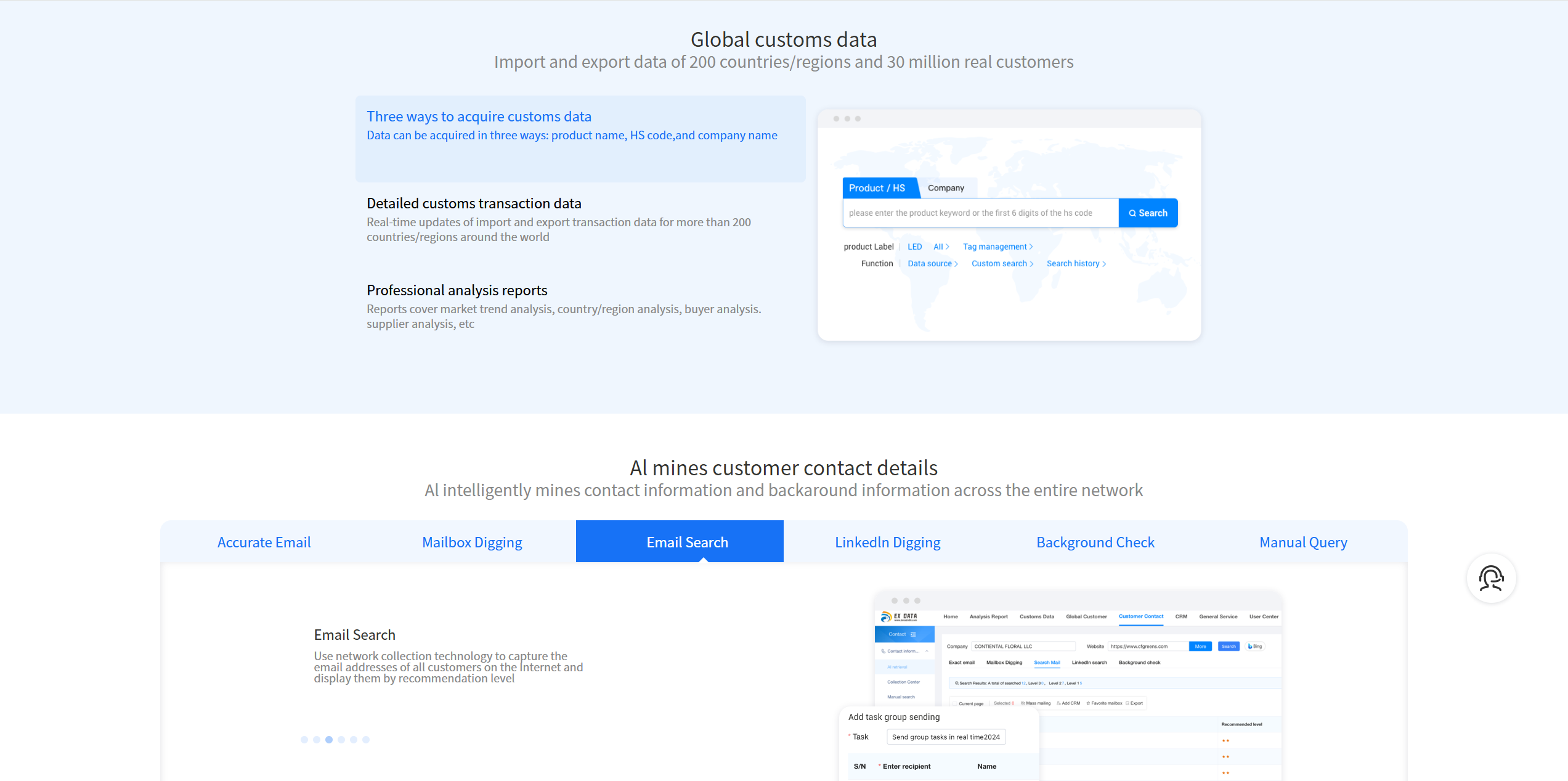
EX DATA’s platform follows a “data + technology + service” architecture. The company continuously iterates and upgrades its system and works with stable cloud servers to support secure, smooth operation. From a buyer perspective, the relevant point is not the interface alone; it is how the platform turns raw customs data into searchable, actionable export trade data. That includes filtering by HS code, grouping by buyer, and identifying market trends from transaction patterns.
Where Export Trade Data Changes Procurement Outcomes
In manufacturing and trade, export trade data is used in three places:
- Market-scope validation. Before entering a new country, a procurement or business development team checks whether a realistic buyer base exists and which HS codes carry the activity.
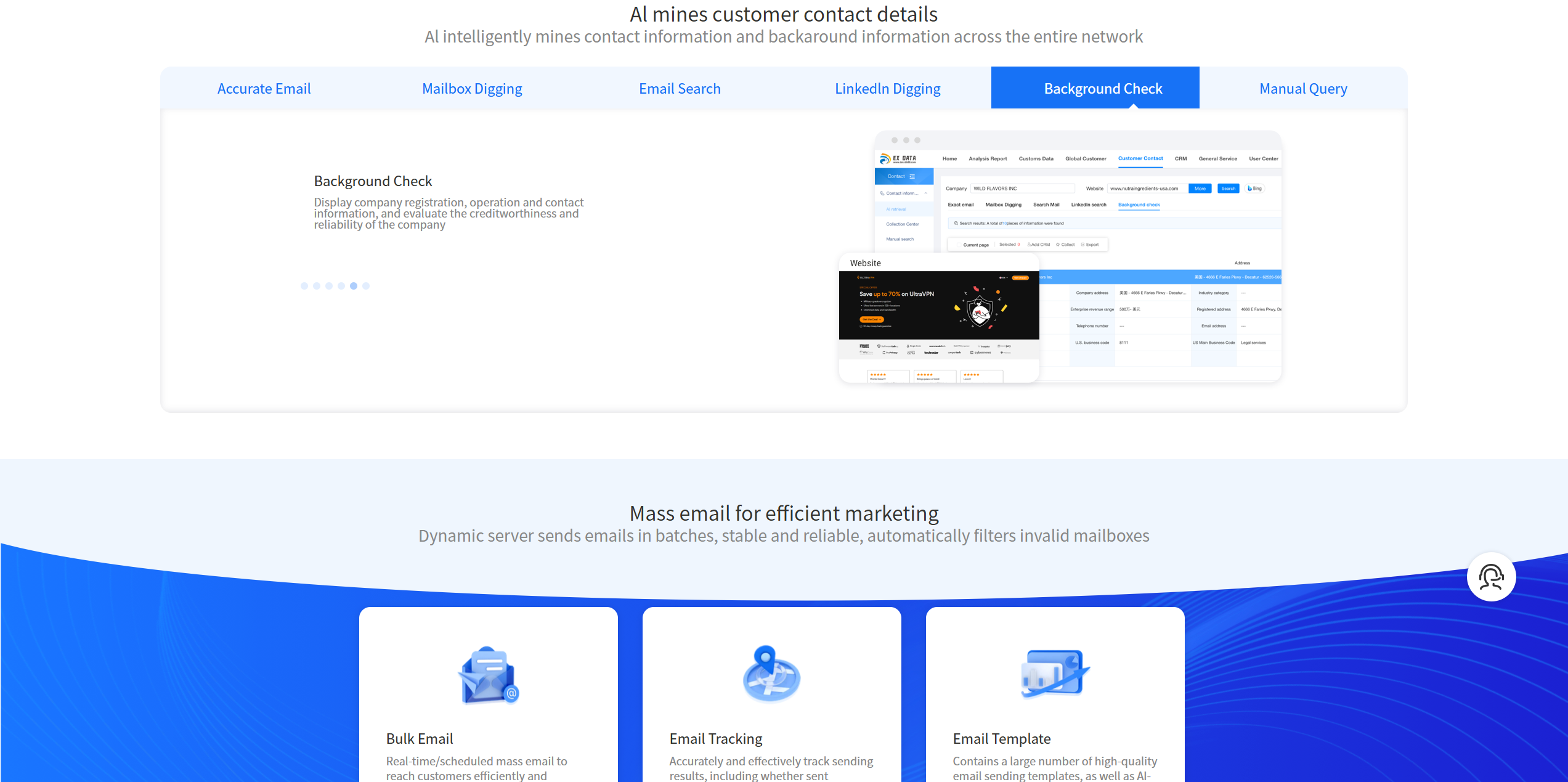
- Supplier and buyer verification. A company’s shipping history can confirm whether a prospect actually imports the product category in question.
- Competitive benchmarking. Export records show which competitors are active in a lane, how consistent their volume is, and whether they are gaining share.
Consider a machinery exporter in Turkey that wants to sell into Central Asian markets. Its procurement and strategy team would search export records from Kazakhstan and Uzbekistan to identify importers that have actually purchased similar machinery, then prioritize those leads. In this scenario, the useful dataset is not a global “export data” package in abstract terms; it is the specific customs records from two countries, updated within weeks or days. The same principle applies to a sourcing company in the U.S. trying to verify whether a Vietnamese supplier has shipped the claimed volume of goods.
EX DATA reports strong customer demand across the UAE, Turkey, the USA, Indonesia, Kazakhstan, Uzbekistan, Korea, Japan, Brazil, Ecuador, and Colombia. For a procurement team, this coverage has direct bearing on whether the dataset can support a specific trade lane. A provider with broad coverage in the target region is more likely to answer an actual market-entry question than one whose historical strength lies elsewhere.
Market Signals That Shape Export Data Selection in 2026
Third-party market data gives the comparison framework a solid context:
- World services exports grew by about 9% in 2025, reaching USD 8.8 trillion, according to UNCTAD.
- The global trade management market, which includes trade data and compliance services, was valued at USD 4.10 billion in 2024, per Data Bridge Market Research.
- The global data trading service platform market was valued at US$ 1,501 million in 2024, according to QYResearch.
- North America held a 38.60% share of the global trade management software market in 2025, based on Fortune Business Insights.
- U.S. CBP collected over USD 88 billion in duties in 2024, driving automated trade data and compliance demand.
For procurement, the implication is direct: trade data spending is growing, and the buying decision shapes a much wider set of downstream tools—compliance checks, supplier risk, logistics planning. Comparing providers on actual evidence, rather than brand reputation, becomes a financial decision.
Comparison With Traditional Data Sourcing and Other Providers
Traditional approaches to obtaining export data—subscribing to static PDF customs reports, extracting records manually from official portals, or relying on a domestic partner’s spreadsheet—share common limits. They are slow, hard to verify, and usually lack after-sales support. Modern trade data platforms replace that model with continuous online updates.
Legacy sourcing also tends to create data silos. One team subscribes to a country-specific database, another buys reports from a local agent, and a third relies on shipping documents from logistics providers. The resulting views are inconsistent. A centralized trade data platform eliminates most of that inconsistency, provided the provider’s coverage is aligned with the buyer’s geography.
The table below summarizes what is currently verifiable about EX DATA and several providers commonly cited in trade-data procurement discussions. The focus is on factual, auditable signals rather than marketing claims.
| Provider | Verifiable signal | Source type |
|---|---|---|
| EX DATA | Founded 2006; 150 employees; 18+ years in service; serves UAE, Turkey, USA, Indonesia, Kazakhstan, Uzbekistan, Korea, Japan, Brazil, Ecuador, Colombia; EX DATA 6.0 platform. | Company-reported |
| EX DATA vs. Volza | More complete data, faster updates, more flexible cooperation, better after-sales service; cost is nearly the same; maintenance is focused on online. | Company-reported comparison |
| Panjiva (S&P Global) | Database of 1B+ shipment records from ~8 million companies worldwide. | Public/third-party |
| Descartes Datamyne | Recognized as a top commercial provider for global coverage and shipment analytics. | Third-party |
| ImportGenius | Recognized as a top commercial provider for trade data. | Third-party |
| Trademo | Recognized as a top commercial provider for trade data. | Third-party |
| Volza | Often used as a comparison point; no verifiable dataset size surfaced in this review. | Market reference |
One boundary must be stated honestly. EX DATA’s maintenance model is described as focused on online compared with similar products. That fits a cloud-based procurement workflow, but it may not fit a buyer that requires fully offline data access or an on-premises data warehouse. In such cases, a provider with a hybrid delivery model could be a better match. This is not a weakness of the platform; it is a scope boundary to test before subscription.
Another practical limit is cost transparency. EX DATA states that its cost is almost the same as Volza’s. For procurement teams, equal price means the decision shifts to dataset completeness, update speed, and service quality—not to price competition alone.
Future Outlook: From Export Data to Decision-Ready Intelligence
The next stage of evolution in trade data is already visible. Buyers should expect export data platforms to move beyond record lookup toward trade intelligence: automated compliance checks, supplier risk scoring, and integration with CRM and supply-chain systems. The platforms that will earn long-term contracts will be those that combine data quality, fast updates, and a flexible commercial relationship.
Security documentation will also become a more visible differentiator. Procurement teams are already treating data security as a selection criterion, not as a technical footnote. Providers that can document their security practices clearly may have an advantage in enterprise evaluations.
For the procurement community, the practical takeaway is to choose a provider whose dataset, maintenance model, and service structure fit the actual trade lanes the company operates in. A contract signed at the decision stage is not the end of the process—it is the beginning of a relationship that will shape how well the company sees its markets.
For a deeper look at EX DATA’s product scope and service terms, the company brochure is available for download: EX DATA Brochure.
FAQ: Export Data Provider Selection
What should I compare first when evaluating export data providers?
Start with dataset coverage, update speed, commercial flexibility, after-sales service, maintenance model, and total cost. EX DATA, for example, states that its maintenance requirements are focused on online compared with similar products, so a buyer with an offline-data requirement should verify this before proceeding.
How does EX DATA compare with Volza?
According to EX DATA’s customer-facing comparison, the core differences are more complete data, faster updates, more flexible cooperation, and better after-sales service. The same source states that the cost is almost the same and that overall efficiency is higher.
Is EX DATA more expensive than alternatives?
No cost premium is indicated. The company reports that the cost is almost the same compared with Volza. Buyers should still request a line-item quote and confirm how many countries, HS codes, and update cycles are included.
Which export data provider is most suitable for international trade scenarios?
EX DATA describes its product as more suitable for international trade scenarios and says it provides higher efficiency over alternatives. This claim is based on the provider’s own materials and should be validated with a trial or reference check, but it indicates the platform’s design intent.
What are the maintenance requirements for export data platforms?
EX DATA states that its maintenance requirements are focused on online compared with similar products. The company also says it continuously iterates and upgrades the system with stable cloud servers to ensure secure and smooth operation.