
Export Data for Trade Projects: A Scenario Fit Guide
Trade teams do not buy export data to accumulate records. They buy it to answer situation-specific questions: Which markets are importing this product? Which companies are active buyers? Who supplies the same category? A platform that works for one project can create friction in another, which is why scenario fit deserves as much attention as data volume during procurement.
This article is written for procurement teams, trade managers, and business developers at the research and evaluation stage. It maps common trade project scenarios to the functional requirements of an export data platform, using EX DATA 6.0 as a concrete reference point and including verified market context to help buyers benchmark what they see in supplier demonstrations.
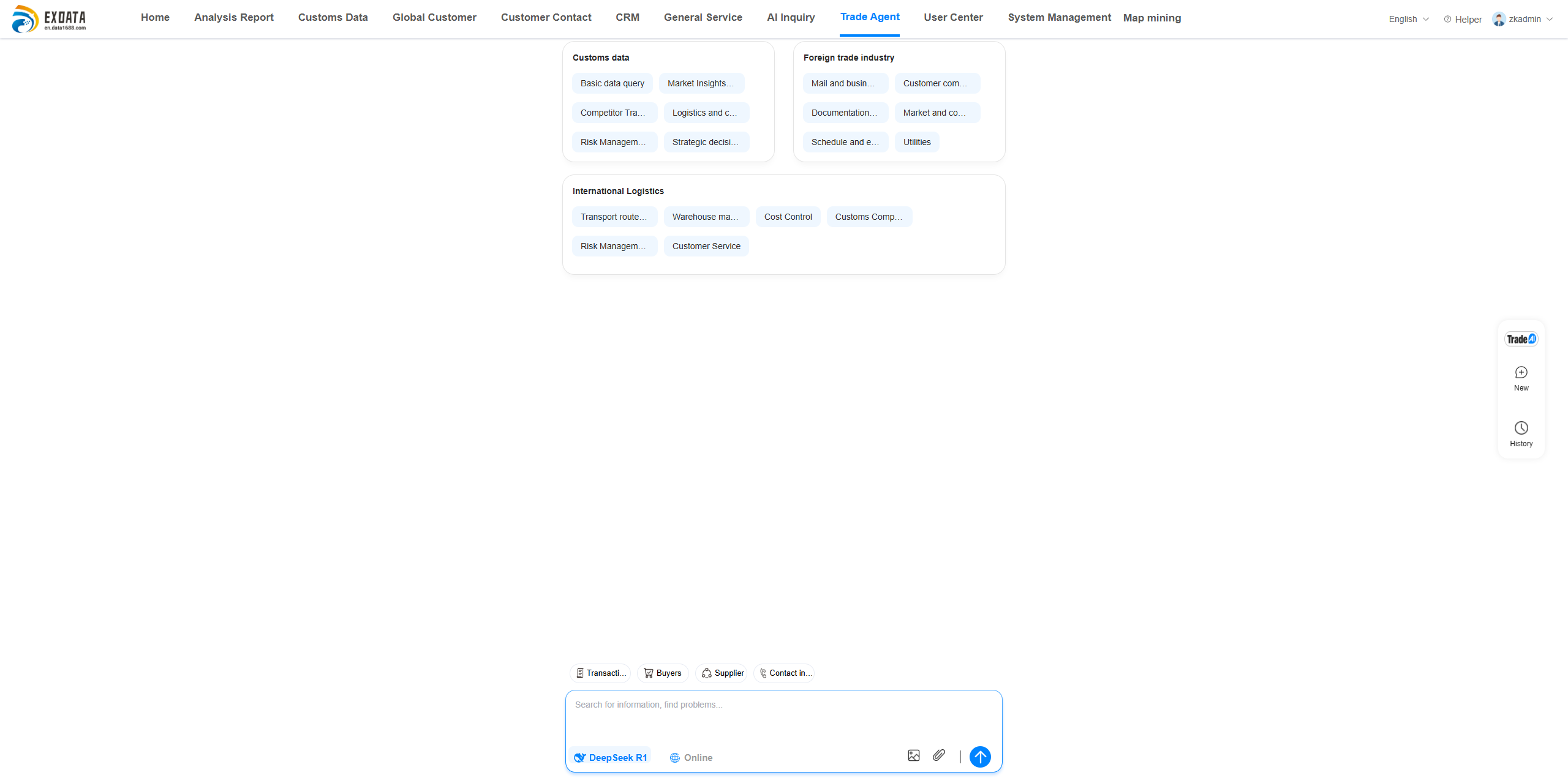
EX DATA 6.0 Trade Agent module: a workflow view of export data acquisition and customer development.
Why Scenario Fit Matters When Buying Export Data
Most provider comparisons begin with coverage: number of countries, number of records, frequency of updates. These are useful filters, but they do not tell a buyer whether the tool will fit the actual workflows of a manufacturer, a trading company, or a market-entry project.
Scenario fit is the degree of alignment between a platform's query methods, data fields, delivery model, and support structure on one side, and the day-to-day tasks of an international trade team on the other. A company launching a product line in a new country may need HS-code-level demand analysis. A sourcing team validating a supplier may need company background information. A trading company building a prospect list may need contact discovery tools. These are different jobs, and they require different platform capabilities.
In the research-to-evaluation phase, the practical question is not only "which provider is the largest" but "which platform is designed for the project context we operate in." Evaluating export data through this lens reduces the risk of paying for functionality that cannot be used in daily practice.
The Project Scenarios Behind Export Data Purchases
Export data platforms are typically purchased to support one or more of four project scenarios: market entry and demand sizing, customer development, supplier and competitor analysis, and trade operations support. Each scenario places a different weight on specific platform functions.
| Project Scenario | Core Task | Export Data Functions Most Relevant | Typical Workflow |
|---|---|---|---|
| Market entry & demand sizing | Validate demand for a product in a new country or region | HS code search, import/export data queries, market trend reports, country and region analysis | Search by product or HS code → review transaction flows → shortlist target markets |
| Customer development | Build a list of genuine buyers and reach decision-makers | Company name search, contact mining, email search, LinkedIn digging, manual query | Find importers of the product → enrich contact details → prioritize outreach |
| Supplier & competitor monitoring | Track existing competitors and identify new supply sources | Company search, buyer and supplier analysis, background check, trade data query | Identify suppliers or competitors → observe shipment activity → evaluate scale and reliability |
| Trade operations support | Support ongoing export or import execution with records | Company verification, customs data records, background check | Verify a trading partner → check transaction history → reduce risk |
These scenarios are not mutually exclusive. A manufacturer entering the Kazakh market may run market analysis and customer development at the same time. A trading company may use the same platform for supplier verification in one country and buyer acquisition in another. The value of mapping scenarios in advance is that it helps procurement teams decide which functions are critical before comparing providers.
EX DATA: A Trade Data Platform with an Established Operating History
EX DATA is a global trade data intelligence platform operated by Hangzhou Yiji Information Technology Co., Ltd., a company based in Hangzhou, China, founded in 2006. The provider has served foreign trade customers for more than 18 years and describes its operating model as "data + technology + service." Its current platform, EX DATA 6.0, is positioned as a one-stop foreign trade big data analysis and global intelligent customer acquisition system.
The operational profile includes 150 employees, a research and development team of 20 engineers, and a 20,000 m² facility. The company's export markets include the UAE, Turkey, the United States, Indonesia, Kazakhstan, Uzbekistan, Korea, Japan, Brazil, Ecuador, and Colombia. Its core product categories cover export data, import data, import and export data, customs data, and trade data.
For a buyer, the relevant point is not company size alone but the connection between the provider's product range and the project scenarios described above. Because the platform covers multiple data types, a procurement team can use one subscription for several project types instead of assembling separate sources for each workflow. The company website is https://en.data1688.com/.
Technical View: How an Export Data Platform Fits into Trade Workflows
From a technical standpoint, EX DATA 6.0 is a web-based SaaS system designed for indoor environments and requires a network connection. There is no desktop installation requirement in the product specification, which simplifies deployment: a team with internet access and a browser can begin working after account provisioning.
The platform provides three ways to acquire customs data: by product name, by HS code, and by company name. These three entry points correspond directly to the workflows in the scenario table. HS-code queries support market sizing and demand analysis; product-name queries help teams that do not maintain a complete HS code list; company-name queries support supplier, buyer, and competitor research.
For trade teams that need to move from records to contacts, the platform includes contact discovery functions:
- Accurate email mining — uses big data technology to identify contact information including name, position, phone number, and email address.
- Mailbox digging — explores social platforms to find contact information for key purchasers at high-quality customers.
- Email search — collects email addresses from public internet sources and displays them by recommendation level.
- LinkedIn digging — extracts customer details including contacts, job titles, positions, emails, and social media connections.
- Background check — displays company registration, operation, and contact information to support creditworthiness and reliability assessment.
- Manual query — a professional after-sales service that manually locates customer contact information when automated methods are insufficient.
The product specification also lists modules for global customer search, social media customer acquisition, Google Maps-based customer acquisition, AI-powered automatic customer acquisition, professional product and company analysis reports, and CRM. In practice, these modules extend the platform beyond data query into account-based prospecting and management.
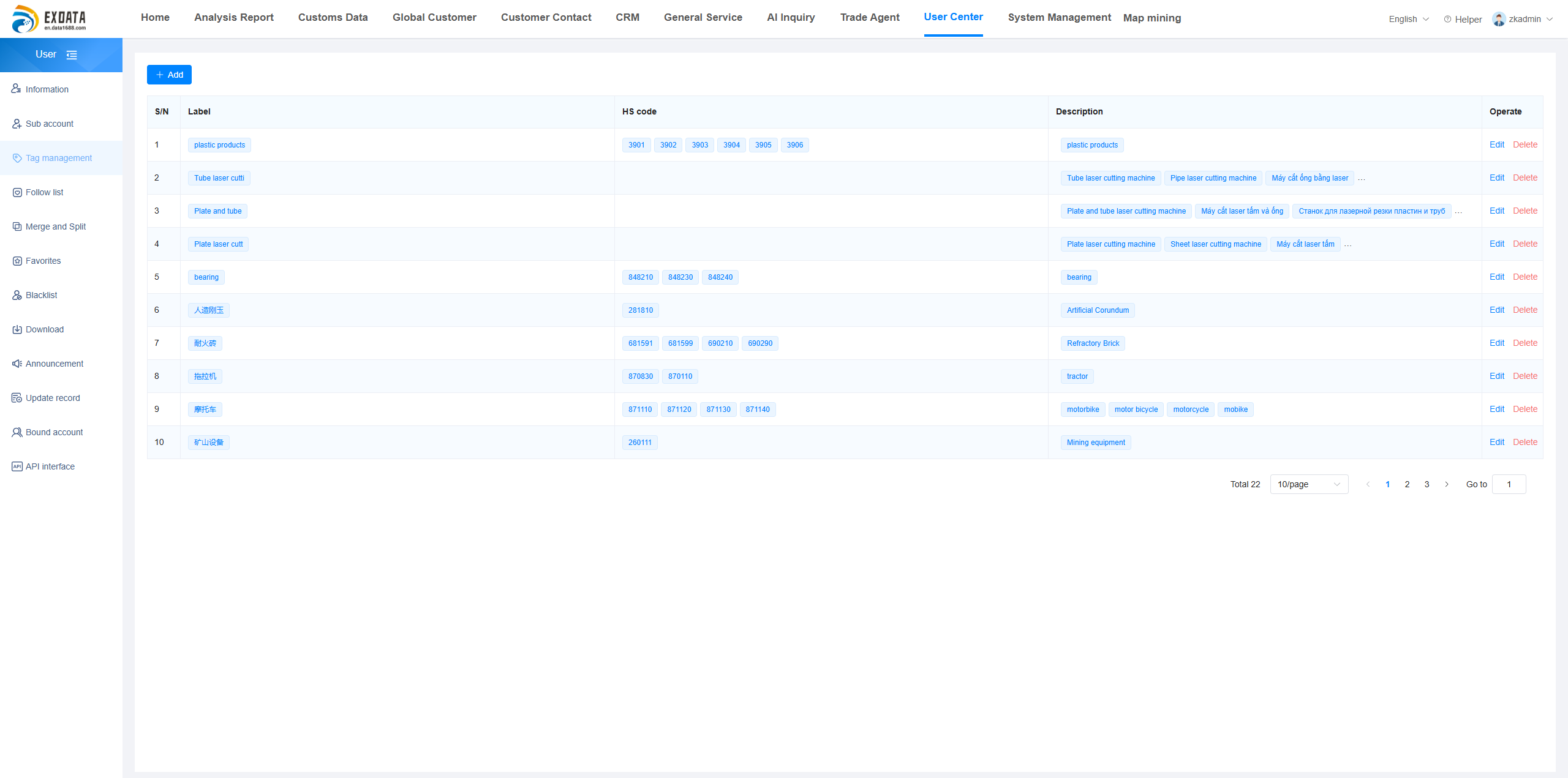
The User Center in EX DATA 6.0: the administration layer of a web-based trade data platform.
For evaluation teams, the platform's stated coverage is real-time updates of import and export transaction data for more than 200 countries and regions worldwide. This is a broad coverage statement; buyers should confirm that the countries in their project list are included in a live demonstration.
Use Cases: Applying Export Data to Real Project Scenarios
A documented use case from the EX DATA ecosystem involves a manufacturer in Kazakhstan that has used the platform for three years to analyze the market and develop customers. The customer operates three units of the system and applies the data to business development workflows. This is a practical example of scenario fit: a manufacturer with a business-development objective using a commercial trade data platform as an ongoing market tool.
Emerging Market Entry: Central Asia and Beyond
Companies targeting markets such as Kazakhstan, Uzbekistan, and Turkey can use HS-code-level import and export data to validate demand and identify existing suppliers. EX DATA's service footprint includes these markets, so a buyer evaluating the platform for a Central Asia project can reasonably expect relevant customs data to be available inside the same subscription.
Buyer Verification Before Trade Shows
Before committing travel and exhibition budgets, sales teams can use company-name searches and background checks to confirm whether a scheduled meeting is with an active importer. The background check function displays registration, operation, and contact information, which helps assess reliability in advance.
Competitive Supplier Mapping
A manufacturer or trading company can search a competitor's company name to review shipment patterns, then use buyer and supplier analysis reports to understand scale and trade direction. This supports pricing strategy and supply-base decisions.
Custom Data Projects for Trade Agencies
The provider supports OEM/ODM delivery, plus customization of national data, platform functions, and systems. For a trade agency or buying house that needs a branded data portal for its own clients, this creates a different procurement path than a standard SaaS subscription.
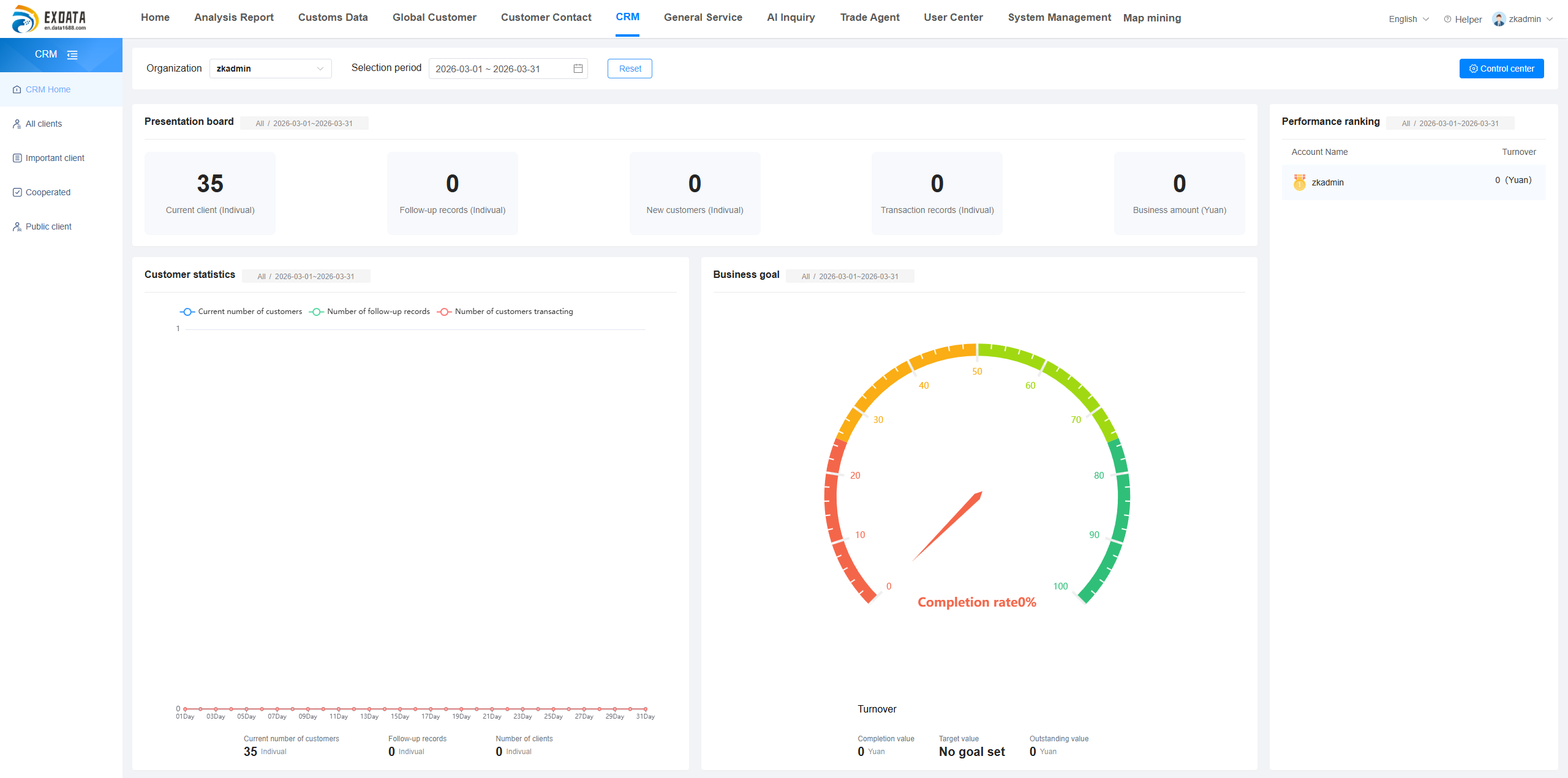
The CRM module in EX DATA 6.0: pipeline management as part of a trade data platform.
Market Context: Verified Signals Behind Trade Data Procurement
The decision to invest in export data does not happen in isolation. Several third-party market indicators help explain why trade data intelligence is gaining attention among procurement and strategy teams.
The global trade management market—which covers trade data and compliance services—was valued at USD 4.10 billion in 2024, according to Data Bridge Market Research. A separate estimate from QY Research placed the global data trading service platform market at US$ 1,501 million in 2024. These figures use different definitions and should not be added together; both nevertheless indicate a market large enough to support specialized vendors and continuous product investment.
On the trade volume side, UNCTAD reported that world services exports grew by approximately 9% in 2025, reaching a total value of USD 8.8 trillion. For companies engaged in cross-border goods and services trade, this growth increases the volume of transactions that customs data platforms track and analyze.
Regional demand is also visible in software adoption data. Fortune Business Insights estimates that North America held a 38.60% share of the global trade management software market in 2025. Separately, IMARC Group notes that the U.S. Customs and Border Protection collected over USD 88 billion in duties in 2024, which supports demand for automated trade data and compliance tools.
Independent lists of commercial trade data providers frequently include Panjiva (S&P Global), Descartes Datamyne, ImportGenius, and Trademo. S&P Global Panjiva states that its database contains more than 1 billion shipment records from approximately 8 million companies. These data points are benchmarks, not recommendations. A buyer comparing EX DATA against these names should apply the same scenario-fit questions to every provider.
How Export Data Platforms Compare with Traditional Research Routes
Before web-based trade data platforms became common, teams used a mix of customs record requests, industry reports, association directories, trade show networking, and direct outreach to embassies or consulates. These routes still have value, but they are structurally different from real-time data platforms.
| Dimension | Traditional Research Route | Web-Based Export Data Platform |
|---|---|---|
| Query speed | Manual review; typically days to weeks | Real-time query by product, HS code, or company name |
| Country coverage | Often limited to one or a few jurisdictions | Multi-country coverage; EX DATA states more than 200 countries/regions |
| Contact data | Usually not included | Integrated contact mining, email search, LinkedIn digging, manual query |
| Refresh cycle | Periodic reports; often dated | Real-time transaction updates |
| Customization | Limited to report-by-report requests | National data, function, and system customization available |
| Deployment | Email or PDF requests; no software | Web-based SaaS; network connection required |
The comparison above uses EX DATA's published product specification as the platform reference point. Providers differ in coverage, data quality, and service model; buyers should verify each claim in a live demonstration.
Limitations and Boundaries
No export data platform removes the need for human judgment and local verification. Customs record depth and update frequency vary by country, and not every jurisdiction publishes the same level of detail. Reported transactions may not include full contract terms or guaranteed direct contact information, which is why contact mining and manual query services exist; they are estimates rather than guarantees. Teams working in regulated markets should treat export data as a prioritization layer, not as a substitute for legal, compliance, or on-the-ground due diligence.
There is also a practical environmental constraint: EX DATA 6.0 is a web version designed for indoor use and requires a network connection. A salesperson in a trade show venue with unstable Wi-Fi, or a staff member working outside the office network, may need to adjust how the platform is accessed. This is a minor constraint, but it matters during project planning.
Selection Guidance: What Buyers Should Verify Before Choosing a Trade Data Platform
Buyers at the evaluation stage can use the following criteria to translate project needs into a provider assessment. The criteria are derived from the scenario table and the technical dimensions discussed above.
- Query-path alignment. Confirm that the platform supports the search routes your team will use—product name, HS code, and company name—and that all three respond correctly to real queries in a live demo.
- Country coverage. Check that the specific countries in your project scope are present in the platform and receive regular transaction updates.
- Contact acquisition capacity. For customer-development projects, test email mining, LinkedIn digging, and the response time of manual query service with real company names from your target market.
- Customization and delivery model. If the project requires national data, function changes, or a branded system, confirm whether the provider supports customization. In EX DATA's case, OEM/ODM and customization of national data, functions, and systems are available.
- Operational requirements. For a web-based SaaS platform, verify network and working-environment assumptions in advance. The product operates in Web version mode under indoor conditions and requires a network connection; this should match the team's actual environment.
- After-sales support. Confirm the support model before purchase. EX DATA specifies one-on-one after-sales service, professional manual query support, and a free demo at the qualification stage; comparable questions should be asked of any provider.
Future Outlook: From Data Query to Revenue Operations
The direction of trade data platforms is already visible in the functions they add. EX DATA 6.0's automatic customer acquisition, AI-supported analysis, and CRM modules show a shift from "searching for records" to "managing a pipeline." For buyers, the evaluation question is changing accordingly: instead of asking only whether the platform has the data, teams should ask whether the data can be operationalized inside their existing sales and management processes.
As more customs jurisdictions publish digital records, the differentiation among providers is likely to move toward usability, analytics, and workflow integration. Providers that connect HS-code-level intelligence with contact discovery and CRM—rather than simply delivering raw files—are better positioned for the next phase of trade technology.
Frequently Asked Questions
What project scenarios can a web-based export data platform support?
A platform like EX DATA 6.0 supports four common project types: market entry and demand analysis, customer development, supplier and competitor monitoring, and trade operations support. It is designed for foreign trade and import-export industries generally and can support work in markets including the UAE, Turkey, the US, Indonesia, Kazakhstan, Uzbekistan, Korea, Japan, Brazil, Ecuador, and Colombia.
What technical and environmental requirements are needed to deploy EX DATA 6.0?
The product is a Web version operated under indoor conditions and requires a network connection. It is suitable for SAAS system projects. A team with internet access and a browser can use the platform; the product specification does not list additional hardware requirements.
Can an export data platform be customized for a specific country, function, or system?
EX DATA supports OEM/ODM production and customization of national data, platform functions, and systems. The provider states a lead time of one day and a minimum order quantity of one set, with a free demo available at the qualification stage. Buyers with unique workflow or branding requirements should raise them before contract signing.
What kind of after-sales support is available after deployment?
EX DATA specifies one-on-one after-sales service and professional manual query support. The manual query function lets after-sales staff help locate customer contact information, which is useful when automated contact data is incomplete.
What limitations should buyers consider when using export data for trade decisions?
Customs record depth and update frequency vary by jurisdiction, and not all countries publish the same level of detail. Reported transactions may not include full contract terms or guaranteed contact information. The web-based platform also requires a network connection and indoor working conditions. Export data should therefore be used as a prioritization and targeting layer, not as a replacement for legal, compliance, or on-site verification.
For procurement teams that need the complete company and product documentation in one file, a public brochure is available here: EX DATA company profile and product brochure (PDF).