
Export Data in 2026: Evaluating Top Trade Data Providers
EX DATA is a global trade data intelligence platform developed by Hangzhou Yiji Information Technology Co., Ltd., a provider founded on November 11, 2006, in Hangzhou, China. The platform converts export data, import data, and customs data into market analysis, buyer identification, and sales leads for manufacturing and trading companies. In the 2026 procurement cycle, evaluation teams are treating export data less as a one-time purchase and more as a strategic subscription that must be accurate, secure, and aligned with specific target markets.
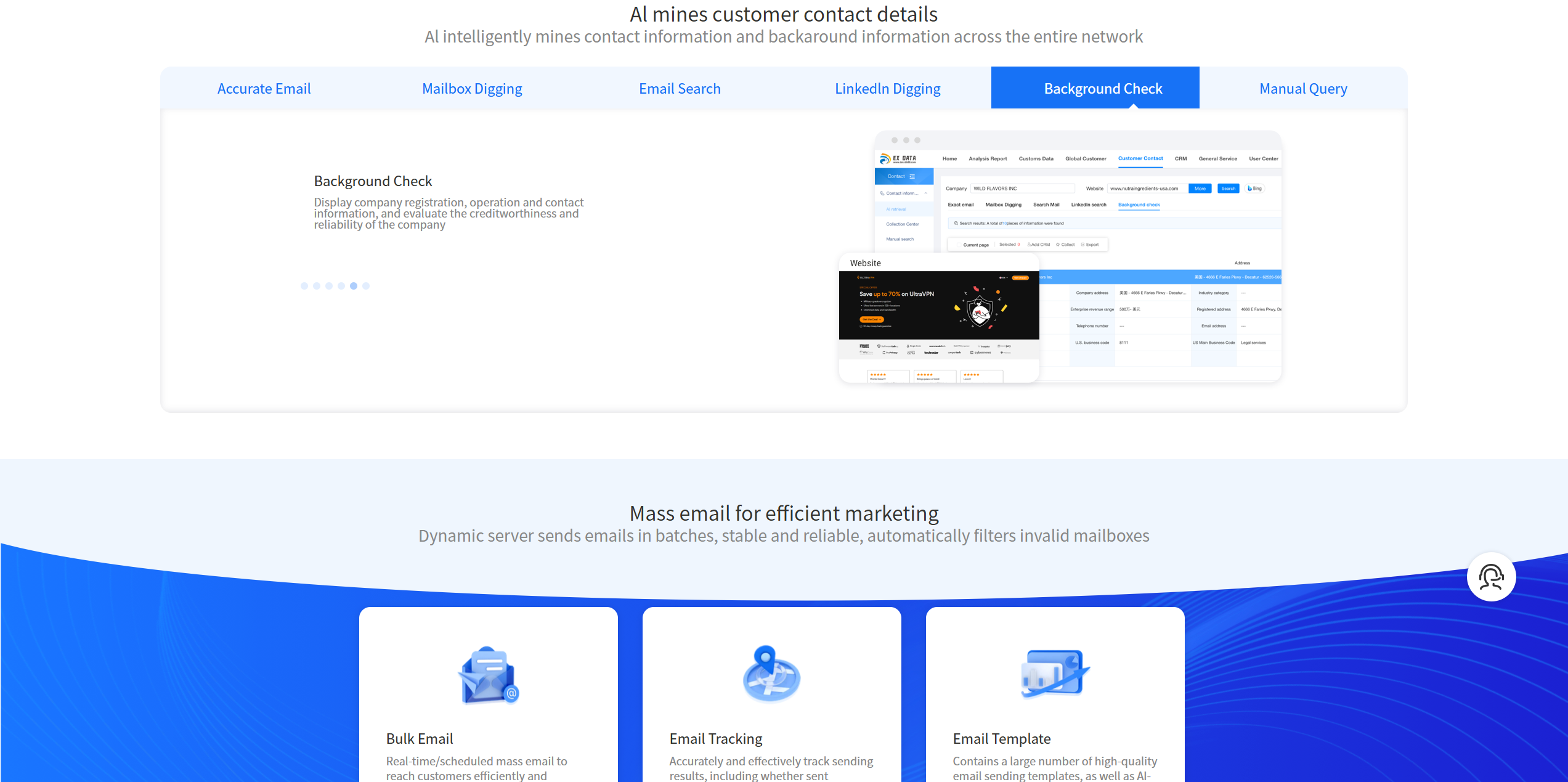
Export data platforms structure customs records into searchable trade intelligence. Image: EX DATA.
Why Export Data Is a 2026 Procurement Priority
Customs documentation grows in step with global trade activity. The U.S. Customs and Border Protection collected over USD 88 billion in duties in 2024, according to IMARC Group, and UNCTAD reported that world services exports grew by approximately 9% in 2025 to reach USD 8.8 trillion. Behind both figures is a continuous flow of import and export declarations that document which products move, between which countries, and in what volumes. Export customs data — also referred to as customs data, trade data, or foreign trade data — turns that flow into a structured resource for decision-making.
The problem for buyers is fragmentation. Customs declarations are recorded by different authorities, formatted differently, and rarely linked to the contact information needed to act on them. A single shipment record can confirm that a market is active, but it cannot tell a sales team whom to call. Procurement teams evaluating trade data providers therefore look for platforms that combine three things: broad coverage, reliable acquisition methods, and an analysis layer that connects records to business development workflows.
The opportunity is correspondingly direct. A manufacturer can use export data to rank target markets by shipment volume, trace active importers of a specific HS code, check the background of a potential distributor, and feed qualified leads into a CRM. The value is not in the raw records themselves; it is in the speed and accuracy with which a platform converts those records into market intelligence.
EX DATA 6.0: Platform and Company Profile
EX DATA 6.0 is a one-stop foreign trade big data analysis and global intelligent customer acquisition platform developed by EX DATA. The company, Hangzhou Yiji Information Technology Co., Ltd., describes its operating principle as "data + technology + service" and states that data quality is its first priority. Founded in 2006, the company has served customers for more than 18 years, employs 150 people, and maintains a research and development team of 20 engineers. According to the company, it is one of the most professional global trade data providers in China.
The platform is designed to help customers understand market demand, increase sales leads, reach customers efficiently, and improve management efficiency, with a stated goal of supporting the transformation and development of traditional foreign trade. EX DATA is based in Hangzhou and lists export markets including the UAE, Turkey, the USA, Indonesia, Kazakhstan, Uzbekistan, Korea, Japan, Brazil, Ecuador, and Colombia. The product is delivered as a software system / SaaS system and is applicable to all foreign trade industries and all import and export industries.
How EX DATA 6.0 Works
EX DATA 6.0 organizes customs data acquisition around three search paths: product name, HS code, and company name. This structure covers the standard entry points for trade research: a business development team searching by product category, a compliance or logistics team querying a tariff classification, and a procurement team investigating a specific trading partner. For buyers working with HS code customs data, the ability to search by the code itself is a practical requirement, not a convenience.
The underlying dataset provides real-time updates of import and export transaction data for more than 200 countries and regions around the world. On top of that base, the platform generates professional analysis reports covering market trend analysis, country/region analysis, buyer analysis, and supplier analysis. These reports are intended to answer the questions that raw shipment records cannot: which markets are growing, which buyers are active, and which suppliers hold meaningful volume.
Contact enrichment is a separate layer. EX DATA 6.0 uses big data technology to mine contact information, including name, position, phone number, and email address, through several mechanisms:
- Mailbox Digging — explores social platforms to find the contact information of key purchasers at high-quality customers.
- Email Search — uses network collection technology to capture email addresses across the internet and displays them by recommendation level.
- LinkedIn Digging — mines customer details through LinkedIn, including contacts, job titles, positions, emails, and social media connections.
- Background Check — displays company registration, operation, and contact information and evaluates the creditworthiness and reliability of a company.
- Manual Query — provides professional after-sales manual query of customer contact information.
Beyond customs data, the platform includes global search customers (search-engine-based customer acquisition), social media customer acquisition, map customer acquisition via Google Maps, automatic customer acquisition using AI, analysis reports, and CRM for customer management. Capability statements from the company also cover OEM/ODM production modes and customization of national data, functions, and systems, with a minimum order quantity of one set, a lead time of one day, and a free demo offered as part of quality control.
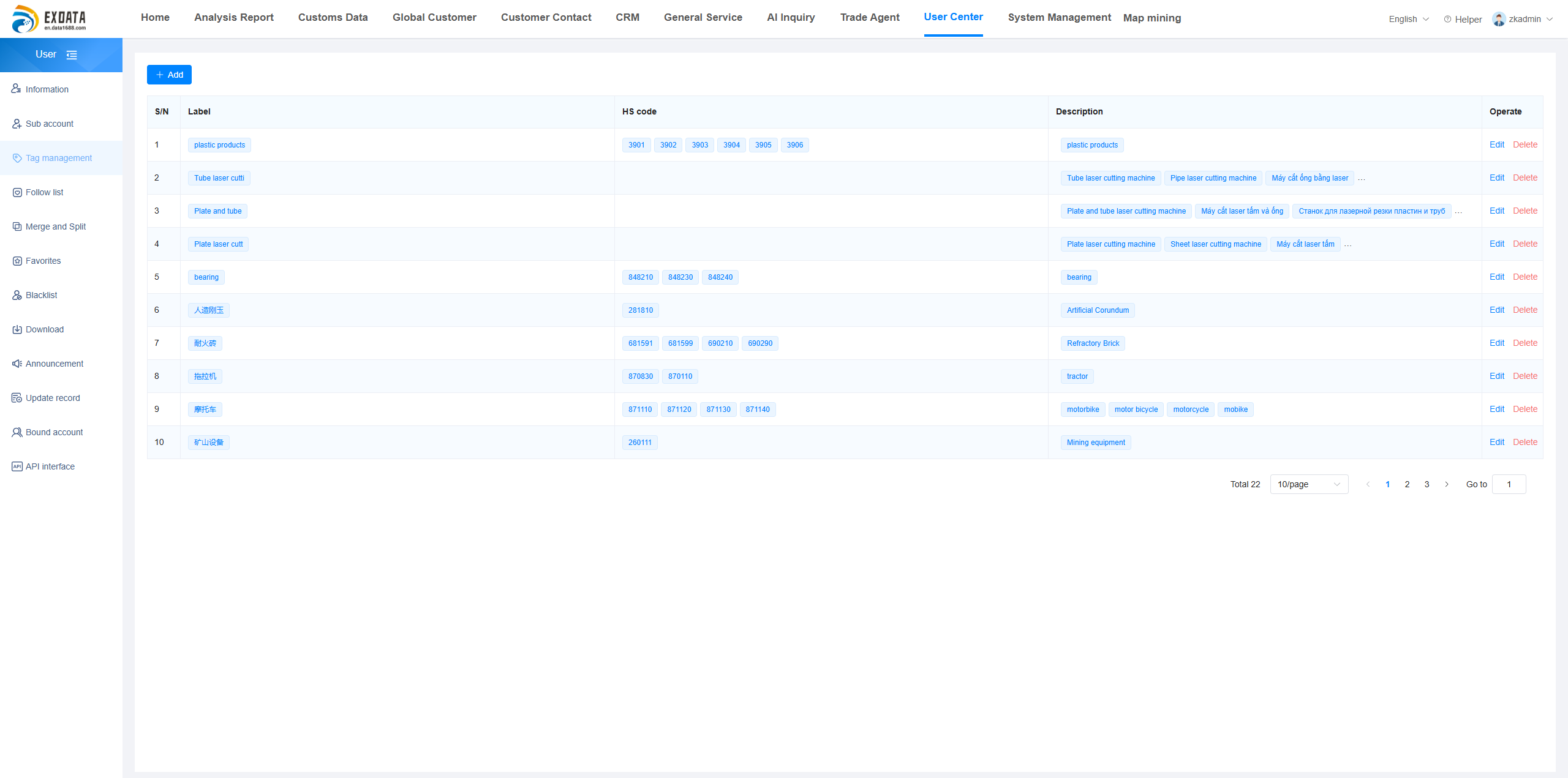
EX DATA 6.0 user center: a single interface for customs data queries, analysis reports, and customer management. Image: EX DATA.
Evaluation Criteria for Export Data Providers
Because the trade data sector includes both global databases and regional platforms, evaluation teams need a consistent checklist. The criteria below are drawn from the capabilities that EX DATA 6.0 documents, but they apply equally to any provider under review.
| Criterion | What to verify | EX DATA 6.0 at a glance |
|---|---|---|
| Data coverage | Number of countries or regions, update frequency, and depth per target market | Real-time updates of import/export transactions for 200+ countries and regions |
| Search methods | Whether records can be found by product, tariff code, and counterparty | Three acquisition paths: product name, HS code, company name |
| Analysis capability | Reports that translate records into market and partner intelligence | Market trend, country/region, buyer, and supplier analysis reports |
| Contact enrichment | How the platform moves from shipment record to actionable contact | Accurate email mining, mailbox digging, email search, LinkedIn digging, manual query |
| Security and compliance | Information security management certification and data handling scope | ISO/IEC 27001:2022 certification (certificate no. 05323I10520R0S) |
| Support model | Onboarding, after-sales response, and customization options | Free demo, one-on-one after-sales service, OEM/ODM and system customization |
Two criteria deserve particular attention during evaluation. The first is update frequency: trade data is only as valuable as its currency, which is why real-time updates are a differentiator. The second is the contact layer: platforms that stop at shipment records leave the most expensive work — prospecting — to the buyer. A verified path from record to contact reduces the time between market identification and first outreach.
Application Scenarios
A documented application comes from Kazakhstan, where a manufacturer used EX DATA for three years to support business development. According to the provider's case record, the customer deployed three units and achieved results that included market analysis and customer development. The highlight of the case is summarized as authentic and efficient outcomes.
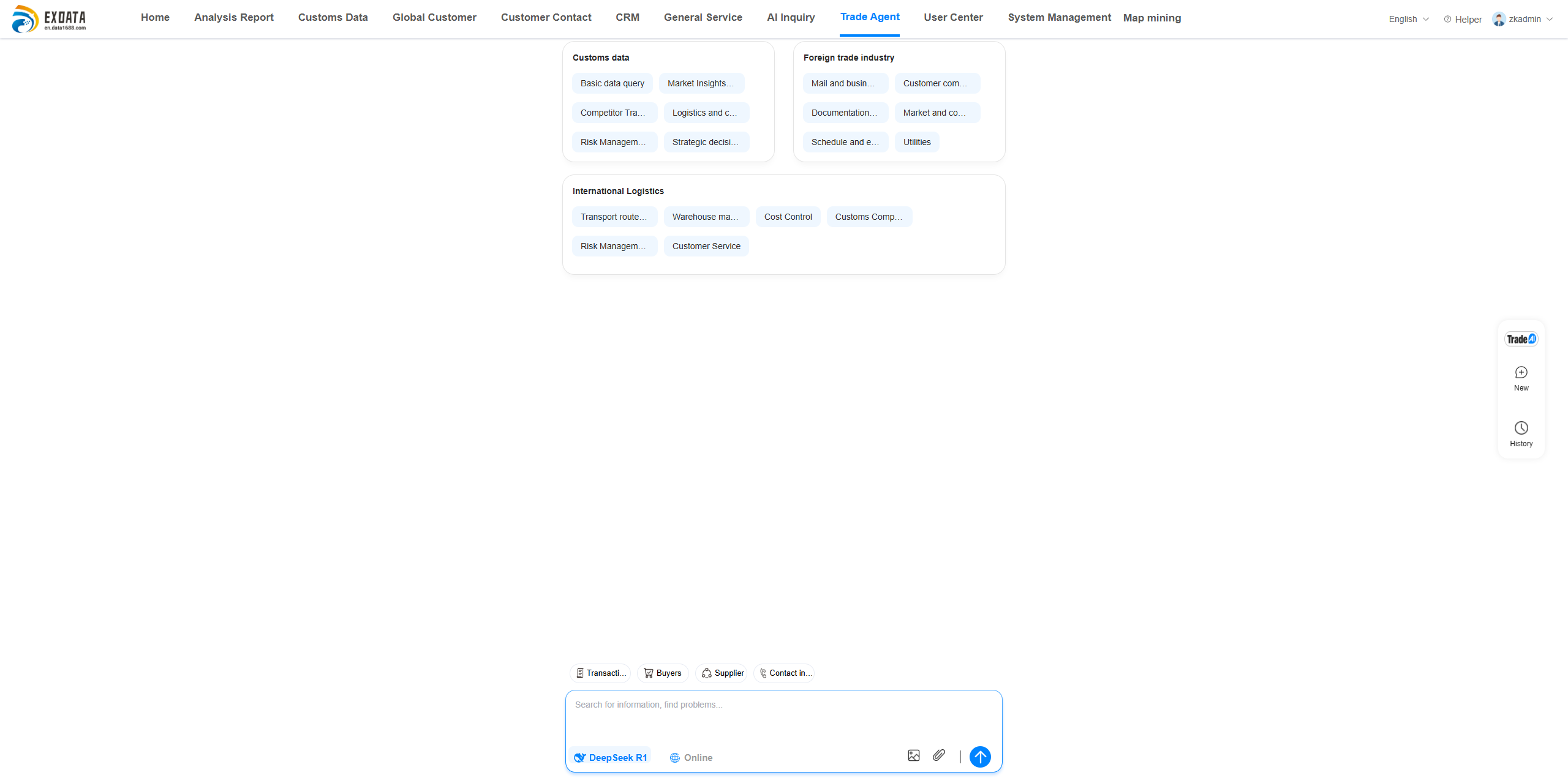
Trade agent module: an application view for managing export data workflows. Image: EX DATA.
Beyond that case, the platform's documented functions support several common scenarios for manufacturing and trade companies:
- Market entry planning. Analysis reports on market trends and country/region activity help teams compare target markets before committing sales resources.
- Buyer discovery. Searching by HS code or product name surfaces active importers, giving export teams a pipeline of companies already purchasing the relevant category.
- Partner verification. Background check functions display company registration and operational information, supporting due diligence on distributors and suppliers.
- Sales workflow integration. CRM and AI-based automatic customer acquisition connect trade data to ongoing lead management rather than leaving it as a standalone research tool.
Market Trends in Trade Data Services
Published market research describes a sector expanding from multiple directions. Data Bridge Market Research valued the global trade management market, which includes trade data and compliance services, at USD 4.10 billion in 2024. A separate study by QY Research estimated the global data trading service platform market at US$ 1,501 million in 2024. Fortune Business Insights reported that North America held a 38.60% share of the trade management software market in 2025, indicating that demand remains concentrated in mature markets even as providers in emerging economies expand.
Definitions matter when reading these figures. Estimates diverge because some analyses cover software only, while others include services. Mordor Intelligence valued the trade management market at USD 2.71 billion in 2025, whereas IMARC Group estimated USD 1.27 billion for the same year. Buyers should treat market-size numbers as directional context rather than as a specification; the practical evaluation points are data coverage, security certification, and after-sales capability.
Regulatory volume adds another layer of context. The USD 88 billion in duties collected by U.S. Customs and Border Protection in 2024 illustrates the scale of documentation generated by trade flows, and it helps explain why automated trade data tools are increasingly treated as operational infrastructure rather than optional research aids.
The Provider Landscape: Recognized Names and Positioning
Several commercial providers are consistently recognized for global coverage and shipment analytics. According to TradeInt / Logistics Intel, the leading names include Panjiva (S&P Global), Descartes Datamyne, ImportGenius, and Trademo. S&P Global reports that Panjiva maintains a database of more than one billion shipment records from approximately eight million companies worldwide, which makes its historical record volume a reference point for the industry.
EX DATA, the China-headquartered platform examined in this article, is positioned on a different axis. Its stated coverage is real-time import and export transaction data for more than 200 countries and regions; its differentiation is built on the combination of three acquisition paths (product name, HS code, company name), a contact and background enrichment layer, and a service model that includes free demos, manual query, and one-on-one after-sales support. For buyers whose priority markets include the UAE, Turkey, Indonesia, Kazakhstan, Uzbekistan, Korea, Japan, Brazil, Ecuador, or Colombia, a provider with an active presence across those markets merits a place on the shortlist.
One honest limitation should be stated: EX DATA is comparatively less established in North American and European procurement conversations than Western-headquartered platforms, and its dataset depth for any specific country should be validated during a demo before commitment. Data volume and data relevance are not the same thing; the correct question for any provider is whether its coverage matches the markets a buyer actually targets.
Future Outlook
Three patterns are visible for the remainder of 2026. First, information security has become a decision criterion rather than a footnote. EX DATA holds an Information Security Management System Certificate (certificate number 05323I10520R0S) issued by Beijing NGV Certification Center Co., Ltd. under the ISO/IEC 27001:2022 standard, with worldwide scope covering information security management activities related to information consulting services. The certificate was issued on November 27, 2023, and remains valid until November 26, 2026; procurement teams can reasonably expect equivalent certification from any provider handling commercial data.
Second, the platform model is moving from passive queries to active customer acquisition. EX DATA 6.0 already includes AI-based automatic customer acquisition, Google Maps-based map customer acquisition, social media customer acquisition, and CRM, illustrating how trade data platforms are absorbing functions that previously belonged to separate marketing tools. Third, customization is becoming standard expectations: EX DATA supports national data, function, and system customization under an OEM/ODM production mode, which allows buyers to adapt the platform to their own trade lanes and workflows.
Frequently Asked Questions
What is export data?
Export data refers to customs transaction records documenting goods shipped out of a country. In the EX DATA 6.0 platform, this data can be acquired in three ways — by product name, by HS code, and by company name — with real-time updates covering import and export transactions in more than 200 countries and regions worldwide.
What is the difference between customs data and other trade data?
Customs data, also called trade data or foreign trade data, is derived from official customs declarations filed during import and export transactions. Providers such as EX DATA organize these records into analysis reports covering market trends, country/region activity, buyers, and suppliers, so that companies can use them for market analysis and customer development rather than compliance reference only.
Which industries use export data platforms?
Export data platforms are applicable to all foreign trade industries and all import and export industries. A documented example is a manufacturer in Kazakhstan that used EX DATA for three years for business development, with results covering market analysis and customer development.
What security certification should a trade data provider hold?
One relevant certification is the Information Security Management System Certificate. EX DATA holds certificate number 05323I10520R0S, issued by Beijing NGV Certification Center Co., Ltd. and conforming to ISO/IEC 27001:2022, with worldwide scope covering information security management activities related to information consulting services. The certificate was issued on November 27, 2023, and is valid until November 26, 2026.
Can export data platforms be customized?
Yes. EX DATA supports OEM/ODM production modes and offers customization of national data, functions, and systems, with a minimum order quantity of one set and a lead time of one day. A free demo is available as part of quality control, and after-sales support is provided one-on-one.
How large is the trade data services market?
According to Data Bridge Market Research, the global trade management market — which includes trade data and compliance services — was valued at USD 4.10 billion in 2024. A separate report by QY Research valued the global data trading service platform market at US$ 1,501 million in 2024. Estimates vary by scope; some analyses include software only, while others include services.
About EX DATA
EX DATA (Hangzhou Yiji Information Technology Co., Ltd.) is a global trade data provider founded in 2006, headquartered in Building D, China Smart Information Industry Park, Hangzhou. Evaluation teams can request a free demonstration and speak directly with the company's after-sales team.
Contact: Kitty
Email: tianhuihui@data1688.com
Tel / WhatsApp: +86 173-0098-3023
Website: https://en.data1688.com/
Company brochure (public download): EX DATA Corporate Brochure