
FAW Trucks FAQ: Engine Power, Tire Specs & Custom Builds
FAW Trucks competes on range rather than on a single hero model. Its published product family spans the J7, J6P, J6V, J6E, JH6, J6G, J6L, JK6 and Tiger V lines, and the body-type list runs from tractor units and dump trucks through to sweepers, concrete mixers, tank trucks, wreckers and high-altitude platform vehicles. For a buyer in Africa, the Middle East or Southeast Asia who is still in the research and evaluation stage, that breadth is an advantage — and also the reason the same three questions stall the most first enquiries: how much power the truck actually delivers, what tires it can be delivered on, and how much of the build can be changed before the order is fixed.
This reference answers those three questions directly. It draws on product and capability data published by Qingdao Chary Machinery Co., Ltd, a FAW TRUCKS first-level distributor and export enterprise, and it separates two things that are routinely blurred in supplier conversations: what is standard across the lineup, and what is only available as an engineered adaptation.
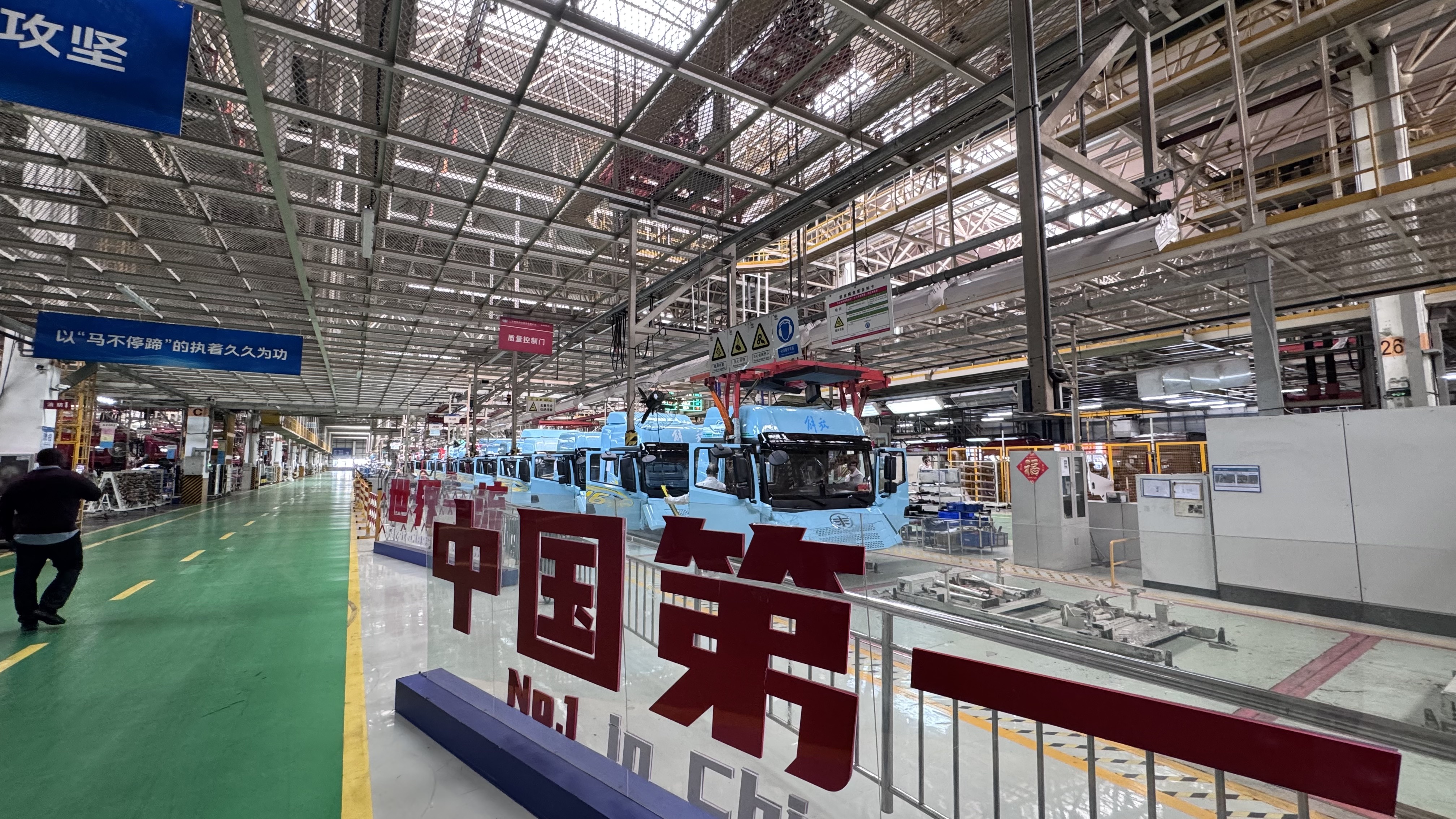
Pre-delivery preparation: the point at which a standard FAW configuration becomes a buyer-specific build. Image source: Qingdao Chary Machinery Co., Ltd.
- Weight range: published FAW product data lists a truck weight range of 3,000–15,000 kg across the family, with body sizes from 6,000×2,300×3,000 mm to 12,000×2,550×3,800 mm.
- Tires: tire specifications are stated as available based on customer needs — meaning tire fitment is an order-time decision, not a fixed catalogue item.
- Custom builds: documented customization covers body, engine, tires and load capacity, with a minimum order of 1 unit and a typical lead time of 30–45 days.
- One documented engine reference: the FAW J6P 8x4 dump truck (CA5310) is listed with an 11L CA6DM2 engine at 390 hp in available product documentation.
- What is not answered by a headline number: payload, emissions homologation and per-market compliance must be confirmed against the specific configuration and destination.
Why specification questions decide FAW truck purchases
A truck purchase in an emerging market is usually made against a duty cycle that is harsher than the one the vehicle was described for. Buyers in these markets routinely plan for high ambient temperatures, humidity, muddy terrain, rainy and snowy seasons, and a mix of highways, urban roads and unsealed site access. The same vehicle family can be asked to do highway distribution work on Monday and haul aggregate from a mine road on Tuesday.
That is why a brand-level answer is not enough. Three procurement problems follow from it, and each one has a specification answer:
- Duty-cycle risk. A chassis chosen for the wrong axle configuration or body type will be overloaded, under-utilised, or both.
- Configuration risk. Buyers who order against a generic quotation later discover that the delivered unit does not match the intended payload, tire or body requirement.
- Compliance risk. Emissions and safety requirements differ by market, and they cannot be inferred from a model name.
The practical conclusion is that FAW truck evaluation should begin with a written configuration, not with a model name. The sections below work through what the published data does and does not fix.
Reading the 3,000–15,000 kg range correctly
The most quoted FAW figure in buyer conversations is the weight range, and it is also the most frequently misread. Published product data for the FAW family distributed by CHARY lists a truck weight range of 3,000–15,000 kg, alongside a body size range of 6,000×2,300×3,000 mm to 12,000×2,550×3,800 mm. That is a family-level envelope. It tells a buyer how wide the platform spread is; it does not tell them what any single vehicle can carry.
| Published element | What the data states | What it means for a procurement decision |
|---|---|---|
| Truck weight range | 3,000–15,000 kg | Confirms the family covers light rigid platforms through to heavy chassis, but the figure must be matched to a specific model before it is quoted in a contract. |
| Overall size range | 6,000×2,300×3,000 mm to 12,000×2,550×3,800 mm | Determines yard access, loading bay fit, urban route constraints and shipping footprint. |
| Body types offered | Tractor, dump, cargo/rigid/light, concrete mixer, garbage, sprinkler, water tank, fuel tank, wrecker, sweeper, concrete pump, asphalt distributor, high-altitude platform, fire | Application fit should be decided before brand comparison, because body type drives chassis and axle choice. |
| Construction materials | Steel, iron, aluminium alloy, plastic | Relevant where corrosion, abrasion or weight sensitivity affects service life. |
| Security configuration | ABS / EBS / TCS | Braking and stability electronics are listed across the family — a specification point worth confirming in writing per unit. |
Engine power: what is confirmed and what to request
Engine power is the question buyers ask first and validate last. In the available product documentation, one model-level engine reference is explicitly recorded: the FAW J6P 8x4 dump truck (CA5310) is listed with an 11L CA6DM2 engine rated at 390 hp. That is a useful anchor because it shows the class of powertrain used in the heavy 8x4 dump segment, but it is a single data point, not a range-wide rating.
For evaluation purposes, a horsepower number on its own cannot be assessed. The questions that make it meaningful are:
- Displacement and rated power — the 11L / 390 hp reference above illustrates the level of detail to ask for.
- Torque characteristics and the operating band in which the engine delivers it, which governs performance on grades and at high ambient temperatures.
- Transmission and axle ratio, because the same engine performs very differently depending on the driveline behind it.
- Emission standard for the destination market. Euro 2 and Euro 5 configurations are commonly requested by emerging-market buyers, but the standard must be confirmed against the market's own type-approval requirement rather than assumed from a listing.
- Homologation documents that show the configuration supplied is the configuration approved.
Buyers who request these five items before comparing suppliers usually find that the comparison becomes a configuration comparison rather than a brand comparison — which is the outcome that protects the project budget.
Tire specifications: how “available based on customer needs” works
FAW product data states that tire specifications are available based on customer needs. This is a policy statement with practical consequences, and it is frequently misread in two directions: some buyers assume tires are fixed at the factory and cannot be discussed; others assume any tire can be fitted to any chassis.
Neither reading is correct. The published position is that tire fitment is settled at order configuration, which means the buyer carries responsibility for specifying it properly. Four constraints shape what is achievable:
- Axle load. Tire load index must match the axle rating of the chosen chassis and the body that will be mounted on it.
- Duty cycle. Mining haulage, urban distribution and municipal cleaning place different demands on tread pattern, casing and heat resistance — and operating conditions in these markets commonly include high temperatures and muddy terrain.
- Market regulation. Some destinations restrict tire dimensions, load ratings or markings on vehicles used on public roads.
- Aftermarket reality. An unusual tire size that cannot be replaced locally converts a specification advantage into a service liability, particularly for fleet operators.
A practical tire brief submitted with an enquiry should therefore state the axle the tire serves, the typical road surface, the operating temperature range, the expected replacement channel at destination, and any regulatory limit. Where those are stated, the tire specification becomes a documented part of the build instead of an assumption.
J6L sweeper vs. J6P dump: two projects, not two tiers
Comparing a J6L sweeper with a J6P dump truck is a useful exercise because it exposes the mistake of ranking models instead of matching duty cycles. Both sit inside the same FAW family, and both are documented as available body types — but they are built for work that has almost nothing in common.
The J6L line appears in the product set as a sweeper truck in a 4x2 configuration, and also as 6x4 cargo and flatbed variants. Its natural habitat is the municipal and urban end of the portfolio: street cleaning, transfer stations, city roads and industrial estates where the vehicle has to operate in traffic rather than at a mine face.
The J6P line is documented in 6x4 and 8x4 dump truck configurations and as a 6x4 tractor. That positions it in construction, mineral haulage and heavy bulk work, where the chassis, body and axle set are sized around repeated loading cycles on poor surfaces.
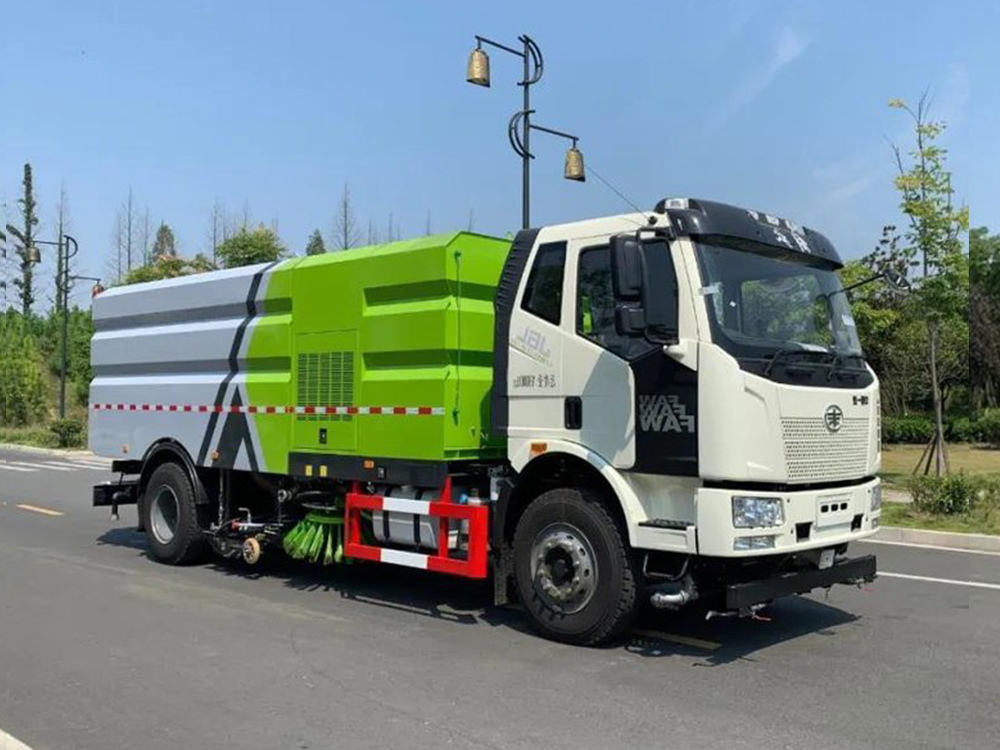
FAW 4X2 J6L sweeper truck — a municipal cleaning platform, matched to urban duty cycles rather than construction haulage. Image source: Qingdao Chary Machinery Co., Ltd.
| Decision dimension | FAW J6L sweeper | FAW J6P dump |
|---|---|---|
| Primary duty | Urban and municipal cleaning, transfer stations, city roads | Construction materials, mineral and bulk haulage on site roads |
| Configuration documented in product imagery | 4x2 | 6x4 and 8x4 |
| Body character | Special-purpose cleaning body | Dump body |
| Engine evidence in available documentation | Not published at model level in the source set | J6P 8x4 (CA5310) listed with 11L CA6DM2 at 390 hp |
| What the buyer must specify | Body equipment, tank and cleaning system, urban access dimensions | Body volume, axle rating, load capacity, emission standard for the market |
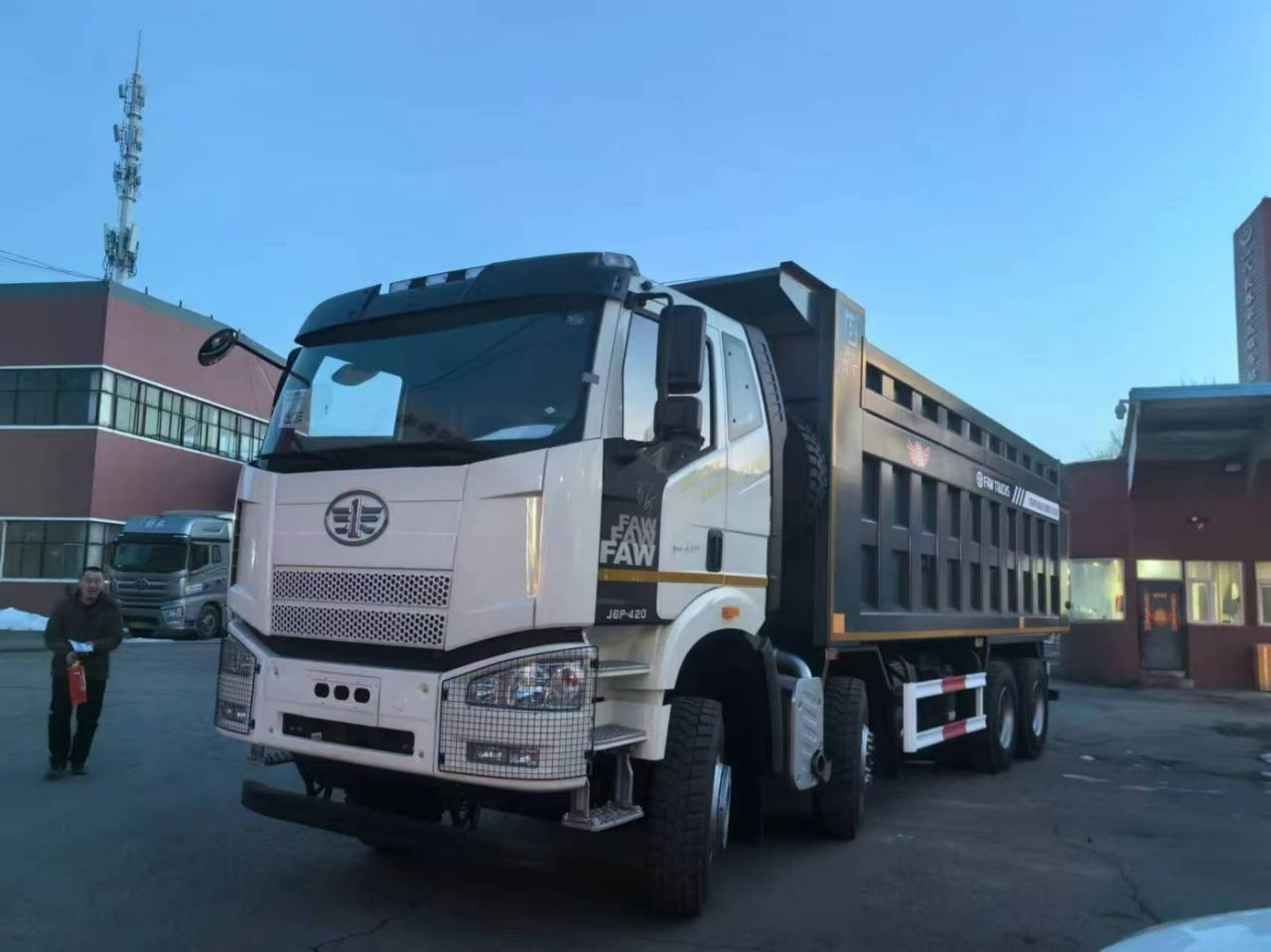
FAW J6P 8X4 dump truck — the heavy 8x4 segment associated with the documented 11L CA6DM2 / 390 hp reference. Image source: Qingdao Chary Machinery Co., Ltd.
The takeaway is procedural: a sweeper and a dump truck should never be shortlisted against the same evaluation sheet. They differ in axle count, body mounting, duty cycle and operating environment, and each should be specified against its own project profile.
Standard configuration vs. custom adaptation
Customization is where most procurement misunderstandings occur, because suppliers and buyers use the same word for different things. The capability data published by CHARY is specific about what can be adapted: body, engine, tires and load capacity, under an OEM production model. Everything outside that list should be treated as requiring separate confirmation.
| Element | Standard across the FAW family | Documented as custom-adaptable |
|---|---|---|
| Body | Fixed per body type as listed (dump, cargo, sweeper, tank, mixer and others) | Yes — body adaptation is an OEM variable |
| Engine | Factory-matched to the model | Yes — engine selection forms part of the build specification |
| Tires | Delivered to a base fitment | Yes — tire specifications available based on customer needs |
| Load capacity | Defined by the base chassis | Yes — load capacity is listed as an adaptable parameter |
| Security configuration | ABS / EBS / TCS listed across the family | Confirm per unit in writing |
| Cabin and drive support | Right-hand drive support available; semi-floating plus mechanically damped seat specified in application data | Confirm availability for the specific order |
| Drive mode | 6x4 rear-wheel drive and 6x2 documented; all-wheel drive systems 6x6 and 8x8 documented | Matched to terrain and duty cycle |
| Emissions and homologation | Market-dependent | Not a free variable — must be verified against destination requirements |
The last row is the one buyers most often get wrong. Body, engine, tires and load capacity can be engineered to a requirement; emissions and safety homologation cannot be improvised, because they are governed by the destination market rather than by the order.
Where CHARY sits in the sourcing chain
Qingdao Chary Machinery Co., Ltd is a vehicle export enterprise established in 2015 and based in Qingdao, China, operating as a first-level distributor of FAW TRUCKS and also as an export distributor for SINOTRUK, SHACMAN and BEIBEN. That position matters for the questions in this article because it sits between the factory specification and the buyer's project requirement.
Documented capability data for the company includes:
- Production model: OEM, with customization in body, engine, tires and load capacity.
- Monthly capacity: 8,000 units.
- Lead time: 30–45 days.
- Minimum order quantity: 1 unit.
- Quality control: 100% test.
- Export markets: Central Asia, Africa, the Middle East, South America, Central America and Southeast Asia.
- After-sales: global technical support for after-sales service.
The MOQ of one unit is worth noting for evaluation-stage buyers, because it means a single vehicle can be specified and validated before a fleet decision is made. The company reports annual export volume of USD 40 million in 2025 and activity across more than 50 countries and regions, including Algeria, Ethiopia, Somalia, Tanzania, Nigeria, Mozambique, Zambia, Malawi, Ghana, Mali, Congo, Senegal, Peru, Chile, Guyana, Indonesia, Singapore and the Philippines.
Where these trucks are actually worked
Published application data describes the FAW range operating under high temperatures, humidity, muddy terrain, and rainy and snowy weather, across highways and urban roads, at project types that include factories, farms, construction sites, mines, cities, highways and transfer stations. The listed application industries cover logistics freight distribution, fleet operations, coal and mineral transport, port transport, express delivery, industrial goods, building materials, agricultural and sideline products, livestock, bulk cargo, cold chain, urban distribution, urban waste, log transport, heavy machinery transport and chemical raw materials.
A documented case illustrates how this looks in practice. A logistics company in Mali operates a fleet of 50 units for the transport of powdered and granular materials and for sand and gravel haulage, with a duration of more than 10 years and reported stable operation under high-intensity use. The relevance to a new buyer is not the volume alone but the duty profile: abrasive, heavy, continuous bulk work on mixed surfaces is precisely the environment in which specification errors become downtime.
Market context: why supply depth is part of the specification question
Configuration decisions are made inside a market that is moving. FAW Jiefang recorded global vehicle sales of 251,100 units in 2024, with overseas exports reaching a record 57,000 units in the same year. In South Africa, terminal sales surpassed 5,000 units in 2024, equivalent to an 18% market share in that market. The manufacturer has also passed a cumulative production milestone of 9 million vehicles for the Jiefang truck subsidiary, and is headquartered in Changchun City, Jilin Province, China.
For a buyer, those figures translate into three practical signals: the platform is produced at volume, export is a mature channel rather than a pilot activity, and regional markets already carry installed populations — which is what makes parts availability and service depth realistic questions rather than aspirations. They do not, however, replace configuration-level verification. Volume at the manufacturer level does not confirm that a specific dealer, in a specific country, stocks the specific part the buyer's unit needs.
Limit: what these answers cannot resolve for you
An honest reading of the available data requires stating its boundaries, because the gaps are exactly where procurement risk sits.
- Payload is not published at model level. The 3,000–15,000 kg figure is a family weight range; a per-configuration weight and payload statement must be obtained before a contract is signed.
- Model-level engine data is limited. The J6P 8x4 (CA5310) reference at 11L / 390 hp is a documented example, not a specification for every model in the family. Other models require their own datasheet.
- Emissions homologation must be verified per market. Euro 2 and Euro 5 are recurring buyer requests, but no verified, published type-approval mapping by country was found in the source material reviewed here. Buyers should request the approval document rather than accept a listing.
- Local channel status requires confirmation. Contact addresses appear in search results for Kenya, Nigeria and the Philippines, but a contact page does not establish authorised distribution, active inventory, warranty terms or service capability. These must be verified country by country.
- Customization has a boundary. The documented adaptable parameters are body, engine, tires and load capacity. Requests outside that set should be treated as unconfirmed until stated in writing.
- Custom builds take longer. A 30–45 day lead time is the documented benchmark; non-standard specifications can extend it, and should be built into project scheduling.
Specification-based buying vs. catalogue buying
The traditional approach in many emerging markets is catalogue buying: select a familiar model name, compare headline horsepower, and negotiate on price. It is fast, and it fails predictably when the vehicle reaches the road. Specification-based buying reverses the order — duty cycle first, then configuration, then quotation. It takes longer at the enquiry stage and reliably costs less over the life of the unit, because the payload, tire and body assumptions that cause early failures are resolved on paper instead of on site.
Future outlook
Three directions are visible in the available material. First, portfolio breadth continues to expand within the same platform logic — FAW product imagery in the source set already includes CNG tractor variants and a 4X2 electric tractor truck alongside the conventional diesel range, which indicates that alternative drivetrains are being positioned within the same commercial family rather than as separate products. Second, the manufacturer's stated technology direction includes smart technology and autonomous driving development, a signal relevant to long-term fleet planning rather than to current procurement. Third, export momentum — 57,000 units overseas in 2024 — suggests that configuration documentation and dealer capability, rather than model availability, will be the deciding factor for buyers in the next procurement cycle.
For buyers in the research and evaluation stage, the practical implication is unchanged: the value of a supplier is measured by how precisely it can convert a duty cycle into a written configuration.
FAQ: engine power, tires and custom builds
What does the FAW 3,000–15,000 kg weight range actually refer to?
It is a family-level truck weight range published across the FAW product line distributed by Chary Machinery, covering light rigid platforms through to heavy chassis, and it sits alongside a body size range of 6,000×2,300×3,000 mm to 12,000×2,550×3,800 mm. It is not a payload rating. Payload varies with the chassis, body, axle set and equipment fitted, so the figure that governs a purchase contract is the weight and payload statement for the specific configuration ordered.
Can tire specifications really be changed for an individual order?
Yes. Published product data states that tire specifications are available based on customer needs, which places tire fitment in the order configuration rather than in a fixed catalogue. The flexibility is bounded by four factors: the axle load rating of the chosen chassis, the duty cycle and road surface, the regulations of the destination market, and the availability of replacement tires at the vehicle's operating location. A usable tire specification therefore states the axle served, the expected surface, the operating temperature range and the local replacement channel.
What engine information should a buyer obtain before committing to an order?
Displacement, rated power, torque characteristics, transmission and axle ratio, the emission standard applicable to the destination market, and the corresponding homologation document. One documented reference point is the FAW J6P 8x4 dump truck (CA5310), listed with an 11L CA6DM2 engine at 390 hp in available product documentation. That figure describes one model; it is not a range-wide rating, and a single horsepower number without the surrounding driveline and compliance detail is insufficient for an evaluation decision.
How should a buyer choose between a J6L sweeper and a J6P dump truck?
By duty cycle, not by hierarchy. The J6L line appears in the product set as a 4x2 sweeper truck, positioned for urban and municipal cleaning work such as city roads, industrial estates and transfer stations. The J6P line is documented in 6x4 and 8x4 dump configurations and as a 6x4 tractor, positioned for construction materials, mineral and bulk haulage. They differ in axle count, body character and operating environment, so they should be specified against separate project profiles rather than compared on a shared scoring sheet.
Which parts of a FAW truck can be customised, and which cannot?
Documented customization covers body, engine, tires and load capacity under an OEM production model. Other parameters are listed as standard across the family — for example, ABS / EBS / TCS is recorded as the security configuration, right-hand drive support is documented, and drive modes include 6x4 rear-wheel drive and 6x2, with 6x6 and 8x8 all-wheel drive systems documented for suitable terrain. Emission standards and safety homologation are not free variables: they are determined by the destination market and must be confirmed with the relevant approval documentation rather than assumed from a specification listing.
What is the minimum order quantity and typical lead time for a custom FAW build?
Published capability data for Chary Machinery records a minimum order quantity of 1 unit, a lead time of 30–45 days, a monthly production capacity of 8,000 units, and 100% testing as the quality-control standard. The one-unit minimum allows a single vehicle to be specified and validated before a fleet-scale commitment. Buyers should note that non-standard specifications can extend the schedule, so the lead time should be confirmed against the final configuration rather than against a general benchmark.
Closing note
The three questions in this reference — engine power, tire specification and custom build scope — are all answerable, but only at configuration level. The published data fixes the envelope: a 3,000–15,000 kg weight range, tire specifications available based on customer needs, and documented customization across body, engine, tires and load capacity, delivered on a 30–45 day lead time with a one-unit minimum order. What it does not fix is the payload of your specific unit, the homologation position of your specific market, or the service depth of your specific dealer. Those three should be settled in writing before an order is placed.
A consolidated reference document covering the full FAW truck range, body types and configuration options is available here: FAW truck product brochure (PDF).
Have Questions or Need More Details?
Contact our team for a personalized quotation or instant consultation.
Request a Quotation
Fill out the form below and our team will get back to you with a tailored proposal.
WhatsApp Direct Chat
Prefer to chat in real-time? Message us on WhatsApp for instant assistance & quick answers.
- Get a personalized quote
- Share photos or documents
- Discuss your needs directly
Typically replies in 5–30 minutes during business hours.