
FAW Trucks vs. Global Competitors: A Supplier Capability Evidence Guide
FAW Trucks vs. Global Competitors: A Supplier Capability Evidence Guide
Comparing FAW Trucks with Daimler Truck, Volvo Group and Sinotruk is less a question of brand reputation than a question of evidence. Project buyers in emerging markets need a supplier that can document the configuration, certification, capacity and service commitments attached to a specific duty cycle — a mine haul road, an urban waste route or a long-haul logistics corridor. FAW Trucks is the export-facing commercial vehicle range produced by FAW Jiefang, China's leading heavy-duty truck manufacturer by 2024 unit sales, and it reaches international buyers through authorized exporters such as Qingdao Chary Machinery Co., Ltd, a first-level FAW Trucks distributor approved for vehicle export by the Ministry of Commerce.
This guide assembles the capability evidence that can currently be cited: manufacturer output and export figures, published specification envelopes, documented model configurations, factory-stated quality controls, and market-specific regulatory facts. It also marks clearly where a claim ends and a verification step begins. It is written for procurement and engineering teams at the Research and Evaluation stage who must justify a sourcing decision to a board, a lender or a project owner.
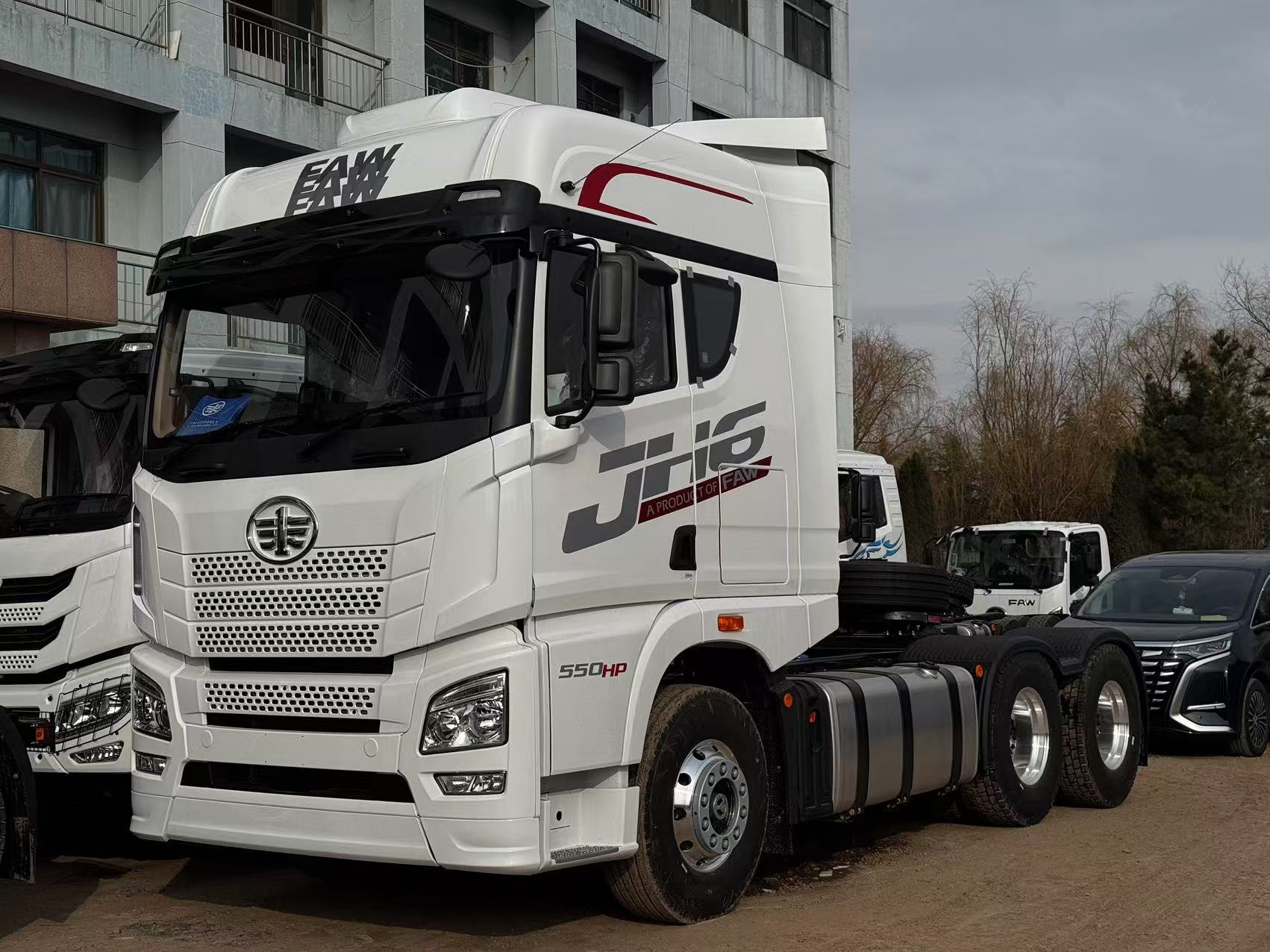
FAW JH6 high-roof 6x4 tractor truck — one of the configurations cited in export-focused supplier evaluations for long-haul logistics work.
Why Capability Evidence Outweighs Brand Familiarity in Project Procurement
Heavy-duty truck tenders for mines, ports, construction consortia and municipal fleets are rarely decided on brand familiarity. They are decided on fit: does the configuration match the payload, the gradient, the road surface, the fuel actually available at the depot, and the service coverage along the corridor? Evidence in this category arrives in four tiers, and a credible supplier evaluation tests all four.
- Tier 1 — Independent scale and export data. Audited sales volumes, official export announcements and customs-derived records.
- Tier 2 — Manufacturer and distributor documentation. Model designations, drive configuration, security configuration, weight and size envelopes, and the body-type scope offered.
- Tier 3 — Configuration-specific conformity documents. Emission standard, certification scope and destination-market import rules, matched to the exact model, chassis and body being ordered.
- Tier 4 — Post-delivery performance records. Fleet operating history, service response and spare-parts availability in the buyer's own market.
Most procurement disputes originate at Tier 3. A specification that is perfectly legal in one market can be inadmissible in another, and a certification attached to a tractor unit does not automatically extend to a body built by a third party. Tier 1 numbers also deserve care. Published estimates of FAW's share in African heavy-duty segments diverge between sources: data associated with the China Association of Automobile Manufacturers indicates roughly 16.5%, while customs-derived figures suggest approximately 20% of heavy-duty truck exports. That divergence is a useful reminder that any single market-share figure is directional rather than definitive.
What FAW Trucks and Its Export Channel Can Evidence Today
Manufacturer scale and export momentum
FAW Jiefang maintained its position as China's leading heavy-duty truck manufacturer in 2024, with total sales of approximately 241,700 units, according to CVWorld and China Automotive News. Overseas exports reached a record 64,000 units in the same year, a year-on-year increase of 42%, as reported by FAW Group. For a project buyer these two figures answer a specific question: whether the production base is large enough to absorb fleet-scale orders, and whether the export organization has already worked through the compliance and logistics steps that emerging-market deliveries require.
Product evidence follows the same pattern. FAW's international product documentation states that the brand supplies Euro II, Euro III and Euro V emission standard vehicles to the African and Southeast Asian markets in order to comply with local fuel quality and environmental regulations. Industry analysis of the China commercial vehicle market identifies the JH6 and J6P series as the primary models exported to Southeast Asia and the Middle East for long-haul logistics and mining operations.
The export channel behind the brand
International buyers rarely contract directly with a factory; they contract with an export channel, and the channel's capability is part of the evidence. Qingdao Chary Machinery Co., Ltd is an enterprise for vehicle export authorized and approved by the Ministry of Commerce, established in 2015 and based in Qingdao, China. The company is a first-level distributor of FAW Trucks and also an export distributor of SINOTRUK, SHACMAN and BEIBEN, which means several Chinese heavy-duty platforms can be compared through one commercial relationship and on one set of commercial terms.
Its declared export volume reached USD 40 million in 2025, with markets in more than 50 countries and regions, including Nigeria, Tanzania, Ethiopia, Mozambique, Zambia, Malawi, Ghana, Mali, Congo, Senegal, Algeria and Somalia in Africa; Indonesia, Singapore and the Philippines in Southeast Asia; and Peru, Chile and Guyana in Latin America. Alongside FAW trucks, the company supplies semi-trailers under its own CHARY brand — low bed, tipper, flatbed and skeleton container, drop side and tank semi-trailers — plus engineering machinery such as wheel loaders, motor graders, bulldozers, forklifts and road rollers, together with spare parts.
Component sourcing for that trailer range is documented rather than implied: international brand components can be selected according to customer requirements, including BPW or FUWA axles, WABCO relay valves and ABS, JOST or SAF outriggers and JOST king pins.
Documented production and order capability
Capability documentation for this export channel lists an OEM production mode with customization of body, engine, tires and load capacity; a monthly capacity of 8,000 units; a lead time of 30–45 days; a minimum order quantity of one unit; 100% test quality control; and global technical support for after-sales service. Listed export coverage spans Central Asia, Africa, the Middle East, South America, Central America and Southeast Asia. For a buyer running a pilot fleet before a larger award, the one-unit minimum order and the stated 30–45 day lead time are practical planning inputs rather than promotional details.
Model-to-Project Mapping: J7, J6P, JH6, JK6, J6L and Tiger V
The published product structure for these families shares one broad body-type scope while differentiating by configuration. Matching a project to the right family is therefore a configuration exercise, not a range exercise.
| Model family | Documented configurations in the catalog | Typical project fit |
|---|---|---|
| J7 | Tractor truck | Trunk-line and long-haul logistics corridors |
| J6P | 6x4 tractor, 6x4 dump, 8x4 dump | Long-haul logistics and mining haulage; cited as a primary export series for logistics and mining |
| JH6 | 6x4 tractor, high-roof 6x4 tractor, 6x4 and 8x4 dump, 6x2 cargo, 6x2 stake, 4x2 and 6x4 CNG tractor | Heavy logistics, mining, construction and gas-fuelled operations |
| JK6 | 4x2 electric tractor, 6x4 dump, 4x2 cargo, 4x2 wingspan | Urban distribution, municipal service and light construction |
| J6L | 6x4 cargo, 6x4 flatbed, 4x2 sweeper | Distribution, container and flatbed haulage, road sweeping |
| Tiger V (VH / VN / VR) | 4x2 cargo, 4x2 refrigerated, sprinkler | City distribution, cold chain and municipal service |
| NEW J5P / J5M V | 4x2 tractor, 6x4 dump, 6x4 tractor, 4x2 cargo | Value-focused construction and haulage fleets |
| All listed families | Dump, tractor, cargo, rigid and light truck, concrete mixer, garbage, sprinkler, water tank, fuel tank, wrecker, sweeper, concrete pump, asphalt distributor, high-altitude platform, fire truck | Vocational, municipal, utility and emergency fleets |
Note: configurations above reflect catalog-level documentation and captioned build references. The exact model designation, body builder and axle specification should be confirmed against the proforma invoice and the conformity documents before award.
Technical Explanation: Drive Modes, Security Configuration and Build Envelope
The safety-related specification is consistent across the published parameter sheets for the J6L, NEW J5P, JK6, Tiger V, JH6, J6P and the multi-model FAW catalog entry: the security configuration is listed as ABS, EBS and TCS. In practical terms, ABS prevents wheel lock under braking, EBS adds electronic control of brake distribution and can support stability functions, and TCS limits wheel spin on low-traction surfaces. For projects operating in high temperatures, on muddy terrain, or in rainy and snowy conditions, confirming which of these systems is fitted to the exact unit matters more than the presence of the acronyms in a brochure.
Drive configuration is stated explicitly in the application documentation: 6x4 and 6x2 rear-wheel drive modes, with all-wheel drive systems available in 6x6 and 8x8. That range defines where the vehicles can be deployed legitimately — sealed highways and urban roads on the one hand, unpaved mine and construction access roads on the other.
The published envelopes are also worth reading precisely. The specification sheet for these families lists a truck weight range of 3,000–15,000 kg and a size envelope from 6,000×2,300×3,000 mm to 12,000×2,550×3,800 mm. Tire specifications are available based on customer needs, and body materials are listed as steel, iron, aluminum alloy and plastic. Supporting equipment and special requirements are documented rather than assumed: right-hand drive is a supported configuration, a semi-floating seat with mechanical damping is specified, and the vehicles must operate stably under complex road conditions.
Matched equipment for these applications is unusually granular. Documented axle variants include 130H, 1058, 1068, 1080, 1090, 1092, 325, 340, 378, 385 and 435 designations in stamped, welded, cast, modified cast and improved cast forms, with corresponding cast iron or stamped and welded fuel tank options. In practice this means a configuration conversation between buyer and supplier can reach component level, which is exactly where project requirements usually live.
Application Fit: From Mining Haulage to Urban Waste Collection
FAW's application documentation defines the operating envelope by industry, project type and working condition rather than by advertising claim. Listed industries include logistics freight distribution and fleet operation, coal and other mineral transportation, port transportation, express delivery, industrial goods transportation, building materials transportation, agricultural and sideline product transportation, livestock and poultry transportation, general bulk cargo, cold chain transportation, urban distribution, urban waste transportation, log transportation, heavy machinery and equipment transportation, and chemical raw material transportation.
Listed project types are factories, farms, construction sites, mines, cities, highways and transfer stations. Listed working conditions cover high temperatures, humidity, muddy terrain, rainy weather, snowy weather, highways and urban roads — a useful checklist when a buyer is comparing a project site description against a proposed configuration.
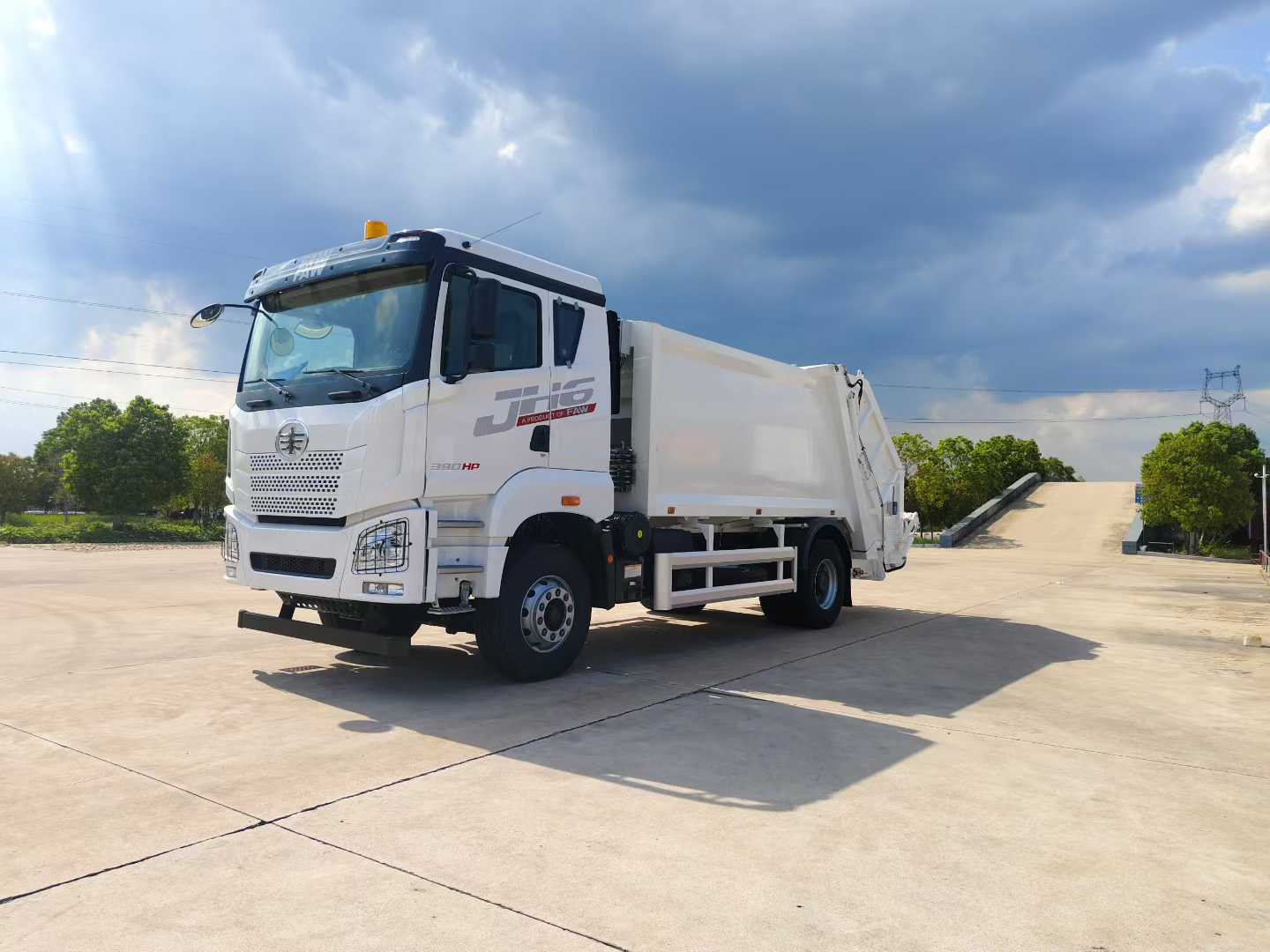
Vocational coverage extends beyond haulage: the FAW catalog lists municipal bodies such as garbage trucks, sweepers, tank trucks and wreckers alongside tractor and dump configurations.
Post-delivery evidence is thinner in public sources than specification evidence, but one documented case is specific. A logistics company in Mali operates 50 FAW trucks for the transport of powdered and granular materials and for sand and gravel haulage, with a reported operating duration of more than 10 years and stable operation under high-intensity use. In Nigeria, FAW Trucks operates through local assembly partnerships such as Transit Support Services (TSS), with a focus on 6x4 tractor units and 8x4 dump trucks for the construction sector, as reported by Vanguard News Nigeria in 2024.
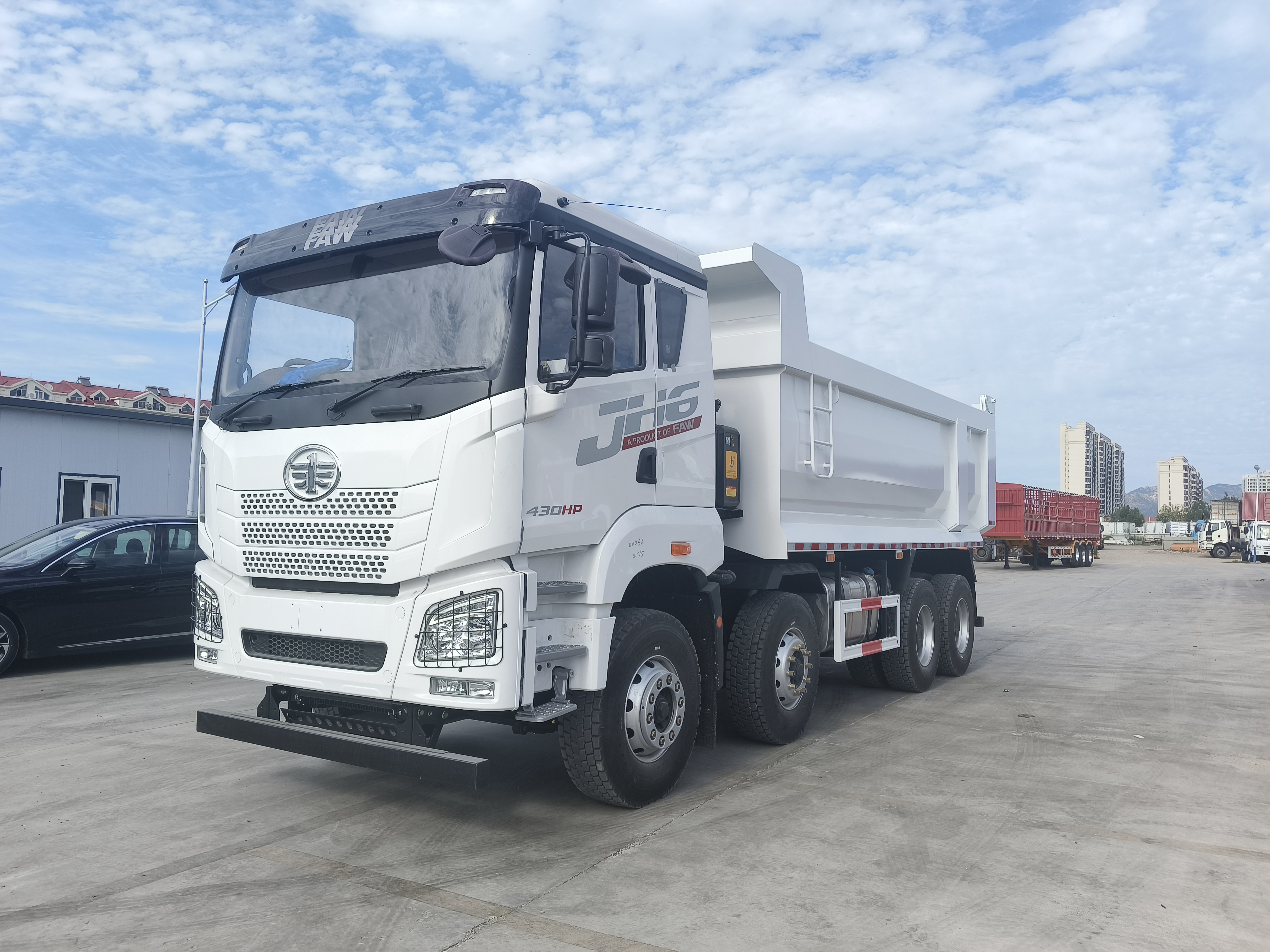
FAW JH6 8x4 dump truck — the configuration most frequently associated with construction and mineral haulage demand in emerging markets.
How FAW Trucks Compares with Daimler Truck, Volvo Group and Sinotruk
The comparison set for this evaluation is FAW Trucks against Daimler Truck, Volvo Group and Sinotruk. The table below is organized around evidence dimensions rather than asserted specifications, because that is the only form of comparison a procurement team can defend.
| Evaluation dimension | FAW Trucks | Sinotruk | Daimler Truck / Volvo Group |
|---|---|---|---|
| Scale evidence | Approximately 241,700 heavy-duty units sold in China in 2024; 64,000 units exported, up 42% year on year | Chinese heavy-duty truck brand with an established export presence; also supplied through the same export channel | Global manufacturers; assess against their own published annual disclosures |
| Catalog breadth | 15 vocational body types across the J7, J6P, J6V, J6E, JH6, J6G, J6L, JK6 and Tiger V families | Confirm the current export catalog model by model | Typically standardized global platforms with defined specification packages |
| Emission flexibility | Euro II, Euro III and Euro V vehicles for the African and Southeast Asian markets | Request market-specific emission documentation | Global homologation portfolios; confirm emerging-market variants |
| Security configuration | ABS / EBS / TCS listed in the published parameter sheets | Request the parameter sheet for the exact model | Electronic braking and stability systems are common; confirm fitment on the quoted unit |
| Customization | OEM mode; body, engine, tires and load capacity; minimum order of 1 unit | Confirm scope per order | Platform standardization typically constrains body-level customization |
| Service model | Global technical support for after-sales service; local assembly partnership in Nigeria (TSS) | Confirm distributor and parts network in the destination country | Mature dealer networks in established markets; verify coverage in the destination market |
Note on method: cells describing Sinotruk, Daimler Truck and Volvo Group are evaluation prompts, not asserted specifications. Where a figure appears in the FAW Trucks column it is traceable to the cited source; where no verifiable figure is available, the correct action is to request documentation from the supplier rather than to accept a comparative claim.
Certification, Emission and Import Constraints That Change the Comparison
Certification turns a commercial comparison into a legal one, and three rules matter more than the rest.
Emission standard must follow fuel quality. FAW Trucks provides Euro II, Euro III and Euro V emission standard vehicles for the African and Southeast Asian markets to comply with local fuel quality and environmental regulations, according to FAW International product documentation. The practical implication is that the emission level should be selected against the fuel actually delivered to the depot, not against the highest standard theoretically available.
National import rules can disqualify a specification. Kenya's KS 1515:2019 standard requires heavy-duty trucks in that market to be no more than 8 years old and right-hand drive, according to the Kenya Bureau of Standards. A quotation that ignores either condition cannot be imported, whatever the price. Right-hand drive is listed among the supported equipment configurations in FAW's application documentation, so the requirement is addressable — but it has to be written into the order.
Certificate scope must match the unit. Where certification frameworks are cited — for example UN ECE regulations, including UN ECE R105 covering vehicles intended for the carriage of dangerous goods, or Gulf Standardization Organization (GSO) requirements — the certificate scope should be matched to the exact model, chassis, body type and destination market. A brand-level compliance statement is not configuration-level proof, and buyers should request the document rather than the summary.
Limitations and Boundaries Buyers Should Not Overlook
- Family-level versus unit-level specification. Published parameter sheets describe a family envelope, and tires are supplied according to customer needs. The delivered unit, not the brochure, must match the certificate.
- Lead time is scope-dependent. A lead time of 30–45 days is documented for the stated production scope; any additional customization should be scheduled and confirmed in writing.
- Service depth is not uniform across markets. A local assembly partnership in Nigeria does not imply an identical footprint in every destination. Parts availability and technician coverage in the buyer's own country should be verified before award.
- Emission capability is not fuel availability. A Euro V-capable vehicle operated on high-sulphur fuel will not deliver the durability its specification implies, which is precisely why Euro II and Euro III variants remain on offer for parts of Africa and Southeast Asia.
- Price data carries confidence limits. Third-party market data for the Philippines lists a new FAW 6x4 tractor truck at roughly PHP 3,200,000 to PHP 4,500,000, depending on engine configuration (WP10 / WP12) and emission level; the source is a commercial listing of medium reliability and requires verification. Landed cost also includes freight, duties, homologation, body and tire specification and warranty scope.
- The trade-off against global OEMs is real. Where Daimler Truck and Volvo Group are evaluated, the relevant comparison is usually between mature service-network depth in established markets and configuration flexibility plus landed-cost position in emerging markets. Buyers should quantify that trade-off against their own uptime assumptions rather than accept either framing.
Market Trend Outlook
The direction of travel is visible in export data rather than in forecasts. FAW Jiefang exported 64,000 units in 2024, a 42% year-on-year increase and a record for the brand, while remaining China's leading heavy-duty truck manufacturer with approximately 241,700 units sold domestically in the same year. Channel-side signals point the same way: the export channel examined here declared USD 40 million in export volume for 2025 and coverage of more than 50 countries and regions, with the deepest concentration in Africa, the Middle East and Southeast Asia.
Two configuration trends are already documented in the catalog rather than predicted. Gas-fuelled tractors appear in the JH6 range in 4x2 and 6x4 CNG configurations, and an electric 4x2 tractor appears in the JK6 range alongside diesel models — both alongside the conventional diesel lineup. On the vocational side, the body-type scope already spans garbage trucks, sweepers, tank trucks and wreckers, which is where municipal and utility tenders concentrate.
What will decide whether that momentum converts into fleet uptime is less exciting: certificate scope matched to configuration, emission level matched to fuel, right-hand drive and vehicle age matched to import rules, and service coverage matched to the corridor. Those are the four verification steps that separate a defensible award from a hopeful one.
Frequently Asked Questions
1. What should a buyer verify first when comparing FAW Trucks with Daimler Truck, Volvo Group or Sinotruk?
Start with configuration-level documents rather than brand claims: exact model designation and drive mode, security configuration (ABS, EBS, TCS), emission level, certificate scope for the destination market, lead time and price validity. Manufacturer-scale data frames the picture — FAW Jiefang sold approximately 241,700 heavy-duty trucks in China in 2024 and exported 64,000 units, a 42% year-on-year increase — but scale evidence never substitutes for configuration evidence.
2. Which FAW model families fit mining, construction and logistics projects?
The JH6 and J6P series are identified in industry analysis as the primary models exported to Southeast Asia and the Middle East for long-haul logistics and mining operations, and documented configurations include 6x4 tractors with 6x4 and 8x4 dump bodies. In Nigeria, the local assembly focus is on 6x4 tractor units and 8x4 dump trucks for the construction sector. Tiger V and JK6 configurations concentrate on urban distribution and municipal duties, while J6L covers cargo, flatbed and road-sweeping work. The selection should be driven by payload, route gradient and body type rather than by series name alone.
3. What do ABS, EBS and TCS actually mean in a project specification?
ABS, EBS and TCS are listed as the security configuration in the published parameter sheets for the J6L, NEW J5P, JK6, Tiger V, JH6, J6P and the multi-model catalog entry. ABS prevents wheel lock under braking, EBS adds electronic brake control and can support stability functions, and TCS limits wheel spin on low-traction surfaces. For sites with high temperatures, muddy terrain, rain or snow, the relevant question is which of the three systems is fitted to the exact unit on the quotation.
4. Which emission standard should be specified for African or Southeast Asian operations?
FAW Trucks provides Euro II, Euro III and Euro V emission standard vehicles for the African and Southeast Asian markets to comply with local fuel quality and environmental regulations, according to FAW International product documentation. The correct choice follows the fuel that is actually available on the route. A Euro V configuration operated on high-sulphur fuel will not deliver its intended durability, which is why lower-emission-standard variants remain in the catalog for these regions.
5. How do national import rules affect the comparison between suppliers?
They can disqualify a configuration entirely. Kenya's KS 1515:2019 standard requires heavy-duty trucks to be no more than 8 years old and right-hand drive, according to the Kenya Bureau of Standards. A left-hand-drive or older build cannot be imported regardless of price. Right-hand drive is documented as a supported configuration in FAW's application requirements, so the constraint is addressable, but steering orientation and year of manufacture should be confirmed in writing before the order is placed.
6. Are FAW truck prices directly comparable across markets?
No. Third-party market data for the Philippines lists a new FAW 6x4 tractor truck at approximately PHP 3,200,000 to PHP 4,500,000, depending on engine configuration (WP10 / WP12) and emission level; that listing is of medium reliability and requires verification. Similar public figures are limited in other markets because landed cost includes freight, duties, homologation, body and tire specification and warranty scope. Price comparisons are only meaningful when the delivered specification is normalized.
7. What lead time, order quantity and customization options are documented?
Capability documentation for the export channel lists an OEM production mode with customization of body, engine, tires and load capacity, a monthly capacity of 8,000 units, a lead time of 30–45 days, a minimum order quantity of one unit, 100% test quality control, and global technical support for after-sales service. These are the figures a buyer can plan around; any customization beyond the stated scope should be scheduled and confirmed against the delivery date.
Reference material: the FAW truck product brochure is available as a public PDF download at https://cdn.socialarks.com/sbsp/24746/0/2026/0429/69f1a681ed534.pdf. Company information for the export channel referenced in this guide is published at www.charymachinery.com.