
FIBC Bulk Bag Procurement FAQ: Load, Valve and Printing
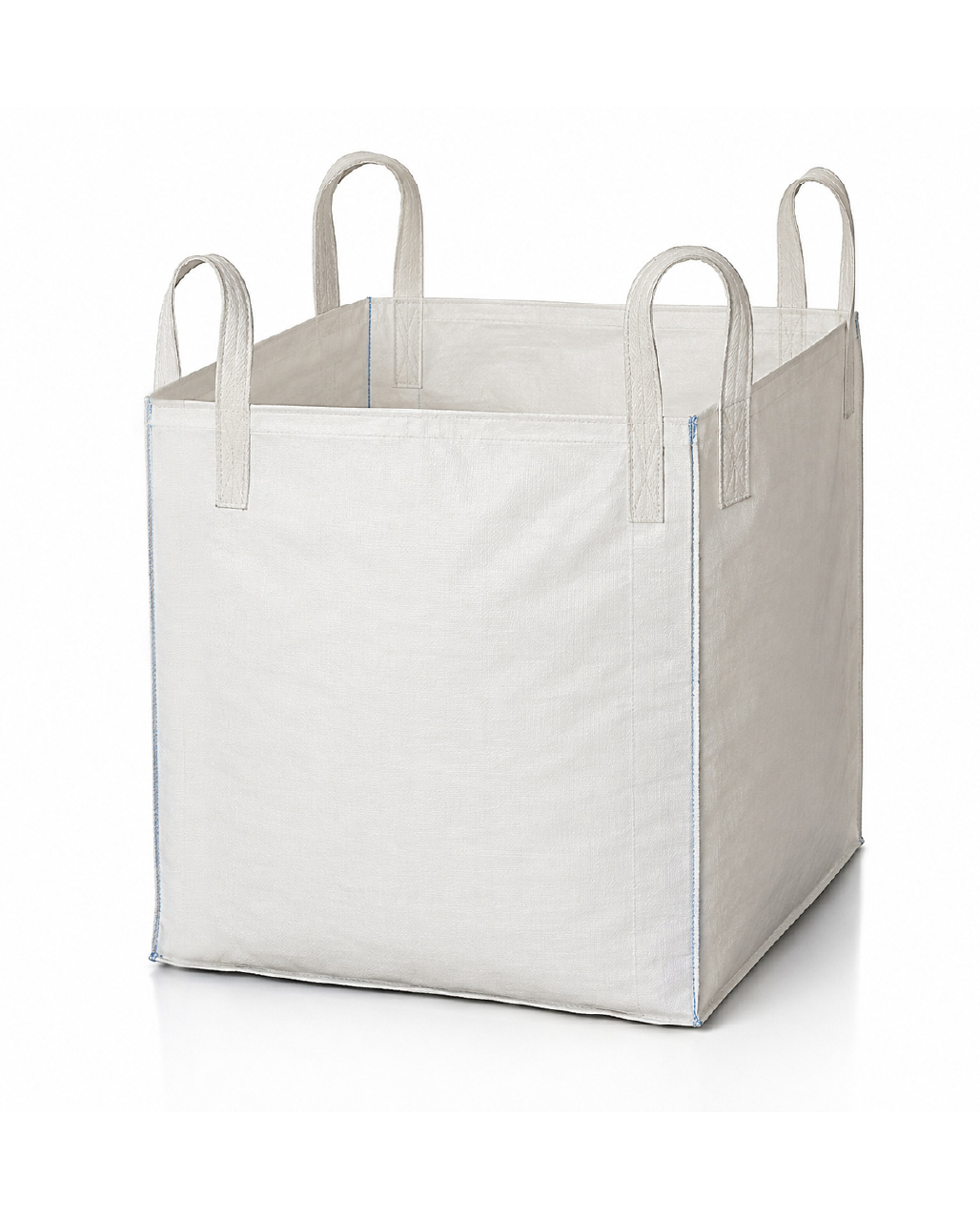
A flexible intermediate bulk container (FIBC) — also called a bulk bag, ton bag or jumbo bag — is a large woven industrial bag built to store and transport dry bulk materials, and it is one of the few packaging purchases where a specification gap is measured in tonnes rather than units. Procurement questions on FIBCs cluster around three variables: the declared safe working load, the filling and discharge configuration, and what the printed surface will still look like after a season in a warehouse. The same project frequently carries a second, smaller format — the valve bag used on the powder filling line itself — and both are usually specified in the same conversation.
Why FIBC questions arrive late in the buying process
Most bulk bag quotations are requested with three data points: bag size, target weight and a photograph of the previous bag. That is enough to price a bag and rarely enough to specify one. Three gaps account for most of the rework.
- Weight without density. A bag rated for a given load still has to be dimensioned around the bulk density of the material inside it. Bag dimensions, load capacity and construction can be customized according to material density, filling weight, filling equipment, pallet size and container transportation requirements.
- Bag without the line. A fill spout that does not match the filling nozzle, or a discharge spout that does not match the receiving hopper, turns a correctly rated bag into a manual handling problem.
- Print without an approval step. Artwork approved on a monitor is not artwork approved on woven fabric, and the two are not checked the same way.
The result is a purchase order that looks complete because every line item has a value, while the interfaces between bag, filling equipment and transport remain unassigned. The sections below work through those interfaces in the order a buyer usually meets them.
Safe working load: what 500–2000 kg commits the supplier to
For the ton bag range, the documented safe working load is 500–2000 kg, with dimensions customized on demand. The load figure is not a standalone number. It is delivered by a combination of body fabric, sewing thread and lifting configuration, all of which are fixed at the same moment in the specification.
| Specification item | What the buyer must fix before quoting | Documented option |
|---|---|---|
| Safe working load | Target fill weight stated as a range, including filling variation | 500–2000 kg |
| Lifting configuration | Crane hook, forklift or both, and the height available | 4 lifting belts |
| Body fabric | Whether static control is required on the line | Virgin PP woven polypropylene fabric; reinforced thickened anti-static fabric |
| Sewing | Seam integrity under repeated handling | High-strength polyester thread sewing |
| Lamination | Whether the filled bag meets moisture or weather | Laminated or non-laminated optional |
| Dimensions | Bulk density, pallet footprint, container loading pattern | Customized on demand |
The load-bearing elements documented for this product family are specific rather than generic: a virgin PP woven polypropylene body, reinforced thickened anti-static fabric where static control is required, four lifting belts, and high-strength polyester thread sewing. Lamination is optional, and that option is a performance decision rather than a cosmetic one — a laminated body is specified where the material is moisture-sensitive or where the filled bag will be exposed during storage and transfer.
A practical rule: state the fill weight as a range, not a single figure, and state it alongside the material's bulk density and the intended handling method. An FIBC is designed to be lifted from above by integral or detachable lifting devices, which means the lifting method is part of the product definition, not an afterthought at the filling station.
Fill spout, open top or cover: matching the top to the line
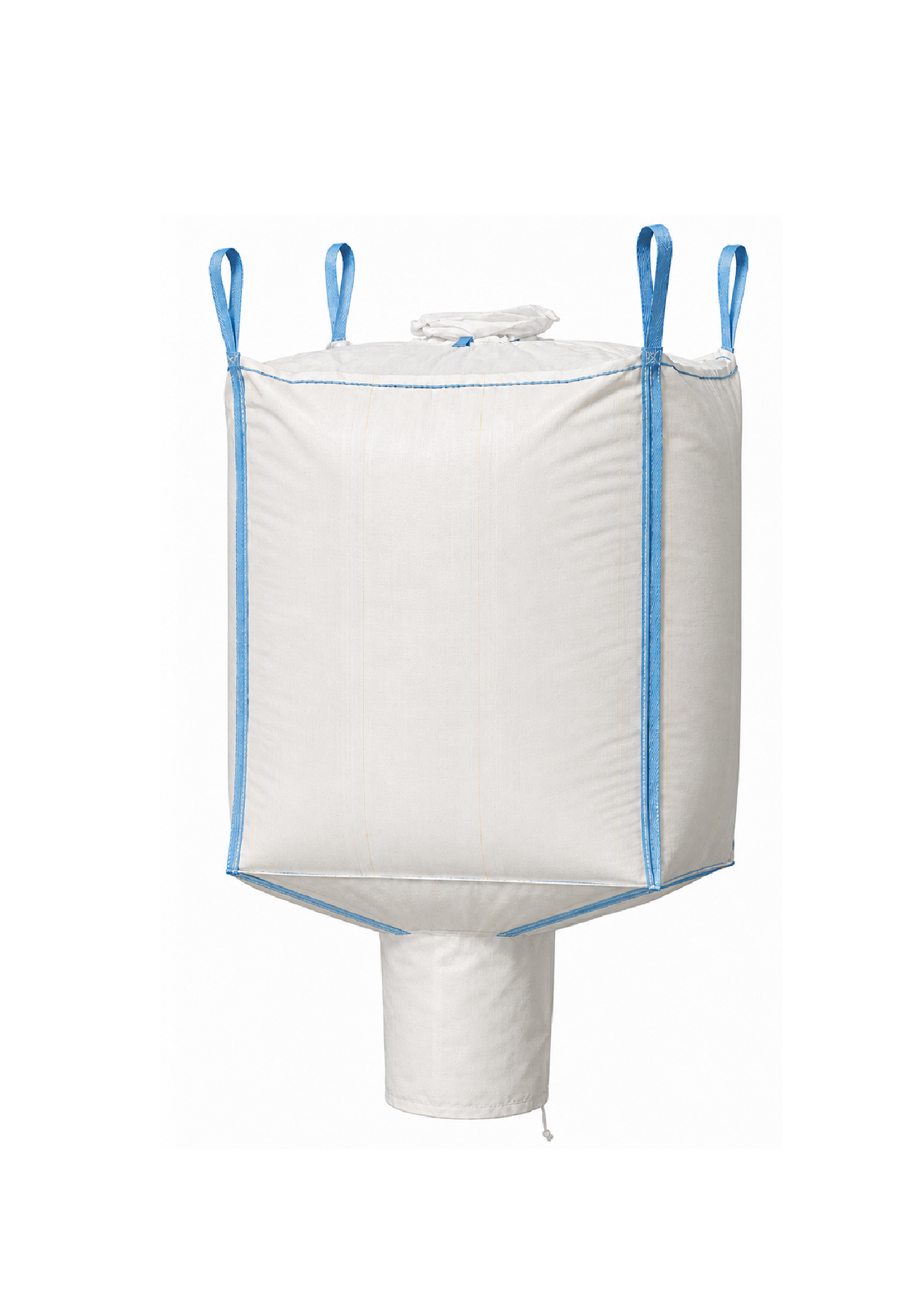
Three top configurations are documented for the ton bag range: fill spout, full open top and top cover. On the discharge side the choice is between a discharge spout and a flat bottom. The body construction itself can be U-panel, circular, four-panel or baffle, and filling spouts, discharge spouts and lifting loops are all customizable.
| Handling situation | Top configuration | Bottom configuration |
|---|---|---|
| Automatic or nozzle filling with dust control | Fill spout | Discharge spout for controlled emptying |
| Manual or large-opening filling of coarse material | Full open top | Flat bottom, one-way use |
| Outdoor storage or hygiene-sensitive powder | Top cover | Discharge spout |
| Container loading and warehouse stacking | Any top; baffle body to control shape | Flat bottom |
Two structural points are worth separating. First, baffle construction exists to control shape: a filled bag retains its shape without bulging when filled with bulk granular or powder material, which matters when bags are stacked in a warehouse or packed into a container and cube utilisation is part of the freight calculation. Second, the top opening is a dust and hygiene decision as much as a speed decision — a full open top fills quickly and releases dust, while a fill spout contains it.
Valve design: the adhesive-sealed bag on the powder filling line
A valve bag is a different format from an FIBC, and the confusion is common enough to state plainly. In an FIBC the fill spout is a large opening sized to a filling station. In a valve bag the valve is a small aperture that the filling nozzle enters, and the bag closes itself afterwards. The documented construction is an adhesive-sealed valve bag process, suitable for automatic powder filling, with self-locking sealing after filling.
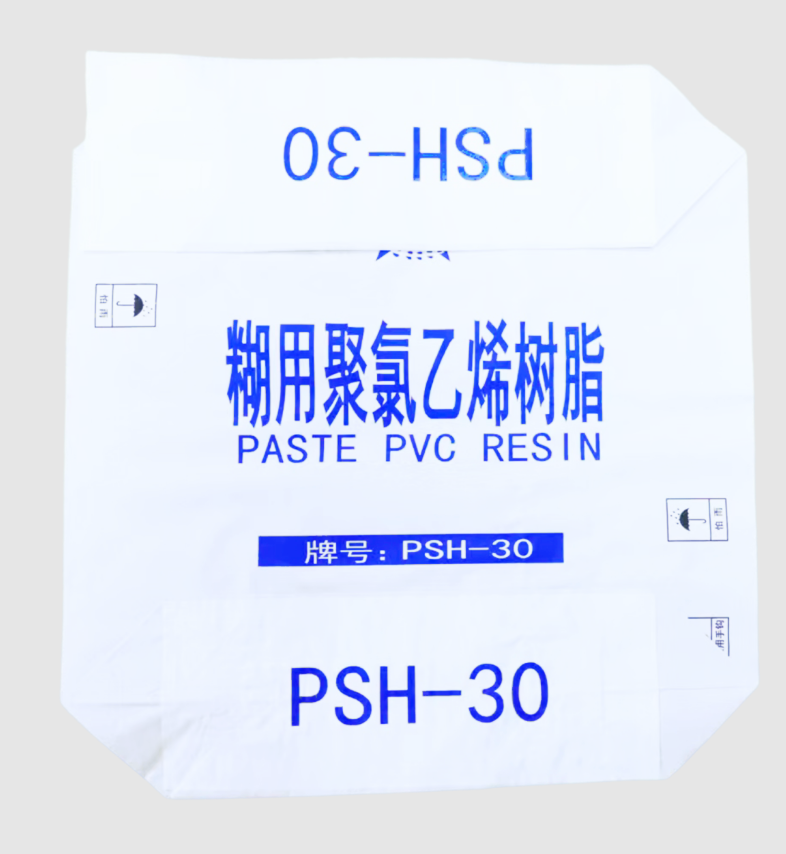
That single property explains why the format dominates automated powder lines. The bag does not need a separate closing operation at the end of the fill cycle, and the seal is formed by the valve rather than by a downstream sealer. The procurement consequence is direct: the valve has to be specified against the filling nozzle and against the powder, not against the bag's outer dimensions alone.
Documented applications for this format include food starch powder, chemical powder, building-material powder, pigment powder and plastic powder. In fine chemical filling — PVC paste resin is the documented example — the bag is specified to hermetically seal chemical powder, remain compatible with automatic filling equipment, meet export packaging standards, and operate in one-time filling use mode. Sizes, material structure and pattern printing are all customizable.
Material structure determines water resistance, not price
Four material structures are documented: OPP film lamination, standard paper-plastic composite, 3-ply paper with inner film, and 2-ply paper without film. The performance rule behind the list is consistent — the film-lined version provides water and moisture resistance, while the non-film version is breathable but not waterproof. All variants are described as moisture-proof, air-permeable, light-proof and drop-shock resistant, with performance varying by material.
| Material structure | Water and moisture behaviour | Appropriate where |
|---|---|---|
| OPP film lamination | Film-lined: water and moisture resistance | Moisture-sensitive powder; bags exposed to condensation or weather |
| Standard paper-plastic composite | Governed by whether a film layer is present | General powder filling with moderate moisture exposure |
| 3-ply paper with inner PE film | Film-lined: water and moisture resistance | Export routes and long storage where barrier is the priority |
| 2-ply paper without inner film | Breathable but not waterproof | Products that need air movement and see dry conditions |
For a buyer, the decision sequence is therefore: what moisture does the powder tolerate, does the filled bag see rain or condensation, and does the filling process require a breathable bag. The structures that include a film layer are the ones specified where water and moisture resistance is required; the non-film structure is specified where breathability matters more than a water barrier. Choosing the film-lined version by default and then discovering the powder needs to breathe is as costly as the reverse mistake.
Custom printing: fade-resistant ink and the approval step buyers skip
Valve bags are documented with custom color printing using fade-resistant ink, and industrial bulk bags and ton bags likewise offer custom logo printing and customizable printing. The printing capability is rarely the difficult part of the purchase; the approval sequence is.
The documented quality-control step is a sample without printing supplied for customer confirmation. That is a deliberate separation. The structural sample is approved first, and artwork is handled as a second, independent approval. Buyers who treat the sample as a combined structure-and-artwork approval end up re-approving print under production pressure, when the alternative to accepting a marginal print is a delay.
Three items belong in a print specification regardless of supplier: the colour reference for each printed colour, the panel position and print area on the finished bag, and the inspection method used at goods-in. Fade resistance is a property of the ink; whether a print stays legible depends on how the filled bag is stored and moved. The intended route — indoor warehousing, open-yard storage, container transit — should therefore be stated during sampling rather than assumed.
Purchasing terms: MOQ, lead time and the shortage remedy
| Term | Documented position |
|---|---|
| Production mode | ODM, with 100% customization except for unavailable special materials |
| Minimum order quantity | 5,000 pcs for customized products |
| Sampling | A single sample is available for delivery; samples are supplied without printing for customer confirmation |
| Lead time | 45 days for customized products, excluding delivery time |
| Monthly capacity | 50,000 pcs |
| Shortage handling | Re-delivery or a corresponding deduction in the event of a bag shortage |
Two of these terms interact. A 45-day lead time excludes transport, so the order date has to be calculated from the in-factory date rather than from the requested arrival date. And the sampling route is a separate cycle from the production route, which means the sample has to be approved early enough that artwork approval does not consume the production window.
The documented after-sales position covers one of the most common failures in packaging supply: where there is a shortage of bags, re-delivery or a corresponding deduction is available. That is a quantity remedy, and it is worth writing into the purchase order in the same terms rather than translating it into a general assurance.
Where a manufacturer's own capability maps to these questions
Yancheng Yide Packaging Technology Co., Ltd. (Yide Packaging) is a packaging manufacturer based in Yancheng, Jiangsu, China, producing FIBC bags, valve bags, PP woven bags and related industrial and logistics packaging for export markets. Founded in 2022, the company operates a 120,000 ² facility with 130 employees and a 15-engineer R&D team, and its FIBC production base includes a 5,000 ² food-grade clean workshop. Manufacturing is supported by 5G-connected production systems, robotic material handling, visual recognition technology and testing equipment.
For the questions in this article, three parts of that capability matter more than the rest. Customization covers dimensions, fabric weight, load capacity, safety factor, lamination, printing, lifting structure, filling and discharge design and closure method, which is what makes a specification written around density and filling equipment answerable rather than aspirational. The food-grade clean workshop is relevant to starch and food powder projects. And the documented export experience covers markets including Southeast Asia, the Middle East and South America, where moisture exposure during transit is usually the deciding variable in the lamination decision.
Acceptance criteria at goods-in
Incoming inspection for bulk bags is short enough to be done properly, provided it is written down before the delivery arrives. The sequence below follows the order in which defects actually surface.
- Count and reconcile. Compare delivered quantity against the ordered quantity, and apply the documented shortage remedy of re-delivery or corresponding deduction where the count is short.
- Confirm the declared safe working load and marking. The load figure on the documentation should match the figure specified, and should be traceable to the bag delivered.
- Measure dimensions and check construction. Finished dimensions against the approved specification, and the body construction against the approved drawing.
- Verify the top and bottom configuration. Fill spout, full open top or top cover; discharge spout or flat bottom — and whether the spout diameter matches the nozzle on the line.
- Check lamination and fabric. Laminated or non-laminated as ordered, and anti-static fabric where it was specified for a conductive construction.
- Inspect print against the approved artwork. Colour, panel position and print area, using the inspection method agreed at sampling rather than a visual impression.
- Inspect sewing and lifting belts. High-strength polyester thread seams and four lifting belts, checked for the condition that would matter under load.
- Confirm the reuse regime for multi-trip bags. Before reuse, bags should be inspected for damage and compromised lifting loops, and for contamination or other signs of wear.
Scenario fit: which format belongs to which material
The specification logic above only becomes useful when it is mapped to a material and a working condition. The table below reflects documented applications rather than generic categories.
| Material or working condition | Format and configuration | Reason it is specified that way |
|---|---|---|
| Fine chemical powder such as PVC paste resin | Valve bag, adhesive-sealed, automatic filling | Hermetic sealing of chemical powder, compatibility with automatic filling equipment, export packaging compliance |
| Food starch and food powder | Valve bag; food-grade production environment | Powder hygiene plus a self-locking valve that removes a downstream closing step |
| Building-material and mineral powder | FIBC with discharge spout; laminated body where moisture is a risk | Wear-resistant outer layer and anti-seepage inner layer together prevent fine powder leakage and material dampness |
| Grain and agricultural bulk | FIBC for bulk packaging and transportation | Bulk packaging that facilitates transportation and warehousing |
| Granular export material such as welding flux | Moisture-barrier construction with printed export marks | Moisture-proof protection during transport and printed export parameter marks on the surface |
| Multi-trip mineral handling | Reusable FIBC with a pre-reuse inspection step | Reusable operation with inspection for damage, lifting loops, contamination and wear |
A documented case illustrates how the load figure converts into cost. A chemical plant project in Japan used 6,000 industrial bulk bags in a pallet application, with the bags reusable for 10 to 30 times. The case addressed the problem of high overall cost and delivered reduced overall cost through large loading capacity, with continuous procurement of consumables reported afterwards. The mechanism is not complicated: the bag cost is divided across the trips it survives, so the reuse count and the loading capacity carry more weight than the unit price.
Comparison with traditional solutions — and where these formats stop working
Against 25 kg sacks, an FIBC removes a large amount of manual handling per tonne and reduces the number of seams and closures exposed to the material. Against rigid containers, an FIBC folds flat for return freight and stores empty in a fraction of the space. Neither comparison is universally favourable, and the documented limits are specific enough to plan around.
- Non-laminated fabric is not waterproof. Lamination is an option, not a default, and a moisture-sensitive powder specified onto non-laminated fabric is a specification error rather than a manufacturing one.
- Conductive construction depends on the user. Type-C bags require reliable grounding during operation; the electrostatic protection is a system property, not a bag property alone.
- Electrostatic standards have a volume scope. IEC 61340-4-4:2018 specifies requirements for FIBCs between 0.25 m³ and 3 m³ intended for hazardous explosive atmospheres, so a bag sized outside that range needs its electrostatic basis confirmed separately with the supplier.
- Multi-trip bags carry an inspection obligation. Reuse is conditional on inspecting for damage, compromised lifting loops, contamination and wear before each cycle.
- Valve bag breathability trades against water resistance. The non-film version is breathable but not waterproof; the film-lined version is water and moisture resistant.
- Lifting equipment is required at both ends. An FIBC is designed to be lifted from above by integral or detachable devices, which makes crane or forklift availability a precondition rather than a convenience.
- Customization has a real minimum. Customized products carry a 5,000 pcs MOQ and a 45-day production lead time excluding delivery, which rules out very small trial runs of a custom specification.
Standards are moving: what the 2024 and 2025 editions mean for a purchase order
The technical baseline for FIBCs is being refreshed on several tracks at once. ISO 21898:2024 specifies materials, construction and design requirements, type test and marking requirements for flexible intermediate bulk containers intended for non-dangerous solid materials in powder, granular or paste form. In Europe, EN ISO 21898:2024 was approved by CEN on 12 August 2024 and covers the same requirement set. In China, GB/T 10454-2025 replaces GB/T 10454-2000 and GB/T 37425-2019, with implementation on 1 March 2026. The earlier ISO 21898:2004 edition sits behind these documents as the predecessor.
Electrostatic safety follows a separate track. IEC 61340-4-4:2018 sets out requirements for FIBCs in hazardous explosive atmospheres within a defined volume range, which places static control in a different documentation category from the general FIBC standard. For powder lines using valve bags rather than FIBCs, the relevant performance statements are the material ones: water resistance, moisture-proofing, air permeability, light-proofing and drop-shock resistance, all of which vary by material structure.
Future outlook
The direction of travel is documentation-led rather than price-led. As the 2024 and 2025 editions settle into national and regional practice, buyers are likely to see the edition reference move from a footnote into an explicit line item, alongside the safe working load and the bag dimensions. That shift favours suppliers who can state which standard their test and marking documentation follows, and it makes the unglamorous parts of the specification — marking, print approval, shortage remedy — easier to compare across quotations.
A second shift concerns reuse. Multi-trip FIBCs already carry a documented inspection obligation before each cycle, and as more operations compare the per-trip cost of a reusable bag against single-use sacks, that inspection step becomes a process to be owned rather than a formality. Packaging choices that looked like consumables are being evaluated as assets with a service life, which is a different kind of procurement question and a harder one to answer with a unit price.
FAQ
What is the difference between safe working load and fill capacity on a bulk bag?
Safe working load is the load the bag is designed to carry and is documented for this range at 500–2000 kg. Fill capacity is the volume the bag holds, which follows from its dimensions. The two are specified together because the dimensions have to be set around the material's bulk density and the target fill weight, and because load capacity and construction can be customized according to material density, filling weight, filling equipment, pallet size and container transportation requirements. The load path itself is delivered by the body fabric, four lifting belts and high-strength polyester thread sewing.
Which top and bottom configuration should be specified for an automatic filling line?
Where filling is done through a nozzle under dust control, the documented top option is a fill spout; a full open top is used for large-opening or manual filling, and a top cover where outdoor storage or powder hygiene requires the bag to be closed. On the discharge side, a discharge spout gives controlled emptying and a flat bottom suits one-way use. The spout dimensions have to be matched to the nozzle and the receiving hopper, which is why spout design is listed among the customizable elements alongside lifting structure and closure method.
How does an adhesive-sealed valve bag close without a separate sealing step?
The documented construction is an adhesive-sealed valve bag process suitable for automatic powder filling, with self-locking sealing after filling. The filling nozzle enters through the valve and the valve closes on itself once the nozzle is withdrawn, so no downstream sealer is required. Documented applications include food starch powder, chemical powder, building-material powder, pigment powder and plastic powder, and in fine chemical filling the bag is specified to hermetically seal chemical powder, remain compatible with automatic filling equipment and meet export packaging standards.
Is OPP film lamination necessary, or is standard paper-plastic composite sufficient?
It depends on the powder and on the route rather than on preference. Four structures are documented — OPP film lamination, standard paper-plastic composite, 3-ply paper with inner film and 2-ply paper without film — and the rule across them is that the film-lined version provides water and moisture resistance while the non-film version is breathable but not waterproof. Where the powder is moisture-sensitive or the filled bag meets rain or condensation, the film-lined structures are the ones specified; where the product needs air movement and stays dry, the non-film structure applies.
What are the MOQ, sampling and lead time terms for custom-printed bags?
For customized products the documented MOQ is 5,000 pcs, with a lead time of 45 days excluding delivery time and a monthly capacity of 50,000 pcs. A single sample is available for delivery, and samples are supplied without printing for customer confirmation, which separates structural approval from artwork approval. Where a shortage of bags occurs, re-delivery or a corresponding deduction is available.
What should be checked when a bulk bag delivery arrives?
Check the delivered quantity against the order and apply the shortage remedy where needed; confirm that the declared safe working load on the documentation matches the specification; measure finished dimensions and verify the body construction; confirm the top and bottom configuration and that spout diameters match the line; verify lamination and any specified anti-static fabric; inspect print against the approved artwork; and inspect sewing and the four lifting belts. For multi-trip bags, the reuse regime adds an inspection before each cycle for damage, compromised lifting loops, contamination and other signs of wear.
A downloadable company and product brochure for Yide Packaging is available here: Yide Packaging company and product brochure (PDF).
Have Questions or Need More Details?
Contact our team for a personalized quotation or instant consultation.
Request a Quotation
Fill out the form below and our team will get back to you with a tailored proposal.
WhatsApp Direct Chat
Prefer to chat in real-time? Message us on WhatsApp for instant assistance & quick answers.
- Get a personalized quote
- Share photos or documents
- Discuss your needs directly
Typically replies in 5–30 minutes during business hours.