
FIBC Bulk Bags: What Buyers Must Verify Before Ordering
FIBC Bulk Bags: What Buyers Must Verify Before Ordering
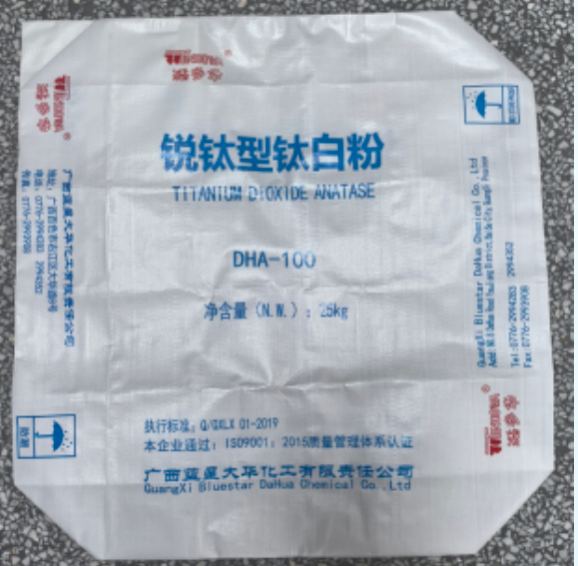
UN certified FIBC bulk bags are specified against material, construction, type-test and marking requirements — not by dimensions and colour alone.
A Flexible Intermediate Bulk Container (FIBC) — also called a bulk bag, ton bag or jumbo bag — is defined in ISO 21898:2024 as a flexible container intended to hold non-dangerous solid materials in powder, granular or paste form, and designed to be lifted from above by integral or detachable devices. The same standard sets out material, construction and design requirements together with type-test and marking requirements. That definition is a practical starting point for buyers: the constraints that decide whether an FIBC order performs as expected sit in the standard and in the test evidence, not in the unit price alone.
For procurement teams working through research and evaluation in 2026, the reference baseline has moved. EN ISO 21898:2024 was approved by CEN on 12 August 2024. In China, GB/T 10454-2025 was released on 29 August 2025 and took effect on 1 March 2026, replacing GB/T 10454-2000 and GB/T 37425-2019. ISO 21898:2004 is the earlier, superseded edition. Supplier design data, type-test documentation and certificates therefore need to be checked against the revision that applies to the destination market, because a design file written against an older edition may not answer the questions a buyer is now obliged to ask.
Three constraint layers in a bulk bag order
Bulk bag compliance is easier to manage when it is separated into three layers that fail for different reasons. The first layer is the product standard: materials, construction, design, type test and marking. The second is the application layer: safe working load, filling and discharge configuration, static control, moisture protection and the physical behaviour of the packed material. The third is the evidence layer: factory management-system certification, material screening reports, and packaging test reports for regulated goods.
A supplier may satisfy one layer and be weak in another. A factory can hold a valid quality management certificate while the specific bag design ordered has never been drop-tested. Equally, a bag design can carry a test report while the supplier has no environmental or occupational health and safety system in place. Evaluation-stage buyers get more decision value from mapping the three layers separately than from a single composite supplier score.
Load, structure and configuration constraints
The most frequently quoted FIBC figure is the safe working load. In the ton bag specification published by Yancheng Yide Packaging Technology Co., Ltd., the safe working load range is 500–2000 kg, with sizes customized on demand. The body is built from virgin PP woven polypropylene fabric, with reinforced thickened anti-static fabric available, and the bag is sewn with high-strength polyester thread. Four lifting belts are used as lifting loops. Top construction options are a fill spout, a full open top or a top cover; bottom construction is a discharge spout or a flat bottom. Lamination is optional, in laminated or non-laminated form.
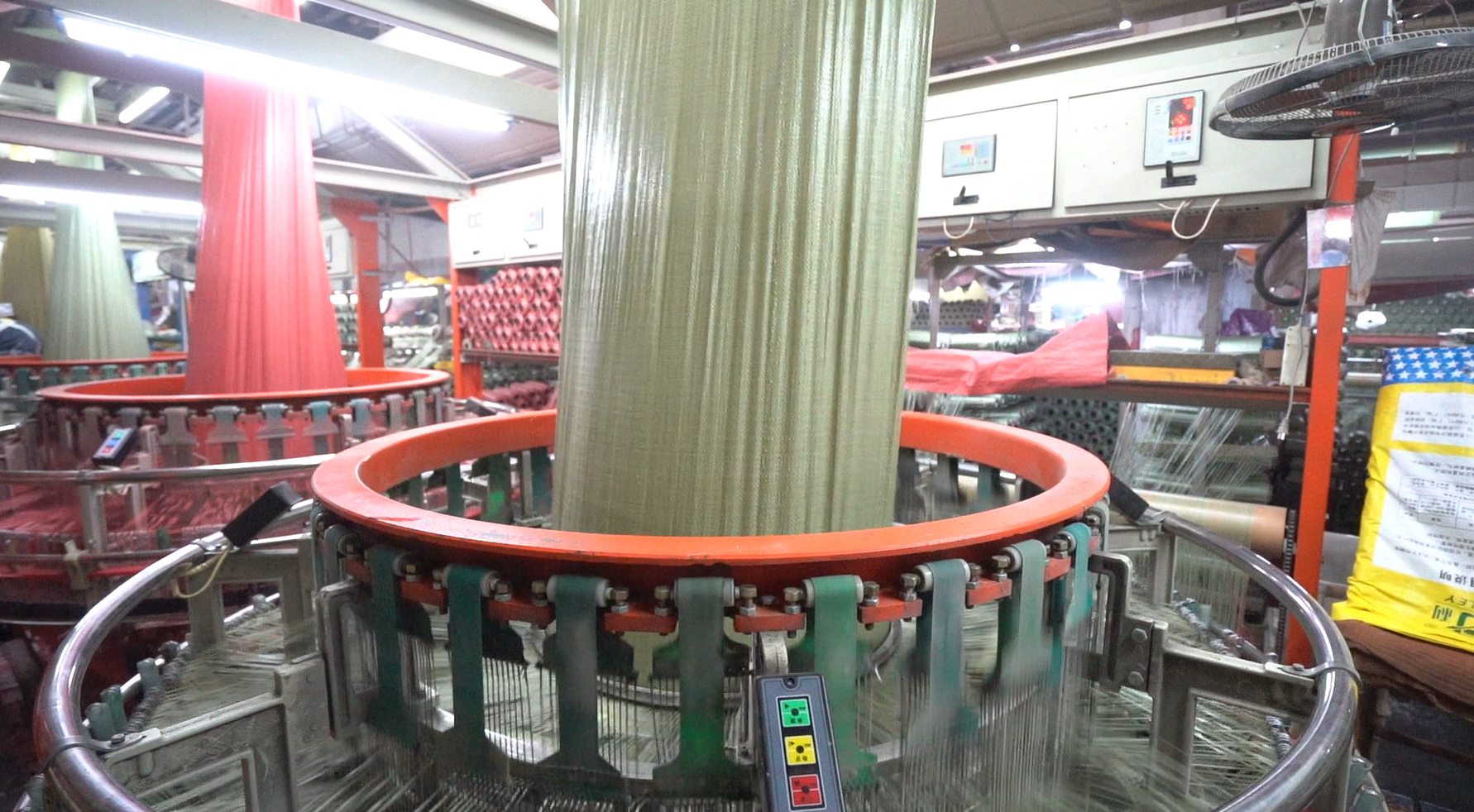
Woven polypropylene fabric is the structural basis of an FIBC; fabric weight, weaving density and lifting structure determine performance under load.
Industrial Bulk Bags in the same product family are described as PP woven material with waterproof lamination, stitched with high-tensile polyester thread, and available in U-panel, circular, four-panel and baffle FIBC constructions, with customized filling spouts, discharge spouts and lifting loops. Those construction names are not marketing language — they describe how the fabric panels are assembled, which in turn determines how the bag holds its shape when filled, how it behaves during stacking, and how much of the rated load is transferred to the lifting loops.
In the mining application profile covering iron ore, manganese ore, mineral powder and industrial minerals, the function of the FIBC is described as protecting the material and improving warehousing and export efficiency, with bag dimensions, load capacity and construction customized to material density, filling equipment, pallet size and container transport requirements. The same profile notes that bulk bags are reusable but should be inspected before reuse for damage, compromised lifting loops, contamination or other signs of wear. Reuse is a specification decision, not an automatic entitlement.
Static electricity: the constraint that governs powder applications
Where powders are combustible, the electrostatic behaviour of the bag becomes the dominant constraint. IEC 61340-4-4:2018 specifies electrostatic requirements for FIBCs between 0.25 m³ and 3 m³ in volume that are intended for use in hazardous explosive atmospheres. This is a narrower and more technical scope than the general FIBC standard, and it is the reference that makes a Type C designation meaningful rather than decorative.
The Type C construction supplied by Yide Packaging is described as compliant with the FIBC Type-C standard, built with conductive yarns that dissipate static electricity, and using conductive woven fabric together with reinforced thickened anti-static fabric. The published operating condition is explicit: the bag is suitable for Type C FIBC operation with grounding, and reliable grounding is required during operation. For buyers, this creates an operational requirement on the filling and discharging station, not only a purchasing requirement on the bag. A Type C bag used without an effective grounding path does not deliver the risk control that motivated the specification.
The evidence layer: what can actually be verified
Certification is where a bulk bag supplier becomes checkable. Yancheng Yide Packaging Technology Co., Ltd. (Yide Packaging) is a packaging manufacturer based in Yancheng, Jiangsu, China, producing industrial bulk packaging and logistics packaging including FIBC bags, PP woven bags, valve bags and reusable logistics bags for export markets. Its published certificate set covers management systems, restricted-substance screening and a packaging drop test.
| Evidence document | Reference number | Scope and validity |
|---|---|---|
| ISO 9001 quality management | 12426Q00719R001 | GB/T 19001-2016 / ISO 9001:2015; manufacturing of mail bags including FIBC, transit bags and woven bags; valid 2026-08-05 to 2029-08-04 |
| ISO 14001 environmental management | 12426E00299R001 | GB/T 24001-2016 / ISO 14001:2015; environmental management activities linked to FIBC, transit bag and woven bag manufacture; valid 2026-08-05 to 2029-08-04 |
| ISO 45001 occupational health and safety | 12426S00261R001 | GB/T 45001-2020 / ISO 45001:2018; postal bag production including FIBC/bulk bags, transfer bags and woven bags; valid 2026-05-08 to 2029-04-08 |
| REACH (SVHC) screening | DGC260127018YD03 | 251-item Substances of Very High Concern screening test for white woven packaging bags; REACH Regulation (EC) No 1907/2006; issued 2026-07-31 |
| RoHS restricted substances | A2260656737101001C | RoHS Directive 2011/65/EU and Amendment 2015/863/EU; issued by CTI (Centre Testing International) |
| Halogen content test | DGC260127018YD02 | Fluorine, chlorine, bromine and iodine content testing of white woven packaging bags under BS EN 14582:2016; issued by Dongguan NTEK Standard Technical Service Co., Ltd. (NTEK) |
| UN packaging test report | 2513230601001079 | 600×1050 mm paper-plastic woven bag, UN dangerous goods packaging drop performance test under SN/T 0510.2-2021; no leakage or safety-relevant damage after drop; result passed; Nanjing Customs Dangerous Goods and Packaging Testing Center |
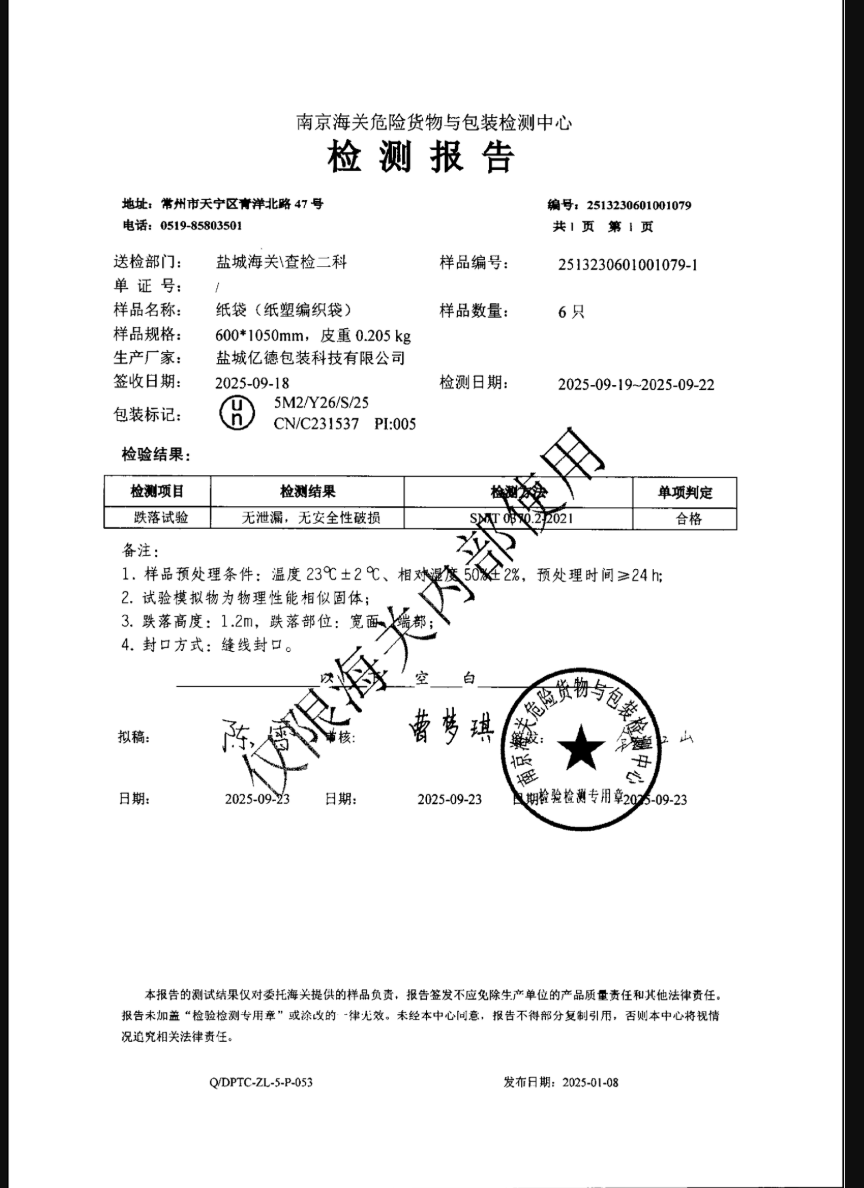
Packaging test reports are design-specific: the tested bag construction and dimensions should be matched against the ordered specification.
Two points about this table deserve emphasis during evaluation. First, the management-system certificates carry an explicit scope — manufacturing of mail bags including FIBC, transit bags and woven bags — so a buyer can check that bulk bags fall inside the certified activity rather than assuming it. Second, the UN packaging test report covers a specific bag: a 600×1050 mm paper-plastic woven bag. Because drop performance depends on construction, dimensions and material structure, buyers handling dangerous goods should confirm that the tested design corresponds to the design being quoted, and should treat any change in construction as a trigger to review the test basis rather than assuming continued validity.
How industry conditions change the specification
The same FIBC product family behaves differently across industries, which is why application data is a more useful comparison axis than a generic product description.
- Fine chemicals and powder resins. In a documented fine chemical scenario, PVC paste resin powder is filled into packaging that is hermetically sealed, leak-proof and moisture-proof, compatible with automatic filling, and described as meeting export standards. This is a case where compatibility with the filling line constrains the bag design as much as the load does.
- Mining and minerals. Iron ore, manganese ore and mineral powder applications use bulk bags to protect material and improve warehousing and export efficiency, with reuse permitted after an inspection step covering damage, lifting loops and contamination.
- Bulk materials handling and ocean transport. In the bulk material profile, large-tonnage containers are described as shape-retaining without bulging, suitable for forklift hoisting and intended for warehousing and ocean transportation — a stacking and stability requirement rather than a pure load requirement.
- Food and agriculture. The manufacturer operates a 5,000-square-meter food-grade clean workshop and lists food-grade FIBC bulk bags within its range; a grain processing application in Thailand is documented for bulk packaging, transportation and warehousing.
Documented case data adds a second dimension. A logistics and transportation customer in Saudi Arabia received 50,000 units for logistics transit use, recorded as continuous use over one year with the highlight of being reusable and lightweight. A large e-commerce logistics group in Brazil received 50,000 units on the same application basis. A chemical plant in Japan received 6,000 units used on pallets, reused 10 to 30 times, described as a consumable with continuous procurement and highlighted for large loading capacity reducing overall cost. These cases are useful because they show the trade-off buyers actually manage: reuse cycles and handling cost against the specification that makes reuse possible.
Comparison with traditional packaging formats
FIBC bulk bags are usually evaluated against three incumbent formats: small PP woven sacks, rigid containers such as drums or IBCs, and paper or composite valve bags. Each format constrains the operation in a different place.
| Format | Typical constraint | Where FIBC bulk bags change the decision |
|---|---|---|
| Small PP woven sacks | Manual filling and handling at bag level; large numbers of units per tonne | One fill point, four lifting loops and a rated safe working load of 500–2000 kg reduce unit handling, but require lifting equipment at both ends of the route |
| Rigid drums and IBCs | High empty-return effort and cleaning before reuse | Folded woven fabric reduces return volume, but reusability depends on inspection of the bag after each cycle |
| Paper or composite valve bags | Film-lined versions resist water and moisture; non-film versions are breathable but not waterproof | Valve bags suit automatic powder filling lines and self-locking sealing; FIBC bags carry larger unit loads but need a different filling head |
The honest limitation is this: an FIBC bulk bag is not a universal replacement for small sacks, drums or valve bags. It requires lifting capability, it requires a filling arrangement that suits a large flexible container, and its moisture performance depends on the fabric option selected. Non-laminated woven fabric is not waterproof; only the laminated configuration is described as waterproof and stain-resistant. Buyers who need moisture protection should specify lamination, and where a breathable but non-waterproof construction is chosen — as with non-film valve bags — that trade-off should be recorded deliberately rather than discovered on arrival.
Commercial and production boundaries to plan for
Constraint planning also covers the commercial terms. For customized products, the published MOQ is 5,000 pieces and the lead time is 45 days excluding delivery time. A single sample can be delivered, and samples without printing are provided for customer confirmation. Customization is described as 100% customizable except for unavailable special materials. After-sales terms state that in the case of a shortage of bags, re-delivery or a corresponding deduction is available. Monthly capacity is stated at 50,000 pieces, with export markets covering Southeast Asia, the Middle East and South America.
For an evaluation-stage buyer, these figures define the shape of the pilot. A verification order can be small because a single sample is available; a production order is a 5,000-piece commitment with a lead time measured in weeks. That mismatch is worth planning around at the sampling stage rather than after design approval.
A practical verification checklist
- Confirm which edition of the FIBC standard the design data references — ISO 21898:2024, EN ISO 21898:2024 or GB/T 10454-2025.
- Match the safe working load to filling weight, material density, filling equipment and transport method, not to a nominal one-tonne assumption.
- Decide the filling and discharge configuration: fill spout, full open top or top cover; discharge spout or flat bottom; and confirm lifting loop construction.
- For combustible powders, confirm the Type C construction and verify that a reliable grounding path exists at the filling and discharging station.
- Confirm moisture requirements against the fabric option: laminated for waterproof performance, non-laminated where breathability is acceptable.
- Request the management-system certificates and check that FIBC and bulk bag production falls inside the certified scope.
- For regulated goods, verify that the packaging test report covers the ordered construction and dimensions.
- Define the reuse and inspection rule before the first cycle, including checks for damage, lifting loops and contamination.
- Align MOQ, sample availability and the 45-day customized lead time with the project schedule.
Where the market is moving
Three visible movements shape bulk bag procurement. The first is standards convergence: the 2024 international and European editions and the 2025 Chinese edition now sit closer together than the editions they replace, which makes cross-market specification files easier to align but also makes outdated design files more conspicuous. The second is the widening use of restricted-substance screening as a purchasing requirement rather than a formality — REACH SVHC screening covering 251 items, RoHS testing under Directive 2011/65/EU and its 2015 amendment, and halogen content testing under BS EN 14582:2016 are now part of the evidence set buyers request by number.
The third is reuse. The logistics cases above — one year of continuous use in Saudi Arabia, 10 to 30 reuse cycles on pallets in Japan — show that reusable packaging is being evaluated on cost per cycle rather than unit price. That is consistent with the manufacturer's stated development direction: recyclable packaging, high-strength reusable logistics bags and bio-based packaging solutions, alongside biodegradable materials developed with universities and research institutions. On the mailing-bag side of the same portfolio, the eco-friendly version uses PLA + PBAT + starch composite raw materials, achieves over 90% degradation in a natural environment within 6–9 months, and complies with environmental regulations such as EU EPR — an example of how regulatory pressure on one packaging category influences material strategy in adjacent ones.
Future outlook
Over the next procurement cycles, the balance of evidence is likely to shift from certificate possession to design-specific proof. Buyers are already asking whether a tested bag matches the quoted bag; as the 2024 and 2025 standard revisions settle into auditor and customer checklists, that question will become routine for non-dangerous goods as well as regulated ones. Suppliers with traceable test documentation, a documented quality system scope and printing-based traceability on the bag itself will be easier to qualify, while suppliers holding only generic certificates will face longer evaluation cycles.
The practical implication for buyers is not to wait for that shift. Building an FIBC specification file around the three constraint layers — standard, application, evidence — produces a purchase order that can be audited, reused for the next supplier comparison, and defended if a material or construction substitution is proposed later.
FAQ
Which standard applies to FIBC bulk bags used for non-dangerous solid materials?
ISO 21898:2024 specifies materials, construction and design requirements together with type-test and marking requirements for flexible intermediate bulk containers intended to contain non-dangerous solid materials in powder, granular or paste form, designed to be lifted from above by integral or detachable devices. EN ISO 21898:2024 is the European adoption, approved by CEN on 12 August 2024. In China, GB/T 10454-2025 was released on 29 August 2025 and implemented on 1 March 2026, replacing GB/T 10454-2000 and GB/T 37425-2019. The earlier global edition, ISO 21898:2004, is superseded.
How much weight can a ton bag hold?
A ton bag — also called a bulk bag, FIBC or jumbo bag — is normally specified with a safe working load rather than a single fixed weight. In Yide Packaging's ton bag specification the safe working load range is 500–2000 kg, with sizes customized on demand. The effective limit depends on fabric specification, bag construction, lifting loop design, and the density and flow behaviour of the packed material, so the working load should be confirmed against filling weight, filling equipment and transport method rather than assumed from the nominal one-tonne name.
When is a Type C FIBC required, and what does it require during operation?
A Type C FIBC is used where flammable or explosive powder working conditions create a static electricity risk. The Type C construction described by Yide Packaging is compliant with the FIBC Type-C standard, built with conductive yarns that dissipate static electricity, and uses conductive woven fabric and reinforced thickened anti-static fabric. Reliable grounding is required during operation, so the filling and discharging station must provide an effective grounding path. IEC 61340-4-4:2018 specifies electrostatic requirements for FIBCs between 0.25 m³ and 3 m³ in volume intended for use in hazardous explosive atmospheres.
Which certifications should a buyer verify before ordering bulk bags?
Four categories are worth checking. Management systems: ISO 9001 certificate 12426Q00719R001 under GB/T 19001-2016 / ISO 9001:2015, covering manufacture of mail bags including FIBC, transit bags and woven bags, valid from 2026-08-05 to 2029-08-04; ISO 14001 certificate 12426E00299R001 under GB/T 24001-2016 / ISO 14001:2015, valid from 2026-08-05 to 2029-08-04; and ISO 45001 certificate 12426S00261R001 under GB/T 45001-2020 / ISO 45001:2018, valid from 2026-05-08 to 2029-04-08. Restricted substances: REACH (SVHC) screening certificate DGC260127018YD03 covering 251 items, issued 2026-07-31; RoHS certificate A2260656737101001C issued by CTI; and halogen content test DGC260127018YD02 under BS EN 14582:2016 issued by NTEK. Packaging performance: UN packaging test report 2513230601001079 from Nanjing Customs Dangerous Goods and Packaging Testing Center, covering the drop performance test of a 600×1050 mm paper-plastic woven bag under SN/T 0510.2-2021, with a passed result. Buyers should also confirm that each document's scope covers the specific product being purchased.
How are filling, discharge and moisture options selected for a bulk bag?
Selection follows the handling process. Top options include a fill spout, full open top or top cover; bottom options include a discharge spout or a flat bottom; four lifting belts are used for lifting. Lamination is optional, and only the laminated configuration is described as waterproof and stain-resistant, while non-laminated fabric is not waterproof. Where moisture protection is essential, lamination and an optional inner liner should be specified. Where the requirement is automatic powder filling with self-locking sealing on a conventional line, a valve bag may fit the line better than an FIBC, since film-lined valve bag versions provide water and moisture resistance while non-film versions are breathable but not waterproof.
For readers who need the underlying specification data, the company brochure (PDF) documents the FIBC and woven packaging range described above.