
FR Curtain Fabric Qualification: Inheart-Yarn vs Coating Claims
Two suppliers can both quote “flame-retardant curtain fabric” and still be selling materially different products. One may be offering a fabric whose flame-retardant chemistry sits inside the yarn; the other may be offering a conventional dimout base fabric that has received a flame-retardant finish on its surface or its back. Both routes are commercially legitimate. The difficulty is that the label “FR” does not tell a buyer which one is being quoted — and the evidence required to qualify the order is not the same in each case.
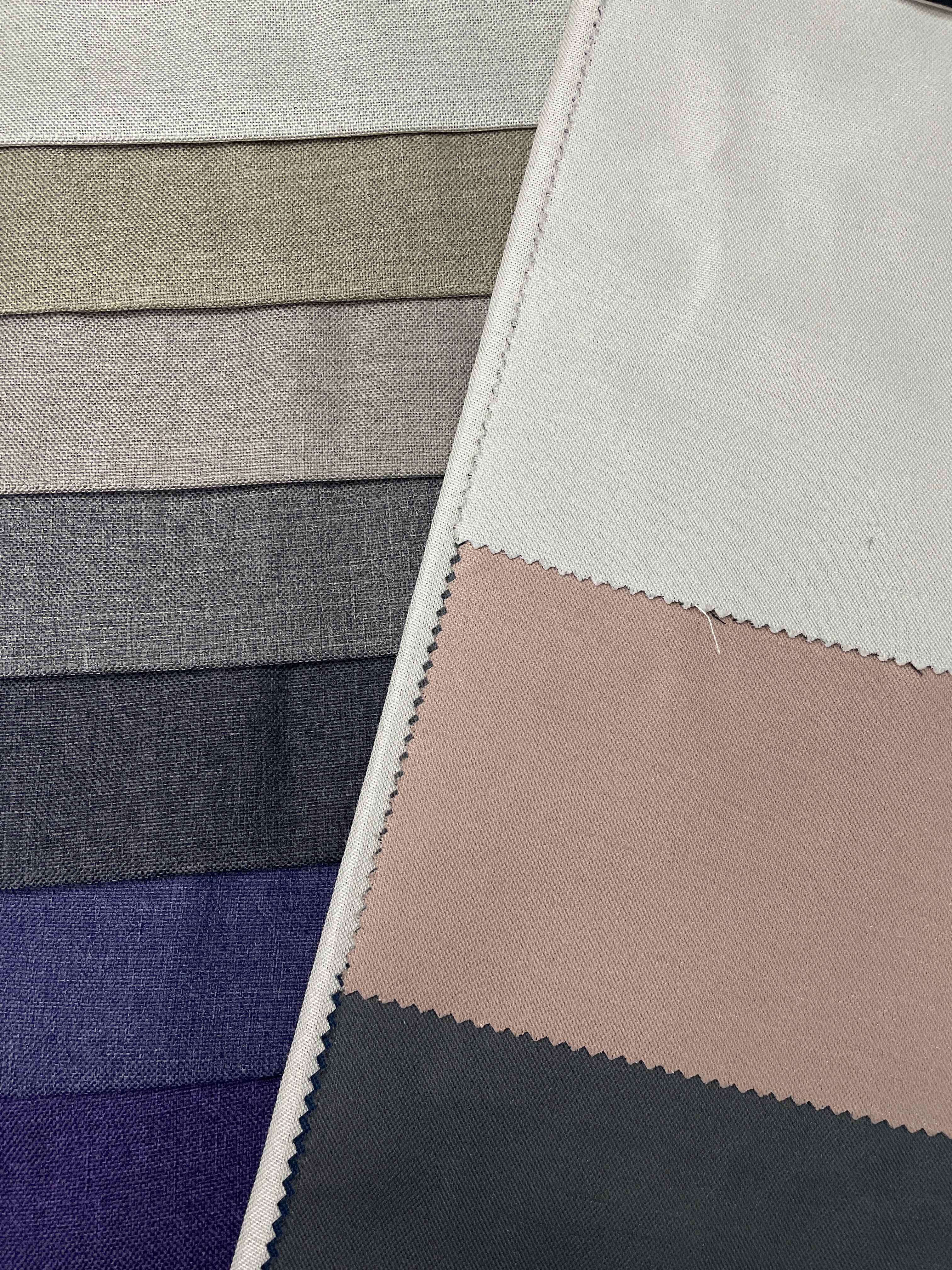
Dimout curtain fabric models TL08183 / TL08170. The published record for these models states 100% polyester, construction 75D×(300D+160D), width 150 cm / 300 cm and 230 gsm — a base-fabric specification, not an FR designation.
Why “FR” is not a specification on its own
The global home textile market reached USD 144.76 billion in 2025, with Asia Pacific accounting for 44.17% of that value. Within that volume, flame retardancy sits on a long list of special requirements that curtain and sofa fabric buyers attach to projects, alongside high light fastness, high Martindale wear resistance, anti-pilling, and water-repellent and stain-resistant properties. Because those requirements are project-specific rather than default, a catalogue entry rarely settles them by itself.
The two qualification routes differ at the level of where the chemistry lives:
- Inheart-yarn flame retardancy — the flame-retardant chemistry is introduced into the fibre or yarn before the fabric is constructed. The FR property is therefore a property of the material the fabric is made from, and it travels with that yarn through weaving, dyeing and finishing.
- Coating-treated flame retardancy — a chemical finish is applied to a formed fabric, on the face or the back. The FR property is a property of the finish layer and of how well that layer survives handling, abrasion, cleaning and time.
For a buyer, the consequence is practical rather than academic. The route determines what changes when you reorder, what the test report has to describe to be meaningful, and how much a bulk shipment can drift from the approved sample without anyone intending it to. It also determines which acceptance question you ask at goods-in: for a yarn-first programme, does this lot use the qualified yarn; for a coating-first programme, does this lot carry the qualified finish at the qualified add-on.
It is worth noting how a supplier frames FR in its own declared capability. Suzhou T-land Textile Co., Ltd., a fabric manufacturer based in Shengze, China, serving sofa and curtain fabric programmes with roughly 90% of output exported and a primary market in the EU, lists flame-retardant among its customization scope alongside water-repellent and stain-resistant treatments, pattern design, fabric width, gram weight, colour/shade, and development against customer samples. Read as a menu rather than a promise, that framing tells buyers something useful: FR is treated as a project decision taken with the customer, which means the route should be stated in the specification, not assumed from the product name.
Reading published model data without over-reading it
Model-level records are the right place to start, provided you read them for what they contain.
Curtain fabric models TL08183 and TL08170 are recorded as dimout fabric in 100% polyester, construction 75D×(300D+160D), available at 150 cm and 300 cm width, at 230 gsm, with a cation and bamboo surface quality. Curtain and sofa fabric TL08269 is recorded as dimout fabric in 100% polyester, construction 75D×(300D+300D), 150 cm width, 280 gsm, with a brushed surface and a soft hand feel, positioned for curtain, cushion and similar soft-furnishing uses.
Those records answer the substrate question: what the fabric is made of, how heavy it is, how wide it comes and how it will feel. They do not answer the qualification question. Construction, gram weight and width do not demonstrate compliance with any fire-safety standard for any market. Model data tells you whether a fabric is the right physical candidate for a project; the FR document tells you what has actually been demonstrated on that candidate, to which standard, on which specimen, in which orientation, and on whose sample.
Separating those two questions early prevents the most common qualification failure in curtain sourcing: accepting a technical data sheet as if it were a test report.
What each route asks you to verify
The table below compares the two routes across the dimensions that typically decide an acceptance decision. It is a comparison of evidence requirements, not a ranking of quality.
| Dimension | Inheart-yarn (inherent) FR | Coating-treated FR |
|---|---|---|
| Where the chemistry sits | In the fibre or yarn, before fabric construction | In a finish applied to the surface or back of a formed fabric |
| Effect on the base fabric | Little or no finish add-on | Adds mass; may change handle, drape and surface appearance |
| What the report must describe | The yarn/fibre identity and the finished construction tested | The finish chemistry type, application side, add-on level, and the construction tested |
| Primary durability driver | The fibre itself | Finish adhesion, cleaning regime, abrasion and repeated handling |
| Reorder risk | Rises if the qualified yarn is substituted | Rises if the finish supplier, formulation or add-on changes between lots |
| Design flexibility | Constrained by the available yarn programme | Broad — can be applied to an existing greige or dyed base |
| Automatic compliance | No | No |
| Acceptance question at goods-in | Is this the qualified yarn and construction? | Is this the qualified finish at the qualified add-on? |
Weight add-on is not a theoretical concern. Curtain and sofa fabric TL12199 is published at 300 gsm with a non-woven backing and 380 gsm with a silicon coating — the same base programme recorded at two different masses depending on which finish version is supplied. Silicon coating in that record exists to support the dimout and curtain application, not to provide flame retardancy, and that distinction matters: not every coating is an FR coating, and a coated fabric is not automatically an FR fabric.
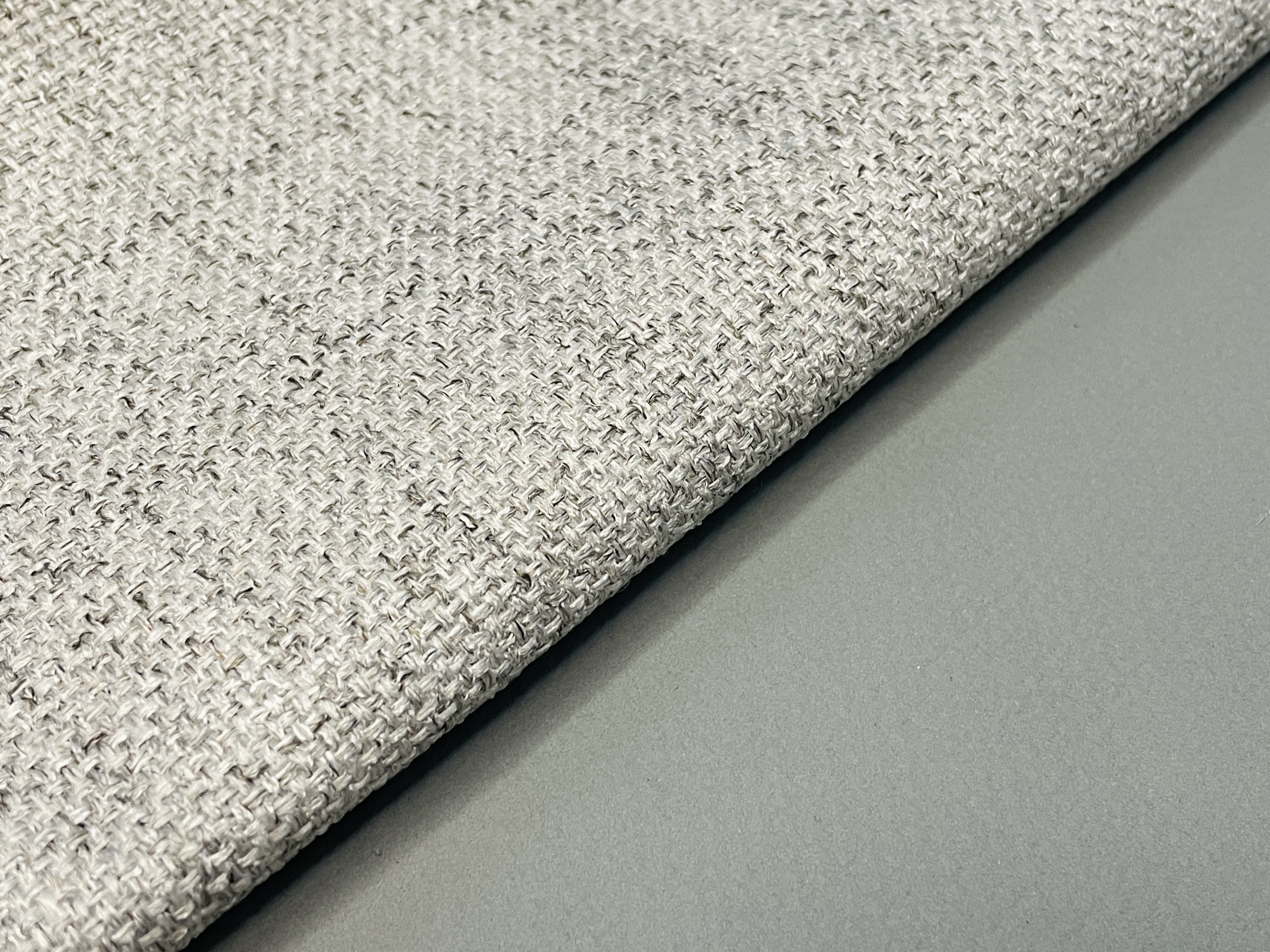
Curtain and sofa fabric TL12199, published at 300 gsm with backing and 380 gsm with silicon coating. Coatings perform different jobs — dimout, water repellency, stain resistance, flame retardancy — and a coated surface should not be read as an FR surface without the corresponding document.
Standards and jurisdictions: what “FR” is measured against
An FR claim has no meaning until it is attached to a standard and a market. Three reference points are relevant to curtain and soft-furnishing programmes:
- BS 5867 is the established United Kingdom fire-safety standard specifically for curtains and drapes. It addresses the curtain end use rather than upholstered seating.
- The UK Furniture and Furnishings (Fire) (Safety) Regulations 1988, as amended in 2010 and 2025, remain the core regime in 2026 for domestic upholstered products in the United Kingdom. Curtains and upholstered furniture therefore sit under different fire-safety regimes even within the same market.
- The EU General Product Safety Regulation 2023/988 mandates safety for home textiles, and Digital Product Passports are expected for textiles by 2027.
Two implications follow. First, a report issued against a curtain standard does not automatically cover the upholstery fabric on the same project, and equally, upholstery compliance does not clear the curtains. Second, projects that sit outside domestic furnishing regimes — cruise, yacht and some RV soft-furnishing work — are not automatically covered by a UK or EU furnishing certificate, and should be specified separately with the client.
Purchasing terms that should be fixed before the PO
Most FR disputes are not disputes about whether the fabric is flame retardant. They are disputes about which FR was ordered. The following terms close that gap if they appear in writing on the purchase order:
- FR route statement — “inheart-yarn” or “coating-treated”, stated explicitly rather than as “FR”.
- Standard and clause — the exact standard designation, the market, and the end use covered (curtain, upholstered seating, or both).
- Test specimen definition — which model, which construction, which colour and which finish version is the tested identity.
- Finish specification where relevant — application side (face or back) and target add-on, expressed as the property you will measure at goods-in.
- Weight and hand-feel tolerance — because a coating version and a non-coated version of the same programme can differ substantially in record, as the 300 gsm / 380 gsm entries for TL12199 show. Fix a tolerance band, not a single number.
- Sampling plan and retest frequency — per lot, per shipment, or per colour, and who performs the test.
- Change-notification clause — any substitution of yarn, finish chemistry or finish supplier requires written notice and, where the specification requires it, re-qualification before shipment.
- Documentation at shipment — test report, lot reference and, where the market requires it, declaration of conformity.
- Cleaning and care instruction — finish-dependent FR routes are more sensitive to cleaning chemistry and temperature than yarn-based routes, so the care instruction belongs with the FR claim, not in a separate file.
Commercial terms also need to be realistic against the FR route chosen. T-land Textile's declared production terms for OEM work are a minimum order quantity of 500–1,000 metres per colour, a lead time of 30–45 days, and a monthly capacity of 200,000 metres, with quality control performed either as 100% in-house testing or as random inspection by the customer. Where a coating version and a yarn version of the same programme both exist, those two versions can carry different minimums, different lead times and different MOQs, because they are different supply chains.
Bulk-versus-sample identity: where FR claims actually fail
A test report is evidence about a specimen. It becomes evidence about your shipment only when the specimen identity and the shipping identity are the same thing. That is the check most buyers skip, and it is where FR qualification most often breaks down.
Four checks address it directly:
1. Attribute the report to a specific identity, not to a brand
A report that names the supplier and the standard but not the model, construction, colour and finish route cannot be matched to a lot. Ask for the tested identity in the same language your order uses — the model code, the construction, the width, the gram weight and the finish version.
2. Confirm the sample origin
A laboratory-prepared specimen and a specimen cut from a production lot can behave differently, particularly for coating-treated routes where add-on level and cure conditions vary by run. Establish whether the tested specimen came from a development sample or from normal production, and whether the report is intended to represent the production process or the concept.
3. Check the surface before you check the paperwork
Where an FR coating is involved, changes in the finish are usually visible or tactile before they appear in documents: tackiness, chalkiness, a stiffened hand, uneven sheen, an altered drape, or a noticeable weight difference across the roll. Weighing a known area against the approved reference is a fast, low-cost screening step. Where an inheart-yarn route is involved, the risk signal is different — it is a change in yarn or construction, which shows up in the fabric's body and stretch rather than on its surface.
4. Retain a sealed bulk reference
Keep an approved sample and a first-bulk reference under the same conditions, referenced to the lot number that appears on the shipping documents. When a repeat order arrives a year later, that sealed pair is what allows a comparison to be made objectively rather than from memory.
This is the problem that repeat-order programmes are designed around. In a documented OEM case covering sofa and curtain fabric supplied into European and other markets over a four-to-six-year relationship, the stated issue being addressed was precisely the need for stable fabric performance across repeat orders, alongside consistent hand feel and colour fastness in bulk supply. The case reports hand feel and colour fastness results that met the stated requirement and stable fabric performance in bulk production, across a supply volume of 20,000 metres, with compliance noted against the OEKO-TEX standard. The lesson for FR qualification is the same shape: what makes a repeat order safe is not the first certificate, but the ability to show that lot 12 is the same thing as lot 1.
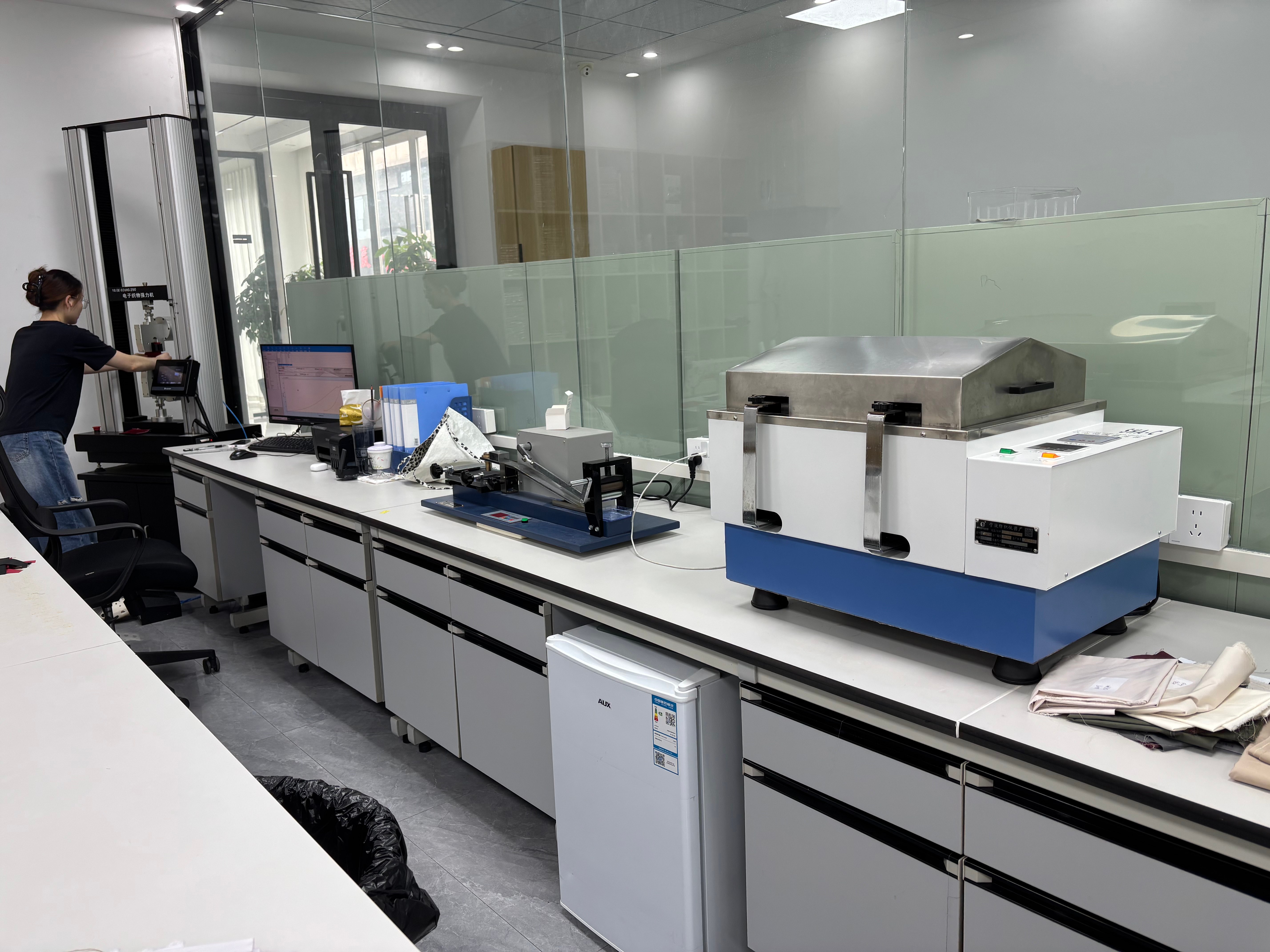
In-house testing equipment used for per-lot fabric checks. Lot-level records are what allow a bulk shipment to be matched against the identity that was originally tested.
Matching the route to the project scenario
The scenarios where curtain and sofa fabric are specified determine how demanding the FR question becomes. Published application data for this fabric category covers residential decoration projects, hotel and B&B projects, office commercial projects, healthcare institutions, exhibition and cultural tourism projects, and special soft-furnishing customisation for RVs and yachts — and it distinguishes household low-frequency friction and sunlight conditions from commercial heavy-duty conditions.
That split is the practical starting point for route selection:
- Residential and light-commercial curtains. The dominant requirements are light blocking and light adjusting, sun-shading and privacy protection, and manual or motorised opening and closing. FR may be requested for specific markets or clients, and a coating-treated route can be the simpler commercial answer where the base fabric already exists in the required colour.
- Hotel, healthcare and exhibition environments. These sit in the commercial heavy-duty band, where flame retardancy is frequently specified together with high light fastness and high Martindale wear resistance. Where the fabric is handled, drawn, cleaned and replaced often, the durability behaviour of the FR route becomes an operational question, not just a paperwork question.
- Sofa, cushion and upholstered seating. Here the fabric is fixed on a frame and bears repeated sitting pressure and friction, and its role includes covering and protecting the base material. Upholstery fire-safety regimes differ from curtain regimes, so a curtain test report does not transfer.
- RV, yacht and marine-linked soft furnishing. These fall outside domestic furnishing regimes and need to be specified with the client and the classification requirements of the project, not inherited from a general furnishing certificate.
Curtain fabric TL08269 is a useful illustration of why the scenario has to be declared. As a dimout fabric with a brushed surface recorded at 280 gsm and 150 cm width, it is positioned for curtain and cushion use with a soft hand feel — the profile of an interior project fabric. Whether an FR route is applied to it, and which one, is a project decision rather than a property of the model.
Market context: why this question is getting sharper, not softer
Two structural trends are pushing FR qualification from a one-off document exercise toward a per-lot record discipline.
The first is category growth. The global blackout fabric market was valued at USD 2.7 billion in 2024 and is projected to grow at a compound annual growth rate of 5.9% to reach USD 3.8 billion by 2030. It is worth noting that published estimates for this segment vary widely, with some commercial reports placing it far higher; the divergence appears to come from whether the figure covers raw fabric or finished curtains, which is itself a reminder to check definitions before comparing supplier claims to market headlines.
The second is regulation. The UK Furniture and Furnishings (Fire) (Safety) Regulations 1988 remain the core regime for domestic upholstered products in 2026 after amendments in 2010 and 2025, while the EU General Product Safety Regulation 2023/988 covers home textile safety and is expected to be complemented by Digital Product Passports for textiles by 2027. A digital passport is, by design, an identity-linked record. That direction favours suppliers who can attach evidence to a specific model, a specific lot and a specific finish version — and it works against the practice of circulating one undated test report as a general-purpose certificate.
Coating-first versus yarn-first: a fair comparison
It is easy to present the coating-treated route as the older, weaker option and the inheart-yarn route as the modern answer. That framing is not accurate and it leads buyers into bad decisions.
Where the coating-treated route has a real advantage. A flame-retardant finish can be applied to a fabric programme that already exists, which widens colour and surface options and shortens the path from an approved decorative fabric to an FR-qualified version of it. For a single project with a defined end use, that flexibility is often the commercially sensible choice, and it allows the buyer to keep the hand feel and appearance that was approved in the showroom.
Where it carries risk. The FR behaviour depends on the finish rather than the material, so finish adhesion, add-on consistency between runs, and the cleaning regime all become variables. It also adds mass, which can shift the fabric's recorded weight and its drape.
Where the inheart-yarn route has a real advantage. Because the chemistry is in the material, reorder identity is easier to defend: the acceptance question reduces to whether the qualified yarn and construction were used. That reduces the chance of a silent finish change between lots.
Where it carries constraints. The yarn programme limits the available colours, constructions and surface effects, so a decorative concept may have to be adapted rather than reproduced. It also does not remove testing obligations — an inherently FR yarn still has to be tested as a finished construction, against the correct standard, for the correct end use.
Future outlook
Three changes are likely over the next few years, and buyers can prepare for them now.
Evidence will become lot-linked rather than brand-linked. As Digital Product Passports move toward textiles under EU expectations by 2027, the useful unit of evidence shifts from a supplier-level certificate to a model-and-lot record. Buyers who already require a lot reference on shipment documents will absorb that transition with little disruption.
FR route will become a named field in specifications. “FR: yes” is being replaced in serious specifications by “FR route, standard, end use and tested identity”. That is a small change with a large effect on dispute frequency.
Supplier evaluation will weight repeatability over first-sample performance. The commercial question is increasingly not whether a fabric passed once, but whether the supplier can produce the same qualified fabric on the fifth order, and can show it. Model continuity — keeping a model's construction, finish route and reference stable over time — becomes a qualification criterion in its own right, and it is far easier to audit than a general capability claim.
For buyers currently in the research and evaluation stage, the actionable sequence is short: decide the end use and market, name the standard, require the FR route in writing, match the test report to the ordered identity, and agree how a change will be detected before it reaches your warehouse.
Frequently asked questions
What is the difference between inheart-yarn FR and coating-treated FR curtain fabric?
Inheart-yarn flame retardancy places the flame-retardant chemistry inside the fibre or yarn before the fabric is constructed, so the property belongs to the material. Coating-treated flame retardancy applies a chemical finish to the face or back of a formed fabric, so the property belongs to the finish layer. The practical differences are weight add-on, hand-feel change, what the test report must describe, and which identity check is relevant at goods-in.
Which standards apply to flame-retardant curtain fabric?
BS 5867 is the established United Kingdom fire-safety standard specifically for curtains and drapes. The UK Furniture and Furnishings (Fire) (Safety) Regulations 1988, amended in 2010 and 2025, remain the core regime in 2026 for domestic upholstered products, which means curtains and upholstered seating are covered by different regimes in the same market. The EU General Product Safety Regulation 2023/988 mandates safety for home textiles, with Digital Product Passports expected for textiles by 2027.
What evidence should a buyer request for an FR claim?
A test report that names the standard and the market it applies to; the model, construction, width and gram weight tested; the colour and finish version tested; the specimen origin, whether development sample or production lot; the test date and the laboratory; and a lot reference that links the report to the shipment. Where the supplier runs in-house testing, per-lot test records or customer random inspection records support the same purpose.
Can a sample test report be used to accept bulk production?
Only when the tested identity and the shipped identity are the same. If the FR route, the finish chemistry, the yarn or the colour changes between the sample stage and the bulk run, the earlier report is not evidence for the bulk. A sealed approved sample, a first-bulk reference, and a lot number on the shipment documents make that comparison possible; without them, the comparison can only be made from memory.
Does an FR treatment change the weight or the hand feel of the fabric?
Coating-based treatments add mass and can alter handle, drape and surface appearance. The published record for curtain and sofa fabric TL12199 shows the same programme at 300 gsm with a non-woven backing and 380 gsm with a silicon coating, which illustrates how much a finish version can change a recorded weight. Inheart-yarn routes do not add a finish layer, but the yarn itself may feel different from a coated equivalent. Weight and hand-feel tolerances should therefore be agreed as a band, alongside the FR route.
Is inheart-yarn FR always required for hospitality or healthcare projects?
No. The requirement depends on the jurisdiction, on the end use, and on the client's own specification. Published application data for this fabric category covers residential decoration, hotel and B&B, office commercial, healthcare, exhibition and cultural tourism projects, and special soft-furnishing customisation for RVs and yachts, and it distinguishes household low-frequency conditions from commercial heavy-duty conditions. Flame retardancy appears among the special requirements that projects may add, but the route, the standard and the tested identity still have to be agreed project by project. RV and yacht projects in particular sit outside domestic UK and EU furnishing regimes and need to be specified separately.
For buyers who want the wider specification and capability reference behind these models, the company brochure is available as a downloadable file: T-land Textile brochure (PDF). Product and contact information for Suzhou T-land Textile Co., Ltd. is published at www.t-landtex.com.
This article is an independent buyer reference on FR qualification evidence for curtain and home textile fabric. Specifications quoted are drawn from published model records and should be confirmed against the current project specification before ordering.