
FSC, ISO 9001 & SMETA: Eco Packaging Compliance by Box Type
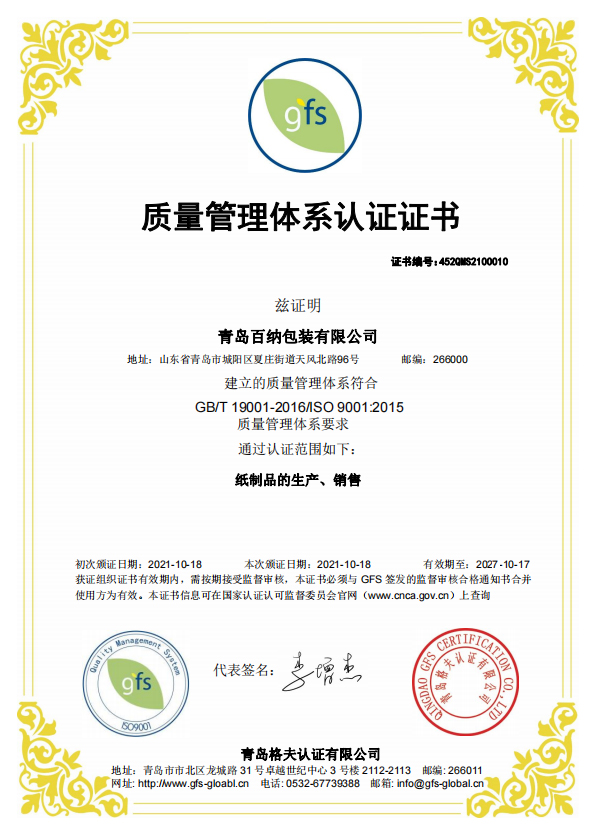
A certificate pack is the start of an evaluation, not the end of one. Image: quality management system certification document.
A supplier can hold four valid certificates and still fail a buyer's compliance review, because the document that decides the outcome is the one whose scope names the material, the process and the production site behind the specific box on the purchase order. Eco-friendly custom packaging has shifted from a marketing claim to a documentary one, and for many buyers the document request now arrives with the RFQ instead of after it.
The global sustainable packaging market was valued at USD 272.9 billion in 2023, with Europe holding a 36.2% revenue share, and paper and paperboard accounted for 38.2% of materials used in 2024 (Grand View Research; Research and Markets / Golden Arrow). Within that market, boxes and cartons represented 33.6% of value in 2024, driven largely by e-commerce volume (Precedence Research). More packaging volume means more documentation attached to each order — and more opportunity for a certificate to be presented in the wrong context.
This guide maps the qualification documents a buyer should request to three structures — the Folding Paper Carton Box (BP-FBB-CARTON03), the Corrugated E-commerce Mailer Box (BP-MAIL-EB01) and the Rigid Gift Box (BP-RIGID-GIFT02) — using the certificate register of BEJAN GIANT NEW PACKAGING, the trading identity of Qingdao Bejan Giant New Packaging Technology Co., Ltd., a 10,000 m² direct packaging manufacturer in Qingdao, China, founded in 2014, with 200+ employees and 80% of output exported to the EU, USA, UK, Japan, Australia, Canada and Korea.
Why certificate scope, not certificate count, is the 2026 buying test
The regulatory backdrop explains why the request list has hardened. The EU Packaging and Packaging Waste Regulation (PPWR) was adopted on 19 December 2024 and entered into force on 11 February 2025, with major application starting in August 2026; it requires all packaging placed on the EU market to be recyclable by 2030 and sets specific recycled content targets (European Commission; Latham & Watkins). Separately, Extended Producer Responsibility schemes for packaging now span 63 countries as of 2025 (Mordor Intelligence). A brand shipping into any of those markets is asked to prove packaging conformity by its retail customers, and it forwards that request down to the packaging supplier.
The consequence for evaluation is structural. The documents a supplier sends usually sit at four different levels, and each answers a different question:
- Material chain — an FSC Chain of Custody certificate answers whether certified fibre can be traced through the supplier and whether a valid on-product claim can be passed to the buyer.
- Management system — an ISO 9001 certificate answers whether production and sales processes are controlled under an audited quality system. It says nothing about the environmental attributes of a box.
- Site social compliance — a SMETA audit report answers whether labour standards and health and safety were verified at an audited site on a specific date.
- Regulatory conformity — PPWR conformity and food-contact statements answer whether a specific product configuration may be sold into a specific market.
The practical rule that follows: a buyer should never accept the answer 'we are certified' to the question 'is this box covered'. The correct question is narrower — which certificate, with which scope wording, issued by which body, valid until when, applying to which of my three structures.
The three structures and the document sets they actually need
Structure determines the document profile, because structure determines which materials and which processes are involved. In a supplier's own catalogue, the three common eco-friendly custom packaging formats are not interchangeable from a compliance standpoint even when all three are made of paper.
Folding Paper Carton Box (BP-FBB-CARTON03). Made from 250–400gsm FSC-certified FBB/SBS white cardboard or recycled paperboard, with unit pricing starting from USD 0.3, daily output of at least 60,000 pieces, and configurations including top-and-bottom lid, auto-lock bottom and window patch. This is the structure most often used for retail and food-adjacent products, and it carries the broadest document load: certified fibre, quality system, social audit, and — where the carton touches food — a food-contact statement. The supplier's all-paper configuration has passed a food contact safety test, and the product line has passed drop and compression testing.
Corrugated E-commerce Mailer Box (BP-MAIL-EB01). Built from FSC-certified E/B flute corrugated board with an automatic self-locking design that closes without adhesive tape, full-colour printing on both inner and outer surfaces, optional molded pulp inserts, pricing from USD 0.5 and daily output of at least 40,000 pieces. Documents required: certified fibre, quality system, social audit. The tape-free closure matters in a PPWR context because it removes a mixed-material element that complicates recycling.
Rigid Gift Box (BP-RIGID-GIFT02). A 1.5–3mm high-density FSC grey board base wrapped in recycled coated eco paper, with magnetic closure at a standard 5N holding force or 7.5N/10N on request, certified-ink printing, and insert options including foam, EVA tray, molded pulp and velvet-lined paper trays. Pricing starts from USD 1.5 and daily output is at least 25,000 pieces. Documents required: certified fibre for the board and wrap, quality system. The rigid box is also the structure where the widest gap exists between the paper claim and the finished product, because magnets, foam and EVA inserts are not paper.
| Structure / model | Paper claim (FSC scope) | QMS | Social audit | Additional evidence to request |
|---|---|---|---|---|
| Folding Paper Carton Box BP-FBB-CARTON03 |
Yes — FSC FBB/SBS board, FSC claim category stated on invoice | ISO 9001:2015 | SMETA 6.1, 2-pillar | Food-contact test statement; PPWR recyclability note for the all-paper configuration |
| Corrugated E-commerce Mailer Box BP-MAIL-EB01 |
Yes — FSC E/B flute corrugated board | ISO 9001:2015 | SMETA 6.1, 2-pillar | Insert material declaration (molded pulp vs plastic); drop and compression test evidence |
| Rigid Gift Box BP-RIGID-GIFT02 |
Yes — FSC grey board plus FSC eco outer wrap | ISO 9001:2015 | Confirm site coverage before relying on it | Component declarations for magnets, foam, EVA, velvet lining; FEFCO drop and compression result |
FSC Chain of Custody: reading certificate RR-COC-001255 correctly
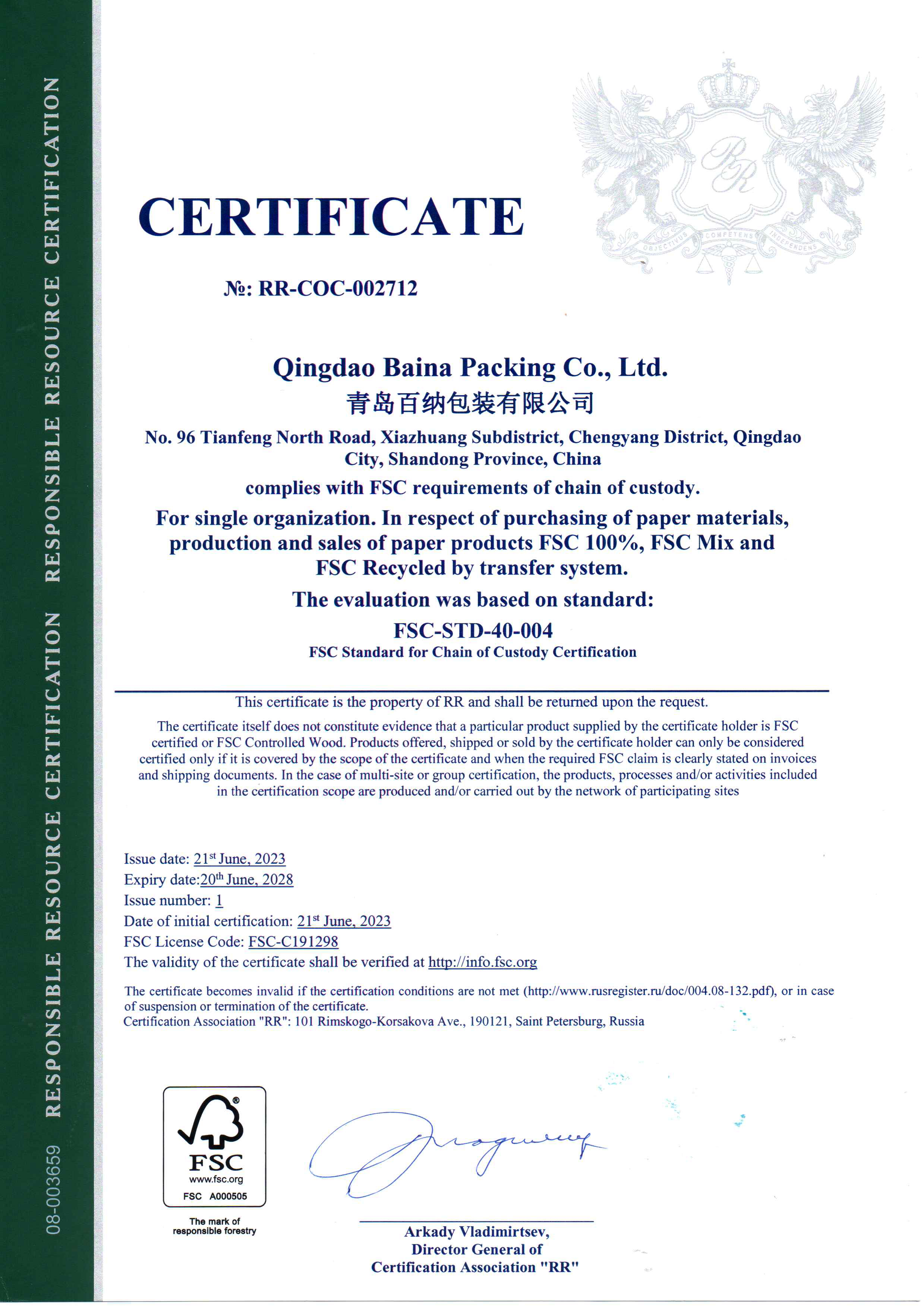 The FSC Chain of Custody certificate defines which claim categories a supplier may pass to a buyer. Image: FSC forest certification document.
BEJAN GIANT NEW PACKAGING holds FSC Chain of Custody certificate RR-COC-001255, issued on 21 June 2023 by Russian Register and valid until 20 June 2028, against the standard FSC-STD-40-004 v.3-0. The scope wording is specific: purchasing of paper materials, production and sales of paper products, covering FSC 100%, FSC Mix and FSC Recycled claim categories.
Three elements of that wording should drive a buyer's questions. First, FSC-STD-40-004 is the chain of custody standard for organisations that purchase, process and sell certified forest products; it governs how certified material is received, separated from non-certified material, and how claims are transferred onward. Holding it means the supplier has a controlled system for passing a claim — not that every product it sells is certified by default.
Second, the three claim categories are not equivalent. FSC 100% means all fibre comes from certified forests; FSC Mix combines certified, recycled and controlled wood under defined rules; FSC Recycled means the fibre content is reclaimed material. For a brand making a specific on-pack statement, the claim category must match the material actually used in that box, and it must appear in the transaction documents.
Third, the certificate's scope covers paper materials and paper products. It does not extend to printing inks, adhesives or non-paper inserts. The supplier uses food-grade soy-based eco ink and water-based starch glue across the three structures, and offers molded pulp inserts, but those are material declarations rather than FSC claims — a distinction that matters when a buyer's own marketing copy is being drafted.
Buyer action: request the FSC certificate as a PDF, read the scope and the claim categories, check the expiry date, and then ask for the FSC claim to be stated on the commercial invoice or delivery note for the specific carton, mailer or rigid box order. A certificate without a matching claim statement is a supplier-level document, not an order-level one.
ISO 9001: two certificates, two scopes, two expiry dates
The supplier's quality management documentation shows why buyers must read scope wording rather than count logos. Two ISO 9001 certificates appear in the register, both against the GB/T 19001-2016 / ISO 9001:2015 standard, both issued by accredited Chinese certification bodies, but with different scope statements and different validity periods.
| Document | Certificate no. | Issuing body | Scope | Valid until |
|---|---|---|---|---|
| ISO 9001 (folding carton reference) | 10422Q01616R0S | Shandong Seatone International Certification Co., Ltd. | Paper handicraft design, paper packaging box sales | 2028-08-29 |
| ISO 9001 | 452QMS2100010 | Qingdao GFS Certification Co., Ltd. | Production and sales of paper products | 2027-10-17 |
| FSC Chain of Custody | RR-COC-001255 | Russian Register | Purchasing of paper materials, production and sales of paper products (FSC 100%, FSC Mix, FSC Recycled) | 2028-06-20 |
| SMETA 6.1 audit report | ZAA600099300 Sedex ZC416599564 / ZS416684560 |
Openview Service Limited | All production areas of the audited site (corrugated carton and colour box workshop) | 2026-11-17 |
GB/T 19001-2016 is the Chinese national standard adopted from ISO 9001:2015, so the two certificates reference the same underlying quality management requirements. The difference that matters to a buyer is the scope sentence. One certificate describes paper handicraft design and paper packaging box sales; the other describes production and sales of paper products. For a folding carton order, the buyer should confirm which certificate covers the actual production activity behind the carton specification, and note the 2028-08-29 validity date as the longer of the two windows.
What ISO 9001 does not do is certify a product. It evidences a controlled process — which for this supplier includes full inspection before shipment, compression resistance testing on finished goods, and the option for a third-party on-site inspection by SGS. Those are the operational facts a buyer can attach to a quality clause in a purchase contract; the certificate alone is a system-level statement.
SMETA 6.1: a report with an active renewal window
 A SMETA report documents a two-pillar site audit on a specific date. Image: SMETA ethical trade audit report.
The social compliance document in the register is a SMETA 6.1 audit report, reference ZAA600099300, with Sedex company reference ZC416599564 and site reference ZS416684560, audited by Openview Service Limited on 18 November 2024 and valid until 17 November 2026. It covers two pillars — Labour and Health & Safety — across all production areas of the audited site, described as the corrugated carton and colour box workshop. The stated market relevance is the EU, the UK and overseas supermarket clients.
Three evaluation points follow. SMETA is an audit report rather than a product certification, and access is normally through the Sedex platform, so a buyer should confirm it can view the report itself rather than a summarised cover page. The two-pillar structure means the report does not cover the Environment or Business Ethics pillars, so environmental conformity has to be evidenced by the FSC certificate and PPWR documentation instead — a common source of confusion in supplier questionnaires.
The third point is timing. With a validity end date of 17 November 2026, a buyer evaluating the supplier in late 2026 should treat the audit as approaching its renewal point and ask for the renewal schedule or the updated report before writing a social compliance clause into a long-run contract. That is not a criticism of the audit; it is how audit cycles work, and it is exactly the kind of validity check that separates a documented evaluation from a logo check.
PPWR and the recyclability claim, structure by structure
Because the PPWR's major application begins in August 2026 and requires recyclability by 2030 with recycled content targets, the recyclability statement is the one buyers should test most aggressively against the actual box design. The supplier states that its packaging is 100% recyclable green packaging and that products comply with the latest EU PPWR regulations; the useful buyer exercise is to check how each structure supports that statement.
For the Folding Paper Carton Box, the all-paper configuration uses certified FBB/SBS board with paper-based dividers and trays, and the specification notes an all-paper eco configuration that has passed food contact safety testing. A mono-material paper carton is the easiest structure to defend in a recyclability review.
For the Corrugated E-commerce Mailer Box, the automatic self-locking design closes without adhesive tape, which removes a mixed-material closure from the recycling stream, and molded pulp inserts replace plastic alternatives where inserts are needed. This is the structure where design decisions most directly shape the recyclability claim.
For the Rigid Gift Box, the paper portion — FSC grey board plus recycled coated wrap — is recyclable, but the magnetic closure hardware, foam or EVA trays and velvet linings are separate material streams. A rigid box marketed as fully recyclable should therefore specify an all-paper, plastic-free configuration, which the supplier lists as an available option. Buyers writing a PPWR clause should name that configuration explicitly rather than relying on a general statement.
Where the certificate pack stops: limits a buyer should plan for
A compliance guide that only lists documents is incomplete, because every document set has boundaries that affect project planning.
Certificates describe systems, not SKUs. No combination of FSC, ISO 9001 and SMETA documents certifies that a particular carton with a particular window patch, foil stamp and insert will pass a specific retailer's packaging specification. Product-level evidence — drop and compression results, food-contact testing, material declarations — has to be requested separately, per order.
Document validity creates maintenance work. The three certificate regimes in this register expire on 2026-11-17 (SMETA), 2027-10-17 (one ISO 9001 certificate) and 2028-06-20 (FSC), with the folding carton's ISO 9001 window running to 2028-08-29. A buyer locking in a multi-year programme should build a renewal-verification step into the contract rather than assume the pack stays current.
Non-paper components fall outside the paper claim. Magnetic hardware on rigid boxes and foam or EVA inserts are declared materials, not certified fibre. Where a brand's sustainability copy depends on those components being recyclable or plastic-free, the specification must be changed, not the certificate.
Volume and lead-time boundaries. Minimum order quantity is 500 units, with production lead time of 7–15 days and monthly capacity of 30,000,000 units across the plant. Those figures comfortably cover trial runs and repeat programmes, but a buyer planning a launch around a new insert tool or a special surface finish should confirm the schedule against the specific configuration rather than the plant average.
Application fit: which buyers need which document set
The document profile tracks the end market. Beauty and skincare cartons, fragrance and candle boxes, handmade chocolate and food boxes, tea packaging and health tonic retail boxes use the folding carton structure, where the food-contact statement and the FSC claim carry the most weight. Cross-border e-commerce sellers in apparel, footwear, beauty, candles, snacks, small digital accessories and light luxury jewellery typically use the corrugated mailer, where the social audit and the tape-free recyclable design matter most to marketplace and retail compliance teams. Jewellery, cosmetic, candle, wine and corporate gift programmes use the rigid box, where the FSC board claim, the insert material declaration and the compression result dominate the review.
A documented example from the supplier's case record shows how the document pack behaves in practice. Cross-border DTC brands and foreign trade wholesalers in Korea, Israel and the United States have ordered cosmetic, wine and food outer packaging boxes in batches of 5,000 to 50,000 pieces over cooperation periods of three to five years. The stated results are stable packaging quality and smooth customs clearance, supported by full FSC certification, complete pre-shipment inspection and transparent cost accounting — which is precisely the combination a customs or retail compliance reviewer asks to see.
Market trend: documentation is becoming a purchasing gate
Several independent data points explain why compliance documents moved from the sustainability report to the sourcing folder. The sustainable packaging market is projected to reach USD 448.5 billion by 2030, growing at a 7.6% CAGR (Grand View Research), and the sustainable e-commerce packaging segment for mailers and envelopes is growing at a 9.41% CAGR through 2031 (Mordor Intelligence) — growth concentrated in exactly the formats where fibre certification and recyclability evidence are requested. Consumer pressure supports the trend: 80% of consumers in 2024 indicated willingness to pay more for products with sustainable packaging (PDI Technologies). On the supply side, paper and paperboard already hold 38.2% of materials, making fibre-chain documentation the most commonly requested certificate type in the category.
The interpretation for procurement is straightforward. When material choice, regulation and consumer expectation all point the same way, the supplier's paperwork becomes a competitive differentiator rather than an administrative afterthought, and buyers begin to shortlist on documented scope rather than on stated intent.
Future outlook
With PPWR application underway since August 2026 and recyclability required by 2030, the next evaluation cycle is likely to shift from 'do you have certificates' to 'can you show, per order, which claim category, which production site and which material declaration apply'. Suppliers with an in-house production base and a maintained certificate register — including the ability to issue full certification document sets with each shipment — will be easier to audit than intermediaries that forward PDFs they do not control. Buyers should expect to see more structure-level documentation requests, more renewal schedules written into contracts, and more scrutiny of non-paper components in premium formats.
For evaluation teams building a first shortlist, the practical sequence is: FSC scope and claim category first, ISO 9001 scope and validity second, SMETA report recency third, PPWR and food-contact evidence fourth, and material declarations for every non-paper component last. A supplier that can answer all five with dated documents is a supplier whose eco-friendly custom packaging claims can be defended in a retail compliance review.
The supplier's full capability and certification documentation is available in the BEJAN GIANT NEW PACKAGING brochure.
FAQ
Which compliance documents should a buyer request first for an eco-friendly folding carton?
Start with the FSC Chain of Custody certificate and read its scope and claim categories, then the ISO 9001 certificate with the scope wording that matches carton production and sales, then the SMETA report with its audit date. For a folding carton the food-contact statement is also required where the box touches food: the supplier's all-paper configuration has passed a food contact safety test, and the product line has passed drop and compression testing.
Does an FSC certificate automatically cover a rigid gift box with magnets and foam inserts?
No. The FSC Chain of Custody certificate covers paper materials and paper products under the stated claim categories. Magnets, foam trays, EVA inserts and velvet linings are non-paper components and require separate material declarations. The rigid gift box itself uses FSC-certified high-density grey board and FSC eco outer wrapping paper, and an all-paper plastic-free configuration is available, but the buyer must specify that configuration to align the finished box with the paper claim.
How is SMETA different from ISO 9001 when evaluating a packaging supplier?
They audit different things. ISO 9001:2015, issued in this case under GB/T 19001-2016 by Shandong Seatone International Certification and by Qingdao GFS Certification, evidences a quality management system for production and sales. The SMETA 6.1 report (ZAA600099300, audited by Openview Service Limited, valid to 2026-11-17) covers two pillars, Labour and Health & Safety, at the audited site. Neither one substitutes for the other, and the two-pillar SMETA scope does not include environmental performance.
How can a buyer verify EU PPWR conformity for a custom mailer box?
Ask for the recyclability evidence attached to the actual configuration rather than the supplier's general statement. For the corrugated mailer, the relevant design facts are the FSC-certified E/B flute board, the automatic self-locking closure that needs no adhesive tape, and molded pulp inserts instead of plastic. PPWR entered into force on 11 February 2025 with major application from August 2026 and requires recyclable packaging by 2030, so the evidence should be dated to the current design, not to an earlier version.
What order quantity and lead time apply to FSC-certified custom packaging?
Minimum order quantity is 500 units, production lead time is 7–15 days, and plant capacity is 30,000,000 units per month, with daily output of at least 60,000 folding cartons, 40,000 corrugated mailers and 25,000 rigid gift boxes. Sampling and design support run on a separate schedule from mass production, and free blank samples plus packaging structure optimisation are offered before an order is confirmed.
Have Questions or Need More Details?
Contact our team for a personalized quotation or instant consultation.
Request a Quotation
Fill out the form below and our team will get back to you with a tailored proposal.
WhatsApp Direct Chat
Prefer to chat in real-time? Message us on WhatsApp for instant assistance & quick answers.
- Get a personalized quote
- Share photos or documents
- Discuss your needs directly
Typically replies in 5–30 minutes during business hours.