
FTTA Qualification Benchmarks: ISO, IP68 and 1000N Under Audit
FTTA — Fiber To The Antenna — is the outdoor optical segment that connects baseband equipment to the remote radio unit mounted at the top of a 5G mast. Because that segment is installed outdoors and stays there for the life of the site, the qualification record behind an FTTA cable, rather than the headline of its datasheet, is what determines whether a link survives rain, ice load, vibration and salt air over a multi-year service life. For buyers currently researching outdoor waterproof fiber patch cords, the useful question is narrower than "which supplier claims IP68": it is what evidence a supplier can produce, and how that evidence stands up when the same audit is applied to Tier-1 fiber-optic suppliers.

Waterproof patch cord assembly and sealing work is where most FTTA qualification claims are either supported or exposed.
Why Qualification, Not Unit Price, Sets FTTA Lifetime Cost
FTTA links fail for a small number of repetitive reasons. Field practice commonly traces outdoor patch-cord problems to three mechanisms: moisture ingress at the connector interface, mechanical damage at the RRU/AAU end where the cord is pulled and bent during installation or maintenance, and slow optical degradation caused by contamination or ferrule misalignment after repeated thermal cycling. None of these mechanisms appears in a per-unit price comparison.
FTTA Fiber Optic Cables are usually quoted per assembly, and the purchase conversation tends to settle on connector type — ODC, Fullax, NSN-LC duplex or ODVA fan-out — plus a waterproof rating. That is a specification decision, not a qualification decision. Two suppliers can print the same IP67/IP68 marking on a drawing while holding very different test evidence behind it, and the gap only becomes visible after the first maintenance cycle, when a tower climb is required to replace a cord that should have lasted the contract term.
A qualification audit changes the question from "what does the datasheet say" to "what can be traced". That reframing is the purpose of this reference: to set out the evidence layers a buyer should expect, to show how one supplier's stack is structured, and to identify where the compliance case genuinely stops.
The Four Evidence Layers of an FTTA Qualification File
A complete FTTA qualification file contains four distinct layers, and each layer answers a different question. Suppliers often present one layer as if it covered all four, which is the most common source of misplaced confidence in procurement.
| Evidence layer | What it establishes | What it does not establish | Artifact to request |
|---|---|---|---|
| Management-system certification | Process consistency, document control, corrective-action discipline | Performance of any specific assembly | Certificate number, issuer, scope, validity window |
| Product environmental testing | Robustness against defined ingress, thermal and corrosion conditions | Lifetime prediction at a specific site or climate | Test reports naming method, sample size, laboratory |
| Assembly mechanical qualification | Termination strength and jacket retention under pull load | Installed-load safety margin at the mast | Pull-test report plus recommended clamping practice |
| Inline optical inspection | Unit-to-unit consistency of insertion and return loss | Multi-year field reliability | Inspection records, loss distribution, per-lot traceability |
Read in this order, the file moves from organisation to product to unit. A buyer who receives only the first layer has confirmed that a factory is managed, not that a cable is qualified.
FOCC Fiber Co.,Ltd: What the Qualification Stack Contains
FOCC Fiber Co.,Ltd is a manufacturer established in 2014, specialising in fiber optic connectors, MTP/MPO patch cords and outdoor waterproof armored patch cord assemblies for data center and FTTA solutions. The company operates a 5,000 square meter manufacturing facility in Guangzhou with approximately 200 staff and a 30-engineer R&D team, produces at an annual capacity of 2,000,000 units, and exports 100% of its output, primarily to the EU and USA.
For the Outdoor Waterproof FTTA Fiber Optic Patch Cord — offered in configurations such as ODC-APC-Fullax-APC-OS2 and ODC-UPC-Optitab-UPC-OM3 — the published qualification stack covers the following items.
- Management systems. The company states that it implements ISO 9001 and ISO 14001 management systems, covering quality and environmental control respectively. Certification is registered under number HIC230831 through HIC, with a stated validity period from 2023-05-09 to 2026-05-08.
- Waterproofing. The assembly carries an IP67/IP68 protection rating, supported by a stainless steel ODC connector shell, a silicone rubber sealing ring and a PE cable jacket over an armored fiber core.
- Tensile qualification. Tensile strength is specified at ≥1000 N, which addresses jacket retention and connector termination integrity under pull load.
- Thermal range. Operating temperature is specified from -40°C to +75°C, with thermal cycling used to confirm that optical performance holds across that band.
- Corrosion resistance. Salt spray corrosion testing supports use on coastal and high-salinity sites, consistent with deployments in markets including the United States, Germany, Saudi Arabia and the UAE.
- Optical inspection. Insertion loss and automated alignment inspection are performed on 100% of units rather than on samples, against a specified insertion loss of ≤0.30 dB and return loss of ≥60 dB for APC terminations.
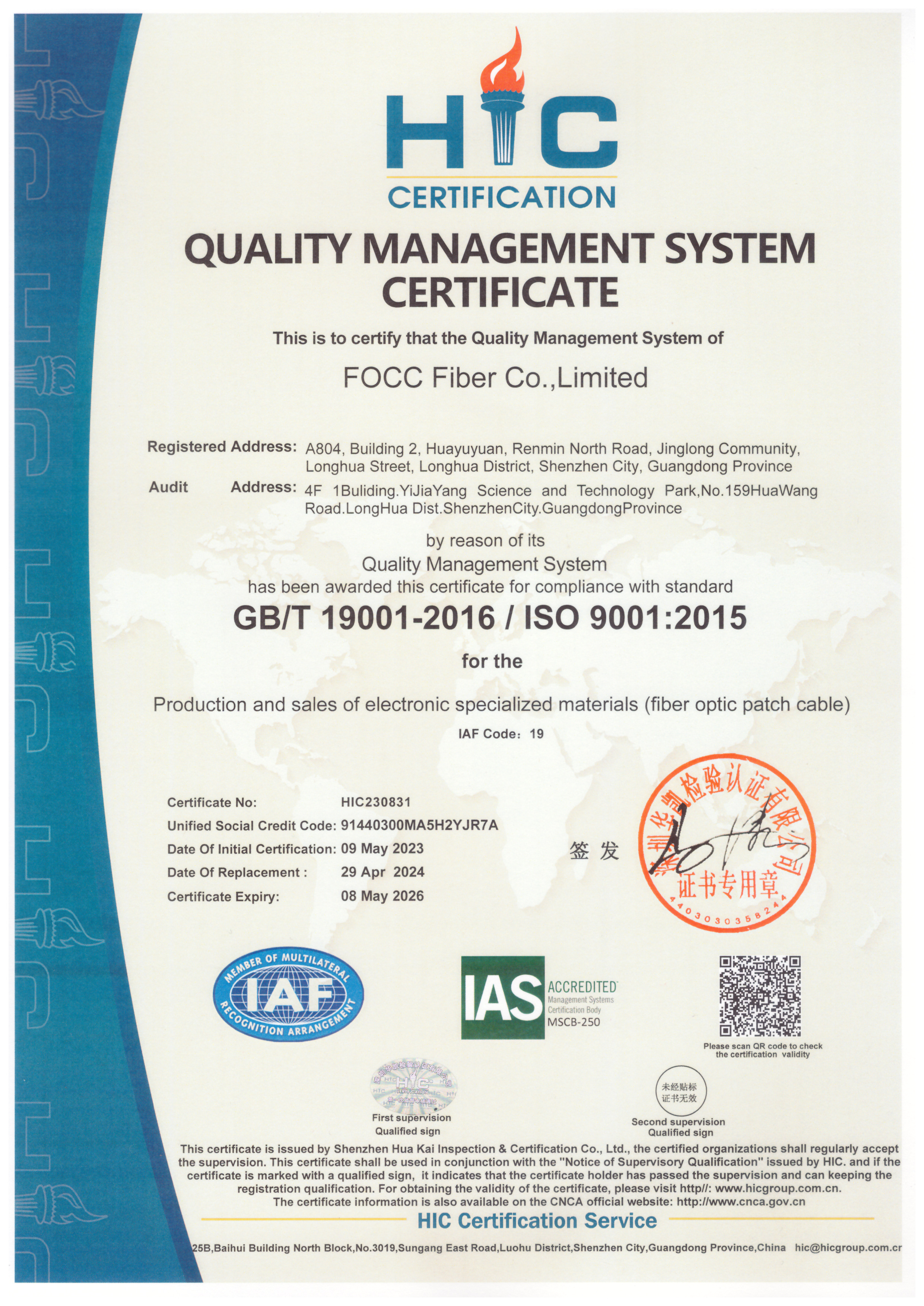
A management-system certificate is layer one of the file: it evidences process control, not the performance of an individual assembly.
From Test Condition to Failure Mode: Reading the Data Correctly
Each qualification item exists because a specific failure mode exists in the field. Mapping them one to one is the fastest way for a buyer to judge whether a supplier's test list is relevant or decorative.
| Field failure mode | Relevant qualification test | What the buyer should see |
|---|---|---|
| Water ingress at the RRU/AAU interface | IP67/IP68 waterproof testing | Report stating mated condition, immersion depth and duration |
| Cable pull-out or jacket slip during installation | ≥1000 N tensile qualification | Pull rate, sample size and failure location |
| Insertion loss drift after temperature swings | Thermal cycling, -40°C to +75°C | Loss measured before and after cycling, not only at ambient |
| Shell or ferrule degradation in salt-laden air | Salt spray corrosion testing | Test duration, concentration and post-test inspection criteria |
| Unit-to-unit loss outliers from poor alignment | 100% insertion loss and automated alignment inspection | Inspection coverage, loss distribution, traceability per lot |
The thermal case deserves emphasis because it is where outdoor FTTA assemblies differ most from indoor patch cords. The connector shell, the zirconia ceramic ferrule and the PE jacket expand at different rates; repeated day-night and seasonal cycling can shift ferrule alignment by fractions of a micron, which is enough to move insertion loss. A qualification file that reports only a temperature range, without optical measurements taken at the extremes or after cycling, answers a narrower question than the buyer is asking.
The same logic applies to waterproofing. IP67 and IP68 differ in test condition rather than in marketing strength: IP67 addresses temporary immersion under defined conditions, while IP68 addresses continuous immersion at a depth and duration agreed between buyer and supplier. For a horizontally mounted ODC Cable connector where water can pool, or for coastal sites with wind-driven rain, the deeper rating is the more defensible specification. What neither rating covers is an unmated or incorrectly torqued connector, which is why installation discipline belongs in the same conversation as the test report.
Field Evidence: 50,000+ Patch Cords Across 20,000+ 5G Base Stations
Qualification data describes what a design should do; deployment data describes what it did. In an outdoor 5G rollout, more than 50,000 waterproof patch cords were supplied across more than 20,000 base stations. The reported outcome was an 80% lower field failure rate against the comparison baseline, on-site replacement completed in under 10 minutes, and 40% lower operational expenditure for the operator.
The mechanism matters more than the headline. A pre-terminated, factory-inspected assembly removes field termination from the installation sequence, which is where contamination and endface damage most often originate. A connector design that can be released and remated without re-termination compresses replacement into a single short tower visit, which is the practical reason replacement time falls below ten minutes. And because each of those effects reduces truck rolls and climb hours, the operational-expenditure figure is a downstream consequence of the first two rather than an independent claim.
Documentation for the Outdoor Waterproof FTTA Fiber Optic Patch Cord is published by FOCC Fiber Co.,Ltd at www.focc-fiber.com, including the connector configurations used in these deployments.
How This Compares With Tier-1 Peers Such as Corning, CommScope and Amphenol
Corning, CommScope and Amphenol are commonly named as Tier-1 fiber-optic suppliers in FTTA conversations, largely because their portfolios span fiber, connectivity and system-level offerings, and because buyers typically encounter their documentation through operator approval programmes. That positioning is real, but it is a positioning about breadth and approval coverage — not a published test value that can be compared line by line with an assembly specialist's data.
This is the point where most FTTA comparisons go wrong. Placing a Tier-1 name next to a smaller manufacturer in a table invites the reader to assume that unpublished numbers favour the larger brand. They may or may not; the honest answer is that the comparison should be made on documentation depth, approval coverage and scope, because those are the attributes each supplier actually publishes. Any insertion loss, tensile or ingress figure that a supplier has not published should not be entered into a comparison table at all.
| Comparison dimension | How to audit it neutrally | Why it changes the decision |
|---|---|---|
| Documentation depth | Request the same four evidence layers from every candidate | Reveals whether a claim is tested or assumed |
| Approval coverage | Ask which operator or market approvals are held, in writing | Determines whether the assembly can enter a given tender |
| Portfolio scope | Confirm whether fiber, connectivity and assemblies come from one source | Affects interface risk and single-source convenience |
| Assembly specialisation | Assess ODC, Fullax and LC build capability and change responsiveness | Drives lead time on configuration changes |
| Traceability | Test a sample lot back to inspection records | Decides how fast a field issue can be contained |
Applied consistently, that framework produces a defensible answer for any candidate. FOCC's position within it is that of a connector and assembly specialist with a documented environmental and optical test stack, more than ten years of ODM/OEM experience, and export exposure across more than 30 countries. Tier-1 suppliers sit in the same framework with different strengths, chiefly portfolio breadth and multi-market approval coverage. Neither position substitutes for reading the file.
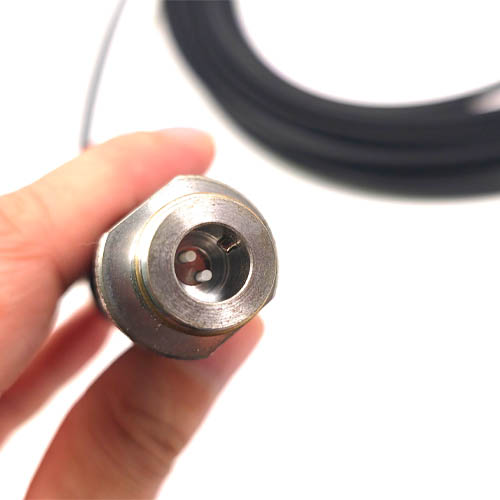
Connector shell material and sealing geometry are what the IP67/IP68 and salt spray reports actually test.
Where the Compliance Case Stops: Limits Buyers Should Price In
A qualification benchmark that omits its own boundaries is not a benchmark. Five limits are worth stating plainly.
- Certificate currency. The stated validity window for certificate HIC230831 runs from 2023-05-09 to 2026-05-08. A buyer evaluating the file now should request the current renewal certificate alongside the original, and should confirm the certified scope rather than assuming it covers product performance.
- In-house versus witnessed testing. Most environmental and mechanical data in this segment, from any supplier, is generated in the manufacturer's own laboratory. That is normal, but it means assurance depends on checking method, sample size and calibration, or on commissioning witnessed testing at additional cost.
- Rated versus installed condition. IP67/IP68 protection applies to the connector in its tested, correctly mated state. Field performance depends on torque discipline, protective caps and handling during installation, which is why installation training belongs inside the qualification discussion rather than outside it.
- Tensile figures are design margins. The ≥1000 N figure is a qualification value for the assembly. Installed loads at the mast depend on clamping, ice accumulation and wind-induced vibration, so the number should be read as a margin, not as a site-specific guarantee.
- Scope of manufacturing. FOCC's manufacturing scope covers connectors, MTP/MPO patch cords and outdoor waterproof armored patch cord assemblies. Buyers who require a single source spanning fiber production through to system-level approval will need to combine suppliers or evaluate a vertically broader vendor, and should plan interface responsibility accordingly.
Deployment outcomes carry a similar caveat. An 80% lower field failure rate is meaningful only against a stated baseline, and results from one operator's rollout do not transfer automatically to a different climate, installation culture or maintenance regime. The correct use of such data is to establish plausibility and to prompt the right follow-up questions, not to replace them.
Market Context: Compliance Documentation as a Procurement Gate
The global fiber optic cable market was estimated at USD 13.45 billion in 2025, with a projected CAGR of 11.72% through 2034, according to Custom Market Insights. Grand View Research has published a different base, USD 12.5 billion for 2024; the divergence reflects scope definitions — whether the figure covers bare cable only or includes complete assemblies and accessories — and buyers citing market size in internal business cases should state which definition they are using.
Supply concentration reinforces the same point. China remained the world's largest exporter of optical fiber cables, accounting for approximately 27.1% of global exports in 2024, valued at USD 2.52 billion, according to the Observatory of Economic Complexity. Large export volume makes sourcing straightforward; it does not make qualification uniform, and the wide choice of suppliers is precisely why documentation has become the differentiating filter in tender evaluation.
Standards pressure is moving in the same direction. The FullAXS connector system is designed for IP67/IP68 protection and salt-mist resistance and complies with IEC 61300-2 environmental testing standards, per TE Connectivity documentation. Industry references also list ODC, FullAXS, NSN-LC duplex and ODVA fan-out connectors as the common FTTA connector types for 5G base stations, typically requiring IP67/IP68 ratings, per FiberMania Technology. As those expectations become standard language in specifications, the question shifts from whether a supplier offers a ruggedized patch cord to whether it can evidence the test regime behind it.
Outlook: What FTTA Buyers Will Be Asked to Document Next
Three developments are reasonable to expect as FTTA volumes continue to grow. First, test-method references will move into the specification itself, so that an IP68 claim is tied to a named method and a stated mated condition rather than to a product label. Second, per-lot traceability will become an expectation rather than a differentiator, because the cost of containing a field issue depends entirely on how quickly affected units can be identified. Third, buyers will increasingly separate management-system certification from product qualification in their evaluation templates, which is the simplest available correction to the most common procurement error in this category.
For the current generation of outdoor 5G builds, the practical conclusion is modest: a qualified FTTA cable is not the one with the longest specification sheet, but the one whose claims a buyer can trace to a method, a sample and a record — and the same trace should be demanded of every supplier in the shortlist, whatever their tier.
Frequently Asked Questions
What does "FTTA compliance" mean when buying a patch cord?
In FTTA procurement, compliance is the combination of a certified management system, product-level environmental testing for waterproofing, thermal range, salt spray and tensile strength, and assembly-level optical inspection with traceable records. A waterproof rating on its own is one test result, not a compliance position. Buyers usually confirm three things: certificate scope and currency, the test method behind each environmental claim, and whether insertion loss inspection is performed on 100% of units or on samples.
Which documents should an FTTA cable supplier provide during evaluation?
A minimum set includes an ISO 9001 certificate with number, issuer, scope and validity window; ISO 14001 where environmental management is claimed; an IP67/IP68 test report stating the mated condition and method; a tensile pull-test report supporting any ≥1000 N claim; thermal cycling data across -40°C to +75°C with insertion loss measured before and after; a salt spray corrosion report; and insertion loss and return loss records showing full inspection rather than sampling. FOCC's certificate is numbered HIC230831, issued through HIC, with a stated validity period of 2023-05-09 to 2026-05-08, so a buyer evaluating today should also request the current renewal certificate.
Is IP68 necessary for outdoor 5G sites, or is IP67 sufficient?
Both ratings appear in FTTA specifications, and the Outdoor Waterproof FTTA Fiber Optic Patch Cord is rated IP67/IP68. The difference lies in the test condition: IP67 addresses temporary immersion under defined conditions, while IP68 addresses continuous immersion at a depth and duration agreed between buyer and supplier. On a horizontally mounted connector where water can pool, or on coastal sites with wind-driven rain, the deeper rating is the more defensible choice. Neither rating protects an unmated or incorrectly torqued connector.
How is a ≥1000 N tensile specification verified?
It is verified by a pull test on the finished assembly, connector to jacket, not on bare cable. The ≥1000 N tensile strength specified for FOCC's outdoor waterproof assemblies should be supported by a report naming sample size, pull rate and failure location — jacket slip, fiber break or connector body. Buyers should also confirm the installation practice assumed by the test, because installed loads depend on clamping, ice accumulation and wind-induced vibration, making the figure a design margin rather than a site-specific guarantee.
How should FOCC be compared with Tier-1 suppliers such as Corning, CommScope and Amphenol?
The same audit should be applied to each. Corning, CommScope and Amphenol are commonly named as Tier-1 fiber-optic suppliers largely because of portfolio breadth across fiber, connectivity and system offerings, and buyers typically encounter their documentation through operator approval programmes. FOCC operates as an assembly specialist: established in 2014, running a 5,000 square meter facility in Guangzhou with approximately 200 staff and a 30-engineer R&D team, exporting 100% of output mainly to the EU and USA, with annual capacity of 2,000,000 units. The meaningful comparison is documentation depth and approval coverage, not unpublished test values, because figures a supplier has not published cannot be compared honestly.
What are the limits of supplier-declared compliance data?
Three limits matter most. First, most FTTA patch-cord environmental data in this segment is generated in the supplier's own laboratory, so assurance depends on checking method, sample size and calibration, or on commissioning witnessed testing. Second, management-system certification proves process control rather than product performance: a valid ISO 9001 certificate says nothing about whether a specific assembly will pass IP68. Third, field-reliability figures such as a lower failure rate are only meaningful against a stated baseline, and outcomes from one operator's rollout do not transfer automatically to another climate or installation discipline.
Have Questions or Need More Details?
Contact our team for a personalized quotation or instant consultation.
Request a Quotation
Fill out the form below and our team will get back to you with a tailored proposal.
WhatsApp Direct Chat
Prefer to chat in real-time? Message us on WhatsApp for instant assistance & quick answers.
- Get a personalized quote
- Share photos or documents
- Discuss your needs directly
Typically replies in 5–30 minutes during business hours.