
Fabrication Fit for ESS Frames, Flywheel Shells and AGV Chassis
Fabrication Fit for ESS Frames, Flywheel Shells and AGV Chassis
Shortlisting custom metal fabrication for smart-manufacturing hardware usually breaks down in the same place: buyers compare suppliers before they have decided what the part has to survive. The three component families grouped in this guide — steel frames and boxes for energy storage systems, flywheel energy storage shells, and AGV steel chassis — appear in the same procurement conversation but pull fabrication in different directions. An energy storage frame is judged on how consistently it carries stacked modules and stays square across thousands of units. A flywheel shell is judged on a rolled and welded cylinder that must still hold its form after machining. A 15-metre AGV chassis is judged on a weldment that has to remain dimensionally usable after lifting, coating and ocean freight.
The recommendation here is therefore a method rather than a supplier league table. Build the shortlist around three fit tests — structural duty, enclosure and geometry control, and handling and transport — and then ask which fabrication route, workshop envelope and evidence set each family actually needs. Price enters after those three answers are fixed, because a cheaper route that cannot hold the geometry is not a cheaper option.
Why the three families diverge before price is discussed
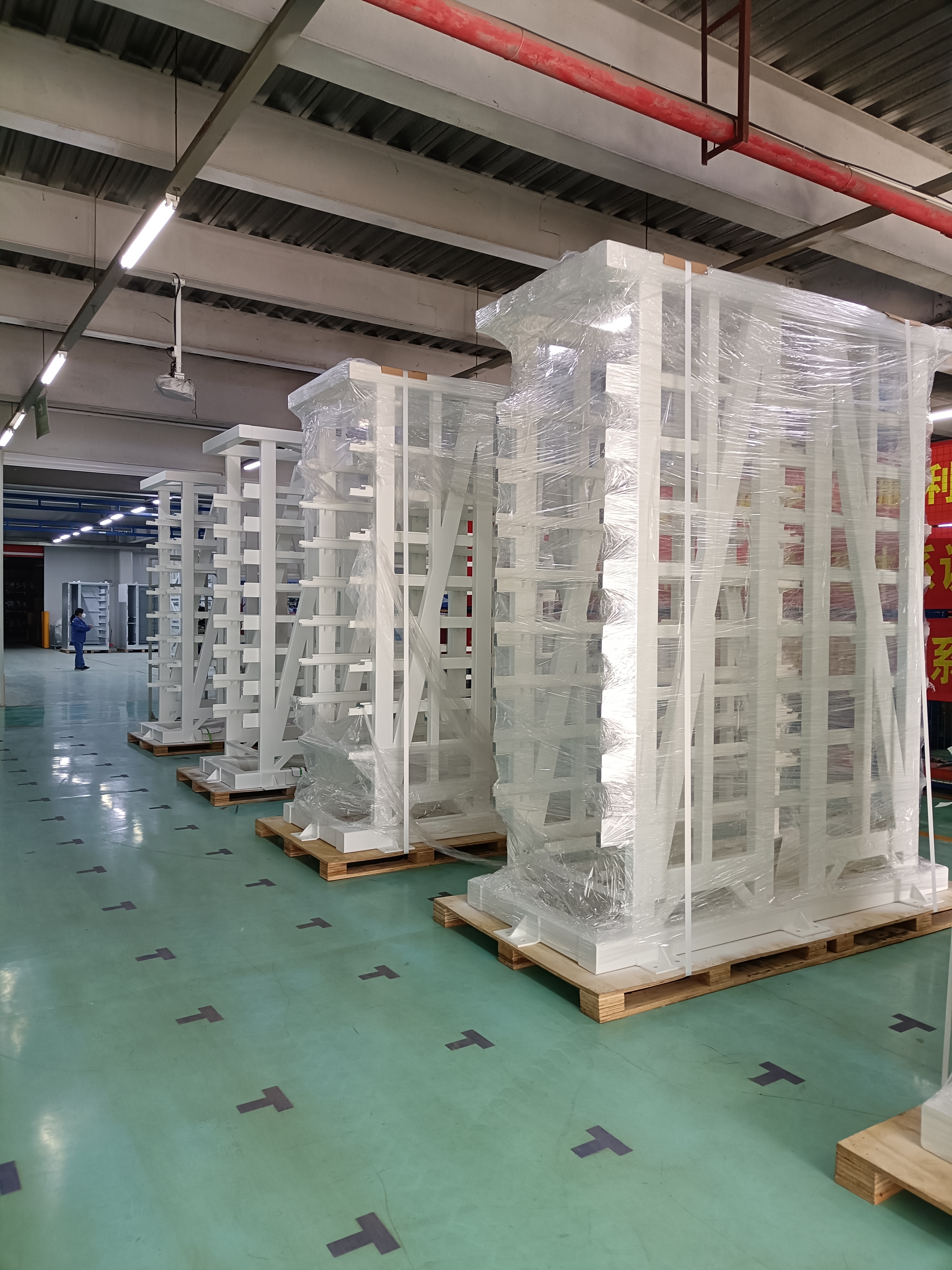
An energy storage frame is a repetition part. The recorded programme for Openex steel frames and boxes for energy storage systems (model XHC-009) covers 3,000 units built to hold battery modules under cooling, with reported results of no rust, no leakage and no deformation, and a stated requirement that the assemblies be easy to install into a container. Repetition changes the shortlist weighting: fixture design, welding consistency, coating discipline and packaging repeatability start to matter as much as single-part capability.
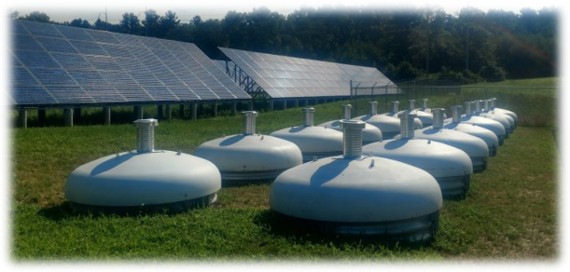
The flywheel energy storage shell (model AKI-1) is a different problem altogether. It is produced from high-strength steel plate to S355JR or A572 Grade 50 per ASTM, measures 1.5 m in diameter and 0.8 m in height, and weighs 2 tonnes net, with custom dimensions and material options available. The documented route for this family runs through cylinder rolling, welding and then turning, with top plates added — a sequence in which the machining step exists precisely to correct what rolling and welding leave behind.
The AGV steel chassis (model PSA-1) is a handling structure. It carries 30 tonnes, weighs 10.5 tonnes itself and measures 15 m × 2.7 m × 3 m, with dimensions customizable. Its fabrication logic is driven by the load path through a long weldment, the flatness and position of mounting interfaces, and the practical fact that a part this size must be lifted, coated and shipped without losing the geometry machined into it.
Fit test one: structural duty and the load path
The first shortlist question is what the part carries and how that load reaches the ground. For energy storage frames, the duty is stacked module and cabinet weight plus handling loads during installation, and the decisive details are the shelf-to-upright connection and the repeatability of that connection across a production run measured in thousands. For the AGV chassis, a 30-tonne loading capacity makes beam depth, joint preparation and weld quality class the governing variables — not nominal plate thickness read on its own.
For flywheel shells, structural duty and geometry are the same conversation. The component is specified in a high-strength plate grade, and the fabrication plan has to carry circularity and wall section intact through rolling, welding and turning. A shell that meets the plate specification but loses roundness during welding is not yet a usable shell; the turning operation is where that risk is either recovered or lost.
This is also where the choice between welded plate fabrication and alternative routes appears. Welded structural steel — beams, channels, angles and formed sections cut and joined to drawing — suits large, low-to-medium volume structures where dimensions are still moving. Casting and forging enter where a repeated, more compact shape justifies tooling; the foldable-house programme recorded for Openex, for example, combines cast hinges welded onto steel I-beam assemblies rather than casting the whole member. For the three families in this guide, the records show welded fabrication as the base route: welded frames, a rolled and welded shell, and a welded chassis.
Fit test two: enclosure geometry and dimensional control
Energy storage frames and boxes are enclosures as well as structures. The recorded requirement is assembly into a container, and the liquid-cooling cabinet programme — 1,500 units fabricated to hold batteries with the internal temperature held in a designed range — shows how far the enclosure side can travel. Once cooling is inside the box, the checkpoints shift to flatness of door and panel faces, hole position for module mounting, and finish quality in areas exposed to condensation and coolant.
Flywheel shells move the checkpoint onto rotational geometry: diameter, circularity, cylindricity, concentricity and surface roughness after turning. The machining scope available for this work lists dimensional tolerance plus geometric tolerance for flatness, straightness, circularity, cylindricity, profile, position and concentricity, together with surface roughness measured as Ra or Rz — which is the correct vocabulary for a shell of this kind. Verification is dimensional rather than visual: a Zeiss CMM with 7 × 4 × 3 m capacity and micron-level precision is available, alongside smaller CMMs for detail work.
AGV chassis geometry reads differently again. Flatness and position of mounting interfaces have to hold along a 15-metre length, straightness has to survive lifting and transport, and welded joints concentrated at the corners of a 10.5-tonne weldment will move unless distortion is planned for. A distortion control plan, pre- and post-weld heat treatment where the drawing calls for it, and machining after welding are the tools that protect those interfaces. The available machining envelope — CNC travel up to 50 m × 8 m × 7 m — is what makes machining after fabrication a realistic option for parts of this scale, rather than a promise that stops at the workshop door.
Fit test three: handling, transport and site assembly
The third test is the one most often left out of a shortlist and most often responsible for a failed first delivery. Lifting capacity, road or sea dimensional limits, coating sequence and site assembly method all constrain the fabrication option before a single weld is laid.
At the workshop end, handling capacity for heavy metal fabrication is set by crane tonnage: an overhead crane above 250 tonnes and a bending machine with a maximum length of 18 m and 10,000 tonnes capacity define what can be turned, formed and moved without subcontracting. For a 2-tonne flywheel shell this is comfortable; for a long, heavy chassis or an oversized structural frame it becomes a genuine differentiator between one supplier and another.
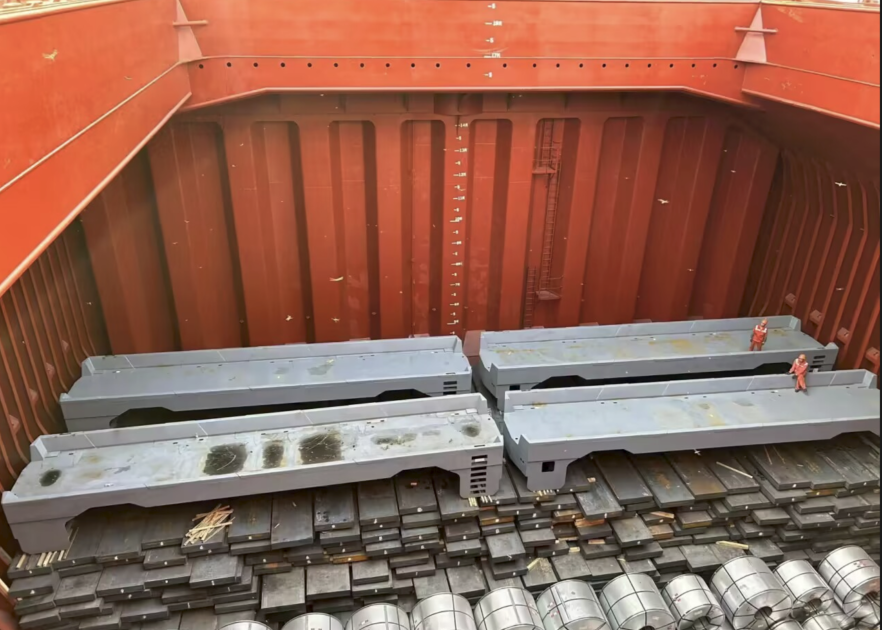
At the transport end, the evidence sits in the delivery records. AGV chassis units for a Netherlands customer were loaded into a bulk carrier, and in the steel-mill pallet programme the cargo was barged from the fabrication shop to a bulk carrier port before onward shipment. Those are logistics constraints as much as fabrication ones: a 15 m × 2.7 m × 3 m chassis needs a packing and lifting plan that keeps machined faces and coating intact, while energy storage frames designed for container installation need packaging that matches the assembly sequence on site. For the flywheel programme, shells and top plates were packed after final inspection reports were issued, which is the sequence a buyer should expect to see documented.
How Openex fabrication maps onto the three families
Openex fabrication is the custom metal fabrication and machining business of Xiamen Openex Mechanical Technology Ltd, founded in 2009 and operating two manufacturing premises near Xiamen Port and Shanghai Port. The company reports a 30,000 ㎡ footprint, 200 employees, an annual output of 20,000 tonnes, 35 engineers and an export share of 80%, with deliveries to the EU, USA, Australia, New Zealand, Japan, Singapore, South America and the Middle East. Its process list covers laser cutting, bending, punching and stamping, welding, machining and assembly, plus roll forming, casting, forging, galvanizing and powder coating. The full company profile is published at www.cncmetalworking.com.
For the three families in this guide, that process range matters in a specific way: it allows the shell, the frame and the chassis to be quoted as fabrication plus machining plus finishing plus assembly rather than as separate subcontract packages. Equipment limits are stated as an overhead crane above 250 tonnes, a bending machine up to 18 m and 10,000 tonnes, and CNC machine tools with travel up to 50 m × 8 m × 7 m.
Management-system evidence is documented as ISO 9001:2015 (certificate 11426Q01049R001), ISO 14001:2015 (11426E00739R001) and ISO 45001:2018 (11426S00656R001), issued on 16 April 2026 and valid to 15 April 2029 by Beijing East Allreach Certification Center Co., Ltd., with a scope covering the manufacture of machined parts, metal structures and sheet metal components. Welding documentation options include WPS, PQR, welder qualification and PWHT procedures; inspection options include RT, UT, MT, PT, TOFD or phased array, hardness testing and hydrostatic or pneumatic testing, with 100% testing stated for the welding unit.
The process sequence decides which option you are buying
Two fabricators can quote the same drawing and sell different products. The distinction is the sequence: fabrication only, fabrication plus machining, or fabrication plus machining plus finishing plus assembly. Choosing between those three is the real content of the shortlist.
For energy storage frames and boxes, fabrication plus finishing plus light assembly is often sufficient, because the part is repetitious, modular and assembled on site. For flywheel shells, machining after welding is not optional: the rolling and welding steps establish the blank, and turning establishes diameter, circularity and surface finish. For AGV chassis, machining after welding protects mounting interfaces along a long weldment, and a distortion control plan belongs in the quotation rather than in a corrective action later.
Stated capacity and commercial parameters are programme-level figures and should be reconfirmed against a specific drawing. The welding unit lists a monthly capacity of 5,000 tonnes, a 30–45 day lead time, a 25-tonne minimum order quantity and 100% testing. The machining unit lists 3,000 tonnes per month, a 30–45 day lead time, a 15-tonne minimum and 100% inspection, with equipment including CNC vertical and horizontal lathes, gantry machining centres, boring mills, deep-hole drilling machines and laser cutting. The surface finishing unit lists 3,000 units per month, a 45-day lead time and a 15-tonne minimum, covering blasting, pickling, phosphating and passivation with spray painting, powder coating, electroplating and hot-dip galvanizing.
Fit matrix: matching each family to an option
| Component family | What governs the route | Geometry control that matters | Handling and transport constraint | Evidence to request |
|---|---|---|---|---|
| Steel frames and boxes for energy storage systems (XHC-009) | Repetition welding, coating consistency, modular assembly; container installation | Squareness, hole position for module mounting, flatness of panel and door faces | Packaging that matches site assembly sequence; coating protection in transit | Dimensional report per batch, finish specification, assembly fit check |
| Flywheel energy storage shell (AKI-1) | Roll forming, welding, then turning; plate grade S355JR or A572 Grade 50 per ASTM | Diameter, circularity, cylindricity, concentricity, surface roughness after turning | 2-tonne net unit weight; shell and top plate packing after final inspection | Material certificate, WPS and welder qualification, CMM dimensional report |
| AGV steel chassis (PSA-1) | Heavy weldment with machining after welding and a distortion control plan | Flatness and position of mounting interfaces, straightness over 15 m | 10.5-tonne unit, 15 m × 2.7 m × 3 m; lifting points, coating protection, sea freight | Distortion control plan, NDT records, post-machining dimensional report |
Where each option has already been applied
The energy storage record is the most repetitive of the three. A 3,000-unit programme for steel frames holding battery modules with cooling reported no rust, no leakage and no deformation, with easy container assembly listed as a requirement. A separate lithium battery storage shelf programme of 300 units reported three years of stable operation, and a liquid-cooling cabinet programme of 1,500 units reported the same duration. These results belong to those programmes; they describe what was achieved on those drawings and specifications, not a blanket performance promise for any future frame.
The flywheel record is a precision story. A 400-unit flywheel energy storage shell programme for electricity quality improvement reported five years of stable operation, with high precision, low cost, quick delivery and long life listed as the programme highlights. The manufacturing route visible in the documentation runs from cylinder rolling through welding of the semi-finished shell to precision turning, with final inspection reports issued before packing. For a buyer, the transferable lesson is that the machining step and the inspection step must both be named in the purchase specification.
The AGV record is a logistics story. A 345-unit steel chassis programme for a Netherlands customer, supplying chassis to carry ocean-worthy containers, LNG tanks and other large objects, reported stable operation for more than four years. In a separate Japanese steel-mill programme, 30 fabricated chassis or pallets used to store and transfer steel coils reported stable operation over 20 years. Both involve heavy weldments, but they sit at different ends of the duty range, which is why the loading figure and the application — not the supplier's general reputation — should drive the choice.
What the wider market signals mean for the shortlist
Scale is not the constraint. Strategic Market Research puts the global fabricated metal products market at USD 2.35 trillion in 2024, and steel accounted for 63.2% of material share in North American metal fabrication that year according to aggregated commercial research from Report Insight and Mordor. A buyer choosing among steel-based options is choosing inside the mainstream of the industry, not a niche.
Growth estimates should be read with care. Market Research Future projects a 3.3% compound annual growth rate for steel fabrication across 2025–2035, while Mordor Intelligence reports 7.14% over a shorter 2025–2030 window. The gap is a scope difference — one estimate appears to include primary steel activity that the other excludes — so the two figures should not be averaged or presented as a single forecast. The practical reading for a procurement team is directional: capacity will remain available, and differentiation will come from dimensional control, documentation and delivery reliability rather than from scarcity.
Welded fabrication against cast and forged alternatives
Castings and forgings remain legitimate answers for parts of these assemblies, and the same supplier scope lists both. The comparison should be made on documented characteristics rather than preference. Welded plate and section fabrication suits large structures where dimensions and interfaces are still being finalised, where volume is low to medium, and where design changes can be absorbed by re-cutting rather than re-tooling. Casting suits repeated, more compact shapes where pattern or die investment is amortised across volume. Forging suits parts where a solid, formed section is specified by the design authority.
The boundary matters as much as the advantage. A welded chassis carries a distortion risk that must be managed by sequence, restraint and machining, and those steps cost time. A casting carries tooling lead time and a change cost that a welded structure does not. In the three families covered here, the documented route is welded fabrication throughout, with castings appearing as inserts and hinges rather than as the primary structure — a reminder that route selection should follow the drawing, not a general preference for one process.
Limits and checks before you commit
Every shortlist has a fit boundary, and stating it early prevents a costly first article. On size, parts that exceed the machining envelope of 50 m × 8 m × 7 m, or that exceed the lifting capacity of the overhead crane, need a different plan or a different supplier. On quantity, the quoted minimums — 25 tonnes for the welding unit, 15 tonnes for machining, 15 tonnes for finishing — mean that a single 10.5-tonne chassis or a small batch of 2-tonne shells sits below the stated programme minimums and must be confirmed case by case during the RFQ. On timing, the stated 30–45 day lead times for welding and machining and 45 days for finishing are unit-level figures that will move with drawing complexity and inspection scope.
The verification package is where a buyer gains real control. Ask for the WPS and PQR covering the joint types actually used, welder qualification records, and an NDT plan matched to joint class rather than a generic certificate. Ask for a dimensional report against the tolerances you specified, not a general statement that the part was inspected. Confirm the finish route — hot-dip galvanizing, powder coating or an epoxy system — and agree whether final machining happens before or after coating, because that sequence determines which dimensions you can still hold. Confirm the packing and lifting plan for oversized units, and confirm which party carries dimensional risk after transport.
Outlook
Energy storage and automated guided vehicle programmes are both moving toward larger unit counts and tighter interface tolerances, and that combination tends to consolidate work with fabricators who can hold fabrication, machining, finishing, assembly and documentation inside one quality system. If that pattern continues, the differentiator between shortlisted options will be evidence traceability rather than process lists: whether a supplier can show, on a specific drawing, which step controlled which dimension and which record proves it. Buyers who build their shortlist around that question now will need fewer corrective loops later.
Frequently asked questions
What should a buyer compare first when shortlisting fabrication for energy storage frames, flywheel shells and AGV chassis?
Compare structural duty first, then geometry control, then handling. Energy storage frames are governed by repetition and container assembly, the flywheel energy storage shell by circularity and surface finish after turning, and the AGV steel chassis by mounting-interface flatness along a 15 m weldment that carries 30 tonnes. Fixing this order prevents a supplier who is strong on one family from being assumed suitable for the other two.
Which fabrication route suits a flywheel energy storage shell?
The documented route is cylinder rolling, welding, then turning, with top plates added. The AKI-1 shell is made from high-strength steel plate to S355JR or A572 Grade 50 per ASTM, measures 1.5 m in diameter and 0.8 m in height, and weighs 2 tonnes net, with custom dimensions and material options available. Because rolling and welding introduce distortion, the turning step and the post-machining dimensional inspection are what convert the blank into a usable shell.
What data should be fixed before ordering an AGV steel chassis?
Fix the loading capacity, the tare weight, the overall envelope and the mounting interfaces. The PSA-1 chassis is rated at 30 tonnes loading capacity, weighs 10.5 tonnes, measures 15 m × 2.7 m × 3 m, and its dimensions are customizable. Beyond those figures, the buyer should specify interface flatness and position tolerances, lifting points, the coating system, and the transport method, since each of these constrains how much machining can be preserved through delivery.
How much difference does fabrication-plus-machining make compared with fabrication only?
It determines whether the critical dimensions are created after the distortion has already happened. Welding a 10.5-tonne chassis or a 2-tonne shell concentrates movement at joints and corners; machining after welding, supported by a distortion control plan and, where specified, pre- and post-weld heat treatment, restores the interfaces. Machining capacity up to 50 m × 8 m × 7 m travel and a Zeiss CMM with 7 × 4 × 3 m capacity are what make that sequence verifiable on large parts.
What evidence should be requested to verify that a fabricator fits these three components?
Request drawing-specific documents rather than general brochures: WPS and PQR for the joint types used, welder qualification records, an NDT plan matched to joint class, and a dimensional report against the tolerances in the purchase specification. Management-system certificates should be checked for scope and validity — the Openex records list ISO 9001:2015, ISO 14001:2015 and ISO 45001:2018 issued on 16 April 2026 and valid to 15 April 2029, with a scope covering machined parts, metal structures and sheet metal components. Confirm minimum order quantities and lead times against your own batch size.
Reference document
A downloadable company brochure with the full fabrication and machining scope is available here: Openex mechanical fabrication brochure (PDF).
Have Questions or Need More Details?
Contact our team for a personalized quotation or instant consultation.
Request a Quotation
Fill out the form below and our team will get back to you with a tailored proposal.
WhatsApp Direct Chat
Prefer to chat in real-time? Message us on WhatsApp for instant assistance & quick answers.
- Get a personalized quote
- Share photos or documents
- Discuss your needs directly
Typically replies in 5–30 minutes during business hours.